
Chlorantraniliprole SC vs GR: Which Formulation Fits Your Market?
Chlorantraniliprole SC and GR serve different application systems and market requirements. SC is generally suited to water-diluted spray programs, while GR is designed for direct granular application, such as broadcasting, furrow placement, or other label-approved placement methods. Neither formulation is universally better. The right choice depends on your target crops, pest-control requirements, application equipment, local registration, and cost per treated hectare.
For agrochemical importers, distributors, and private-label brands, POMAIS offers several Chlorantraniliprole SC and GR formulation options, including 18.5% SC, 200 g/L SC, 250 g/L SC, and 0.4% GR.
The commercial decision should not be based on concentration alone. You need to consider how each formulation fits your market, which customers can use it, and whether the product can support a sustainable distribution business.
What Is the Difference Between Chlorantraniliprole SC and GR?
Both formulations contain the same active ingredient, Chlorantraniliprole, an anthranilic diamide insecticide classified under IRAC Group 28 (Ryanodine Receptor Modulators).
It acts on insect ryanodine receptors, disrupting normal calcium regulation in muscle cells. This causes muscle dysfunction, feeding cessation, paralysis, and eventual insect death.
The main difference is how the active ingredient is formulated and delivered.
Chlorantraniliprole SC: Suspension Concentrate
SC (Suspension Concentrate) is a liquid formulation in which fine solid particles of the active ingredient are dispersed in a liquid phase.
Before application, the product is generally diluted with water according to the label and applied using suitable spraying equipment.
Its main characteristics include:
- Liquid formulation suitable for water-diluted application.
- Compatibility with conventional agricultural spraying systems, subject to label requirements.
- Availability in different active ingredient concentrations.
- Flexible packaging options, including bottles and larger containers.
- Quality requirements involving particle size, suspensibility, viscosity, and storage stability.
For distributors serving rice, maize, cotton, vegetables, and fruit-growing markets, SC provides a flexible format for building a foliar insecticide portfolio where the relevant crop and pest uses are registered.
Chlorantraniliprole GR: Granules
GR (Granules) is a solid formulation in which the active ingredient is incorporated into granular carrier materials.
Unlike SC, GR is generally applied directly in granular form rather than diluted in a spray tank.
Depending on the registered product, application methods may include:
- Broadcasting across the crop area.
- Placement in planting furrows.
- Application near the plant base.
- Targeted placement in specific crop areas.
Important quality characteristics include granule size distribution, active ingredient uniformity, granule strength, flowability, dust generation, and moisture control.
For markets with established granular pesticide application systems, GR provides an alternative to conventional spray-based products.
Chlorantraniliprole SC vs GR: Technical Comparison
The following table summarizes the main differences that buyers should evaluate before selecting a formulation.
| Comparison | Chlorantraniliprole SC | Chlorantraniliprole GR |
|---|---|---|
| Formulation | Suspension Concentrate | Granules |
| Physical form | Liquid | Solid granules |
| Application | Usually diluted and sprayed | Generally applied directly |
| Equipment | Agricultural spraying equipment | Granule applicators or approved placement equipment |
| Main application direction | Foliar and other registered spray uses | Broadcasting, furrow or targeted placement |
| Typical packaging | Bottles, drums | Moisture-resistant bags |
| Quality control | Suspensibility, particle size, viscosity | Granule uniformity, strength, flowability |
| Storage considerations | Temperature and suspension stability | Moisture protection and granule integrity |
| Main purchasing consideration | Concentration and spray-program compatibility | Granule specifications and application-system compatibility |
One important distinction: GR should not be confused with WG or WDG. GR is generally applied in granular form, whereas WG/WDG is designed to disperse in water before application.
For a broader understanding of pesticide formulation specifications, see our pesticide formulation types buyer guide.
Which Crops and Markets Are Suitable for Chlorantraniliprole SC?
SC is particularly relevant to markets where water-diluted pesticide application is already well established.
For importers, this can provide opportunities across several crop-protection segments.
Rice and Maize Markets
Chlorantraniliprole is widely recognized for its activity against important Lepidopteran larvae.
Potential target pest groups include:
- Rice Stem Borers
- Rice Leaf Folder
- Fall Armyworm
- Corn Borers
SC can be positioned for spray-based insecticide programs where the specific product is registered for the relevant crop and pest.
Cotton and Vegetable Markets
Cotton and vegetable distributors often need insecticide products covering different caterpillar pests.
Chlorantraniliprole SC can be considered for product portfolios targeting pests such as Cotton Bollworm, Spodoptera species, and selected vegetable caterpillars.
For importers, the advantage is the possibility of introducing one active ingredient into multiple crop-protection categories without developing an entirely different chemical platform for every crop.
However, individual crop registrations and approved pest claims must be confirmed before commercial positioning.
Fruit and Horticultural Markets
In fruit-growing regions, Chlorantraniliprole may be relevant to selected fruit-feeding caterpillars and leaf-feeding larvae.
Buyers should evaluate:
- Registered fruit crops.
- Target pest species.
- Pre-harvest interval (PHI).
- Maximum residue limits (MRLs).
- Application restrictions during flowering and fruit development.
These factors are particularly important for markets supplying fresh produce to export destinations.
Which Markets Are Suitable for Chlorantraniliprole GR?
GR is more suitable for markets where granular application is an established part of crop-protection practice.
Its commercial value depends on whether distributors, growers, and agricultural service providers already have suitable application methods and equipment.
Rice Markets
Rice is an important application segment for certain Chlorantraniliprole GR products.
For example, an Indian-market 0.4% w/w GR product label identifies Rice Stem Borer and Paddy Leaf Folder as target pests and specifies broadcasting as an application method.
This demonstrates that granular Chlorantraniliprole is not limited to turf or ornamental applications.
However, the application claims of one country’s registered product cannot automatically be transferred to another country’s product.
Sugarcane Markets
Certain registered Chlorantraniliprole GR products also have applications in sugarcane.
Depending on the approved label, granules may be placed in planting furrows or around emerging plants for the management of specific borers.
This creates a potential product-development opportunity in markets where sugarcane production and granular insecticide application are commercially established.
Maize and Other Agricultural Markets
Maize and other crops may also offer opportunities for granular formulations where a specific registered application method supports their use.
However, buyers should not assume that every Chlorantraniliprole GR formulation is suitable for every crop.
The formulation concentration, carrier system, particle characteristics, target pest, and registered application method all need to be evaluated together.
How Should Importers Compare Concentration and Purchasing Costs?
Concentration is an important procurement factor, but it should not be used as the only basis for comparing SC and GR.
POMAIS currently lists several Chlorantraniliprole product specifications, including 18.5% SC, 200 g/L SC, 250 g/L SC, and 0.4% GR.
Buyers should first confirm the concentration expression and its measurement basis.
Understand w/w and g/L Concentrations
Different concentration expressions represent different measurements.
| Expression | Meaning |
|---|---|
| 18.5% w/w | 185 g active ingredient per kg of finished product |
| 200 g/L | 200 g active ingredient per liter of finished product |
| 250 g/L | 250 g active ingredient per liter of finished product |
| 0.4% w/w | 4 g active ingredient per kg of finished product |
An important purchasing detail is that 18.5% w/w and 200 g/L are not automatically identical.
The conversion depends on the formulation’s density.
When comparing supplier quotations, buyers should confirm the exact concentration basis, density where relevant, and product specification before calculating the active ingredient cost.
Compare Cost per Treated Hectare
A lower price per kilogram or liter does not necessarily mean a more economical product.
A more meaningful comparison is:
Product cost per hectare = Product price per unit × Registered application rate per hectare
You should also calculate the active ingredient delivered per hectare.
This allows you to compare different concentrations and formulation types using a consistent basis.
For commercial procurement, the following factors should be included:
- Purchase price per unit.
- Active ingredient concentration.
- Registered application rate.
- Packaging cost.
- Freight and storage expenses.
- Application equipment requirements.
- Local registration and distribution costs.
The result is a more realistic comparison of commercial value rather than a simple comparison of product prices.
How Do SC and GR Differ in Packaging, Storage, and Transportation?
Packaging and logistics can affect the total landed cost of an agrochemical product.
SC and GR require different packaging considerations because their physical characteristics are different.
SC Packaging Requirements
SC products are generally supplied in liquid-compatible containers.
Common packaging options include:
- 100 ml and 250 ml bottles.
- 500 ml and 1 L bottles.
- 5 L containers.
- Larger drums for bulk supply.
Buyers should pay attention to container compatibility, cap sealing, leakage resistance, and storage stability.
GR Packaging Requirements
GR products generally require moisture-resistant bags or other suitable solid-product packaging.
Common considerations include:
- Moisture protection.
- Bag strength.
- Seal integrity.
- Granule breakage during transportation.
- Particle uniformity after storage.
The packaging format should protect the product throughout warehousing, export transportation, and distribution.
Neither SC nor GR is automatically cheaper to transport. The actual cost depends on formulation density, packaging size, shipment volume, pallet configuration, and destination.
What Quality Parameters Should Buyers Check?
For importers and private-label brands, product quality should be evaluated according to the specific formulation rather than applying the same inspection checklist to both products.
SC Quality Control
| Parameter | Purpose |
|---|---|
| Active Ingredient Content | Confirms concentration |
| Suspensibility | Evaluates suspension performance |
| Wet Sieve | Checks coarse particles and residue |
| Particle Size | Evaluates particle distribution |
| Viscosity | Assesses physical handling characteristics |
| Pourability | Evaluates ease of product dispensing |
| Storage Stability | Checks physical and chemical stability |
GR Quality Control
| Parameter | Purpose |
|---|---|
| Active Ingredient Content | Confirms concentration |
| Granule Size Distribution | Checks particle uniformity |
| Granule Strength | Evaluates resistance to breakage |
| Flowability | Checks suitability for granular application |
| Dust Generation | Evaluates dust formation |
| Moisture Content | Monitors moisture-related quality risks |
| Storage Stability | Evaluates product condition during storage |
The exact test methods and acceptance limits should follow the applicable product specification, registration requirements, and agreed quality standards.
For procurement projects, buyers can also refer to our guide on pesticide product specifications before supplier approval.
Does Formulation Type Affect IRAC Resistance Management?
No. Changing the formulation from SC to GR does not change the insecticide’s mode of action.
Chlorantraniliprole belongs to IRAC Group 28, which contains Ryanodine Receptor Modulators.
Both SC and GR act through the same active ingredient and the same insect target site.
Therefore:
- Chlorantraniliprole 18.5% SC is Group 28.
- Chlorantraniliprole 200 g/L SC is Group 28.
- Chlorantraniliprole 0.4% GR is Group 28.
Switching from SC to GR does not constitute a different-mode-of-action rotation.
For distributors developing long-term insecticide portfolios, it is important to include products with different IRAC groups and appropriate resistance-management strategies.
This also helps prevent a common product-positioning mistake: presenting two formulations of the same active ingredient as two independent resistance-management options.
Should Your Business Purchase SC, GR, or Both?
The decision depends on your existing customer base and the application systems used in your target market.
| Market Situation | Recommended Product Direction | Commercial Reason |
|---|---|---|
| Established foliar spray market | SC | Fits existing spraying systems |
| Rice market with registered granular applications | GR or SC | Depends on application preference and registration |
| Sugarcane market with granular placement systems | GR | Can serve specific granular application requirements |
| Multi-crop insecticide distribution | SC | Offers flexible spray-based product positioning |
| Established granular pesticide distribution | GR | Fits existing equipment and distribution channels |
| Brand expansion across different application systems | SC + GR | Provides complementary product options |
For distributors already selling conventional spray insecticides, SC may be a practical starting point.
For companies with established granular pesticide channels, GR can add a different application format.
If your business serves both market segments, developing both formulations may create additional commercial coverage.
However, dual-formulation development should be supported by actual customer demand, separate product specifications, registration feasibility, and a clear SKU strategy.
Frequently Asked Questions
Is Chlorantraniliprole SC better than GR?
Neither formulation is universally better.
SC is generally suitable for spray-based application, while GR is designed for direct granular application. The choice depends on crop requirements, registered uses, application systems, and market demand.
What is the difference between Chlorantraniliprole 18.5% SC and 0.4% GR?
They contain the same active ingredient but have different concentrations and formulation structures.
The SC is a liquid suspension concentrate, while the GR is a solid granular formulation. Their application methods and target product positioning may also differ.
Can Chlorantraniliprole GR be used in rice?
Certain registered 0.4% GR products have rice applications, including management of stem borers and leaf folders.
However, the approved application method and use conditions must be confirmed against the specific country’s product label.
Can Chlorantraniliprole SC be used on multiple crops?
Chlorantraniliprole SC products may be developed for multiple agricultural crops, but the approved crops and target pests depend on the specific formulation and local registration.
Does Chlorantraniliprole SC have a longer residual effect than GR?
Not necessarily.
Residual performance depends on the product specification, application method, target pest, environmental conditions, and registered use pattern. Formulation type alone does not establish which product has longer residual activity.
Are Chlorantraniliprole SC and GR in the same IRAC group?
Yes. Both belong to IRAC Group 28 because they contain the same active ingredient and share the same mode of action.
Can POMAIS supply both SC and GR?
POMAIS lists Chlorantraniliprole 18.5% SC and 0.4% GR, alongside additional SC concentration and combination-formulation options.
Available specifications, packaging, and production arrangements can be discussed according to the buyer’s target market and order requirements.
Choose the Right Chlorantraniliprole Formulation for Your Market
Chlorantraniliprole SC and GR provide two different ways to develop an insecticide product portfolio around the same active ingredient.
SC is generally suited to spray-based agricultural markets, while GR provides an alternative for markets with established granular application systems.
For importers and distributors, the best purchasing decision should consider more than concentration or unit price. Crop registration, target pests, application equipment, cost per hectare, packaging, product quality, and long-term market demand all influence the commercial value of each formulation.
POMAIS supplies Chlorantraniliprole insecticide formulations for professional B2B customers, including SC and GR options.
Our support covers:
- OEM/ODM manufacturing and private-label development.
- Customized active ingredient concentrations and packaging, subject to technical feasibility and regulatory requirements.
- Multilingual label design.
- COA, SDS/MSDS, and TDS documentation.
- Product quality control and batch testing.
- Export and registration documentation support.
If you are planning to introduce Chlorantraniliprole SC or GR into your market, contact POMAIS with your destination country, target crops, required formulation, and estimated order quantity. We can help evaluate suitable product specifications and develop a supply solution aligned with your distribution and branding strategy.
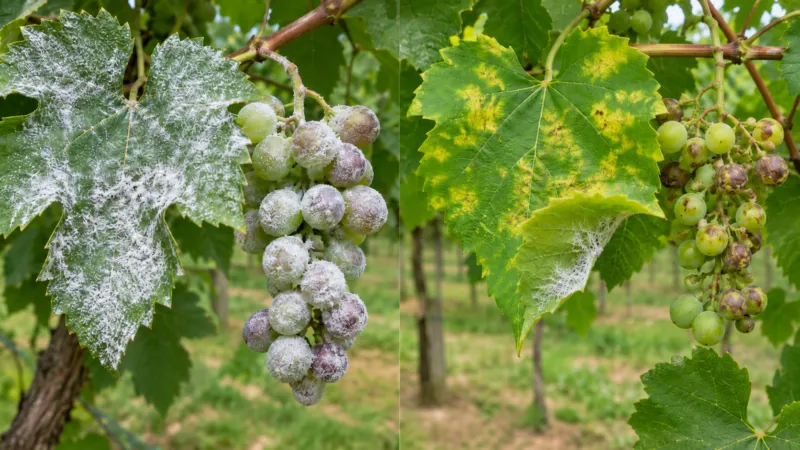 Powdery Mildew and Downy Mildew in Grapes: Distinguishing Symptoms and Choosing Fungicides
Hot Products
Hot news
Recommended news