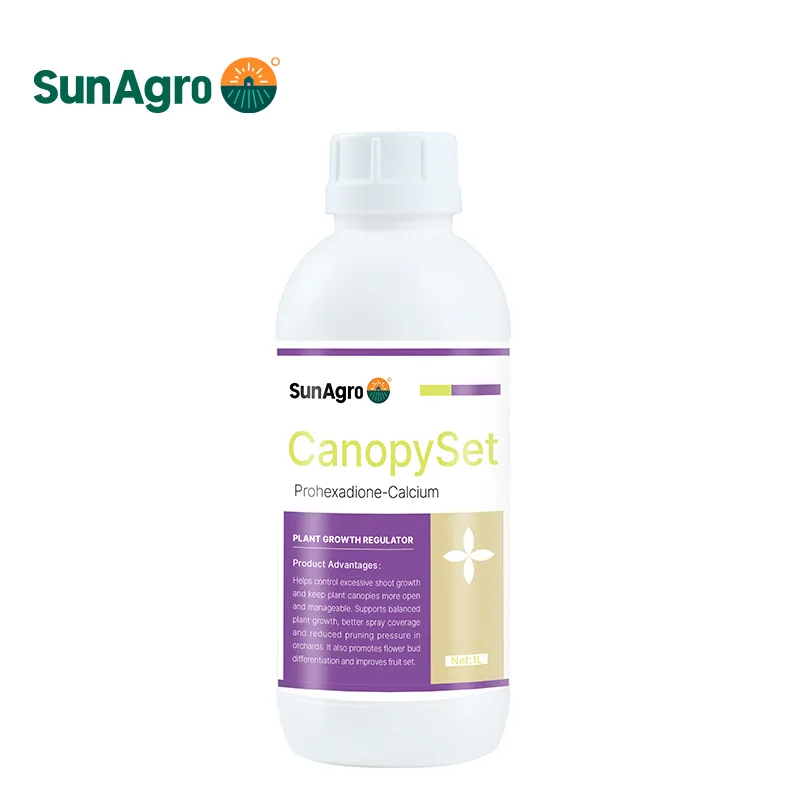
Prohexadione-Calcium Plant Growth Regulator
POMAIS Prohexadione-Calcium Plant Growth Regulator is a professional PGR used for vegetative growth control, shoot vigor management, and orchard canopy regulation in approved crop programs.
As a gibberellin biosynthesis inhibitor, Prohexadione-Calcium helps reduce excessive shoot elongation where local registration supports use. It is mainly reviewed for apples, pears, cherries, strawberries, peanuts, grass grown for seed, watercress, and other specialty crops according to approved label directions.
POMAIS supplies Prohexadione-Calcium in 10% WDG, 10% WP, 15% WP, and 15% WDG formulations for importers, distributors, agricultural retailers, crop protection channels, and local partners looking for practical plant growth regulator products for orchard and specialty crop markets.
- Active Ingredient: Prohexadione-Calcium
- Available Formulations: 10% WDG, 10% WP, 15% WP, 15% WDG
- Product Type: Plant Growth Regulator
- Mode of Action: Gibberellin biosynthesis inhibition
- Main Use: Vegetative growth control, shoot suppression, canopy management, orchard vigor regulation
- Designed for Professional Buyers & Bulk Orders
- We support custom packaging, labeling, and formulation to meet your market needs.
- Export wholesale inquiries only.
- Please include destination country, business type (importer/distributor/registrant), and expected volume.
- Retail requests will not be processed.

About Prohexadione-Calcium Plant Growth Regulator
| Item | Details |
|---|---|
| Product Name | Prohexadione-Calcium Plant Growth Regulator |
| Active Ingredient | Prohexadione-Calcium |
| Available Formulations | 10% WDG, 10% WP, 15% WP, 15% WDG |
| Product Type | Plant Growth Regulator / PGR |
| Mode of Action | Gibberellin biosynthesis inhibitor |
| Main Function | Vegetative growth control and shoot growth suppression |
| Main Crop Direction | Apple, pear, cherry, strawberry, peanut, grass grown for seed, watercress, and other approved crops |
| Main Use Direction | Orchard vigor management, canopy regulation, shoot control, and specialty crop growth management |
| Formulation Position | WDG and WP formulation options for different market preferences |
| Concentration Position | 10% mainstream options and 15% higher-concentration options |
| Supply Direction | POMAIS supply for import, distribution, and local market cooperation |
| Document Support | COA, SDS / MSDS, TDS, product specification, sample support, formulation information, batch quality information, and available technical documents |
What Is Prohexadione-Calcium?
Prohexadione-Calcium is a plant growth regulator used to manage excessive vegetative growth in approved crop programs. It is not a fertilizer, fungicide, insecticide, or herbicide.
Its main value is growth regulation. In orchard production, excessive shoot growth can increase canopy density, reduce spray penetration, increase pruning work, and make fruit-zone management more difficult. Prohexadione-Calcium helps growers manage this vegetative pressure where approved.
For distributors and crop protection channels, this product is suitable for markets where growers need professional PGR solutions for orchard vigor control, shoot suppression, and balanced crop growth management.
Main Functions of Prohexadione-Calcium
Prohexadione-Calcium is mainly used where crop growth is too vegetative and requires structured management.
It can help:
- Manage excessive vegetative growth where locally approved
- Suppress shoot elongation in orchard and specialty crop programs
- Support canopy openness in high-vigor orchards
- Improve spray access in dense canopy conditions
- Help reduce pruning pressure in managed orchard systems
- Support seasonal balance between vegetative growth and crop development
- Provide a growth-retarding PGR direction for crop protection portfolios
- Support orchard plant growth regulator product planning
Prohexadione-Calcium should be positioned as a growth-retarding plant growth regulator, not as a growth promoter or direct disease-control product.
Mode of Action: Gibberellin Biosynthesis Inhibition
Prohexadione-Calcium works by inhibiting gibberellin biosynthesis. Gibberellins are plant hormones closely related to shoot elongation, internode extension, and vegetative growth.
When gibberellin biosynthesis is reduced, excessive shoot growth can be suppressed where the product is applied according to approved crop programs. This makes Prohexadione-Calcium useful for orchard vigor management and canopy regulation.
For orchard markets, the practical value is connected with shoot growth control, canopy structure, spray access, pruning workload, and balanced seasonal growth. Final performance depends on crop type, variety, growth stage, tree vigor, weather, irrigation, fertility, spray timing, dosage, formulation, and local label directions.
Prohexadione-Calcium for Orchard Vigor Management
Orchard vigor management is one of the most important application directions for Prohexadione-Calcium.
In apple, pear, and cherry orchards, excessive vegetative growth can lead to dense canopies, difficult spray coverage, increased pruning pressure, and less efficient orchard management. A plant growth regulator program can help manage these issues where local registration supports use.
Prohexadione-Calcium should be used as part of a professional orchard management system. It does not replace pruning, nutrition management, irrigation control, or disease management. Its role is to support vegetative growth regulation and canopy management.
Target Crops and Application Areas
Prohexadione-Calcium can be reviewed for orchard and specialty crop programs where local registration supports use. Final crop scope, application timing, dosage, interval, and safety requirements must follow the approved local label.
Apple Orchard Programs
Apple orchards are a core use direction for Prohexadione-Calcium.
In high-vigor apple orchards, excessive shoot growth can make canopy management difficult. Prohexadione-Calcium can be reviewed where local registration supports shoot suppression, orchard vigor control, and canopy regulation.
Pear and Cherry Programs
Pear and cherry programs can also be reviewed where locally approved.
For these orchard crops, the product should be positioned around controlled vegetative growth, canopy balance, shoot management, and orchard structure regulation. Final use must follow the approved local label.
Strawberry and Specialty Crop Programs
Strawberry, watercress, and other specialty crops can be reviewed where local registration supports use.
For specialty crop markets, Prohexadione-Calcium should be evaluated according to crop stage, local growing practice, growth regulation target, and approved label claims.
Peanut and Grass Grown for Seed Programs
Peanut and grass grown for seed programs can be included where local registration supports use.
These crop directions should be handled as crop-specific growth regulation programs. Application timing, crop stage, dosage, and local production practice are especially important for plant growth regulator performance.
Orchard and Specialty Crop Channel Development
For importers, distributors, agricultural retailers, and crop protection channels, Prohexadione-Calcium can serve as a practical PGR product for orchard and specialty crop portfolios.
It can be positioned alongside other plant growth regulators, crop nutrition programs, fungicide programs, and orchard management solutions. The role of Prohexadione-Calcium should remain clear: vegetative growth control and canopy regulation where locally approved.
Application Guidance
Prohexadione-Calcium should be used only where it is locally registered and approved. Final use must follow the approved local label.
General use considerations include:
- Apply according to approved crop, timing, rate, spray volume, interval, and label direction
- Review crop stage, shoot vigor, variety sensitivity, weather, irrigation, fertility, and management goal before use
- Use the product as a growth-retarding PGR, not as a general growth promoter
- Do not exceed the approved label rate
- Do not make unsupported crop claims or unsupported disease-control claims
- Check tank-mix compatibility before commercial use
- Conduct a jar test before large-scale tank mixing where required
- Avoid application under crop stress unless the label allows use
- Follow local PHI, MRL, worker safety, storage, transport, and environmental requirements
Plant growth regulators are highly stage-sensitive. Product response can vary by crop stage, vigor level, temperature, water status, fertility level, spray timing, dosage, and local growing conditions.
Formulation Selection Guide
POMAIS supplies Prohexadione-Calcium in WDG and WP formulation options, with 10% and 15% concentration directions available for different market needs.
| Formulation | Positioning | Suitable Market Logic |
|---|---|---|
| 10% WDG | Mainstream granule option | Suitable for markets that prefer cleaner handling, lower dust, and modern granule presentation |
| 10% WP | Traditional powder option | Suitable for markets where wettable powder products remain familiar and cost-sensitive |
| 15% WP | Higher-concentration powder option | Suitable for markets reviewing a more concentrated WP product direction |
| 15% WDG | Higher-concentration granule option | Suitable for markets that prefer both higher content and granule-format positioning |
The final formulation choice should depend on local registration, channel preference, handling practice, pricing structure, formulation familiarity, and market positioning.
Difference Between Prohexadione-Calcium WDG and WP
WDG and WP formulations have different handling characteristics and market positioning.
| Item | WDG Formulation | WP Formulation |
|---|---|---|
| Full Name | Water-Dispersible Granule | Wettable Powder |
| Product Form | Granule | Fine powder |
| Handling Feature | Lower dust and cleaner handling | Traditional powder handling |
| Water Behavior | Disperses into water before spraying | Needs proper wetting and suspension |
| Market Fit | Modern product presentation and cleaner handling preference | Familiar and cost-sensitive market channels |
| Storage Focus | Moisture control and granule integrity | Moisture control and caking prevention |
| Final Choice | Depends on local registration and channel preference | Depends on local registration and channel preference |
WDG is often preferred where clean handling and granule presentation are important. WP may still fit markets where powder formulations are widely accepted and cost structure is important.
Difference Between 10% and 15% Prohexadione-Calcium Formulations
10% and 15% formulations serve different market and registration directions.
| Item | 10% Formulation | 15% Formulation |
|---|---|---|
| Content Level | Standard concentration direction | Higher-concentration direction |
| Market Position | Mainstream product option | More concentrated product option |
| Formulation Options | 10% WDG / 10% WP | 15% WDG / 15% WP |
| Best Fit | Markets needing familiar PGR concentration | Markets reviewing higher-content PGR positioning |
| Use Direction | Vegetative growth control where approved | Vegetative growth control where approved |
| Final Choice | Depends on registration, crop program, dosage system, and market preference | Depends on registration, crop program, dosage system, and market preference |
The difference between 10% and 15% should not be described as stronger performance in all situations. Final product choice should be based on registration direction, dosage system, crop program, channel preference, and local market planning.
WDG and WP Formulation Features
POMAIS Prohexadione-Calcium formulations are available in both WDG and WP formats to match different market requirements.
For WDG formulations, key technical points include:
- Water-dispersible granule format
- Lower dust during handling
- Granule integrity
- Good dispersibility
- Wetting behavior
- Storage stability
- Moisture protection
- Practical handling for modern crop protection channels
For WP formulations, key technical points include:
- Wettable powder format
- Familiar formulation type in many markets
- Wetting behavior
- Suspensibility
- Powder flowability
- Caking prevention
- Moisture control
- Practical fit for established powder formulation channels
Both formulation types require proper storage, sealed packaging, moisture control, and use according to approved label directions.
Product Advantages
Prohexadione-Calcium gives importers and distributors a clear plant growth regulator direction for orchard and specialty crop markets.
Key advantages include:
- Clear plant growth regulator positioning
- Gibberellin biosynthesis inhibition mode of action
- Vegetative growth control and shoot suppression direction
- Strong fit for orchard vigor management programs
- Useful role in apple, pear, cherry, and specialty crop channels where locally approved
- 10% and 15% concentration options
- WDG and WP formulation choices
- Practical product line for crop protection and PGR portfolios
- Technical document support for product evaluation
- Stable product supply for import and distribution cooperation
Its main value is not only the active ingredient itself. The value is the combination of crop-fit positioning, concentration choice, formulation selection, local registration review, and stable supply planning.
Crop Safety, Tank Mix, and Use Precautions
Prohexadione-Calcium should be handled as a professional plant growth regulator. It should be applied strictly according to approved label directions.
Important precautions include:
- Confirm approved crop scope before use
- Review crop stage, vigor level, variety sensitivity, and local growing condition
- Avoid use under crop stress unless the label allows application
- Do not exceed approved application rate or interval
- Do not promote the product as a fertilizer, fungicide, or insecticide
- Do not claim that it replaces pruning or complete orchard management
- Evaluate tank-mix compatibility case by case
- Conduct a jar test before large-scale tank mixing where required
- Follow PPE, storage, transport, PHI, MRL, and local safety requirements
Plant response can be influenced by variety, crop stage, tree vigor, water status, nutrient status, temperature, spray coverage, and application timing. Final use must follow local registration and approved label directions.
Field Use Scenarios
Prohexadione-Calcium is most useful where crop growth is too vegetative and needs structured management.
High-Vigor Apple Orchards
In apple orchards with strong vegetative growth, shoot extension can increase canopy density and make spray coverage more difficult.
Prohexadione-Calcium can be reviewed as part of a shoot growth management program where local registration supports use. Its value is connected with canopy structure, spray access, pruning pressure, and seasonal growth balance.
Orchard Canopy Management Programs
For orchard production, canopy management is not only about reducing shoot length. It is also related to light distribution, air movement, spray access, labor planning, and overall crop management.
Prohexadione-Calcium can support these programs where approved, but it should be used as one tool within a complete orchard management plan.
Specialty Crop Growth Regulation Programs
In specialty crops such as strawberry, peanut, watercress, and grass grown for seed, Prohexadione-Calcium should be reviewed according to crop-specific registration and local agronomic practice.
These use directions should not be generalized. Final claims must follow the approved crop scope, label rate, application timing, and local crop safety requirements.
Orchard Disease-Management Context
In apple production, vegetative growth management may also support broader orchard disease-management discussions where local agronomic programs recognize this relationship.
However, Prohexadione-Calcium should remain positioned as a plant growth regulator, not as a fungicide or bactericide. It should not be promoted as a direct disease-control product.
Related Product and Category Directions
For better product portfolio navigation, this page can connect with related plant growth regulator and crop management pages.
Suggested internal link anchors:
- Plant Growth Regulators
- Brassinolide Plant Growth Regulator
- Forchlorfenuron CPPU Plant Growth Regulator
- Gibberellic Acid Plant Growth Regulator
- Plant Growth Regulator for Fruit Crops
Use only one internal link under each major H2 section. The anchor text should match the target page content and should not be repeated too many times in the same page.
Supply and Document Support from POMAIS
POMAIS supplies Prohexadione-Calcium formulations for importers, distributors, agricultural retailers, crop protection channels, and local partners that need stable plant growth regulator supply.
Available support may include:
- COA
- SDS / MSDS
- TDS
- Product specification
- Sample support
- Formulation information
- Batch quality confirmation
- Packing information
- Export document coordination
- Available technical documents
For market planning, partners can discuss formulation preference, concentration direction, registration needs, channel positioning, product specification, sample availability, and supply schedule with POMAIS.
The purpose is to help partners evaluate whether Prohexadione-Calcium 10% WDG, 10% WP, 15% WP, or 15% WDG fits their crop market and local distribution strategy.
FAQ
Request Prohexadione-Calcium Product
Looking for Prohexadione-Calcium formulations for orchard vigor control and plant growth regulation programs?
POMAIS supplies Prohexadione-Calcium in 10% WDG, 10% WP, 15% WP, and 15% WDG for importers, distributors, agricultural retailers, crop protection channels, and local partners.
Share your target country, crop market, formulation preference, concentration direction, registration plan, channel positioning, and expected supply schedule. Our team will help you review product specifications, sample availability, available documents, formulation suitability, and supply planning.
Contact POMAIS to discuss Prohexadione-Calcium product cooperation.
Contact us!
We will reply to you within 24 hours on business days!