
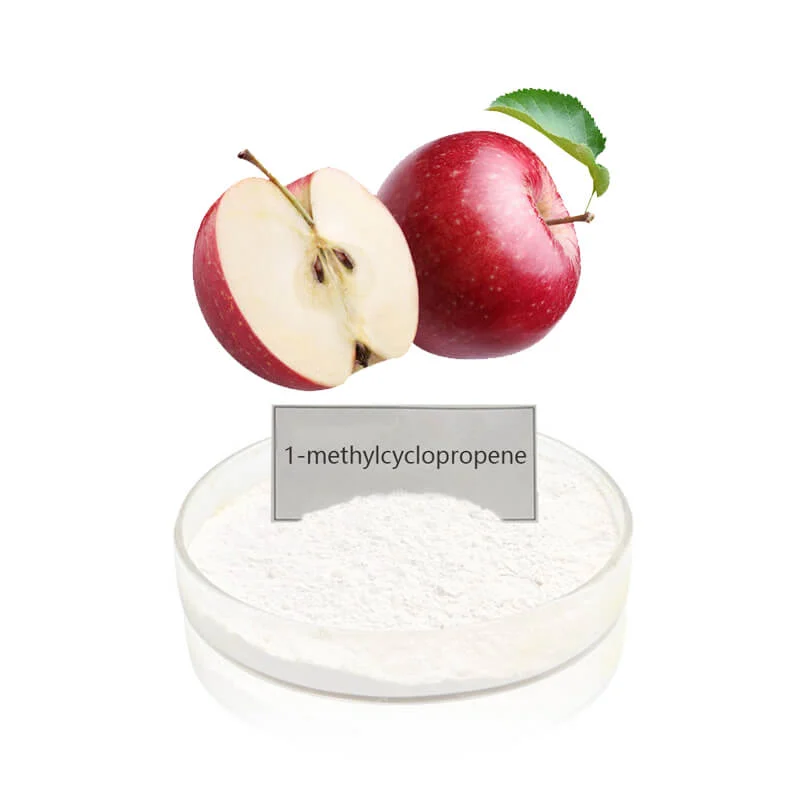


1-Methylcyclopropene (1-MCP) Plant Growth Regulator
POMAIS 1-Methylcyclopropene (1-MCP) is a plant growth regulator mainly used for postharvest quality management by regulating plant responses to ethylene.
Unlike growth-promoting plant regulators, 1-MCP works as an ethylene action inhibitor. It binds with ethylene receptors and reduces ethylene-related physiological responses, helping delay ripening, softening and senescence processes in suitable harvested products.
POMAIS supplies 1-MCP formulations for fruit storage companies, agricultural distributors, postharvest technology providers and registration partners with formulation support, technical documents and customized packaging solutions.
- Designed for Professional Buyers & Bulk Orders
- We support custom packaging, labeling, and formulation to meet your market needs.
- Export wholesale inquiries only.
- Please include destination country, business type (importer/distributor/registrant), and expected volume.
- Retail requests will not be processed.

About 1-Methylcyclopropene (1-MCP) Plant Growth Regulator
| Product Attribute | Specification |
|---|---|
| Active Ingredient | 1-Methylcyclopropene (1-MCP) |
| Product Type | Plant Growth Regulator |
| Functional Category | Ethylene action inhibitor |
| Chemical Class | Cyclopropene compound |
| CAS Number | 3100-04-7 |
| Molecular Formula | C₄H₆ |
| Mode of Action | Ethylene receptor inhibition |
| Main Application | Postharvest quality management |
| Target Use | Fruit storage and ethylene-sensitive products |
| Available Formulations | Powder, tablet and controlled-release formulations |
| Application Direction | Postharvest treatment programs |
| Supply Support | COA, SDS, TDS and technical documents |
The available concentration, formulation type, application method and approved crops depend on customer requirements and local regulations.
What Is 1-Methylcyclopropene (1-MCP)?
1-Methylcyclopropene, commonly known as 1-MCP, is a synthetic plant growth regulator used primarily in postharvest management.
Plants naturally produce ethylene, a hormone involved in:
- Fruit ripening;
- Fruit softening;
- Leaf aging;
- Flower senescence;
- Quality changes after harvest.
1-MCP does not remove ethylene from the environment.
Instead, it reduces plant sensitivity to ethylene by interacting with ethylene receptors.
This makes 1-MCP different from traditional plant growth regulators that mainly influence:
- Plant height;
- Root development;
- Flowering;
- Fruit formation.
The primary commercial value of 1-MCP is maintaining harvested product quality during storage and transportation.
How Does 1-MCP Work?
Ethylene Receptor Blocking Mechanism
The main mode of action of 1-MCP is blocking ethylene perception.
Normally, ethylene binds with plant receptors and activates ripening-related physiological processes.
After 1-MCP treatment:
1-MCP molecules bind to ethylene receptors.
This reduces ethylene signaling and slows related processes, including:
- Fruit softening;
- Respiration changes;
- Color development;
- Senescence progression.
The effectiveness of 1-MCP depends on:
- Crop species;
- Variety;
- Harvest maturity;
- Storage conditions;
- Treatment timing.
1-MCP as an Ethylene Action Inhibitor
The relationship between ethylene and 1-MCP is the key to understanding its application.
| Ethylene | 1-MCP |
|---|---|
| Natural plant hormone | Synthetic plant growth regulator |
| Activates ripening signals | Blocks ethylene response |
| Accelerates physiological aging | Helps delay ethylene-related changes |
| Promotes softening in many fruits | Helps maintain firmness in suitable crops |
Because 1-MCP regulates ethylene response, it is mainly positioned for postharvest management rather than field crop growth regulation.
1-MCP Formulations and Product Options
POMAIS supplies 1-MCP products in different formulation forms according to market and application requirements.
1-MCP Powder Formulation
Powder formulations are widely used for controlled-release applications.
Important formulation characteristics include:
- Active ingredient consistency;
- Release performance;
- Storage stability;
- Packaging protection.
Powder formulation selection depends on:
- Treatment system;
- Application method;
- Customer market requirements.
1-MCP Tablet Formulation
Tablet formulations provide standardized unit-based handling.
Potential advantages include:
- Convenient dosage management;
- Consistent product handling;
- Easy transportation and storage.
Tablet specifications depend on:
- Market requirements;
- Application equipment;
- Registration standards.
Controlled-Release 1-MCP Systems
Some applications require controlled release characteristics to achieve suitable treatment conditions.
The formulation design should consider:
- Release speed;
- Treatment environment;
- Storage system;
- Crop sensitivity.
1-MCP Uses and Applications
1-MCP is mainly used in postharvest management programs for ethylene-sensitive products.
The application effect depends on:
- Crop type;
- Variety;
- Storage environment;
- Treatment timing;
- Local approval.
Apple Storage Applications
Apple is one of the most common application areas for 1-MCP.
In apple storage programs, 1-MCP may help manage:
- Fruit firmness;
- Ripening speed;
- Storage quality;
- Postharvest physiological changes.
Performance depends on:
- Apple variety;
- Harvest maturity;
- Storage temperature;
- Storage duration.
Pear Storage Applications
Pear ripening is closely associated with ethylene response.
Where registered, 1-MCP may be used in pear storage programs to help manage:
- Softening;
- Ripening progression;
- Storage performance.
Other Ethylene-Sensitive Fruits
Depending on registration and market approval, 1-MCP may also be applied to other ethylene-sensitive crops.
Examples may include:
- Kiwi;
- Mango;
- Avocado;
- Other climacteric fruits.
Specific crop use should always follow approved local requirements.
Cut Flower and Ornamental Applications
Some ornamental products are sensitive to ethylene.
Where approved, 1-MCP may be included in postharvest programs to help reduce ethylene-related quality changes.
Application suitability depends on:
- Flower species;
- Treatment conditions;
- Market requirements.
How to Select a 1-MCP Product?
Selecting a suitable 1-MCP product requires considering several factors.
Formulation Type
Different formulations provide different handling and release characteristics.
Customers should consider:
- Powder or tablet preference;
- Application system;
- Storage environment.
Product Concentration
The required concentration depends on:
- Crop;
- Treatment method;
- Local approval;
- Customer application system.
Storage Conditions
Important factors include:
- Temperature;
- Humidity;
- Storage duration;
- Controlled atmosphere conditions.
Quality Control for 1-MCP Formulations
For 1-MCP products, formulation quality directly affects application consistency.
| Quality Parameter | Importance |
|---|---|
| Active Ingredient Content | Confirms product specification |
| Purity | Supports product reliability |
| Release Performance | Influences treatment consistency |
| Particle Characteristics | Supports formulation quality |
| Moisture Control | Maintains product stability |
| Packaging Integrity | Protects active ingredient |
| Storage Stability | Supports commercial shelf life |
POMAIS applies quality-control procedures to ensure batch consistency and product reliability.
Packaging and Storage
Because 1-MCP products require controlled stability, suitable packaging is important.
Commercial packaging should support:
- Moisture protection;
- Product stability;
- Transportation requirements;
- Storage management.
Packaging options depend on:
- Formulation type;
- Market requirements;
- Order quantity;
- Transportation conditions.
Regulatory and Market Considerations
1-Methylcyclopropene registration requirements vary between countries.
Before commercialization, customers should confirm:
- Approved crops;
- Postharvest treatment regulations;
- Label requirements;
- Import requirements;
- Local registration status.
A product approved for one market may not automatically be accepted in another market.
POMAIS supports customers with available technical documents and product information required for market evaluation.
Supply Support for 1-Methylcyclopropene (1-MCP)
POMAIS supplies 1-MCP plant growth regulator products for approved agricultural and postharvest applications.
Available support may include:
- COA;
- SDS;
- TDS;
- Product specification;
- Packaging information;
- Technical documents;
- Export documentation.
Customized supply solutions can be developed according to:
- Destination market;
- Required formulation;
- Packaging requirements;
- Registration needs;
- Order quantity.
Frequently Asked Questions
What is 1-Methylcyclopropene (1-MCP)?
1-Methylcyclopropene (1-MCP) is a plant growth regulator used mainly for postharvest quality management through ethylene action inhibition.
What is 1-MCP used for?
1-MCP is mainly used for fruit storage and postharvest programs to help regulate ripening and maintain quality.
How does 1-MCP work?
1-MCP blocks ethylene receptors and reduces ethylene-related physiological responses.
Is 1-MCP an ethylene inhibitor?
Yes. 1-MCP is commonly classified as an ethylene action inhibitor.
Is 1-MCP a fertilizer?
No. 1-MCP is a plant growth regulator and is not used as a fertilizer.
What crops use 1-MCP?
Applications vary by country and registration. Common uses include apples, pears and other ethylene-sensitive products.
What formulations of 1-MCP are available?
1-MCP may be supplied in powder, tablet and other controlled-release formulations depending on market requirements.
What is the CAS number of 1-MCP?
The CAS number of 1-Methylcyclopropene is 3100-04-7.
Does 1-MCP increase crop yield?
No. 1-MCP is mainly used for postharvest quality management rather than yield improvement.
Does 1-MCP work on all fruits?
No. Crop response depends on species, variety, maturity stage and storage conditions.
How should 1-MCP be stored?
Storage requirements depend on the formulation and product specification.
What documents can POMAIS provide?
POMAIS can provide available COA, SDS, TDS, product specifications and technical documents.
Request 1-MCP Product
For a 1-Methylcyclopropene project, please provide:
- Destination country;
- Target crop;
- Required formulation;
- Required concentration;
- Packaging requirements;
- Registration requirements;
- Technical document requirements.
POMAIS will review product specifications, market requirements and documentation needs before confirming supply options.
1-Methylcyclopropene (1-MCP) is an ethylene action inhibitor plant growth regulator designed for postharvest quality management, supporting fruit storage and ripening-control programs in approved applications.
Contact us!
We will reply to you within 24 hours on business days!