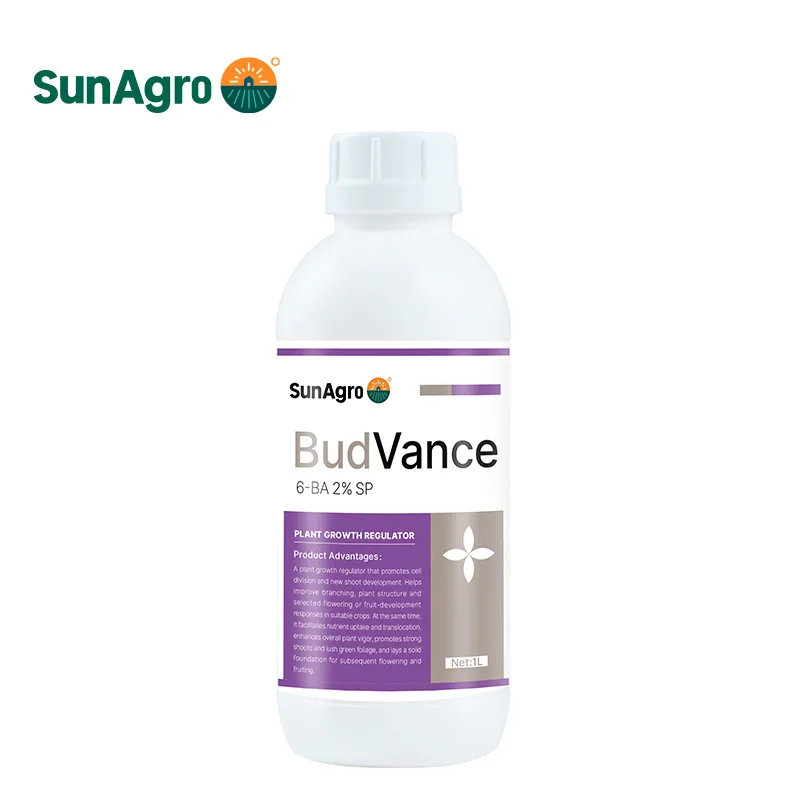
6-BA 2% SP Cytokinin Plant Growth Regulator
6-BA 2% SP is a soluble-powder plant growth regulator containing 6-Benzylaminopurine, a synthetic cytokinin used in registered horticultural and agricultural programs.
6-BA supports cell division and can influence lateral bud activity, shoot development, branching and plant architecture. In selected registered crop programs, it may also be used for flowering or fruit-management purposes.
We supply agricultural 6-Benzylaminopurine 2% SP for agrochemical importers, plant growth regulator distributors, registration companies, agricultural brands, nursery suppliers, orchard channels and professional horticultural projects.
This is an agricultural finished formulation. It is not a laboratory tissue-culture reagent, sterile 6-Benzylaminopurine solution or high-purity research chemical.
- Designed for Professional Buyers & Bulk Orders
- We support custom packaging, labeling, and formulation to meet your market needs.
- Export wholesale inquiries only.
- Please include destination country, business type (importer/distributor/registrant), and expected volume.
- Retail requests will not be processed.

About 6-BA 2% SP Cytokinin Plant Growth Regulator
| Item | Details |
|---|---|
| Active Ingredient | 6-Benzylaminopurine / 6-Benzyladenine |
| Common Names | 6-BA, 6-BAP, BAP, BA |
| Content | 2% |
| Formulation | SP, Soluble Powder |
| Product Type | Plant Growth Regulator |
| Hormone Class | Synthetic Cytokinin |
| CAS Number | 1214-39-7 |
| Main Physiological Direction | Cell division and shoot-development response |
| Core Commercial Direction | Branching, shoot development and plant architecture |
| Additional Direction | Registered flowering and fruit-management programs |
| Main Crop Channels | Ornamentals, nurseries, horticultural crops and approved orchard programs |
| Product Boundary | Not a fertilizer, rooting hormone or tissue-culture reagent |
| Supply Support | Packaging, documents, quality control and export coordination |
What Is 6-Benzylaminopurine 2% SP?
6-Benzylaminopurine 2% SP is an agricultural plant growth regulator in soluble-powder formulation.
6-Benzylaminopurine is also known as:
- 6-BA
- 6-BAP
- BAP
- BA
- 6-Benzyladenine
- N6-Benzyladenine
These names normally refer to the same active ingredient.
6-BA is a synthetic cytokinin. Cytokinins are plant growth substances involved in cell division, bud activity, shoot development and other crop-specific growth responses.
The clearest product positioning is:
6-BA 2% SP is a synthetic cytokinin plant growth regulator for registered branching, shoot-development, plant-architecture and horticultural crop programs.
It should not be promoted as a general nutrient, fertilizer or universal yield enhancer.
Agricultural Formulation, Not a Laboratory Reagent
6-BA 2% SP is an agricultural finished formulation. It is different from high-purity tissue-culture reagents and sterile laboratory solutions.
These products may include:
- High-purity 6-BA powder
- Tissue-culture-grade BAP
- Sterile 6-Benzylaminopurine solution
- 1 mg/mL laboratory solution
- Gram-scale research packs
- Cell-culture reagents
6-BA 2% SP is different.
It is a finished agricultural formulation designed for registered crop applications. It is supplied in commercial sachets, bags and cartons for agricultural import, distribution and market registration.
How 6-BA Works as a Cytokinin
6-BA affects cytokinin-related growth responses in treated plants.
A simple product pathway is:
Cytokinin response → Cell division → Lateral bud activity → Shoot development → Crop-specific growth response
6-BA may support cell division in active plant tissues and influence how growth is distributed between the main shoot, lateral buds and developing plant organs.
Depending on the crop, variety, application timing and registered use objective, 6-BA may influence:
- Lateral bud activity
- Basal branching
- New shoot development
- Plant architecture
- Flowering response
- Fruit thinning
- Fruit sizing
- Return bloom
- Other registered horticultural responses
The result is not the same in every crop.
6-BA should not be described as simply making all plants grow faster. It changes specific growth responses when crop, variety, timing, dose and environmental conditions are suitable.
Main Use Direction: Branching and Shoot Development
One of the strongest commercial directions for 6-BA is branching and shoot development.
In suitable registered programs, 6-BA may help:
- Increase lateral bud activity
- Encourage basal shoot development
- Support new branch formation
- Improve plant fullness
- Create a more balanced plant structure
- Reduce excessive dependence on one dominant shoot
- Improve the market appearance of selected ornamental crops
This direction is especially relevant to:
- Ornamental plant producers
- Nursery crop suppliers
- Greenhouse growers
- Container plant programs
- Landscaping plant channels
- Commercial propagation projects
The final plant response depends on the crop species and variety.
Some plants may show strong branching. Other plants may show a limited response or require a different application stage.
Ornamental and Nursery Programs
6-BA 2% SP may be positioned for registered ornamental and nursery crop programs.
Lateral Branching
6-BA may support lateral bud activity and branch formation in crops where local registration supports this use.
This can help produce fuller plants with more balanced canopy development.
Basal Shoot Development
In selected nursery and ornamental crops, 6-BA may support basal shoot formation.
The response depends on plant vigour, variety, growing conditions and application timing.
Plant Architecture
6-BA may help growers manage plant form where a compact, branched or more marketable structure is required.
It should not be promoted as a universal growth-control product. It does not act in the same way as a gibberellin inhibitor such as Paclobutrazol.
Flowering Response
Some registered programs may use 6-BA to influence flowering or bud response.
Flowering claims must remain crop-specific and label-dependent. The product should not be promoted as a universal flowering promoter.
Orchard and Fruit-Management Programs
6-Benzylaminopurine may also be used in selected registered orchard and fruit-management programs.
Possible directions include:
- Fruit thinning
- Fruit sizing
- Return bloom management
- Fruit-shape response
- Crop-load management
- Other registered fruit-development purposes
These applications are highly dependent on:
- Crop species
- Cultivar
- Fruit-development stage
- Application timing
- Spray concentration
- Tree vigour
- Temperature
- Canopy coverage
- Crop-load condition
- Local registration
6-BA 2% SP should not be promoted as a universal fruit-enlargement product.
Apple, pear and other orchard uses should only be included where the destination-market registration supports the specific formulation, timing and use objective.
Fruit Thinning Direction
In some registered orchard programs, 6-Benzylaminopurine may be used as part of a fruit-thinning program.
The response can vary according to:
- Cultivar
- Fruit size at application
- Tree age
- Temperature after treatment
- Tree vigour
- Pollination level
- Existing crop load
- Spray coverage
- Product concentration
Excessive thinning or insufficient thinning may occur if timing and crop conditions are not suitable.
A local label and established orchard protocol should always guide use.
Fruit Size and Return Bloom Direction
In selected registered programs, 6-BA may support fruit-size development or return bloom.
These are not guaranteed results.
The final response depends on the full orchard program, including:
- Crop load
- Fertility
- Irrigation
- pruning
- pollination
- weather
- cultivar
- treatment timing
For export fruit crops, PHI and MRL requirements must be confirmed before use.
Vegetable and Horticultural Programs
6-BA 2% SP may also fit registered vegetable, greenhouse and horticultural crop programs.
Possible objectives may include:
- Shoot-development response
- Plant-architecture management
- Flowering response
- Fruit-development response
- Other crop-specific cytokinin programs
Relevant market channels may include:
- Greenhouse vegetable suppliers
- Commercial horticultural farms
- Protected-crop projects
- Seedling nurseries
- Regional agricultural distributors
Tomato, pepper, cucurbit and other crop claims should only be added where local registration supports the use.
Plant Response Depends on Crop, Variety and Timing
Plant growth regulators require more precise use than ordinary fertilizers.
The final response to 6-BA can be affected by:
- Crop species
- Cultivar or variety
- Growth stage
- Plant age
- Temperature
- Light level
- Water management
- Fertility
- Growing media
- Plant vigour
- Container size
- Spray concentration
- Application timing
- Spray coverage
- Drying conditions
- Other growth regulators used in the program
A treatment that works well on one variety may not produce the same response on another variety.
When crop or variety response is not already established, conduct a limited commercial trial before treating the full production area.
This is especially important for:
- New ornamental varieties
- Sensitive fruit cultivars
- Greenhouse crops
- High-value nursery plants
- Export-oriented fruit programs
- New tank mixtures
What 6-BA 2% SP Does Not Do
6-BA 2% SP should not be promoted as:
- A fertilizer
- A micronutrient
- A rooting hormone
- A fungicide
- An insecticide
- A herbicide
- A universal flowering promoter
- A universal fruit-enlargement product
- A guaranteed yield enhancer
- A guaranteed germination enhancer
- A replacement for irrigation or nutrition
- A laboratory tissue-culture reagent
- A sterile 6-Benzylaminopurine solution
6-BA affects plant growth responses. It does not replace complete crop management.
Is 6-BA a Rooting Hormone?
No.
6-BA is a cytokinin-type plant growth regulator. It is mainly associated with cell division, shoot development and bud activity.
Rooting programs more commonly use auxin-related active ingredients such as:
- IBA
- NAA
- IAA
- Other approved rooting compounds
A high cytokinin-to-auxin balance may favour shoot development rather than root formation in some plant systems.
This is why 6-BA should not be marketed as a general rooting hormone.
6-BA Compared With Other Plant Growth Regulators
Different plant growth regulators serve different purposes.
| PGR Direction | Main Practical Role |
|---|---|
| 6-BA / 6-Benzylaminopurine | Cytokinin response, branching, shoot development and registered fruit-management uses |
| GA3 | Stem elongation and crop-specific fruit-development responses |
| IBA | Auxin-related rooting programs |
| NAA | Rooting, fruit thinning and crop-specific auxin responses |
| CPPU / Forchlorfenuron | Strong cytokinin-type fruit-development direction |
| Brassinolide | Brassinosteroid-type growth and stress-response programs |
| Paclobutrazol | Gibberellin biosynthesis inhibition and vegetative growth control |
| 6-BA + IBA | Combined cytokinin and auxin positioning for selected programs |
No product is automatically better.
The correct choice depends on the target response, crop, variety, growth stage, local registration and production system.
Difference Between 6-BA and GA3
6-BA and GA3 are different plant growth regulators.
6-BA is a synthetic cytokinin. Its main directions include cell division, bud activity, branching and crop-specific fruit responses.
GA3 is a gibberellin. It is more closely associated with:
- Stem elongation
- Internode extension
- Dormancy-related responses
- Flowering response in selected crops
- Fruit elongation or enlargement in registered programs
They should not be described as interchangeable.
Difference Between 6-BA and CPPU
Both 6-BA and CPPU have cytokinin-related activity, but their commercial positioning is different.
6-BA is commonly associated with:
- Branching
- Shoot development
- Plant architecture
- Selected fruit-management uses
CPPU is often positioned more strongly toward:
- Fruit cell division
- Fruit sizing
- Fruit-development management
- Crop-specific fruit quality programs
The correct product depends on the registered crop and use objective.
SP Formulation Features
SP means soluble powder.
6-BA 2% SP is a dry formulation designed to be mixed with water before application.
For importers and distributors, important SP characteristics include:
- 6-BA content
- Powder appearance
- Dissolution performance
- Solution appearance according to specification
- Insoluble matter
- Moisture content
- Caking control
- Storage stability
- Sachet or bag sealing
- Carton protection
SP formulation offers practical dry-product handling and is suitable for sachet, bag and carton distribution channels.
SP should not be described as dissolving instantly in every water source.
Dissolution can be affected by:
- Water temperature
- Water hardness
- pH
- Mixing order
- Agitation
- Product storage condition
- Other materials in the tank
The approved preparation method should always be followed.
Application Guidance
Use 6-BA 2% SP only where locally registered.
Before application, confirm:
- Target crop
- Target variety
- Intended growth response
- Growth stage
- Application timing
- Product concentration
- Water volume
- Spray coverage
- Environmental conditions
- Local registration
- PHI and MRL where applicable
Important application principles include:
- Measure the product accurately.
- Use calibrated equipment.
- Mix according to the approved instructions.
- Maintain even crop coverage.
- Avoid treating stressed plants.
- Do not use a rate from another crop or country.
- Check variety sensitivity.
- Conduct a limited test when the response is uncertain.
- Follow maximum application numbers.
- Follow local worker-safety requirements.
No universal dosage should be used for every crop and market.
Water Quality and Mixing
Water quality can affect preparation and crop response.
Before commercial application, check:
- Water pH
- Water hardness
- Water temperature
- Suspended solids
- Mixing order
- Tank cleanliness
- Partner-product compatibility
Add the product according to the approved mixing instructions.
Maintain suitable agitation where required.
Do not assume that complete physical dissolution confirms crop safety.
Compatibility and Tank Mixing
Compatibility depends on the crop, formulation, water quality and partner product.
Before mixing 6-BA 2% SP with other materials:
- Review the local label.
- Check physical compatibility.
- Conduct a jar test where appropriate.
- Confirm crop safety.
- Check the use timing of each product.
- Review water pH.
- Avoid unsupported combinations.
- Conduct a limited crop test where necessary.
Possible partner categories may include:
- Other plant growth regulators
- Foliar nutrients
- Fertilizers
- Fungicides
- Insecticides
- Wetting agents
- Adjuvants
Physical compatibility does not guarantee the desired biological response.
Mixing 6-BA with GA3, auxins or other PGRs may change plant response. These combinations should only be used where the label and local technical program support them.
Crop Safety and Use Boundary
Crop safety depends on:
- Species
- Variety
- Growth stage
- Application rate
- Spray concentration
- Temperature
- Light
- Plant stress
- Root condition
- Irrigation
- Fertility
- Tank-mix partner
- Application frequency
Possible undesirable responses from incorrect use may include:
- Excessive branching
- Uneven growth
- Excessive thinning
- Weak or unwanted shoots
- Delayed crop development
- Reduced plant balance
- Variety-specific injury
- Unwanted fruit response
These possible responses do not occur in every program, but they show why precise use is important.
Responsible product communication should avoid promises such as:
- Guaranteed more branches
- Guaranteed larger fruit
- Guaranteed higher yield
- Safe on every variety
- No crop response risk
- Works under all conditions
Registration and Residue Compliance
Before importing, promoting or using 6-BA 2% SP, local partners should confirm:
- Product registration
- Approved crop
- Approved use objective
- Formulation
- Active ingredient concentration
- Application rate
- Growth stage
- Application timing
- Maximum application number
- PHI
- MRL
- Export-market residue requirements
- Worker-protection instructions
- Label language
- Import documentation
- Packaging requirements
Fruit and vegetable programs may be subject to strict residue requirements.
Destination-market MRLs should be reviewed before commercial use.
POMAIS supports product and document communication for registration and distribution cooperation.
Final claims and field directions remain subject to local authorities and approved labels.
Storage and Transport
Store 6-BA 2% SP in sealed original packaging.
Keep the product in a cool, dry and ventilated location.
Avoid:
- Moisture
- Direct sunlight
- Excessive heat
- Package damage
- Contamination
- Caking
- Long-term storage under unsuitable conditions
For SP formulations, moisture protection is especially important.
Inspect sachets, bags and cartons before shipment and before use.
Storage and transport must follow SDS and local regulations.
Packaging and Market Preparation
POMAIS supports packaging preparation according to product specification, destination market and order requirements.
Available packaging directions may include:
- Sachets
- Bags
- Inner liners
- Cartons
- Export cartons
- Batch coding
- Production-date coding
- Carton marks
- Multilingual label communication
- Destination-market pack planning
Packaging materials should protect the soluble powder from moisture and contamination.
Final pack size depends on:
- Registration plan
- Distribution channel
- Product specification
- Market demand
- Shipment method
- Order volume
Document and Registration Support
POMAIS can provide standard product and shipment documents according to order requirements.
Available documents may include:
- COA
- SDS/MSDS
- TDS
- Product specification
- Packing information
- Label reference
- Batch information
- Physical and chemical data where available
- Shipment documents
- Registration-related documents where applicable
Document requirements should be confirmed before production and shipment preparation.
Quality Control
Quality control for 6-BA 2% SP focuses on active ingredient content and soluble-powder performance.
Batch review may include:
- 6-Benzylaminopurine content
- Powder appearance
- Dissolution performance
- Solution appearance
- Insoluble matter
- Moisture content
- pH after dilution where applicable
- Caking condition
- Sachet or bag sealing
- Carton inspection
- Storage-stability review
- Batch traceability
- Shipment-document review
Each batch should meet the agreed product specification before shipment.
Stable SP quality is important because excessive moisture, poor dissolution or caking can affect product preparation and commercial handling.
Price and Bulk Supply
The price of 6-Benzylaminopurine 2% SP depends on the actual procurement requirement.
Important price factors include:
- Product specification
- Active ingredient content
- Package size
- Packaging material
- Order volume
- Destination country
- Label language
- Registration documents
- Shipment terms
- Market preparation requirements
Laboratory retail prices for gram-scale 6-BA powder or sterile solution are not suitable references for bulk agricultural formulation supply.
For a commercial quotation, buyers should provide:
- Destination country
- Required specification
- Package size
- Label requirement
- Registration status
- Expected order volume
FAQ
Why Choose POMAIS
POMAIS supplies plant growth regulator products for qualified importers, distributors, registration companies, agricultural brands, horticultural suppliers and professional growing channels.
For 6-BA 2% SP, we support:
- Clear active ingredient specifications
- Finished agricultural SP formulation
- Batch quality control
- Moisture-resistant packaging preparation
- Product documentation
- Multilingual label communication
- Registration-related coordination
- Export shipment preparation
Our goal is to help buyers understand the product clearly and position it correctly for agricultural, nursery, ornamental and registered horticultural markets.
Request 6-BA 2% SP
Please share:
- Destination country
- Target crop
- Intended growth response
- Registration status
- Required package size
- Label language
- Expected order volume
We will review your requirements and prepare a suitable 6-Benzylaminopurine 2% SP supply proposal.
Contact us!
We will reply to you within 24 hours on business days!