
How to Control Common Purslane (Portulaca oleracea)
Common purslane (Portulaca oleracea) is a fast-growing summer annual broadleaf weed that can become difficult to manage once dense mats develop and seed production begins.
The most effective strategy is not to wait for mature purslane and then rely on one rescue spray. Control should focus on preventing establishment, treating young seedlings early, stopping seed production, and reducing repeated emergence from the soil seedbank.
Common purslane can produce very large numbers of seeds, and its fleshy stems can remain viable after cultivation and reroot when moisture returns. This is why late hoeing or cultivation can sometimes move the weed around rather than eliminate it.
For broader weed-management planning, see our weed control solutions for crop- and market-specific herbicide programs.
The exact herbicide decision must always follow:
- Crop
- Use site
- Purslane growth stage
- Other weeds present
- Herbicide registration
- Crop tolerance
- Resistance history
- Destination-market label
Common Purslane Control at a Glance
| Field Situation | Best Strategy Direction |
|---|---|
| No purslane visible yet | Prevent seedling establishment |
| Newly emerged seedlings | Early postemergence treatment or shallow cultivation |
| Small spreading plants | Crop-labeled postemergence control before seed set |
| Dense mature mats | Suppress existing plants, stop seed production, and plan follow-up control |
| Orchard or vineyard floor | Directed or inter-row treatment where registered |
| Vegetable crop | Crop selectivity and label come first |
| Nursery or ornamental production | Combine mulch, sanitation, and registered residual products |
| Turf | Use turf-selective programs and improve turf competition |
| Repeated yearly infestation | Reduce the seedbank through residual control, sanitation, and repeated scouting |
The best control window is normally before emergence or while purslane is still in the early seedling stage. UC IPM notes that postemergence control is generally more reliable on seedlings, while control of mature plants becomes more erratic and seed set may already have occurred.
How to Identify Common Purslane
Accurate identification matters because purslane management differs from the control of grasses, sedges, and other broadleaf weeds.
Seedling Identification
Young purslane plants are low-growing and fleshy.
Look for:
- Thick, smooth cotyledons
- Hairless succulent leaves
- Low growth close to the soil
- Reddish or green-red stems as plants develop
Seedlings can grow quickly under warm conditions after rainfall or irrigation.
Mature Plant Identification
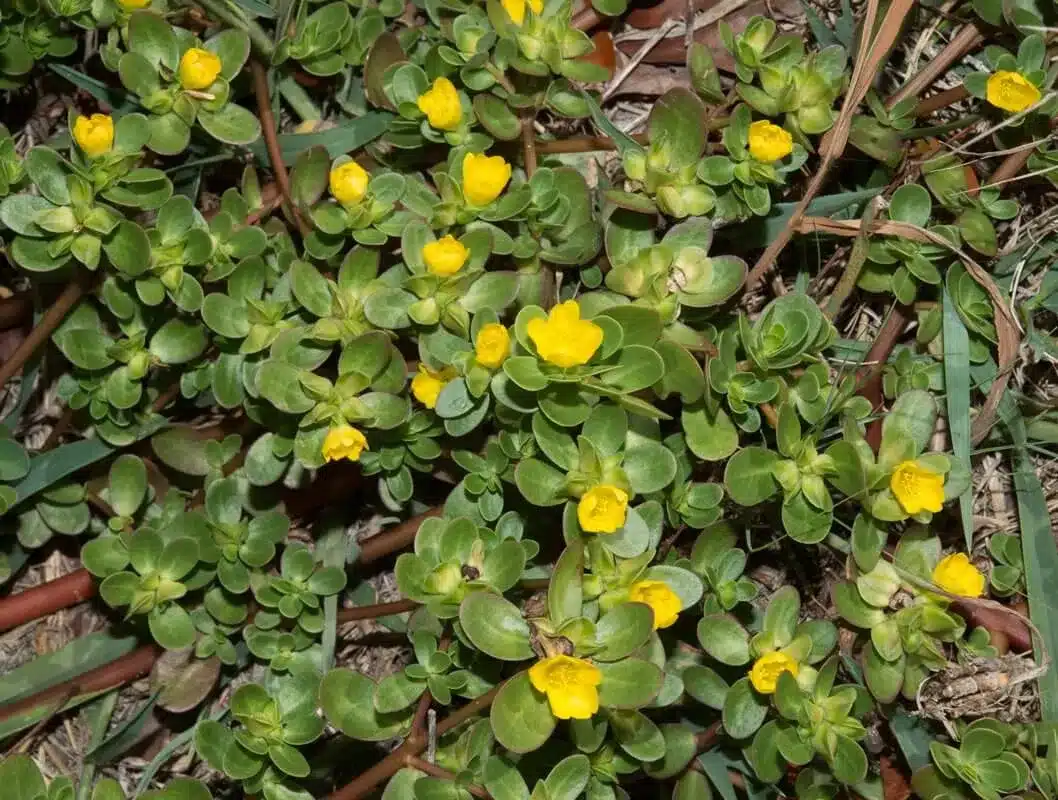
Mature common purslane typically forms a flat, spreading mat.
Key features include:
- Prostrate growth
- Thick, fleshy stems
- Smooth oval or spoon-shaped leaves
- Reddish stems radiating from a central area
- Small yellow flowers
- Tiny dark seeds
UC IPM describes mature purslane as a prostrate succulent annual with smooth fleshy leaves and reddish stems that spread outward from a central rooting point.
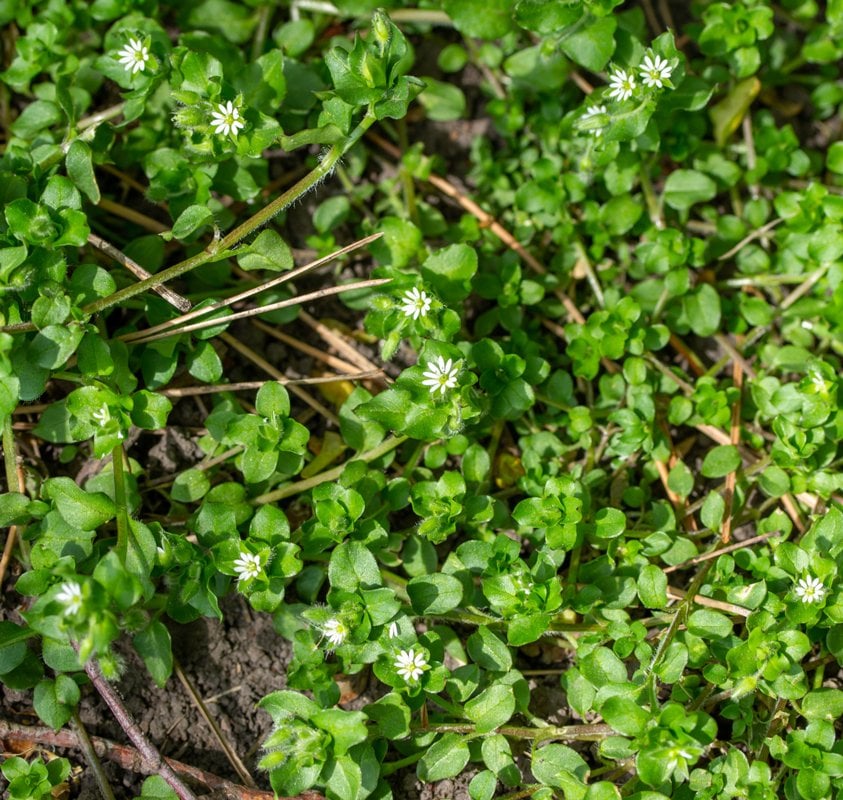
Common Purslane vs Spurge
Purslane can be confused with prostrate spurges when viewed quickly.
A practical distinction is:
| Feature | Common Purslane | Prostrate Spurge |
|---|---|---|
| Leaf texture | Thick and succulent | Thin |
| Stem | Fleshy | Slender |
| Plant sap | No characteristic milky latex | Often produces milky sap when broken |
| Growth habit | Dense succulent mat | Flat branching mat |
Correct identification should come before herbicide selection.
Why Is Common Purslane Hard to Control?
Common purslane combines several biological traits that make late control inefficient.
Rapid Summer Growth
Purslane performs particularly well in warm, disturbed, irrigated environments.
Surviving seedlings can expand quickly and form low mats that compete with crops for:
- Light
- Water
- Nutrients
- Open soil space
The low growth habit also allows small plants to remain unnoticed until they have already branched extensively.
High Seed Production
Seed production is one of the main reasons infestations return year after year.
UC IPM reports that a single common purslane plant can produce extremely large numbers of tiny seeds, and some seed can remain viable in soil for many years.
Allowing even a small number of mature plants to produce seed can therefore increase future weed pressure.
The management objective should be:
control purslane before seed set whenever possible.
Repeated Emergence
Purslane does not necessarily emerge in one flush.
New seedlings can appear after:
- Rain
- Irrigation
- Cultivation
- Soil disturbance
This means one early treatment may not control later flushes.
Follow-up scouting remains necessary.
Regrowth From Stem Fragments
Common purslane has succulent stems that can retain moisture after hoeing or cultivation.
UC IPM notes that larger stem sections can remain viable and reroot after irrigation if they are left in contact with moist soil.
This makes the weed different from many annual broadleaf weeds that die quickly after being uprooted.
When Is the Best Time to Control Purslane?
Timing is one of the most important factors in purslane management.
The preferred order is:
- Prevent establishment where possible.
- Control new seedlings quickly.
- Do not allow surviving plants to mature and set seed.
- Scout again after irrigation, rainfall, or cultivation.
The weakest strategy is to wait until purslane has formed a mature mat.
At that stage:
- Coverage becomes more difficult
- Plant biomass is greater
- Seed production may have started
- Stem fragments can survive cultivation
- Crop contact risk may be higher
- Follow-up treatment becomes more likely
How to Control Purslane Before It Emerges
Pre-emergence management aims to reduce establishment from the soil seedbank.
A pre-emergence herbicide should not simply be described as “stopping seeds from germinating.”
Depending on the active ingredient, the treatment may affect germinating seedlings by disrupting:
- Root development
- Shoot development
- Cell division
- Early seedling establishment
The practical goal is to maintain an active herbicide zone near the soil surface where young purslane seedlings emerge.
UC IPM notes that preemergence products need to be present near the soil surface and properly activated; excessively deep incorporation can reduce purslane control.
Where crop registration allows, Pendimethalin pre-emergent herbicide can be one component of a residual weed-management program.
Other possible tools may include different registered residual active ingredients depending on:
- Crop
- Soil
- Use site
- Irrigation
- Local registration
A pre-emergence product does not normally control established mature purslane, so application timing matters.
How to Control Purslane After It Emerges
Once purslane is visible, the strategy changes from preventing establishment to controlling living plants.
Small Seedlings
Small seedlings are usually the most favorable postemergence target.
At this stage:
- Leaf coverage is easier
- Plants have less stored biomass
- Seed production has not started
- Mechanical removal is easier
- Crop competition is still limited
This is normally a better intervention point than waiting for a large mat.
Established Plants
Established purslane requires more careful treatment.
A suitable registered postemergence product may still provide control, but results depend on:
- Active ingredient
- Crop
- Plant size
- Coverage
- Growth conditions
- Formulation
- Label rate
Non-selective products require particular care around desirable crop foliage.
For example, Glufosinate-Ammonium herbicide may fit selected directed or non-selective weed-control systems where the crop label permits its use.
Why Mature Purslane Is Harder to Control
Mature plants present several problems at once:
- Greater biomass
- Dense overlapping leaves
- Seed production
- Potential stem regrowth
- More difficult spray penetration
Do not assume that one late postemergence application will solve an established infestation completely.
Follow-up scouting is essential.
Which Herbicides Can Be Used for Purslane?
The correct herbicide depends first on crop and use site.
There is no single universal “best purslane herbicide.”
| Active Ingredient | Timing Role | Typical Positioning | Main Limitation |
|---|---|---|---|
| Pendimethalin | PRE | Selected crop, orchard, nursery, or turf systems | Does not control established mature plants |
| Oxadiazon | PRE | Selected ornamental, turf, nursery, and crop markets | Registration is use-site specific |
| Prodiamine | PRE | Primarily turf, nursery, and landscape markets | Not appropriate for every crop |
| Oxyfluorfen | PRE / POST depending on label | Orchards, vineyards, and selected crops | Crop foliage contact can cause injury |
| Glufosinate | POST | Directed or non-selective treatments | Avoid contact with desirable vegetation |
| Paraquat | POST contact | Selected professional burndown programs | Registration and applicator restrictions vary widely |
These are examples of possible use positions, not universal recommendations.
For selected orchard, vineyard, and professional weed-control programs, Oxyfluorfen herbicide may provide both residual and contact activity where the crop and use site are registered.
Always confirm:
- Crop label
- Growth stage
- Application method
- PHI or REI
- Adjuvant instructions
- Local regulatory status
How to Control Purslane in Different Crop Systems
The same active ingredient cannot be treated as equally suitable in every production system.
Vegetable Crops
Vegetable production requires especially careful crop-specific selection.
A herbicide that is acceptable in:
- Tomato
- Onion
- Brassica
- Potato
may not be registered in another vegetable crop.
Nonchemical methods can also play an important role.
UC IPM recommends approaches such as mulch, soil solarization, and early cultivation for vegetable systems, while emphasizing that herbicide registration varies among crops.
Orchards and Vineyards
Perennial systems often allow more opportunities for directed treatment between rows or beneath established trees and vines.
The main considerations are:
- Avoiding crop foliage contact
- Protecting young trunks
- Managing irrigation areas
- Controlling repeated flushes
- Using residual products where registered
A combination of residual and carefully directed postemergence control can reduce repeated rescue treatments.
Nurseries and Ornamentals
Nursery production can be especially vulnerable because purslane thrives in:
- Disturbed media
- Irrigated areas
- Container edges
- Open ground
Mulch, clean potting media, sanitation, and registered residual herbicides can all contribute to management.
UC IPM identifies mulching as a useful method because reducing light at the soil surface suppresses purslane emergence.
Turf and Landscape Areas
Healthy turf provides strong competition against common purslane.
Thin or poorly maintained turf creates more open soil where seedlings can establish.
Management should therefore combine:
- Turf density
- Correct irrigation
- Fertility
- Pre-emergence control
- Turf-selective postemergence treatment
UC IPM similarly notes that improving turf health and competitiveness is a core control strategy.
Can Cultivation Control Purslane?
Yes, especially when plants are very small.
Shallow cultivation after seedling emergence can remove young plants before they become established.
However, cultivation has two important limitations.
Soil Disturbance Can Trigger New Emergence
Purslane germinates close to the soil surface.
Cultivation can bring previously buried seed into a more favorable germination zone.
This means another flush may appear after irrigation.
Large Stem Fragments Can Reroot
When larger plants are cultivated, do not leave moist fleshy stems lying on wet soil.
UC IPM recommends removing larger plants or allowing them to dry thoroughly before irrigation so stem sections cannot reroot.
Otherwise, cultivation can function more like transplanting than weed control.
Does Mulch Help Control Purslane?
Yes.
Mulch can reduce the amount of light reaching the soil surface and physically interfere with seedling emergence.
It can be particularly useful in:
- Orchards
- Vineyards
- Ornamentals
- Vegetable systems
- Landscaped areas
Possible materials include:
- Organic mulch
- Plastic mulch
- Landscape fabric
The goal is to maintain enough coverage to suppress emerging seedlings.
Mulch should be integrated with sanitation because purslane can still establish in openings, edges, irrigation zones, and disturbed areas.
How to Prevent Purslane From Coming Back
Long-term purslane control is primarily a seedbank-management problem.
The most useful practices include:
Prevent Seed Production
Do not allow surviving plants to mature.
A few uncontrolled plants can contribute large numbers of new seeds.
Scout After Irrigation
Purslane often emerges after moisture reaches the soil surface.
Check high-risk areas after:
- Rain
- Irrigation
- Cultivation
Clean Equipment
Soil, seed, and plant fragments can move between fields on:
- Cultivation equipment
- Mowers
- Harvest machinery
- Nursery equipment
Sanitation can reduce spread into clean areas.
Maintain Crop Competition
Rapid crop canopy closure reduces open space and light availability at the soil surface.
Avoid Unnecessary Bare Soil
Long periods of disturbed, uncovered soil favor repeated emergence.
Combine Multiple Control Tools
A strong program may include:
- Pre-emergence herbicide
- Early postemergence treatment
- Cultivation
- Mulch
- Crop competition
- Sanitation
No single measure needs to carry the entire program.
What About Herbicide-Resistant Purslane?
Herbicide resistance has been documented in common purslane populations, but resistance status is field- and population-specific.
The important resistance principle is not:
postemergence herbicides cause more resistance.
It is:
repeated dependence on the same effective mode of action increases selection pressure.
A resistance-aware program should:
- Confirm weed identification
- Review treatment history
- Distinguish application failure from resistance
- Rotate effective modes of action where registered
- Use residual and postemergence tools strategically
- Prevent survivors from producing seed
- Combine chemical and nonchemical control
Do not assume that changing product brand names provides meaningful mode-of-action diversity.
How Should Distributors Choose a Purslane Herbicide Portfolio?
For importers and distributors, purslane control should be built around market use rather than one universal product.
| Procurement Question | Why It Matters |
|---|---|
| What is the destination country? | Registration differs by market |
| Which crops dominate? | Crop selectivity determines product choice |
| Is the need PRE or POST? | Different active ingredients fill different timing roles |
| Is the market orchard, vegetable, turf, or nursery? | Use-site registration changes |
| Which other weeds occur with purslane? | Portfolio may need broader spectrum |
| What resistance history exists? | Mode-of-action diversity becomes important |
| Which formulation is preferred? | EC, SC, SL, WG, GR, and others fit different channels |
| What packaging is needed? | Distributor and grower demand varies |
| Which documents are required? | COA, SDS/MSDS, TDS, and registration support |
| What is annual volume? | Determines commercial feasibility |
A practical distributor portfolio may therefore include:
- A pre-emergence residual option
- A selective postemergence option for specific crops
- A directed non-selective option
- A resistance-management alternative
The portfolio should reflect local crops and registrations rather than trying to sell every herbicide as a purslane solution.
Frequently Asked Questions
What kills common purslane?
Common purslane can be controlled with cultural methods and registered pre- or postemergence herbicides. The correct method depends on crop, use site, and weed stage.
What is the best time to control purslane?
Before emergence or during the early seedling stage is normally the most efficient timing.
Does pre-emergence herbicide kill existing purslane?
Usually no. Pre-emergence herbicides are designed mainly to reduce establishment of germinating seedlings.
What kills purslane after it emerges?
Several registered postemergence herbicides can control emerged purslane, but crop selectivity and use-site restrictions must be checked.
Can purslane grow back after pulling?
Large fleshy stem sections can remain viable and reroot under moist conditions if they are left on the soil.
Can purslane regrow from cut stems?
Yes, stem fragments can reroot under favorable conditions.
Does glyphosate kill purslane?
Glyphosate can control susceptible purslane in registered non-selective use situations, but crop contact, plant stage, resistance, and label restrictions matter.
Does glufosinate kill purslane?
Glufosinate may provide control in registered postemergence systems, particularly when coverage and plant stage are suitable.
Does 2,4-D kill purslane?
2,4-D can control common purslane in some registered turf and other use patterns, but it is not suitable for every crop.
What pre-emergent controls purslane?
Active ingredients such as pendimethalin and other residual herbicides may control purslane where registered. Crop and use site determine suitability.
Is mature purslane harder to kill?
Yes. Mature plants have more biomass, may already be producing seed, and are generally less reliable postemergence targets than young seedlings.
Can cultivation control purslane?
Yes, especially when seedlings are small. Larger plants should be removed or thoroughly dried so stem fragments cannot reroot.
How do you control purslane in vegetable crops?
Use crop-specific registered herbicides together with early cultivation, mulch, sanitation, and scouting.
How do you control purslane in orchards?
Orchard programs may combine residual products and directed postemergence treatment while avoiding crop foliage and trunk injury.
How do you stop purslane from coming back?
Prevent seed set, reduce the seedbank, control new seedlings early, keep equipment clean, improve crop competition, and scout after irrigation.
Can common purslane become herbicide resistant?
Yes. Resistance has been documented in some populations, so repeated reliance on one mode of action should be avoided.
Control Purslane Early and Prevent the Next Generation
Common purslane is easiest to manage before it becomes a mature, seed-producing mat.
A strong program follows four priorities:
- Prevent seedling establishment where possible.
- Control small emerged plants early.
- Stop surviving plants from producing seed.
- Combine herbicides with sanitation, cultivation, mulch, and crop competition.
For growers, this reduces repeated rescue treatments.
For distributors, it means building a herbicide portfolio around:
- Crop
- Use site
- PRE versus POST timing
- Selectivity
- Mode of action
- Local registration
POMAIS supplies herbicide solutions for professional weed-management programs, including residual and postemergence options for different crop and market requirements.
The key decision is not simply:
Which herbicide kills purslane?
It is:
Which registered strategy controls purslane at its current growth stage without creating unacceptable crop, resistance, residue, or regulatory risk?
Hot Products
Hot news
Recommended news