
Lambda-Cyhalothrin vs Bifenthrin: Which Should You Choose?
Lambda-Cyhalothrin and Bifenthrin are both synthetic pyrethroid insecticides classified in IRAC Group 3A. They act on voltage-gated sodium channels in the insect nervous system and are mainly used as non-systemic contact and ingestion insecticides.
The main difference is therefore not their basic mode of action.
Lambda-Cyhalothrin is a Type II pyrethroid with a strong commercial position in foliar crop protection and vector-control programs. Bifenthrin is a Type I pyrethroid with broad agricultural use and an especially strong position in turf, termite, perimeter, and structural pest-control markets.
For buyers, the better choice depends on the target pest, crop or use site, formulation, residual requirement, local registration, and resistance history.
Lambda-Cyhalothrin vs Bifenthrin: Quick Comparison
| Comparison | Lambda-Cyhalothrin | Bifenthrin |
|---|---|---|
| Insecticide class | Synthetic pyrethroid | Synthetic pyrethroid |
| Pyrethroid type | Type II | Type I |
| IRAC group | 3A | 3A |
| Main target | Voltage-gated sodium channels | Voltage-gated sodium channels |
| Main activity | Contact and ingestion | Contact and ingestion |
| Systemic? | No | No |
| Crop foliar pest control | Strong fit | Strong fit |
| Caterpillar programs | Strong commercial position | Relevant where registered |
| Sucking pests | Registered use possible | Registered use possible |
| Mosquito / vector programs | Strong position | Strong position |
| Turf pest control | Less central | Stronger commercial position |
| Termite market | Less central | Strong commercial position |
| Structural perimeter use | Product-specific | Strong commercial position |
| Soil-oriented professional use | More limited | Stronger commercial position |
| Different IRAC group for rotation? | No | No |
| Universal residual winner | No | No |
The most important conclusion is simple:
Both products share the same IRAC mode of action, but their strongest commercial applications are not identical.
What Do Lambda-Cyhalothrin and Bifenthrin Have in Common?
Both active ingredients belong to the pyrethroid insecticide family.
Their main biological target is the insect nervous system.
They interfere with normal sodium-channel function, causing abnormal nerve signaling that can lead to:
- Hyperexcitation
- Loss of coordination
- Knockdown
- Paralysis
- Death after sufficient exposure
Both are classified in IRAC Group 3A.
This shared classification matters because it means that changing from Lambda-Cyhalothrin to Bifenthrin does not represent a change to a completely different insecticide mode of action.
Both are also non-systemic.
They depend largely on:
- Direct contact
- Contact with treated surfaces
- Ingestion from treated material
This makes application coverage, pest exposure, and formulation important in both agricultural and professional pest-control programs.
For a more detailed explanation of Group 3A neurotoxic action, see how Bifenthrin kills insects.
How Are Lambda-Cyhalothrin and Bifenthrin Different?
Although they share the same IRAC group, they are different molecules and should not be treated as interchangeable products.
Type II vs Type I Pyrethroid
Lambda-Cyhalothrin is classified as a Type II pyrethroid and contains an alpha-cyano group.
Bifenthrin is classified as a Type I pyrethroid and does not contain that alpha-cyano group.
This difference is useful for chemical classification, but it should not be turned into a simple commercial claim such as:
Type II is stronger.
or:
Type I is safer.
Those conclusions are too broad.
Field performance depends on the pest, concentration, formulation, treatment surface, crop, resistance status, and local registration.
Different Commercial Positioning
Lambda-Cyhalothrin has a particularly strong position in:
- Foliar crop protection
- Caterpillar control
- Selected sucking-pest programs
- Cereals
- Cotton
- Rice
- Vegetables
- Vector-control formulations
Bifenthrin also has extensive agricultural use, but its commercial footprint extends further into:
- Turf
- Structural pest control
- Perimeter treatment
- Termite control
- Soil-oriented professional programs
- Mosquito barrier treatment
This broader non-crop positioning is one of the clearest practical differences between the two active ingredients.
Which Is Better for Agricultural Crop Protection?
Both are important agricultural pyrethroids.
The better choice depends on the crop and pest rather than the chemical class alone.
Lambda-Cyhalothrin has a very strong foliar crop-protection position against susceptible pests such as:
- Armyworms
- Cutworms
- Bollworms
- Leaf folders
- Selected borers
- Aphids
- Leafhoppers
- Whiteflies
Bifenthrin is also widely used in crop protection against chewing and sucking insects in cotton, corn, vegetables, fruit, and other registered crops.
A useful starting point is:
| Agricultural Requirement | Starting Direction |
|---|---|
| Foliar caterpillar program | Lambda-Cyhalothrin worth evaluating |
| Broad pyrethroid crop portfolio | Compare both |
| Selected sucking pests | Compare label, resistance and crop |
| Agricultural + turf market | Bifenthrin has broader flexibility |
| Agricultural + structural market | Bifenthrin has stronger cross-market positioning |
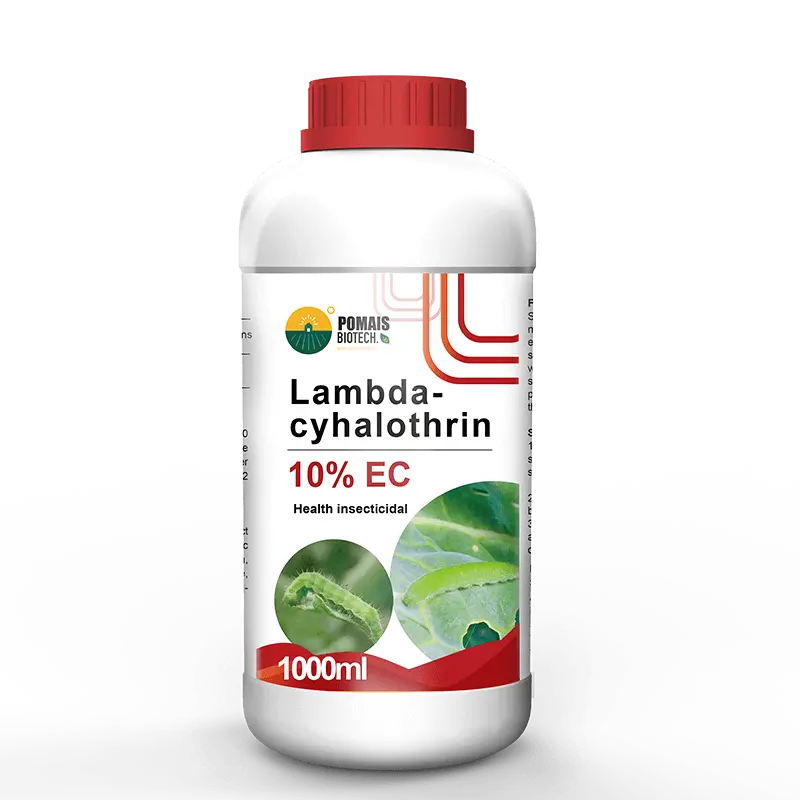
For commercial formulations and crop-use directions, see Lambda-Cyhalothrin insecticide.
Which Is Better for Caterpillars?
Lambda-Cyhalothrin has a particularly strong commercial position against exposed Lepidopteran larvae.
Typical crop-pest directions can include:
- Armyworms
- Cutworms
- Bollworms
- Leaf folders
- Selected borers
- Other exposed caterpillars
This makes Lambda-Cyhalothrin a common starting point for crop markets where caterpillar pressure is a major commercial driver.
However, this does not mean Bifenthrin cannot control caterpillars.
Bifenthrin may also be registered against Lepidopteran pests.
The correct decision should consider:
- Pest species
- Larval stage
- Crop
- Local pyrethroid resistance
- Formulation
- Registration
- Coverage requirement
The more exposed the larvae are, the better both contact-oriented pyrethroids can fit the program.
Which Is Better for Termites and Structural Pest Control?
Bifenthrin generally has the clearer commercial position.
It is widely associated with professional programs involving:
- Termites
- Ants
- Cockroaches
- Spiders
- Crawling insects
- Turf pests
- Exterior perimeter treatment
- Structural pest management
This gives Bifenthrin a strong role in markets where one active ingredient needs to support both agricultural and professional pest-control portfolios.
Lambda-Cyhalothrin can also appear in structural or public-health products, but Bifenthrin is more strongly positioned in termite, soil, perimeter, and building-protection markets.
For these applications, see Bifenthrin insecticide for structural pest control.
The final product must still be registered for the intended pest and use site.
Which Is Better for Mosquito Control?
Both active ingredients can fit mosquito-control programs.
The better choice may depend more on the finished formulation and treatment system than on the active ingredient name alone.
Lambda-Cyhalothrin is widely positioned in public-health and vector-control products and can be formulated for residual surface or barrier applications.
Bifenthrin also has a strong mosquito-market position, especially in perimeter and vegetation treatments.
When comparing products for mosquito control, buyers should consider:
- Formulation
- Treated surface
- Required residual profile
- Vegetation coverage
- Rainfall
- UV exposure
- Target mosquito species
- Local registration
It is therefore too simplistic to say:
Lambda-Cyhalothrin is always better for mosquitoes.
or:
Bifenthrin always lasts longer.
Both can perform well when the formulation and application system are appropriate.
For broader professional pest applications, review POMAIS Pest Control Solutions.
Does Bifenthrin Last Longer Than Lambda-Cyhalothrin?
Not universally.
Bifenthrin is often commercially associated with strong residual surface performance, especially in:
- Turf
- Structural pest control
- Termite programs
- Exterior perimeter treatment
But residual performance cannot be ranked accurately by active ingredient name alone.
Actual persistence can change with:
- Formulation
- Surface type
- Sunlight
- Rainfall
- Temperature
- Vegetation
- Soil characteristics
- Application rate
- Pest behavior
A Lambda-Cyhalothrin CS formulation and a Bifenthrin EC, SC, WP, or granular product may behave differently under real use conditions.
The correct question is not:
Which molecule always lasts longer?
It is:
Which finished product provides the residual profile required for this specific use site?
Does Formulation Change the Comparison?
Yes.
Formulation can significantly affect how a pyrethroid product behaves in the field or on structural surfaces.
Lambda-Cyhalothrin products can be available in formulation directions such as:
- EC
- SC
- CS
- WP
Bifenthrin products can also appear in multiple formulation types, including:
- EC
- SC
- WP
- Granular products
The formulation can influence:
- Spray coverage
- Surface retention
- Release profile
- Handling
- Drift behavior
- Compatibility with application equipment
- Residual positioning
This is why comparing only active ingredient names can be misleading.
For example, a microencapsulated or suspension formulation may have a different commercial purpose from a conventional emulsifiable concentrate even when both contain a Group 3A pyrethroid.
Buyers should compare the finished formulation, not only the technical active ingredient.
Can Lambda-Cyhalothrin Replace Bifenthrin?
Not automatically.
Although both are Group 3A pyrethroids, their products may differ in:
- Crop registration
- Pest claims
- Concentration
- Formulation
- Application rate
- Use site
- Residue requirements
- Packaging
- Commercial positioning
A distributor should therefore not treat Lambda-Cyhalothrin and Bifenthrin as direct one-to-one substitutes.
The replacement question should start with:
What problem is the finished product supposed to solve?
If the requirement is:
foliar crop caterpillar control, Lambda-Cyhalothrin may be a strong starting direction.
If the requirement is:
termite or structural perimeter treatment, Bifenthrin may be a more suitable commercial direction.
If the requirement is simply:
another Group 3A pyrethroid, either product may still belong to the same resistance-management category.
Can Lambda-Cyhalothrin and Bifenthrin Be Rotated for Resistance Management?
They are different active ingredients, but both belong to IRAC Group 3A.
This means:
Switching from Lambda-Cyhalothrin to Bifenthrin should not be treated as a true change in mode of action.
If a pest population is already under strong selection pressure from Group 3A pyrethroids, changing between these two active ingredients may not provide the same resistance-management benefit as rotating to an effective insecticide from another IRAC group.
Professional programs should consider:
- IRAC group
- Local resistance history
- Previous pyrethroid use
- Pest generation
- Crop cycle
- Other effective registered modes of action
Changing the brand name is not the same as changing the biological target.
Which One Should Buyers Choose?
The best starting point depends on the market requirement.
| Market Requirement | Better Starting Direction |
|---|---|
| Foliar crop caterpillar market | Lambda-Cyhalothrin |
| General agricultural pyrethroid | Compare both |
| Cotton and vegetable pest programs | Compare crop and pest fit |
| Mosquito / vector-control market | Compare both + formulation |
| Turf insect-control market | Bifenthrin |
| Termite market | Bifenthrin |
| Structural perimeter market | Bifenthrin |
| Soil-oriented professional treatment | Bifenthrin |
| Need for a different IRAC group | Neither |
| Known Group 3A resistance | Evaluate another effective mode of action |
The comparison should therefore be based on:
pest + crop or use site + formulation + registration + resistance
rather than asking which molecule is universally “stronger.”
Frequently Asked Questions
Are Lambda-Cyhalothrin and Bifenthrin the Same Insecticide?
No.
They are different synthetic pyrethroid active ingredients, but both belong to IRAC Group 3A and target voltage-gated sodium channels in insects.
Which Is Stronger, Lambda-Cyhalothrin or Bifenthrin?
There is no universal answer.
Performance depends on pest species, formulation, concentration, use site, exposure, resistance, and application conditions.
Which Lasts Longer, Lambda-Cyhalothrin or Bifenthrin?
Bifenthrin is often commercially positioned for strong residual performance in turf and structural markets, but actual persistence depends heavily on formulation, surface, environment, and application conditions.
There is no universal residual winner.
Which Is Better for Caterpillars?
Lambda-Cyhalothrin has a particularly strong crop-market position against susceptible caterpillars.
Bifenthrin can also be used against certain caterpillar pests where registered.
Which Is Better for Termites?
Bifenthrin generally has the stronger commercial position in termite, soil, and structural perimeter markets.
Which Is Better for Mosquitoes?
Both can be effective.
The better choice often depends on formulation, treatment surface, residual requirement, and local registration.
Are Both Lambda-Cyhalothrin and Bifenthrin IRAC Group 3A?
Yes.
Both are Group 3A pyrethroids and act as sodium-channel modulators.
Can Lambda-Cyhalothrin and Bifenthrin Be Rotated for Resistance Management?
They can be used as different products where registered, but they should not be considered different IRAC modes of action.
Both remain Group 3A.
Can Lambda-Cyhalothrin Replace Bifenthrin?
Not automatically.
Their crop registrations, pest claims, formulations, concentrations, use sites, and commercial applications may differ.
Comparing Pyrethroid Products for Your Market?
POMAIS supplies insecticide products for agricultural, public-health, turf, structural, and professional pest-control markets.
When comparing Lambda-Cyhalothrin and Bifenthrin, buyers should first confirm:
- Destination country
- Target crop or use site
- Main pest
- Required concentration
- Formulation
- Registration status
- Residual requirement
- Packaging
You can review our Lambda-Cyhalothrin insecticide and Bifenthrin insecticide product pages for available commercial directions.



Hot Products
Hot news
Recommended news