
Boxelder Bug Control: How to Get Rid of Boxelder Bugs
The most effective way to get rid of boxelder bugs is to stop them from entering buildings before fall migration. Seal exterior gaps, repair screens and door seals, remove outdoor aggregations, and vacuum bugs that have already entered indoors. Once boxelder bugs are inside a building, physical removal is usually more practical than indoor insecticide treatment.
If large numbers repeatedly gather on exterior walls, a locally registered perimeter insecticide may be considered before the insects move into wall voids or indoor spaces. Products containing pyrethroid active ingredients such as bifenthrin, deltamethrin, lambda-cyhalothrin, or permethrin may be available for exterior building treatments, depending on the market and approved product label.
The key is timing: prevent the migration first, rather than trying to solve the problem after hundreds of bugs are already indoors.
How to Identify Boxelder Bugs
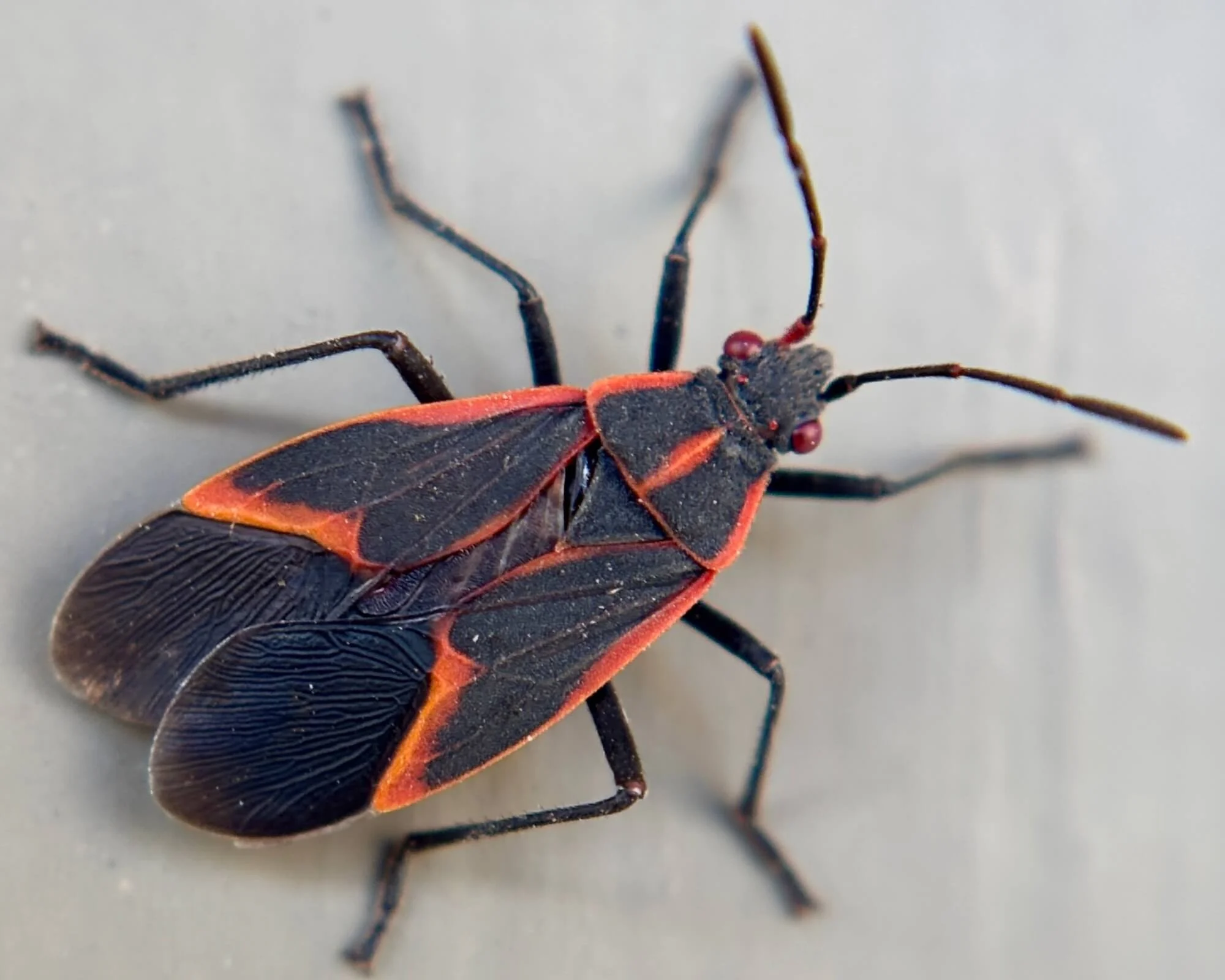
Boxelder bugs are black-and-red true bugs that commonly gather in large groups on trees, exterior walls, windows, and other warm surfaces.
The common boxelder bug is generally identified as Boisea trivittata, while the western boxelder bug is Boisea rubrolineata. The western species is particularly associated with western North America.
Adults are roughly 1/2 inch long and are mainly black with distinctive red or orange-red markings. Nymphs are much brighter red and gradually develop darker markings as they mature.
A useful identification feature is the red pattern on the thorax and wings. Large seasonal clusters around buildings are another strong clue.
Correct identification matters because boxelder bugs can be confused with other red-and-black true bugs. If you are dealing with a different nuisance insect, the prevention and treatment strategy may also change.
For other common insect problems, see POMAIS Pest Control Solutions.
Why Do Boxelder Bugs Enter Homes?
Boxelder bugs usually do not enter houses because they want to feed or reproduce indoors.
They enter because they are searching for a dry, protected place to overwinter.
During late summer and fall, adults begin moving away from feeding areas and gathering on warm buildings. South- and west-facing walls are especially attractive because they receive more sunlight and remain warmer during the day.
From these exterior surfaces, the insects can move through:
- Window gaps
- Door frames
- Damaged screens
- Utility penetrations
- Siding joints
- Foundation cracks
- Soffit and roof vents
- Gaps around trim
Once inside walls, attics, or other protected spaces, they may remain inactive through cold weather.
On warm winter or early-spring days, some become active again and appear near windows or inside rooms.
This is why people sometimes believe they have a new indoor infestation in winter.
In reality, many of those bugs entered the structure during the previous fall. Boxelder bugs generally do not establish reproducing populations inside homes.
Are Boxelder Bugs Harmful?
Boxelder bugs are primarily a nuisance pest, not a major structural or public-health pest.
They normally do not damage buildings, furniture, or stored materials. They are not considered important biting pests, and their presence indoors is usually more annoying than dangerous.
The main indoor problems are:
- Large numbers of visible insects
- Staining on curtains, walls, and other surfaces
- Unpleasant odor if insects are crushed
- Repeated appearance around windows during warm weather
Outdoors, boxelder bugs commonly feed on box elder trees, especially seed-bearing trees. They may occasionally feed on other plants or fruits, but serious landscape damage is uncommon. UC IPM describes most infestations as nuisance problems rather than major plant-health threats.
For most properties, the main objective is therefore not protecting the tree.
It is keeping the insects out of the building.
How to Get Rid of Boxelder Bugs
The best control method depends on where the insects are.
If Boxelder Bugs Are Already Inside the House
For bugs already indoors, physical removal is usually the best starting point.
Use a vacuum cleaner to collect visible insects and dispose of the contents promptly. Sweeping can also work when numbers are small.
Avoid crushing boxelder bugs against walls, curtains, carpets, or furniture because their body fluids can leave stains and unpleasant odors.
Indoor insecticide applications are generally of limited value once the insects are already dispersed through a structure. Extension guidance recommends vacuuming or physical removal instead.
After removing them, identify where they may have entered and seal those openings before the next migration period.
If Boxelder Bugs Are Gathering Outside
Large exterior clusters do not always require insecticide.
A strong stream of water can physically remove groups from walls, tree trunks, and other surfaces. UC IPM specifically recommends hosing off aggregations as a practical nonchemical option.
You can also reduce sheltered areas around the building by removing excessive debris and checking exterior cracks.
The goal is to reduce clustering while identifying where insects are likely to enter.
If Boxelder Bugs Return Every Fall
Recurring infestations indicate that the building itself is providing attractive entry points.
The long-term solution should therefore focus on:
exclusion first → exterior population management second → chemical treatment only when justified
This approach is usually more reliable than repeatedly treating bugs after they appear indoors.
How to Keep Boxelder Bugs Out of Buildings
Exclusion is the most important long-term control step.
University of Minnesota Extension recommends sealing access points and repairing building openings before insects begin moving indoors in fall.
| Entry Point | What to Check |
|---|---|
| Windows | Torn screens, frame gaps, loose caulk |
| Doors | Weatherstripping, thresholds, door sweeps |
| Utility lines | Openings around pipes, cables, and conduits |
| Siding | Joints, trim gaps, damaged panels |
| Foundation | Cracks and wall penetrations |
| Roof and soffits | Unscreened or damaged vents |
| Attic vents | Mesh condition and surrounding gaps |
| Garage doors | Bottom and side seals |
The best time to complete this work is before peak fall migration.
Waiting until insects are already inside wall voids makes control much more difficult.
For properties with a history of severe infestation, inspect the warmest south- and west-facing sides first because these surfaces are especially attractive during seasonal aggregation.
Should You Remove a Box Elder Tree?
Removing a box elder tree should not normally be the first response to a boxelder bug problem.
Seed-bearing female box elder trees can support large local populations, and UC IPM notes that removing nearby female trees may reduce a local source of insects. However, adults are mobile and can migrate from surrounding areas.
This means:
Removing one tree does not guarantee that boxelder bugs will disappear.
Tree removal may be worth considering when:
- A property experiences severe infestations every year
- A large seed-bearing tree is immediately adjacent to the building
- The tree has little landscape value
- Other exclusion measures have already been improved
If the tree is healthy and valuable, sealing the building and managing migration is usually a more practical first strategy.
When Is the Best Time to Control Boxelder Bugs?
Timing matters because the control objective changes during the year.
Spring and Summer
Boxelder bugs are mainly outdoors.
Monitor host plants and exterior areas, but building treatment usually has less value if migration has not started.
Late Summer and Fall
This is the most important prevention period.
Adults begin gathering on buildings and searching for overwintering sites. This is when you should:
- Repair screens
- Seal cracks
- Check doors and windows
- Inspect utility penetrations
- Remove exterior aggregations
- Consider a labeled exterior perimeter treatment if infestation pressure is severe
University of Minnesota identifies fall as the most effective time for exclusion and, where needed, timely exterior insecticide use.
Winter and Early Spring
Bugs appearing indoors are usually overwintering insects that entered earlier.
At this stage, vacuuming and physical removal are normally more useful than broad indoor pesticide applications.
What Insecticides Are Used for Boxelder Bug Control?
Chemical control should be secondary to exclusion.
When large numbers repeatedly gather on building exteriors, some registered perimeter pest-control products may contain pyrethroid active ingredients such as:
| Active Ingredient | Chemical Group | Typical Professional Position |
|---|---|---|
| Bifenthrin | Pyrethroid | Exterior perimeter and structural pest programs where registered |
| Deltamethrin | Pyrethroid | Residual surface and nuisance-pest programs where registered |
| Lambda-Cyhalothrin | Pyrethroid | Exterior and professional pest-control programs where registered |
| Permethrin | Pyrethroid | Structural and public-health pest programs where registered |
University of Minnesota specifically identifies bifenthrin, cyfluthrin, deltamethrin, lambda-cyhalothrin, and permethrin among active ingredients that may appear in products labeled for building-exterior treatment.
The important phrase is “labeled for the use.”
An active ingredient being known for boxelder bug control does not mean every formulation containing that active ingredient can legally be used on buildings or against boxelder bugs.
For professional markets, POMAIS supplies Bifenthrin insecticide for structural pest-control programs. Its current product portfolio includes structural pest-control positioning in addition to agricultural uses.
Buyers should confirm the exact concentration, formulation, pest claim, application site, and destination-country registration before selecting a commercial product.
Why Are Pyrethroids Commonly Used for Exterior Perimeter Control?
Bifenthrin, deltamethrin, lambda-cyhalothrin, and permethrin are all synthetic pyrethroid insecticides.
This group is commonly used in professional nuisance-pest programs because appropriately registered formulations can provide contact activity and residual surface control against susceptible crawling insects.
For boxelder bug migration, the commercial objective is usually not to treat the insects inside living spaces.
Instead, an exterior treatment—where specifically approved—is intended to reduce insects gathering or crossing around likely entry areas before they move indoors.
POMAIS also supplies Deltamethrin insecticide formulations for professional pest-control markets. Its current portfolio includes public-health and perimeter-treatment directions, but the finished product must still match the locally approved pest and use site.
Chemical treatment works best when it supports a good building-exclusion program rather than replacing one.
Which Pyrethroid Formulation Fits Professional Pest-Control Markets?
The active ingredient is only one part of a finished commercial insecticide.
Professional pest-control markets may require different formulation types depending on registration, target surfaces, handling expectations, packaging, and distribution channels.
Common pyrethroid formulation directions can include:
- EC
- SC
- CS
- WP
- Other locally registered structural formulations
For example, POMAIS currently supplies Lambda-Cyhalothrin professional pest-control formulations across EC, WP, and other product directions for registered agricultural and professional markets.
A distributor should therefore avoid asking only:
“Which active ingredient kills boxelder bugs?”
A better purchasing question is:
“Which registered formulation fits the pest-control channel and exterior treatment claim in my market?”
For a broader explanation of EC, SC, WP, CS and other formulation systems, see our Pesticide Formulation Types Buyer’s Guide.
What Should Distributors Check Before Sourcing a Boxelder Bug Product?
Boxelder bug treatment is usually part of a wider structural nuisance-pest portfolio, rather than a stand-alone product category.
This matters for importers and distributors.
A product that can only be positioned around one seasonal pest may have less commercial value than a locally registered formulation covering a broader structural pest segment.
| Buyer Check | Why It Matters |
|---|---|
| Active ingredient | Defines chemistry and market positioning |
| Concentration | Must match registration and product specification |
| Formulation | Affects handling, packaging, and application direction |
| Boxelder bug claim | Cannot be assumed from active ingredient alone |
| Exterior/structural use | Must match the approved application site |
| Residual positioning | Important for perimeter-market positioning |
| Pack size | Should fit professional or retail distribution |
| Technical documents | Supports QC, registration, and import evaluation |
| Destination country | Determines legal product fit |
For wider professional channels, Permethrin public health insecticide is another pyrethroid product direction available through POMAIS. The current product page is specifically positioned for professional buyers, residential insect-management channels, and public-health use.
The final product should always be selected according to the approved local pest claim and treatment site.
Professional Structural Pest-Control Products
For distributors, boxelder bugs usually sit within the broader market for seasonal and structural nuisance insects.
A useful product portfolio may therefore need to cover several pest groups rather than one species alone.
POMAIS supports importers, distributors, wholesalers, brand owners, pest-control channels, and project buyers with professional public health pest-control formulations, including multiple liquid, solid, bait, and other formulation directions with private-label and technical-document support.
Before choosing a product, confirm:
- Target pest market
- Destination country
- Approved structural or exterior use
- Active ingredient
- Concentration
- Formulation
- Packaging
- Registration status
This prevents a common sourcing mistake: buying a technically suitable active ingredient in a finished formulation that does not match the actual market registration.
Frequently Asked Questions
What Is the Best Way to Get Rid of Boxelder Bugs Inside?
Vacuuming or physically removing them is usually the most practical indoor method.
Once boxelder bugs are already inside a building, insecticide treatment generally provides limited benefit compared with removal and prevention of future entry.
Why Are There So Many Boxelder Bugs on My House?
Large groups usually appear during seasonal migration.
In late summer and fall, adults gather on warm, sunny building surfaces while searching for protected overwintering sites. South- and west-facing walls are particularly attractive.
Do Boxelder Bugs Reproduce Inside Homes?
Normally no.
The insects found indoors are generally overwintering adults that entered from outside. They do not usually establish a reproducing household infestation.
What Insecticide Kills Boxelder Bugs?
Products containing pyrethroid active ingredients such as bifenthrin, deltamethrin, lambda-cyhalothrin, cyfluthrin, or permethrin may be used in some exterior building pest-control programs.
The exact finished product must be labeled for the pest and application site in the relevant market.
Does Bifenthrin Kill Boxelder Bugs?
Bifenthrin is one of the pyrethroid active ingredients identified in Extension guidance for exterior building treatments used against seasonal boxelder bug invasions.
However, do not assume that every Bifenthrin product is approved for this purpose. Check the finished product label, pest claim, and use site.
Should I Spray Boxelder Bugs Inside My House?
Broad indoor insecticide treatment is usually not the preferred solution for boxelder bugs.
Physical removal is more practical once the insects have entered, while sealing exterior openings provides better long-term prevention.
Will Removing a Box Elder Tree Eliminate Boxelder Bugs?
Not necessarily.
Removing a nearby seed-bearing box elder tree may reduce a local population source, but adult boxelder bugs can migrate from other areas. Tree removal should therefore not replace building exclusion.
When Should Exterior Boxelder Bug Treatment Be Applied?
Where a locally registered exterior treatment is justified, late summer or early fall is generally the more useful timing because treatment can target migrating insects before they enter the structure.
Always follow the approved product label for timing, surfaces, rates, and application restrictions.
Building a Professional Structural Pest-Control Product Line?
POMAIS supplies professional insecticide formulations for importers, distributors, registration companies, pest-control channels, and private-label brands.
If you are evaluating products for seasonal crawling insects or wider structural pest-control markets, send us your:
- Destination country
- Required active ingredient
- Concentration
- Formulation
- Target pest segment
- Registration status
- Packaging requirements
- Estimated order volume
We can help you evaluate available pyrethroid and public-health insecticide directions, technical documentation, private-label packaging, and export requirements.
Discuss your professional pest-control product requirements with POMAIS.
Hot Products
Hot news
Recommended news