
Acetamiprid: Uses, Applications, and Properties
Acetamiprid is a neonicotinoid insecticide used in registered agricultural, greenhouse, ornamental, and selected professional pest-control programs.
It is mainly positioned against aphids, whiteflies, leafhoppers, planthoppers, mealybugs, psyllids, thrips, and other susceptible pests. Acetamiprid provides systemic activity together with contact and ingestion exposure.
Acetamiprid belongs to IRAC Group 4A. Its approved crops, target pests, application methods, rates, pre-harvest intervals, and pollinator restrictions vary between product labels and destination markets.
Quick Answer: What Is Acetamiprid Used For?
Acetamiprid is mainly used against piercing-sucking pests that remove plant sap and may transmit crop diseases.
Important use directions include:
- Aphids
- Whiteflies
- Leafhoppers
- Planthoppers
- Mealybugs
- Psyllids
- Thrips
- Selected beetles
- Selected leafminers
- Other label-listed insects
It may be applied as a foliar spray, soil treatment, seed treatment, or another registered application method, depending on the formulation and local label.
Agricultural Acetamiprid products should not automatically be used for indoor pests, bed bugs, ants, or other professional sanitation applications. These uses require separately registered products and approved treatment sites.

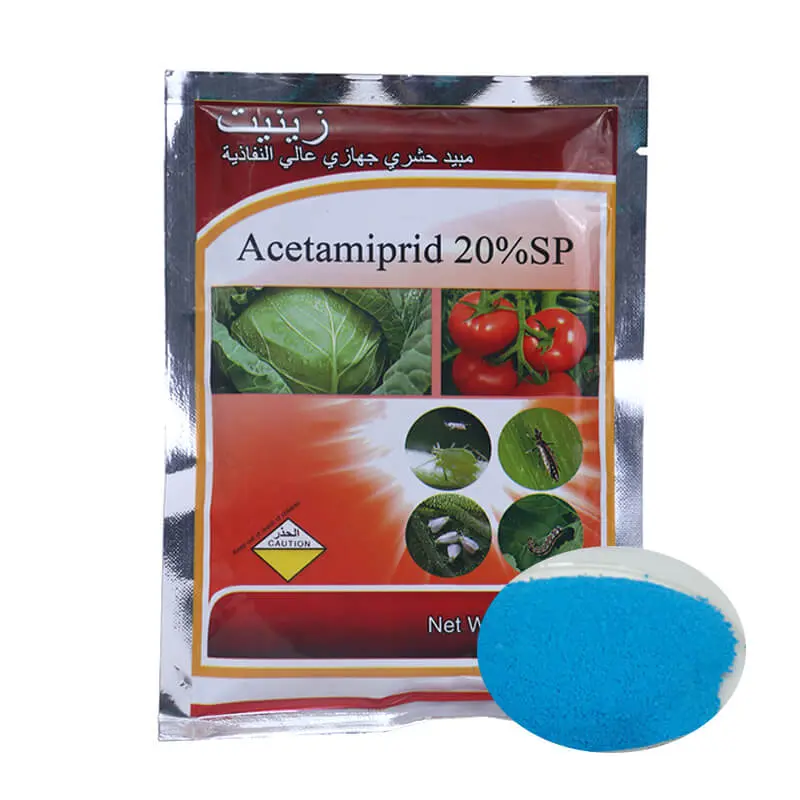

What Is Acetamiprid?
Acetamiprid is a systemic neonicotinoid insecticide developed for the control of susceptible crop pests.
| Property | Acetamiprid Position |
|---|---|
| Active Ingredient | Acetamiprid |
| CAS Number | 135410-20-7 |
| Chemical Class | Neonicotinoid |
| IRAC Group | Group 4A |
| Target Site | Nicotinic acetylcholine receptors |
| Main Activity | Systemic, contact, and ingestion |
| Main Pest Direction | Piercing-sucking insects |
| Common Formulation Directions | SP, WP, WDG, EC, SL, and combination products |
| Main Limitation | Crop-, pest-, and label-specific use |
| Resistance Concern | Repeated exposure to Group 4A |
Acetamiprid can be absorbed by treated plants and transported within plant tissues under approved use conditions. This allows the active ingredient to reach some pests feeding on plant sap or protected plant surfaces.
However, systemic activity does not mean that every application method produces identical plant movement or complete protection of all new growth.
Buyers evaluating commercial specifications can review available Acetamiprid insecticide formulations.
Uses of Acetamiprid
Agricultural Uses
Acetamiprid is primarily used in crop-protection programs against sucking pests and selected chewing insects.
Depending on registration, crop directions may include:
- Vegetables
- Fruit crops
- Cotton
- Cereals
- Rice
- Potatoes
- Oilseeds
- Legumes
- Tea
- Tobacco
- Ornamentals
- Greenhouse crops
The exact crop-pest combination must appear on the local product label.
Acetamiprid should not be promoted as a universal insecticide for every pest occurring on these crops.
Greenhouse and Ornamental Uses
Acetamiprid may be used in registered greenhouse, nursery, and ornamental plant programs.
Relevant pest directions may include:
- Aphids
- Whiteflies
- Mealybugs
- Thrips
- Psyllids
- Leafhoppers
- Scale insects where approved
Greenhouse conditions can affect pest pressure, residue persistence, worker exposure, and pollinator risk. Application methods, re-entry requirements, ventilation, and beneficial-insect protection should follow the exact product label.
Registration-Dependent Non-Agricultural Uses
Acetamiprid may appear in separately registered formulations for selected urban or professional pest-control uses.
Agricultural formulations should not be used for:
- Bed bugs
- Indoor ants
- Flies
- Cockroaches
- Residential surfaces
- Food-handling areas
unless the exact product label approves both the pest and the treatment site.
A product registered for agricultural foliar spraying is not automatically suitable for indoor pest control.
What Pests Does Acetamiprid Control?
The strongest Acetamiprid positioning is generally associated with piercing-sucking pests.
| Pest Group | Representative Direction |
|---|---|
| Aphids | Core sucking-pest use |
| Whiteflies | Adults and immature stages where registered |
| Leafhoppers | Crop-specific sucking-pest programs |
| Planthoppers | Rice and other approved crop programs |
| Mealybugs | Label-dependent crop uses |
| Psyllids | Selected fruit and vegetable programs |
| Thrips | Species- and crop-dependent control or suppression |
| Selected beetles | Only where listed on the label |
| Leafminers | Formulation-, species-, and crop-dependent |
| Urban pests | Only in separately registered products |
The word “thrips” or “leafminer” should not be treated as one universal label claim. Different species may respond differently and may have different resistance profiles.
Before selecting Acetamiprid, confirm:
- Exact pest species
- Crop
- Pest life stage
- Local susceptibility
- Control or suppression claim
- Approved application method
Mode of Action of Acetamiprid
Acetamiprid belongs to IRAC Group 4A, the neonicotinoid group.
It acts as a competitive modulator of insect nicotinic acetylcholine receptors. These receptors are involved in normal nerve-signal transmission.
The process can be summarized as follows:
- The insect contacts or consumes treated material.
- Acetamiprid reaches the insect nervous system.
- It binds to nicotinic acetylcholine receptors.
- Normal nerve signaling becomes disrupted.
- Continuous stimulation and loss of coordination develop.
- Paralysis and death may follow.
Acetamiprid, Imidacloprid, Thiamethoxam, Clothianidin, and Dinotefuran are all members of IRAC Group 4A.
Changing from Acetamiprid to another Group 4A insecticide does not create a true mode-of-action rotation.
Is Acetamiprid Systemic or Contact?
Acetamiprid is a systemic insecticide that also provides contact and ingestion activity.
Its movement within plants depends on:
- Formulation
- Application method
- Crop species
- Growth stage
- Application rate
- Soil and moisture conditions
- Leaf and root uptake
- Local registration
Foliar application, soil treatment, and seed treatment do not create identical movement patterns.
Systemic activity can improve exposure to some sap-feeding pests, but it does not remove the need for:
- Correct application timing
- Adequate spray coverage
- Pest identification
- Treatment of susceptible pest stages
- Resistance monitoring
New plant growth may not always receive the same active ingredient concentration as tissue present during application.
How Long Does Acetamiprid Remain Effective?
There is no universal residual period for all Acetamiprid formulations and uses.
Residual performance depends on:
- Formulation
- Registered active ingredient rate
- Foliar, soil, or seed application
- Crop growth
- Ultraviolet exposure
- Rainfall
- Irrigation
- Temperature
- Pest pressure
- Pest susceptibility
- Resistance status
A soil-applied product cannot be compared directly with a foliar spray exposed to rainfall and rapid leaf growth.
The claim that Acetamiprid always remains effective for “several weeks” should not be applied across all crops and formulations.
Treatment intervals and reapplication decisions must follow the registered product label, field scouting, pest pressure, and local technical guidance.
Chemical Properties and Identification
| Identification Item | Information |
|---|---|
| Common Name | Acetamiprid |
| CAS Number | 135410-20-7 |
| Molecular Formula | C10H11ClN4 |
| Chemical Class | Neonicotinoid |
| IRAC Classification | Group 4A |
| Product Type | Insecticide |
| Main Biological Activity | Systemic, contact, and ingestion |
| Primary Pest Direction | Piercing-sucking insects |
Common formulation directions may include:
- 20% SP
- 20% WP
- 25% WP
- 70% WDG
- Liquid formulations
- Registered combination products
A higher Acetamiprid concentration does not automatically mean:
- Broader pest control
- Longer residual activity
- Better crop suitability
- Fewer applications
- Stronger performance against resistant pests
The final product position depends on the registered active ingredient rate, formulation quality, crop-pest claim, application method, and market requirements.
Pollinator and Environmental Precautions
Acetamiprid should not be described as completely safe for bees, beneficial insects, or other non-target organisms.
Its risk profile may differ from that of other neonicotinoids, but direct spray exposure and contaminated flowering surfaces can still create risks.
Follow the pollinator restrictions on the exact product label.
Important precautions may include:
- Do not apply when bees are actively foraging where prohibited.
- Prevent drift onto flowering crops and weeds.
- Follow restrictions for bloom-stage applications.
- Protect adjacent pollinator-attractive plants.
- Avoid contamination of water bodies.
- Prevent runoff and equipment wash water from entering drains or irrigation systems.
- Consider the presence of parasitoids and predatory insects.
Early-morning or evening application does not replace label-specific pollinator restrictions.
Environmental risk also depends on the formulation, application method, rate, weather, and treatment site.
Resistance Management
Repeated use of Acetamiprid or other IRAC Group 4A insecticides can select resistant pest populations.
A resistance-management program should:
- Confirm the target pest.
- Treat the most susceptible pest stage.
- Avoid unnecessary repeat applications.
- Follow the maximum number of treatments on the label.
- Rotate with effective insecticides from different IRAC groups.
- Use spray windows based on pest generations where possible.
- Monitor field performance.
- Integrate biological and cultural controls.
- Investigate control failure before increasing the rate or frequency.
Changing from Acetamiprid to Imidacloprid, Thiamethoxam, Clothianidin, or Dinotefuran normally remains within Group 4A.
Changing brands does not change the mode of action.
Rotation partners should be registered, effective against the target pest, and compatible with the crop and local pest-management program.
Application Precautions and Safety
Acetamiprid products should be handled according to the exact product label and Safety Data Sheet.
General precautions include:
- Wear label-specified PPE.
- Avoid contact with skin, eyes, and clothing.
- Avoid inhaling spray mist or formulation dust.
- Do not eat, drink, or smoke while handling pesticides.
- Prevent spray drift.
- Protect water bodies and drainage systems.
- Observe pollinator restrictions.
- Follow the registered PHI and REI.
- Keep the product in its original labeled container.
- Store separately from food, feed, and seed.
There is no universal application rate, PHI, REI, or treatment interval suitable for every Acetamiprid product.
These requirements depend on:
- Concentration
- Formulation
- Crop
- Pest
- Application method
- Destination market
- Local registration
Acetamiprid may be included in an IPM program where it supports local monitoring, economic thresholds, beneficial-insect protection, resistance management, and other non-chemical controls.
It should not be described as automatically compatible with every IPM system.
Can Acetamiprid Be Mixed with Other Pesticides?
Tank-mix compatibility should not be assumed.
Before mixing Acetamiprid with another insecticide, fungicide, fertilizer, oil, or adjuvant, confirm:
- Both product labels permit the combination.
- The crop and use timing are compatible.
- The mixture is legally registered where required.
- Water quality is suitable.
- Formulation order has been evaluated.
- Physical compatibility is acceptable.
- Crop-safety data are available.
- Combined PHI and MRL requirements can be met.
A jar test may identify visible physical incompatibility, but it does not confirm legal approval, crop safety, biological performance, or chemical stability.
What Buyers Should Confirm
Importers and distributors evaluating an Acetamiprid project should confirm:
- Destination country
- Active ingredient approval status
- Registered crop
- Exact target pest
- Control or suppression claim
- Required formulation
- Acetamiprid concentration
- Application method
- IRAC rotation plan
- Maximum application number
- PHI and REI
- Domestic and export MRLs
- Pollinator restrictions
- Crop-safety data
- Efficacy data
- COA, SDS, and TDS
- Registration-document requirements
- Packaging and label language
- Expected annual procurement volume
Product selection should begin with the destination market, crop, and target pest rather than concentration alone.
For wider active ingredient and formulation options, review the POMAIS insecticide portfolio.
Frequently Asked Questions
What is Acetamiprid used for?
Acetamiprid is mainly used against aphids, whiteflies, leafhoppers, planthoppers, mealybugs, psyllids, thrips, and other susceptible pests on registered crops.
What pests does Acetamiprid control?
Its strongest general position is against piercing-sucking insects. Selected beetles, leafminers, and other pests may also appear on crop-specific product labels.
Is Acetamiprid systemic or contact?
Acetamiprid is systemic and also provides contact and ingestion activity. The extent of plant movement depends on the formulation, application method, crop, and label.
What IRAC group is Acetamiprid?
Acetamiprid belongs to IRAC Group 4A, the neonicotinoid group of nicotinic acetylcholine receptor competitive modulators.
Is Acetamiprid effective against aphids and whiteflies?
Yes. Aphids and whiteflies are among its most important target directions where the crop and pest are approved on the product label.
Can Acetamiprid control thrips?
Acetamiprid may control or suppress selected thrips species on registered crops. The exact claim and expected performance depend on species, resistance, formulation, and label.
Is Acetamiprid safe for bees?
Acetamiprid should not be described as harmless to bees. Direct exposure and contaminated flowering surfaces may create risks. Follow the pollinator restrictions on the exact product label.
Can Acetamiprid be rotated with Imidacloprid?
Acetamiprid and Imidacloprid both belong to IRAC Group 4A. Changing between them is not a true mode-of-action rotation.
Can agricultural Acetamiprid be used for bed bugs?
Not unless the exact formulation is specifically registered for bed bugs and the intended indoor treatment site. Agricultural crop products should not be used for unapproved indoor applications.
Summary
Acetamiprid is a systemic neonicotinoid insecticide in IRAC Group 4A.
It is mainly used against piercing-sucking pests such as:
- Aphids
- Whiteflies
- Leafhoppers
- Planthoppers
- Mealybugs
- Psyllids
- Thrips
Its performance depends on the formulation, application method, crop, pest stage, coverage, plant uptake, weather, and resistance status.
Acetamiprid should not be positioned as:
- Harmless to bees
- Safe for every beneficial insect
- Suitable for every crop
- Effective for one fixed residual period
- A universal indoor pest-control product
- A different rotation partner from other Group 4A insecticides
The local product label remains the controlling reference for approved crops, pests, rates, application methods, PHI, REI, MRLs, and environmental restrictions.
Review an Acetamiprid Product Direction
POMAIS works with qualified agrochemical importers, distributors, registration companies, and crop-protection brands.
To evaluate an Acetamiprid project, provide:
- Destination country
- Target crop
- Target pest
- Required formulation
- Registration status
- Packaging specification
- Label language
- Required technical documents
- Expected annual volume
The product direction can then be reviewed according to registration, pest fit, formulation, resistance management, residue requirements, packaging, and supply planning.
Hot Products
Hot news
Recommended news