
Control of Grape Downy Mildew: Fungicide Selection and FRAC Mechanisms of Action
Grape downy mildew is a major disease that affects grape yield, cluster quality, and plant health. An effective control strategy cannot rely on a single fungicide alone but should involve a rational combination of protective fungicides and oomycete-specific fungicides, based on disease risk, the growth stage of the grapevine, the mode of action of the active ingredients, and local resistance patterns.
In practical control, multi-site protective fungicides such as Mancozeb and Propineb can provide basic protection, while active ingredients such as Cymoxanil, Dimethomorph, Mandipropamid, Fluopicolide, and others that target oomycetes can be incorporated into control plans based on their specific modes of action. Products with specific modes of action, such as Metalaxyl and Oxathiapiprolin, require more rigorous consideration of pathogen susceptibility and resistance management requirements.
For grape growers, the key is to determine when protection is needed, when to adjust the mode of action, and how to reduce infection of flower clusters and young fruit.
For pesticide importers, distributors, and brand owners, the key is to understand the practical technical positioning of different active ingredients, avoid purchasing too many products with similar modes of action, and to establish a fungicide portfolio suited to local grape-growing conditions.
What is downy mildew of grapes? How can disease symptoms be identified?
Downy mildew of grapes is caused by the oomycete
Plasmopara viticola.
Although it is typically included in fungicide control systems in agricultural production, it is not a true fungus. It exhibits growth and reproduction characteristics similar to fungi, yet there are distinct differences in its biological classification and susceptibility to certain pesticides.
This is why standard broad-spectrum fungicides do not necessarily provide effective control of downy mildew in grapes.
The disease primarily infects the green tissues of grapevines, including leaves, young shoots, petioles, inflorescences, fruit stalks, and young fruits. Under warm, humid, and frequently rainy conditions, the pathogen can multiply rapidly and cause new infections.
What are the typical symptoms of downy mildew on grape leaves?
Grape leaves are typically a key focus during early surveys.
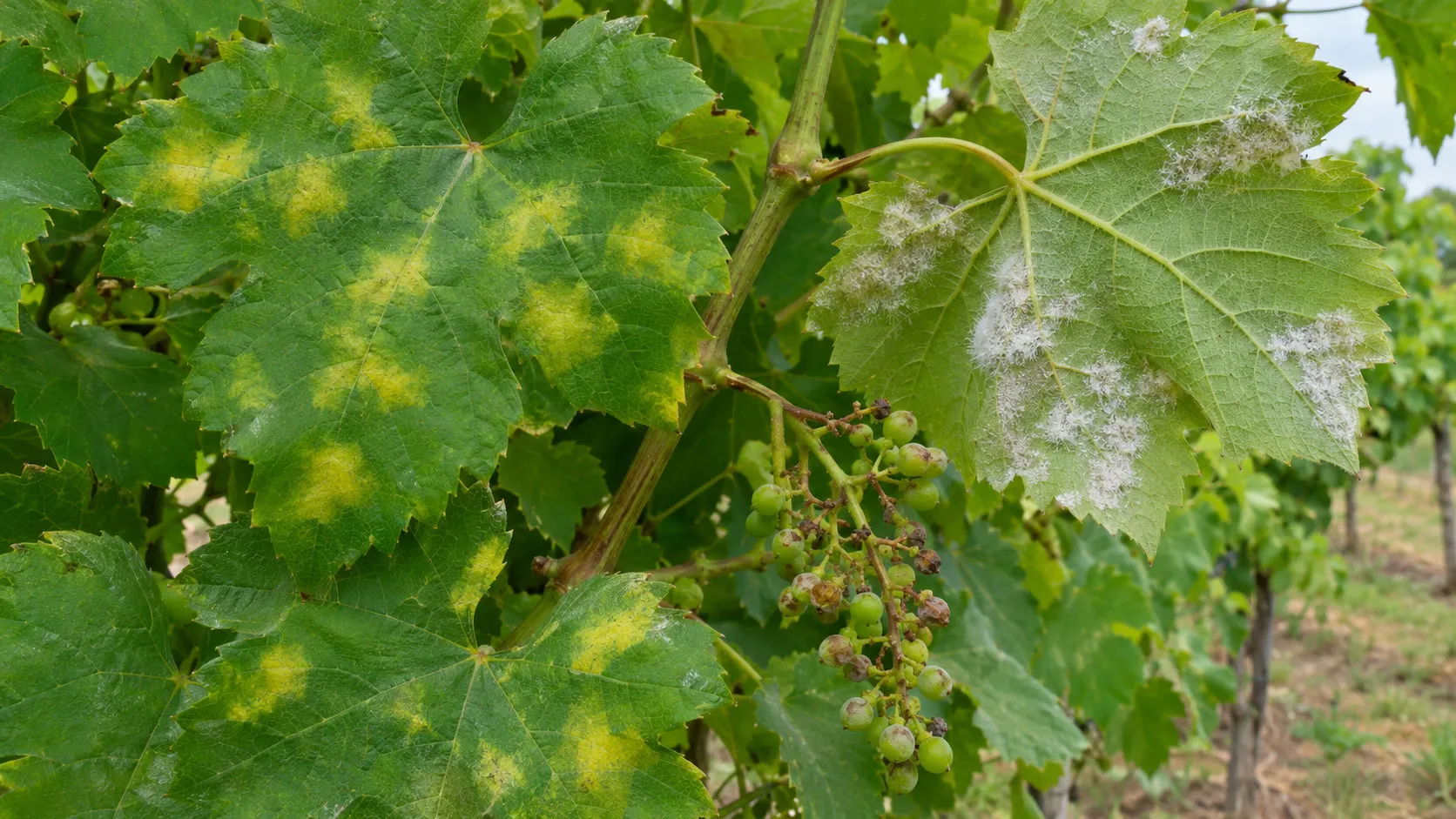
Following initial infection, yellow, translucent, or oil-stain-like lesions—commonly referred to as “oil spots”—may appear on the upper surface of the leaves.
As the disease progresses, these lesions may gradually expand and turn brown or become necrotic tissue.
Under high humidity conditions, a white, downy mycelium may form on the infected areas of the leaf’s underside; this is a key indication that the pathogen is producing sporangia.
The main symptoms are as follows:
| Infected Areas | Main Symptoms | Key Identification Features |
|---|---|---|
| Upper leaf surface | Yellow, translucent, oil-stain-like spots | Early-stage “Oil Spots” |
| Lower leaf surface | White, velvety fungal growth | More pronounced under humid conditions |
| Late-stage leaves | Brown necrotic spots; withered tissue | Premature leaf drop in severe cases |
| Young shoots | Abnormal growth, curling, necrosis | Severe infection may cause young shoots to die |
| Petiole and tendrils | Brown lesions, tissue necrosis | May affect normal tissue growth |
| Inflorescences | Inflorescences turn brown and wither | Severe infections may affect fruit set |
| Young fruit | Gray-green or brown lesions, gradually shriveling | Young fruit are highly susceptible to infection |
| Stem | Localized necrosis | May affect the integrity of the grape cluster |
Downy mildew in grapes cannot be diagnosed solely by the presence of yellow spots on the leaves. Leaf age, time of infection, humidity, and the stage of disease development all influence symptom expression.
Therefore, in commercial vineyards, a comprehensive survey should be conducted, examining both sides of the leaves, young shoots, and grape clusters.
How does downy mildew affect inflorescences and fruit?
Infection of inflorescences and young berries can directly affect the marketable yield of the current season.
During the critical period from pre-bloom to post-bloom, if the pathogen infects inflorescences, the infected tissue may gradually turn brown and wither; in severe cases, this can lead to inflorescence drop and poor fruit set.
When young fruits are infected, gray-green lesions may appear, with a white mold layer forming on the surface, followed by gradual shriveling of the fruit.
As the fruit matures, the berries’ susceptibility to direct infection by downy mildew typically decreases; however, this does not mean the entire cluster is no longer at risk.
The fruit stalks may still be infected, and some infections may also affect mature fruits and the cluster tissue.
Therefore, control strategies should adapt to the grapevine’s growth stage rather than focusing solely on leaf symptoms throughout the year.
What is the difference between downy mildew and powdery mildew in grapes?
These two diseases are often confused, but the types of pathogens and the choice of fungicides are completely different.
| Comparison Items | Downy Mildew | Powdery Mildew |
|---|---|---|
| Chinese Name | Downy Mildew | Powdery Mildew |
| Pathogen | Plasmopara viticola | Erysiphe necator |
| Biological Type | Oomycete | True Fungus |
| Leaf Symptoms | Yellow, oily spots | White, powdery mycelium |
| Underside Characteristics | White mold layer appears when damp | May develop a white, powdery coating |
| Main Favorable Conditions | Rainfall, high humidity, and persistent leaf wetness | Warm conditions and suitable humidity |
| Key Considerations for Pesticide Selection | Oomycete-specific fungicides | Effective fungicides against this fungus |
It is important to note that DMI-class fungicides (FRAC Group 3) are commonly used to manage powdery mildew in grapes; however, their widespread use in grape disease control does not mean they are effective against downy mildew.
Accurate identification of the pathogen is the first step in selecting a fungicide.
What weather conditions are conducive to downy mildew in grapes?
The occurrence of downy mildew in grapes is closely related to temperature, rainfall, relative humidity, and the duration of leaf wetness.
In the presence of the pathogen, favorable environmental conditions can lead to rapid infection and continuous secondary transmission.
How do temperature and rainfall affect disease occurrence?
Plasmopara viticola requires suitable temperature and humidity conditions for reproduction and infection.
According to UC IPM’s technical information on grape diseases, temperatures of approximately 20–25°C generally favor disease development, but actual occurrence also depends on leaf wetness duration, rainfall, grape variety, and local microclimate.
Special attention should be paid to the following conditions:
-
- Prolonged rainfall or frequent showers.
- Heavy nighttime dew.
- Relative humidity that remains high for extended periods.
- Poor air circulation within the vine canopy.
- Low-lying terrain with inadequate drainage.
- Leaves that remain wet for long periods after irrigation.
When these conditions occur simultaneously, the risk of infection in vineyards may increase significantly.
How do pathogens infect and spread?
The pathogen responsible for downy mildew in grapes can spread through various life stages.
In many grape-growing regions, the pathogen primarily overwinters as oospores in fallen leaves.
When conditions are favorable in the spring, the oospores germinate and serve as the initial source of infection.
Subsequently, the pathogen multiplies within infected tissue, producing sporangia, and continues to spread under favorable, moist conditions.
Rain splash and wind can help sporangia reach new grapevine tissue.
When sufficient moisture is present on the leaf surface, the pathogen can germinate and infect the plant.
Infected tissues subsequently form new lesions and sporangia, leading to further secondary transmission.
Therefore, the control of downy mildew in grapes must not only address the initial infection but also manage the potential for continuous infection throughout the growing season.
Why is leaf wetness duration important?
Leaf wetness is a critical factor in assessing the risk of downy mildew infection.
Even if the daily average temperature across a vineyard is the same, the actual risk of infection can vary significantly between different plots.
For example:
-
-
- In well-ventilated vineyards, leaves dry more quickly.
- Moisture tends to accumulate more easily within dense canopies.
- In plots with improper sprinkler irrigation, leaf wetness duration may be prolonged.
- Low-lying plots may maintain high humidity for extended periods after rainfall.
-
These differences affect the germination, infection, and spread of the pathogen.
For large-scale grape cultivation projects, it is recommended to assess infection risk by combining local meteorological data, rainfall records, and field surveys.
Why is it not recommended to apply pesticides according to a fixed calendar year-round?
A fixed application calendar does not adequately reflect actual disease pressure.
For the same grape variety, the timing of downy mildew outbreaks may vary significantly across different countries, years, and growing conditions.
If the weather is dry and pathogen levels are low, mechanically increasing the frequency of applications may not necessarily yield corresponding control benefits.
Conversely, under conditions of continuous rainfall, rapid growth, and high disease pressure, the protective layer may be compromised by rainfall, and new growth may not be adequately protected.
A more reasonable approach is to consider the following factors in combination:
-
-
- Local weather forecasts.
- Grapevine growth stages.
- Historical disease incidence.
- Current field infection levels.
- Application intervals specified on the product label.
- FRAC resistance management requirements.
-
Establish a risk-based control plan.
How to select the right fungicide for downy mildew in grapes?
When selecting a fungicide for downy mildew in grapes, it is first necessary to distinguish between the modes of action of different products.
Not all active ingredients capable of controlling oomycetes provide the same level of protection, nor can all systemic fungicides restore damaged plant tissue after infection has occurred.
When are protective fungicides appropriate?
Protectant fungicides primarily act on the plant surface.
They must form a sufficient protective layer before the pathogen completes infection, thereby reducing the likelihood of spore germination and initial infection.
Common active ingredients include:
| Active Ingredient | FRAC Group | Key Features |
|---|---|---|
| Mancozeb | M03 | Multisite contact protection |
| Propineb | M03 | Multisite contact protection |
| Copper compounds | M01 | Multisite protection from copper-based formulations |
| Captan | M04 | Multi-site contact protection |
The primary value of these products is to provide basic protection, rather than to treat grape tissue that is already severely infected.
In actual production, the effectiveness of protection depends on spray coverage, new leaf growth, rain wash-off, and the application intervals specified on the product label.
Among these, Mancozeb is a protective active ingredient worthy of attention in grape downy mildew control regimens.
Importers needing to evaluate different concentrations and formulations can review the relevant product specifications for Mancozeb Fungicide.
Why Are Multi-Site Fungicides Suitable for Resistance Management?
Both Mancozeb and Propineb belong to FRAC Group M03.
Unlike single-site fungicides, multi-site fungicides can affect multiple metabolic processes in pathogens.
This typically makes it more difficult for pathogens to develop resistance through multiple biological changes simultaneously.
However, it is important to note:multi-site fungicides do not automatically resolve existing resistance issues, nor do they guarantee that all mixture combinations will be effective.
When used in combination with fungicides that have different modes of action, they can provide a protective synergistic effect under appropriate conditions.
It is also important to note that although Mancozeb and Propineb are different active ingredients, they both belong to FRAC Group M03 and cannot be rotated as if they belonged to different FRAC groups.
What control needs is Cymoxanil suitable for?
Cymoxanil belongs to FRAC Group 27 and is an active ingredient primarily used for managing oomycete diseases.
It exhibits locally systemic activity and some translaminar movement.
Compared to contact fungicides that primarily remain on the plant surface, Cymoxanil can penetrate plant tissues at the application site and inhibit the development of susceptible pathogens in the early stages of infection.
Its main characteristics include:
-
-
- Activity against certain oomycete diseases.
- It can penetrate plant tissues at the application site.
- It exhibits some early post-infection activity.
- It can be combined with effective partners that have different modes of action.
- Its duration of action is relatively limited, requiring proper planning for subsequent protection.
-
It is important to distinguish between two concepts here:
“Early Post-Infection Activity” does not equate to a complete cure.
If grapes have already developed extensive necrotic tissue, Cymoxanil cannot restore these tissues to health.
Therefore, it should not be used as a standalone remedial measure following severe infection.POMAIS offers Cymoxanil in formulations such as 20% SC, 50% WDG, and 80% WDG, and also provides procurement and evaluation support for related formulated products. Specific crop applications and usage requirements for each product are subject to the corresponding registration data.
You can further review the technical specifications for Cymoxanil Fungicide.
What are the functions of Dimethomorph and Mandipropamid?
Both Dimethomorph and Mandipropamid belong to FRAC Group 40, specifically the CAA (Carboxylic Acid Amides) class of fungicides.
They are primarily used for the management of oomycete diseases, and their mode of action is related to the processes involved in oomycete cell wall formation.CAA active ingredients can interfere with the normal cell wall formation and development of pathogens, thereby inhibiting their growth and reproduction.
These products are of significant value in the control of downy mildew in grapes; however, resistance management is a critical consideration for their long-term use.
Key Features:
-
-
- Targets oomycete diseases.
- Offers preventive control benefits.
- Some products exhibit partial systemic activity or translaminar movement.
- Requires combination with other effective partners with different modes of action.
- Not suitable for long-term, continuous, or repeated use.
-
POMAIS’s Dimethomorph product specifications include:
| Product Specifications | Formulation | Supply Evaluation Focus |
|---|---|---|
| Dimethomorph 40% SC | Suspension Concentrate | Liquid Formulation Procurement |
| Dimethomorph 50% WDG | Water-Dispersible Granules | Procurement of Solid Formulations |
| Dimethomorph 80% WDG | Water-Dispersible Granules | Evaluation of High-Concentration Formulations |
These formulations can serve as a basis for evaluating a portfolio of grape fungicides; however, the same application rates and registered uses cannot be directly applied across different formulations.
Importers should pay particular attention to the following: Although Dimethomorph and Mandipropamid are different active ingredients, they both belong to Group 40.
Replacing Dimethomorph with Mandipropamid does not constitute a true FRAC mode-of-action rotation.
Is Metalaxyl suitable for controlling downy mildew on grapes?
Metalaxyl belongs to FRAC Group 4, i.e., the phenylamide class of fungicides.
It primarily acts by interfering with the RNA synthesis process of susceptible oomycete pathogens; it is systemic and can be translocated to a certain extent within plant tissues.
Key technical characteristics of Metalaxyl:
-
-
- It is systemic.
- It primarily targets susceptible oomycete pathogens.
- Its mode of action differs from that of M03, 27, and 40.
- It carries a high risk of resistance development.
- Declining susceptibility may already be an issue in some grape-growing regions.
-
Therefore, Metalaxyl cannot be considered a universal solution for all grape-growing regions.
If local pathogens have already developed resistance to phenylamide-class fungicides, switching to Metalaxyl-M cannot be regarded as a true change in the FRAC mode of action.
Both Metalaxyl and Metalaxyl-M belong to Group 4.
When evaluating such products, pesticide buyers must consider not only the active ingredient concentration but also local pathogen susceptibility, specific product registration scope, and application restrictions.POMAIS offers Metalaxyl in formulations such as 50% WDG, 35% WP, and 240 g/L EC; specific availability and registration applicability must be further confirmed based on the procurement market.
For product technical information, please refer to Metalaxyl Fungicide.
What other obligate oomycete fungicides are worth noting?
In addition to the active ingredients mentioned above, certain other FRAC groups also offer value in the control of downy mildew on grapes.
| Active Ingredient | FRAC Group | Mode of Action or Technical Characteristics | Selection Considerations |
|---|---|---|---|
| Cyazofamid | 21 | QoI-class respiratory inhibitor | Monitor for resistance and observe label restrictions |
| Fluopicolide | 43 | Affects the localization of intracellular proteins and cell division | Use in accordance with valid registrations and resistance management requirements |
| Ametoctradin | 45 | QioSI-class respiratory inhibitor | Requires effective partners and proper rotation |
| Oxathiapiprolin | 49 | OSBPI, affects lipid homeostasis and transport | Moderate to high risk of resistance; use strictly restricted |
| Fosetyl-Al | P07 | Phosphonate class; involves pathogen suppression and plant physiological defense responses | Select based on specific product registration and usage requirements |
| Phosphorous Acid Salts | P07 | Phosphonate class | Note product chemical forms, registration, and usage restrictions |
These active ingredients should not simply be regarded as identical control products.
They differ in terms of the stage of control, mode of action, resistance risk, product registration, and usage restrictions.
For example, Oxathiapiprolin belongs to Group 49 and is completely different from the CAA in Group 40, but its application frequency still requires strict management.
Therefore, when establishing a product portfolio, one should consider both control efficacy, FRAC groups, and local pathogen susceptibility, rather than merely pursuing a high number of active ingredients.
How should downy mildew management be scheduled for different growth stages of grapes?
The control objectives for downy mildew in grapes change as the vines grow.
Early on, the focus is on reducing the risk of initial infection; around flowering, the priority is protecting inflorescences and young fruits; and during fruit development, it is necessary to continue protecting the leaves and controlling the spread of the disease.
For commercial grape production, management cannot focus solely on applications at a single point in time; rather, the entire growing season must be incorporated into the management plan.
From Budbreak to New Shoot Growth
After budbreak, tender tissues are gradually exposed and become susceptible to downy mildew infection.
At this stage, the following should be prioritized:
-
-
- The vineyard’s history of disease.
- Whether sources of infection are present in the field.
- Local spring rainfall patterns.
- Shoot growth rate.
- Leaf wetness duration.
-
If there is a history of severe downy mildew in the area and weather conditions are conducive to infection, evaluate protective fungicides based on local technical guidelines and product labels.
Multisite protective products such as Mancozeb and Copper can be considered as options, but specific use should be determined based on product registration and grape variety susceptibility.
Pre-flowering Stage (Inflorescence Formation)
This stage is a critical period in downy mildew management for grapes.
As inflorescences gradually form, vineyards need to focus on protecting leaves, young shoots, and inflorescences simultaneously.
Technical materials on grape diseases from Cornell University identify the period from approximately two weeks before flowering to three weeks after flowering as one of the key windows for downy mildew control.
The reasons are as follows:
-
-
- Inflorescence tissues are gradually exposed.
- Tender leaves continue to grow.
- The structure of the grape clusters has not yet stabilized.
- Rainfall and high humidity may increase the risk of infection.
-
If favorable weather conditions for infection occur during this stage, priority should be given to products with confirmed activity against downy mildew, rather than relying solely on general-purpose broad-spectrum fungicides.
From Flowering to Fruit Set
The flowering and fruit set stages are critical periods that determine the quality of the season’s grape clusters.
Key considerations at this time include:
-
-
- Whether early infection is present in the inflorescences.
- Whether oil spots have formed on the leaves.
- Whether continuous rainfall occurs after flowering.
- Whether high humidity conditions exist inside the fruit clusters.
- Whether the spray adequately covers the inflorescences and leaves.
-
Under high disease pressure, ensure that control products remain effective against the target pathogens.
Single-site fungicides should be managed according to FRAC guidelines, and continuous reliance on the same mode of action should be avoided.
Young Fruit Enlargement and Cluster Development Stages
As young fruits gradually form, the focus of downy mildew management shifts to cluster health, leaf protection, and canopy management.
At this stage, special attention should be given to:
-
-
- Whether there are signs of infection on the fruit stalks.
- Whether gray-green or brown lesions appear on young fruits.
- Whether there is ongoing infection on the leaves.
- Whether good air circulation is maintained within the canopy.
- Whether newly emerged leaves are adequately protected.
-
As the fruit ripens, the berries’ direct susceptibility to downy mildew typically decreases, but the leaves and fruit stems may still be susceptible to infection.
Therefore, disease monitoring throughout the vineyard must not be neglected simply because the fruit has begun to ripen.
From Veraison to Maturity
After veraison, control objectives need to be further adjusted.
At this stage, it is necessary to consider not only disease pressure but also final product quality and harvest requirements.
For table grapes, the appearance of the fruit surface, market grade, and post-harvest residue requirements are critical.
For wine grapes, leaf health and cluster maturity also affect the final product quality.
The following must be carefully verified:
-
-
- The product’s PHI (Pre-Harvest Interval).
- MRLs (Maximum Residue Limits) for the target market.
- Maximum number of applications per season.
- Last permitted application date.
- Sensitivity to phytotoxicity of the target grape variety.
-
The PHI is not a fixed number that is the same for every active ingredient, in every country, or for every formulation.
Post-Harvest Management
The end of harvest does not necessarily mean the end of downy mildew management.
In some humid regions, if leaves remain under active infection, premature leaf drop may affect the vine’s photosynthesis and winter reserves.
Therefore, post-harvest management should be based on:
-
-
- Local climate.
- Remaining leaf growth period.
- Current infection levels.
- Overwintering conditions in the vineyard.
- Production goals for the following year.
-
to determine whether continued disease management is necessary.The decision to apply fungicides after harvest should be based on local regulatory approvals and actual disease risk, rather than as a mandatory practice for all vineyards.
| Growth Stage | Major Risks | Management Priorities | Fungicide Selection Guidelines |
|---|---|---|---|
| Bud Break | Initial Pathogen Source and Infection of Tender Tissue | Pathogen survey, weather monitoring | Appropriate protective products |
| Shoot growth stage | Initial leaf infection | Protect new growth | Protective strategies such as M03, M01, etc. |
| Inflorescence formation stage | Inflorescence infection | Enhance canopy and inflorescence coverage | Protective and specific oomycete fungicides |
| Flowering stage | Inflorescence and young fruit infection | Prioritize protection | Select effective modes of action based on risk |
| Fruit-setting stage | Infection of young fruit and leaves | Monitor disease progression and manage resistance | Properly rotate between different FRAC groups |
| Fruit Enlargement Stage | Ongoing Infection of Leaves and Fruit Stems | Maintain Leaf Health | Protective and Other Effective Mechanisms |
| Color Change and Ripening Stage | Leaf Infection, Residue Risk | PHI, MRL, Harvest Schedule | Prioritize registration and residue requirements |
| Post-harvest | Early leaf drop, overwintering pathogens | Field sanitation and plant health | Determine follow-up management based on actual risk |
How to Manage Downy Mildew Resistance in Grapes Using FRAC Groups?
The FRAC (Fungicide Resistance Action Committee) groups different active ingredients based on their mode of action.
A proper understanding of FRAC groups can help growers and buyers determine:
-
-
- Whether different active ingredients share the same mode of action.
- Whether two products can constitute a true mode-of-action rotation.
- Whether the use of a particular active ingredient needs to be limited.
- Whether a mixed-formulation product offers effective resistance management value.
-
For downy mildew in grapes, Groups 40, 49, and 4 are of particular concern.
Group 40: Resistance Management for CAA-Class Fungicides
FRAC Group 40 includes:
-
-
- Dimethomorph
- Mandipropamid
- Benthiavalicarb
- Iprovalicarb
- Valifenalate
- Flumorph
- Pyrimorph
-
These active ingredients belong to the CAA class of fungicides and exhibit cross-resistance.
Therefore, switching between active ingredients within Group 40 does not constitute a true rotation across different modes of action.
According to materials from the 2026 FRAC meeting, the pathogen causing downy mildew of grapevine is classified as a high-risk pathogen; however, the overall resistance risk associated with CAA fungicides for this disease is assessed as moderate and can be managed through sound application strategies.
Monitoring data from 2025 indicate that some European grape-growing regions have already detected a high frequency of CAA resistance.
| Monitored Regions | 2025 CAA Monitoring Status |
|---|---|
| Armagnac, Champagne, Val de Loire, France | High frequency of resistance |
| Germany: Mosel | High frequency of resistance |
| Switzerland: Valais | High frequency of resistance |
| Italy: Lazio, Marche, Piedmont, Tuscany, Trentino | High frequency of resistance |
| Spain: Basque Country, Galicia, Rioja | Moderate to high frequency of resistance |
| Portugal | Variations exist across regions; some populations exhibit moderate to high frequency |
| Peloponnese, Greece | No CAA resistance detected in this monitoring |
These results reflect the situation in specific regions and monitoring samples and do not directly represent all grape-growing regions across the entire country.
The main recommendations from FRAC 2026 regarding CAA-class fungicides for downy mildew on grapes include:
-
-
- Prioritize preventive application.
- The number of CAA-class fungicide applications should not exceed 50% of the total treatment plan.
- Apply CAA-class fungicides no more than 4 times per growing season.
- In areas with high resistance, limit applications to a maximum of 3 per growing season.
- Mix with effective multi-site fungicides or other effective partners that do not exhibit cross-resistance.
- Alternate with other modes of action throughout the control program.
-
Here is an important procurement consideration:
If a formulated product contains both Dimethomorph and Mandipropamid, it remains a combination of two Group 40 active ingredients and cannot be considered to offer cross-group resistance management benefits simply because it contains two active ingredients.
Similarly, if another active ingredient in a formulated product cannot provide satisfactory control of the target disease on its own at the actual mixing rate, it cannot be regarded as an effective resistance management partner.
Group 49: Resistance Risk of Oxathiapiprolin
Oxathiapiprolin belongs to FRAC Group 49, specifically the OSBPI (Oxysterol Binding Protein Homologue Inhibitors) class of fungicides.
It disrupts the normal physiological activities of pathogens by interfering with their lipid homeostasis and transport processes.
Its key technical characteristics include:
-
-
- Active against a wide range of oomycete pathogens.
- Classified as a site-specific fungicide.
- Primarily used for preventive control.
- Requires combination with effective partners from different cross-resistance groups.
- Presents a moderate to high risk of resistance.
-
Monitoring data released by FRAC in 2026 indicate that, in 2025 samples of downy mildew on grapes, reduced susceptibility or resistance to oxathiapiprolin had already been detected in certain growing regions, including France and Italy.
Specifically, populations with reduced susceptibility were detected in commercial grape-growing regions such as Armagnac, Cognac, and Languedoc-Roussillon in France; moderate to high frequencies of resistance were detected in multiple regions of Italy.
In contrast, samples from Brazil, China, India, Hungary, and Romania monitored in this study all exhibited sensitivity.
This indicates that resistance issues exhibit significant regional variations.FRAC 2026 has proposed the following restrictions for Group 49 products used on grapes:
| Management Program | FRAC Recommendations |
|---|---|
| Application Timing | Preventive use only |
| Consecutive Applications | Consecutive applications not permitted |
| Maximum Number of Applications per Season | 2 times |
| If the total number of applications in the entire downy mildew control program does not exceed 4 | Group 49 may be used no more than once |
| Mixing Requirements | Mix with effective fungicides from different cross-resistance groups |
| Percentage of Total Protection Period | OSBPI: Foliar exposure time must not exceed 33% of the total crop protection period |
These are FRAC resistance management recommendations; specific products must still comply with stricter restrictions outlined in local registration labels.
Group 4: Resistance Risk for Metalaxyl
Metalaxyl and Metalaxyl-M belong to FRAC Group 4.
Phenylamide fungicides are systemic and primarily target susceptible oomycete pathogens.
However, this group is associated with a high risk of resistance development due to its mode of action.
In some grape-growing regions, long-term use may lead to a decline in pathogen susceptibility, thereby affecting the product’s control efficacy.
Therefore:
-
-
- Metalaxyl should not be used as the first-line treatment in all regions.
- Confirm whether local pathogens remain susceptible.
- Avoid long-term, continuous use.
- Metalaxyl and Metalaxyl-M cannot be rotated as different FRAC groups.
- Other effective modes of action should be selected based on local registrations and resistance guidelines.
-
For importers, the value of purchasing Group 4 products cannot be determined solely by their systemic properties and active ingredient content; the actual resistance situation in the target market must also be considered.
How to establish a reasonable FRAC rotation system?
Effective resistance management does not simply involve rotating applications based on product names.
For example:
Dimethomorph → Mandipropamid → Dimethomorph
This still constitutes repeated use within Group 40 and cannot be considered effective cross-group rotation.
A more reasonable management approach is:
-
-
- First, identify the target disease and pathogen.
- Select a fungicide that remains effective against the current pathogen.
- Identify the FRAC Group corresponding to each active ingredient.
- Avoid consecutive use of the same mode of action.
- Control the number of applications throughout the growing season based on FRAC restrictions for specific groups.
- Use different modes of action that provide practical control benefits.
- Adjust subsequent control strategies based on weather conditions and field surveys.
-
It is also important to note that different FRAC Groups do not mean that any two products can be mixed directly. Actual control efficacy, formulation compatibility, product labels, and local registration requirements must be considered.
Why Does Downy Mildew Control in Grapes Sometimes Fail?
In commercial grape cultivation, unsatisfactory control results do not necessarily indicate a problem with the quality of the fungicide.
It is necessary to systematically investigate factors such as disease identification, application timing, spray coverage, weather conditions, and resistance status.
Was the disease correctly identified?
If powdery mildew, downy mildew, or other foliar diseases are confused, even high-concentration fungicides may not yield the desired results.
Therefore, the target pathogen should first be confirmed through symptoms and necessary laboratory diagnosis.
Was the application timing appropriate?
Protective fungicides must establish protection before infection occurs.
If the pathogen has already penetrated deep into the tissue and the product used provides only contact protection, the control efficacy will naturally be limited.
Products with post-infection activity also have clear limits to their effectiveness and cannot be used to restore tissue that has already undergone severe necrosis.
Is spray coverage sufficient?
When the grapevine canopy is dense, it may be difficult for the spray to reach the undersides of leaves, internal tender shoots, and the grape cluster area uniformly.
Coverage quality in the grape cluster area is particularly important during the inflorescence and young fruit stages.
In practical management, the following should be checked:
-
-
- Whether the spray equipment is suitable for the current canopy.
- Whether both sides of the leaves are adequately covered.
- Whether there are spray blind spots inside the grape clusters.
- Whether new leaves remain continuously exposed.
- Whether there is excessive plant density and insufficient ventilation.
-
Does rainfall affect the efficacy of the pesticide?
The effectiveness of contact-action protective fungicides is easily affected by rainfall and the growth of new plant tissue.
If heavy rainfall occurs after application, foliar residue may be compromised.
At the same time, newly emerged leaves may not be covered by the existing protective layer.
Therefore, it is necessary to determine whether subsequent protection needs to be adjusted based on the specific product’s rainfastness characteristics and label requirements.
Are there resistance issues?
If the disease diagnosis is correct, the application timing is appropriate, and spray coverage is adequate, yet a product from a specific FRAC group continues to show declining efficacy, the possibility of resistance should be further investigated.
This can be determined by combining local susceptibility monitoring, laboratory bioassays, or molecular testing.
Resistance should not be concluded solely based on a single failed application.
How can downy mildew pressure be reduced through vineyard management?
Fungicides are an important tool for managing downy mildew in grapes, but they are not the only means.
Proper vineyard management can reduce environmental conditions that favor the reproduction and spread of the pathogen.
Improve canopy ventilation
Reduce overcrowding within the grape canopy through proper pruning, shoot thinning, and leaf management.
This helps improve air circulation, shortens the time leaves remain wet, and enhances spray coverage.
Proper Irrigation Management
Whenever possible, avoid unnecessary prolonged leaf wetness.
In vineyards using sprinkler irrigation systems, adjust irrigation timing and frequency based on local climate and irrigation conditions.
Reducing Overwintering Pathogen Sources
Promptly remove diseased plant debris and fallen leaves from the vineyard after harvest.
In suitable regions, oospores in fallen leaves may become a significant initial source of infection for the following year.
Therefore, field sanitation management is also part of a long-term downy mildew control system.
Selecting Grape Varieties Suitable for the Local Area
Different grape varieties vary in their susceptibility to downy mildew.
When establishing new vineyards, local climate, market demand, and the disease resistance characteristics of the varieties should be comprehensively considered.
In areas with high disease pressure, disease resistance should be considered a key factor in variety selection.
How Should Pesticide Importers Select Fungicides for Grape Downy Mildew?
For pesticide importers and distributors, the procurement of fungicides for grape downy mildew should not be based solely on active ingredients and price.
A competitive product portfolio requires consideration of technical efficacy, target market registrations, product specifications, and long-term supply stability.
Do not limit procurement to different active ingredients within the same FRAC group
For example, although Dimethomorph and Mandipropamid are different active ingredients, they both belong to Group 40.
If a distributor’s product portfolio is primarily concentrated in Group 40, it may not fully meet the resistance management needs of different regions.
A more reasonable procurement approach involves evaluating:
-
-
- M03: Multisite protectants such as Mancozeb and Propineb.
- Group 27: Cymoxanil.
- Group 40: CAA products such as Dimethomorph and Mandipropamid.
- Group 4: Phenylamide products such as Metalaxyl.
- Groups 21, 43, 45, and 49: Other applicable specific oomyceticides.
-
The intention here is not to require importers to procure products from every group, but rather to help them identify potential overlaps in modes of action within their existing product portfolios.
How should different formulations be evaluated?
The same active ingredient may be available in different formulations, but product quality cannot be judged solely based on the active ingredient content.
| Formulation | Full English Name | Key Procurement Quality Considerations |
|---|---|---|
| SC | Suspension Concentrate | Suspension rate, particle size, pourability, redispersibility, storage stability |
| WDG | Water-Dispersible Granules | Wettability, disintegration, dispersibility, suspension rate, dust level |
| WP | Wettable Powder | Wettability, suspension rate, particle size, storage stability |
| EC | Emulsifiable Concentrate | Emulsion stability, low- and high-temperature storage stability, packaging compatibility |
For importers, it is best to confirm the following based on actual specifications prior to procurement:
-
-
- Active ingredient content.
- Impurity control requirements.
- Physicochemical specifications of the formulation.
- COA (Certificate of Analysis).
- SDS.
- TDS.
- High- and low-temperature storage stability.
- Packaging and shipping requirements.
- Batch consistency.
-
When purchasing high-concentration WDG products, it is also essential to evaluate disintegration, dispersion, and the physical state after storage.
When purchasing SC products, attention should be paid to suspension rates and redispersibility after long-term storage.
These parameters all affect the product’s commercial performance once it enters the target market.
How to Build a Grape Fungicide Portfolio Suited for the Target Market?
POMAIS can evaluate the supply specifications of different fungicides based on the customer’s target market, existing product line, and procurement plans.
Product directions currently worth including in the evaluation of the grape downy mildew product portfolio include:
| Product Options | Representative Formulations | Technical Positioning |
|---|---|---|
| Mancozeb | 80% WP, 75% WG | M03 Multi-site Protection |
| Propineb | 70% WP | M03 Multi-site Protection |
| Cymoxanil | 20% SC, 50% WDG, 80% WDG | Group 27 |
| Dimethomorph | 40% SC, 50% WDG, 80% WDG | Group 40 |
| Metalaxyl | 35% WP, 50% WDG, 240 g/L EC | Group 4 |
| Mancozeb + Dimethomorph | 600 g/kg + 90 g/kg WDG | M03 + 40 formulation options |
The specifications listed above represent available supply options for procurement and product portfolio evaluation; they do not imply that all specifications have obtained registration for downy mildew control in grapes.
For importers, the most important consideration is to match the active ingredients, formulation types, concentrations, and local registration scopes.
For example, even for the same product—Dimethomorph 40% SC—different countries may have varying regulations regarding grape crops, target diseases, application frequency, and PHI.
Therefore, usage instructions from one market cannot be directly copied to another.
Frequently Asked Questions on Grape Downy Mildew Control
Which fungicide is best for controlling grape downy mildew?
No single fungicide is suitable for all grape-growing regions.
Mancozeb and Propineb are primarily used for preventive protection; Cymoxanil has limited activity against early-stage infections; Dimethomorph and Mandipropamid belong to Group 40; other oomycete-specific fungicides must be selected based on local pathogen susceptibility.
The optimal strategy depends on the grape growth stage, weather conditions, local registrations, and resistance status.
Can Mancozeb control downy mildew in grapes?
Mancozeb belongs to FRAC Group M03 and is a multi-site contact protective fungicide.
It provides preventive protection on the plant surface, reducing the likelihood of pathogen germination and initial infection.
However, it is not a systemic curative agent and cannot restore already necrotic grapevine tissue.
Can Dimethomorph and Mandipropamid be rotated?
The two cannot be rotated as if they belonged to different FRAC groups.
Both Dimethomorph and Mandipropamid belong to Group 40 CAA fungicides and exhibit cross-resistance.
Changing the name of the active ingredient does not mean that the mode of action has actually changed.
Is Cymoxanil a systemic fungicide?
Cymoxanil primarily exhibits local systemic activity and some ability to translocate through leaf tissue.
It can penetrate plant tissue at the application site and inhibit the early stages of infection by certain oomycetes.
However, it is not a fully systemic fungicide capable of unlimited translocation throughout the entire plant, nor can it serve as a curative treatment for severe infections.
Can Metalaxyl be used to treat downy mildew in grapes?
Metalaxyl belongs to Group 4 and is primarily effective against susceptible oomycete pathogens.
Resistance to phenylamide-class fungicides may already exist in some grape-growing regions; therefore, local pathogen susceptibility must be considered before use.
If significant resistance is present, it should no longer be used as the primary control measure.
Is it still necessary to control downy mildew after grapes begin to change color?
This must be determined on a case-by-case basis.
As grapes ripen, the berries generally become less susceptible to direct infection by downy mildew, but leaves and fruit stems may still be infected.
If the disease continues to progress and causes premature leaf drop, it may affect the plant’s normal physiological activities.
Therefore, field monitoring should continue after color change, and decisions on whether to continue spraying should be made in consideration of the pre-harvest interval (PHI), maximum residue limits (MRLs), and the harvest schedule.
How can you determine if resistance has developed to grape downy mildew fungicides?
First, you need to rule out factors such as misidentification of the disease, inappropriate application timing, insufficient spray coverage, and the impact of rainfall.
If, under appropriate application conditions, a product with a specific mode of action consistently shows declining efficacy, further confirmation is needed through local resistance monitoring, laboratory susceptibility testing, or molecular testing.
Resistance should not be concluded based on a single failed control attempt.
How to Establish a Long-Term, Reliable Fungicide Regimen for Grape Downy Mildew?
The core of downy mildew management in grapes is not to find a single fungicide that solves all problems, but to establish a long-term control system suited to local grape-growing conditions.
From a technical perspective, one should first identify the pathogen and assess the risk of infection, then select appropriate protective fungicides and specific oomycete fungicides based on the grapevine’s growth stage.
Multisite protective fungicides such as Mancozeb and Propineb can serve as foundation products; Cymoxanil, Dimethomorph, and other specific oomycete fungicides should be used judiciously, taking into account their respective modes of action and FRAC groups.
Particular attention should be paid to cross-resistance within Group 40 and the application frequency limits for Group 49.
For pesticide importers, distributors, and brand owners, when establishing a product portfolio, it is also necessary to evaluate the following from a long-term commercial supply perspective:
-
-
- Whether the portfolio covers different FRAC modes of action.
- Whether there are too many overlapping active ingredients.
- Whether the portfolio meets the grape registration requirements of the target market.
- Do the formulation types meet local customers’ application and packaging requirements?
- Do product quality and batch consistency meet procurement standards?
- Are complete technical documents, such as COAs, SDSs, and TDSs, available?
-
POMAIS offers a wide range of fungicide product specifications and export supply services to pesticide importers, distributors, registration companies, and agricultural brand clients.
Based on your target market, grape downy mildew control needs, product registration status, and existing fungicide portfolio, we can assist in evaluating suitable active ingredients, formulations, and procurement specifications.
If you are developing a grape fungicide product line, we welcome the opportunity to discuss your target markets and product requirements.
A reliable fungicide portfolio starts with the right active ingredients, effective resistance management, and consistent product quality.
 Controlling Potato Late Blight: How to Choose the Right Fungicide
Hot Products
Hot news
Recommended news