
Rice Planthopper Management: Insecticide Selection and Resistance Considerations
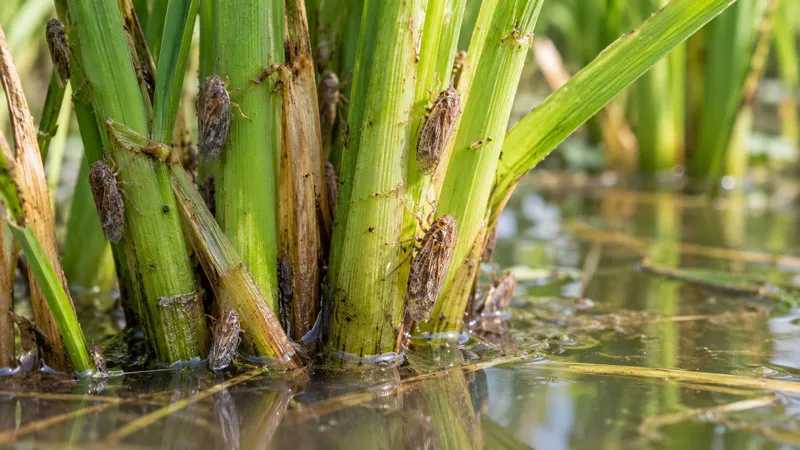
The rice planthopper is a piercing-sucking pest that requires close monitoring in rice production. When pest densities are high, sustained feeding can stunt plant growth and cause leaf yellowing; in severe cases, localised wilting may occur, or even result in distinct ‘hopperburn’ symptoms. As some species of rice planthopper can also transmit rice viruses, it is crucial to accurately identify the pest species and assess field risks in a timely manner.
However, controlling rice planthoppers involves more than simply selecting a single insecticide. The same active ingredient may exhibit varying levels of efficacy across different regions, whilst the repeated use of the same group of insecticide modes of action may increase the pressure for resistance selection. Furthermore, applying treatments too early, too frequently, or using broad-spectrum insecticides unnecessarily may also impair the ability of natural enemies to control rice planthopper populations.
A more rational management approach involves combining field monitoring, pest identification, insecticide selection, rotation of Insecticide Mode of Action (IRAC) groups, and Integrated Pest Management (IPM). For importers and distributors needing to plan their rice crop protection product portfolios, these factors are equally helpful in determining product positioning and target market requirements. POMAIS’s Rice Crop Protection Solutions page provides a broader overview of rice crop protection products and crop protection strategies.
1. What Are Rice Planthoppers and How Do They Damage Rice?
Rice planthoppers are sucking pests that obtain nutrition primarily by sucking sap from rice tissues. Different species vary in appearance, distribution, migratory patterns and ability to transmit diseases; therefore, control strategies should be based on accurate pest identification.
1.1 Major Rice Planthopper Species
Common rice planthoppers in rice production include the following categories.
| Common names | English names | Scientific names | Key identification and management points |
|---|---|---|---|
| Brown planthopper | Brown Planthopper (BPH) | Nilaparvata lugens | Feeds primarily on the base of rice plants; may cause ‘hopperburn’ at high population densities |
| White-backed Planthopper | White-Backed Planthopper (WBPH) | Sogatella furcifera | Identification requires consideration of adult appearance, life stage and field distribution |
| Grey Planthopper | Small Brown Planthopper (SBPH) | Laodelphax striatellus | Associated with the transmission of rice viruses in some regions; the specific risk depends on local pest species and disease conditions |
These pests cannot be distinguished solely on the basis of symptoms such as plant yellowing or stunted growth. During field surveys, insects should be inspected at the base of the rice plants, near the leaf sheaths and at various other parts of the plant, and a judgement should be made in conjunction with local pest occurrence records.
1.2 Feeding Damage, Hopperburn and Virus Risk
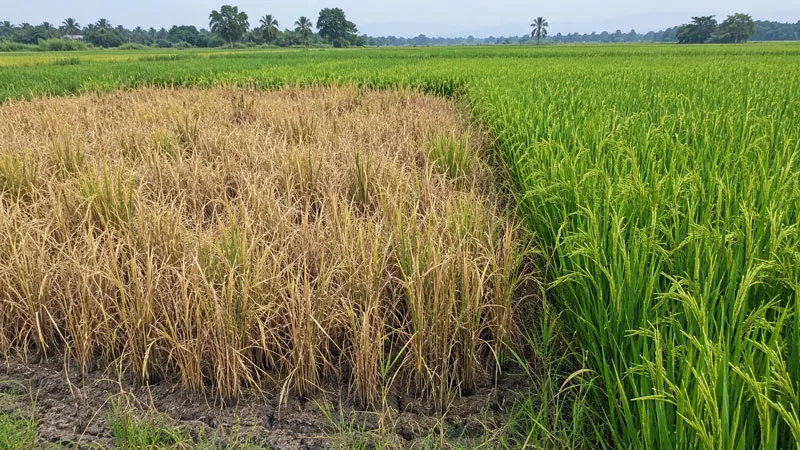
The direct damage caused by rice planthoppers stems from continuous feeding. When population densities are high, rice plants may exhibit symptoms such as leaf yellowing, wilting, stunted growth, and localised dieback.
In the event of a severe outbreak, patches of yellowed and withered plants may appear in the field; this phenomenon is commonly referred to as ‘hopperburn’.
Furthermore, some brown planthoppers can transmit specific rice viruses. The types of viruses and their transmissibility depend on the specific pest and the local disease system; therefore, not all symptoms of rice viruses can be attributed to brown planthoppers.
Management Focus: Surveys should not be delayed until obvious symptoms of hopperburn appear. Regular monitoring of pest populations helps to determine whether action is required before losses escalate.
2. When Should Insecticide Intervention Be Considered?
Immediate application of insecticide is not required every time rice planthoppers are detected. Rice fields may harbour spiders, predatory insects and other natural enemies that can provide natural control over parts of the planthopper population. Overuse of insecticides may disrupt this ecological balance, thereby increasing the difficulty of subsequent pest management.
2.1 Field Scouting and Population Assessment
Field surveys should focus on the following information:
- The species, life stage and population density of the rice planthoppers.
- The distribution of the pests within the field—whether they are locally concentrated or widespread.
- The growth stage of the rice and the condition of the plants.
- The abundance of natural enemies in the field and the recent history of pesticide applications.
- The economic control thresholds recommended by local agricultural extension services.
For fields where pest populations are already showing an upward trend, monitoring results should be recorded continuously, rather than basing the entire growing season’s pesticide application schedule on a single observation.
2.2 Crop Stage and Treatment Timing
The growth stage of rice influences pest risk, expected yield losses and decisions regarding pesticide application.
During growth stages such as the tillering stage, whitefly populations may gradually increase at the base of the plants and near the leaf sheaths; during the reproductive growth stage, risks must be reassessed in light of pest density, plant condition, the remaining growing period and harvest arrangements.
A specific growth stage should not be equated with a fixed application time, nor should preventive spraying be scheduled solely on the basis of calendar dates.
Economic control thresholds vary depending on region, variety, cultivation conditions and monitoring methods. Actual application should follow local technical guidance and product labels, rather than directly applying figures from other countries.
3. How to Select an Insecticide for Rice Planthoppers
When selecting an insecticide for rice planthoppers, the target pest should first be identified, followed by a comparison of active ingredients, IRAC groups, local resistance status and product registration details.
One should not assume that a product is suitable for all rice planthopper populations based solely on its product name, marketing claims or the past control performance of a particular active ingredient.
3.1 Selection Criteria for Insecticide Products
| Evaluation Criteria | Information to be Verified | Significance for Control Decisions |
|---|---|---|
| Target Pest | Does the product target the specific species of rice planthopper actually present? | Avoid misidentification of the target pest |
| Active Ingredient | Active ingredient and its known mode of action | To determine whether the product meets control requirements |
| IRAC Group | The mode-of-action group to which the active ingredient belongs | To support sound resistance management and rotation |
| Local Susceptibility | Information on the susceptibility or resistance of local populations | To assess whether existing control efficacy may be declining |
| Pest Life Stage | The product’s suitability for the target pest life stage | To improve the precision of application decisions |
| Selectivity | Impact on natural enemies and non-target organisms | Minimises disruption to natural control systems |
| Registration and Label | Locally registered crops, target pests, application restrictions and safety intervals | Ensure product use complies with local regulations |
3.2 Examples of Active Ingredients and IRAC Groups
The modes of action and suitable pest life stages vary between different active ingredients. The following is provided solely to explain the technical information that needs to be compared when selecting a product; it does not constitute a uniform recommendation applicable to all countries.
| Active ingredient | IRAC group | Factors to consider when selecting a product |
|---|---|---|
| Pymetrozine | Group 9B | Verify local registered uses, target pest susceptibility and applicable control programmes |
| Buprofezin | Group 16 | Its mode of action is related to the insect’s moulting process; particular attention should be paid to the target insect life stage and product label requirements |
| Nitenpyram | Group 4A | Belongs to the neonicotinoid class of insecticides; verify previous use of products within the same group and local resistance information |
| Dinotefuran | Group 4A | As it belongs to the same mechanism-of-action group as other Group 4A active ingredients, it cannot simply be regarded as a cross-group rotation |
The above groupings are based on the IRAC classification of modes of action. The latest version should be used as the definitive classification.
It should also be noted that belonging to different IRAC groups does not automatically mean that there is no cross-resistance between two pesticides. Whether rotation is appropriate must still be determined by considering the resistance status of local target pests, the actual efficacy of the product and the product label.
For procurement and product portfolio assessment, please refer to POMAIS’s Insecticide Product Portfolio to further verify product data for different active ingredients, concentrations and formulations. Whether a specific product is suitable for the control of rice leafhoppers must be confirmed based on registrations and labels in the target market.
3.3 Formulation and Application Conditions
In addition to the active ingredient, the formulation and actual application conditions also influence a product’s performance.
For example, WDG (Water-Dispersible Granules) is a common formulation type, but the formulation itself does not guarantee that the product will necessarily offer higher efficacy or safety than other formulations.
When making a selection, consideration should also be given to product specifications, dispersibility, application equipment, field coverage conditions and the application methods specified on the label.
If field efficacy is unsatisfactory, one should simultaneously verify whether the pest species has been correctly identified, whether the target life stage falls within the product’s scope of application, whether application coverage is adequate, and whether the product is affected by local resistance issues, rather than immediately concluding that a particular formulation or active ingredient has become ineffective.
4. Why Does Insecticide Resistance Develop in Rice Planthoppers?
Resistance is one of the key risks in the long-term management of rice planthoppers. When individuals within a population possessing resistance traits gain a survival and reproductive advantage under sustained pesticide pressure, the associated resistance may gradually increase, ultimately reducing the field efficacy of certain pesticides.
4.1 Repeated Use of the Same Mode of Action
The continuous use of insecticides belonging to the same IRAC group may exert repeated selective pressure on the pest population.
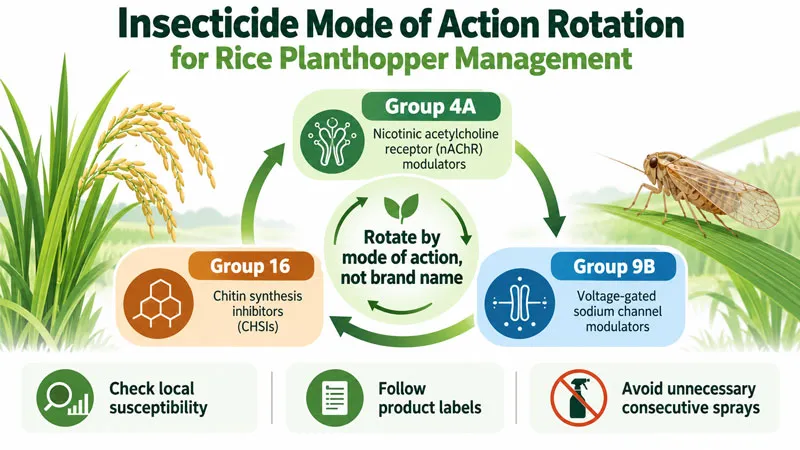
Even if products have different trade names, if their active ingredients belong to the same IRAC group, they cannot simply be regarded as an effective rotation strategy.
For example, nitenpyram and dinotefuran both belong to Group 4A. Using them in succession is not equivalent to rotating between two different IRAC groups.
Therefore, resistance management should focus on the active ingredients and their modes of action, rather than merely on product brands or packaging names.
4.2 Why Does an Insecticide Sometimes Fail?
Failure to achieve the expected control efficacy after a single application does not necessarily indicate that resistance has developed.
Possible causes include:
- Inaccurate identification of the target pest.
- Reduced sensitivity of the local population to the relevant active ingredient.
- Mismatch between the timing of application and the target life stage.
- Suboptimal spray coverage or other application conditions.
- Weather and field conditions affecting actual control efficacy.
- Issues with product quality, storage conditions or application methods.
If the same product continues to perform poorly despite correct use, further investigation into possible causes should be carried out, and a judgement made in conjunction with local resistance monitoring or professional diagnostic results.
In the absence of evidence, not all failures in control efficacy should be directly attributed to resistance, nor should the problem be masked by simply increasing the frequency of application.
4.3 The Role of Natural Enemies and Crop Conditions
Changes in the brown planthopper population depend not only on the insecticides themselves but are also influenced by rice varieties, field ecology and the activity of natural enemies.
Relevant research by the International Rice Research Institute (IRRI) indicates that the timing and frequency of insecticide application, the host variety and its interactions with natural enemies may influence the population dynamics of the brown planthopper. In certain circumstances, unnecessary pesticide applications may also weaken the resistance of rice varieties and the protective role of natural enemies.
This implies that the causes of control failure cannot be attributed solely to the pesticides themselves. Field pest conditions, application history, variety characteristics and ecological conditions should all be examined simultaneously to determine whether the problem stems from reduced sensitivity to the pesticide or from flaws in the overall control strategy.
5. How to Rotate Insecticides and Reduce Resistance Risk
Effective resistance management should be based on local pest monitoring, IRAC mode-of-action groups and product labels, rather than mechanically stipulating that a different product must be used for every application.
5.1 Rotate Effective Modes of Action, Not Brand Names
When formulating a rotation plan, one should first record the active ingredients and IRAC groups used previously, and then confirm whether the next control treatment requires a different yet still effective mode of action.
If Group 4A was used in the previous rotation, whether Group 9B or Group 16 should be considered for the next rotation should depend on the target pest species, local registrations, evidence of efficacy, resistance status and product labels.
The names of different IRAC groups should not be used as the sole basis for rotation, nor should it be assumed that any two different groups are suitable for alternating use in a specific rice field.
Rotation plans should also take into account pest generations, crop growth stages and local resistance management guidelines. Specific rotation windows and the number of applications should follow applicable technical recommendations and product labels.
5.2 Avoid Unnecessary Consecutive Applications
If field monitoring has not yet met the locally recommended intervention thresholds, insecticide applications should not be automatically scheduled simply because a particular growth stage has been reached.
Unnecessary applications increase costs and may also heighten selection pressure for resistance and adversely affect natural enemies.
For fields where control measures have already been implemented, changes in pest population levels, application records and expected outcomes should be reviewed before determining whether further action is required.
5.3 Evaluate Combination Products Carefully
Combination products may contain active ingredients with different modes of action, but this does not automatically mean they can resolve resistance issues.
When evaluating combination formulations, the following should be confirmed:
- Whether both active ingredients provide practical control benefits against the target pests.
- Whether the two active ingredients have different modes of action.
- Whether there is known resistance to either active ingredient in local populations.
- Whether the product is registered in the target country for the relevant crops and pests.
- How the subsequent rotation programme should be arranged following use of this product.
For example, POMAIS’s Nitenpyram 20% + Pymetrozine 60% WDG product data sheet illustrates a combination formulation containing two active ingredients. This product is provided solely as an example to illustrate the specifications and mode of action of a mixed formulation; it does not imply that it is suitable for all planthopper populations or all target markets.
Each active ingredient in a mixed formulation should be included in resistance management records. If one of the ingredients has already become ineffective locally, it cannot be assumed that the other ingredient will automatically compensate for the entire control gap.
6. How Does Integrated Pest Management Support Planthopper Control?
Integrated Pest Management (IPM) emphasises the joint management of pests through monitoring, agronomic measures, biological control and, where necessary, chemical control, rather than relying on continuous application of pesticides to maintain low pest densities.
6.1 Conserve Natural Enemies
Spiders, predatory insects and other natural enemies in rice fields can help control some rice planthopper populations.
Therefore, when selecting insecticides, consideration should be given to their impact on non-target organisms, and unnecessary broad-spectrum applications should be avoided wherever possible.
If natural enemies are abundant and pest populations remain at acceptable levels, preserving natural control mechanisms may be more beneficial for maintaining long-term field balance than applying additional treatments.
6.2 Consider Resistant Rice Varieties and Crop Management
In suitable regions, rice varieties with appropriate insect-resistant traits may be selected in accordance with local agricultural extension advice.
However, varietal resistance does not mean that field monitoring can be completely disregarded. Different whitefly populations may respond differently to varietal resistance, and the continued effectiveness of a single source of resistance must be monitored when it is used over the long term.
Nitrogen fertiliser management, field cropping arrangements and other agronomic measures should likewise follow local recommendations to avoid increasing pest risk through improper management.
6.3 Combine Monitoring with Targeted Chemical Control
IPM does not mean completely ruling out insecticides, but rather emphasises that chemical intervention should only be undertaken when fully justified.
When pest densities reach the locally recommended intervention thresholds, products that target the specific pest, comply with registration requirements and incorporate a sound resistance management strategy should be selected, and the effectiveness of the treatment should be reassessed following application.
This approach ensures that chemical control forms part of an integrated management strategy, rather than being the sole measure in the overall control plan.
7. Common Mistakes in Rice Planthopper Management
In the practical management of rice planthoppers, the following issues should be particularly avoided.
| Common mistakes | Potential problems | More appropriate practices |
|---|---|---|
| Identifying pests based solely on chlorosis symptoms | May lead to misidentification of pest species or the cause of the disease | Examine the insects and combine this with field surveys |
| Scheduling pesticide applications without monitoring pest populations | Increases unnecessary pesticide use and costs | Make judgements based on local monitoring methods and thresholds |
| Changing only the trade name without verifying the IRAC Group | May result in the continued application of the same resistance selection pressure | Record pesticide applications by active ingredient and mode of action |
| Treating combination products with different modes of action as a guarantee of resistance management | Ignoring the risk that one of the components may become ineffective | Assess the control efficacy of each active ingredient separately |
| Ignoring natural enemies and varietal resistance | May weaken natural control capabilities in the field | Incorporating ecological factors into IPM |
| Ignoring local registration and labelling | May result in non-compliant use or residue risks | Adhere to the label approved in the target country |
For importers and distributors, understanding these differences also helps to assess product positioning more accurately. Simply comparing active ingredient concentrations or product prices is insufficient to determine whether a product is suitable for the target market.
8. Frequently Asked Questions
What are the main rice planthopper species?
Common species found in rice production include the brown planthopper (Nilaparvata lugens), the white-backed planthopper (Sogatella furcifera) and the grey planthopper (Laodelphax striatellus). The specific species present depend on the region and production conditions; accurate identification should be carried out prior to control measures.
How do you choose an insecticide for rice planthoppers?
First, confirm the target pest, life stage, local resistance status and economic control criteria; then check the active ingredients, IRAC mode of action groups, locally registered uses and product labels. Decisions should not be based solely on trade names or usage experience from other regions.
Why do insecticides sometimes fail to control rice planthoppers?
Possible causes include resistance, incorrect pest identification, inappropriate timing of application, insufficient coverage, weather conditions or non-compliance with product usage requirements. Where control efficacy issues persist, a systematic investigation should be carried out rather than simply increasing the application frequency.
How should insecticide modes of action be rotated?
Rotation should be based on the IRAC groups of the active ingredients, local resistance information, the biological characteristics of the target pests, and product labels. Changing the brand name does not equate to changing the mode of action, and cross-resistance may still exist between different mode-of-action groups.
Can broad-spectrum insecticides exacerbate rice planthopper problems?
In certain circumstances, broad-spectrum insecticides may harm predatory natural enemies and disrupt natural control processes in rice fields, increasing the risk of subsequent population rebound. The actual impact depends on the pesticide, application method, field ecology and pest population status; therefore, unnecessary broad-spectrum applications should be avoided.
9. Build a More Reliable Rice Planthopper Management Strategy
The key to rice planthopper management lies not in finding a single insecticide that can be reused across all regions and at all growth stages, but in establishing a control strategy that can be continuously adjusted according to field conditions.
This begins with accurate pest identification, combined with field monitoring to determine whether intervention is necessary, followed by product selection based on active ingredients, IRAC groups, local resistance profiles and registration labels. At the same time, natural enemies should be protected as far as possible, unnecessary applications minimised, and control efficacy regularly assessed.
For pesticide importers, distributors and registration companies, product evaluation should go beyond a simple comparison of price and concentration. The actual requirements for the target pest, the mode of action, local registration conditions, technical documentation and the product’s role within the overall plant protection portfolio are all factors that warrant thorough consideration prior to procurement decisions.
If you are evaluating products for the control of rice leafhoppers, it is advisable to first identify the target country, specific pests, required active ingredients or formulation types, and local registration requirements, before confirming product specifications and supply conditions. This approach ensures that product selection is more closely aligned with actual market needs and provides a more reliable foundation for long-term, rational rice plant protection programmes.
Hot Products
Hot news
Recommended news