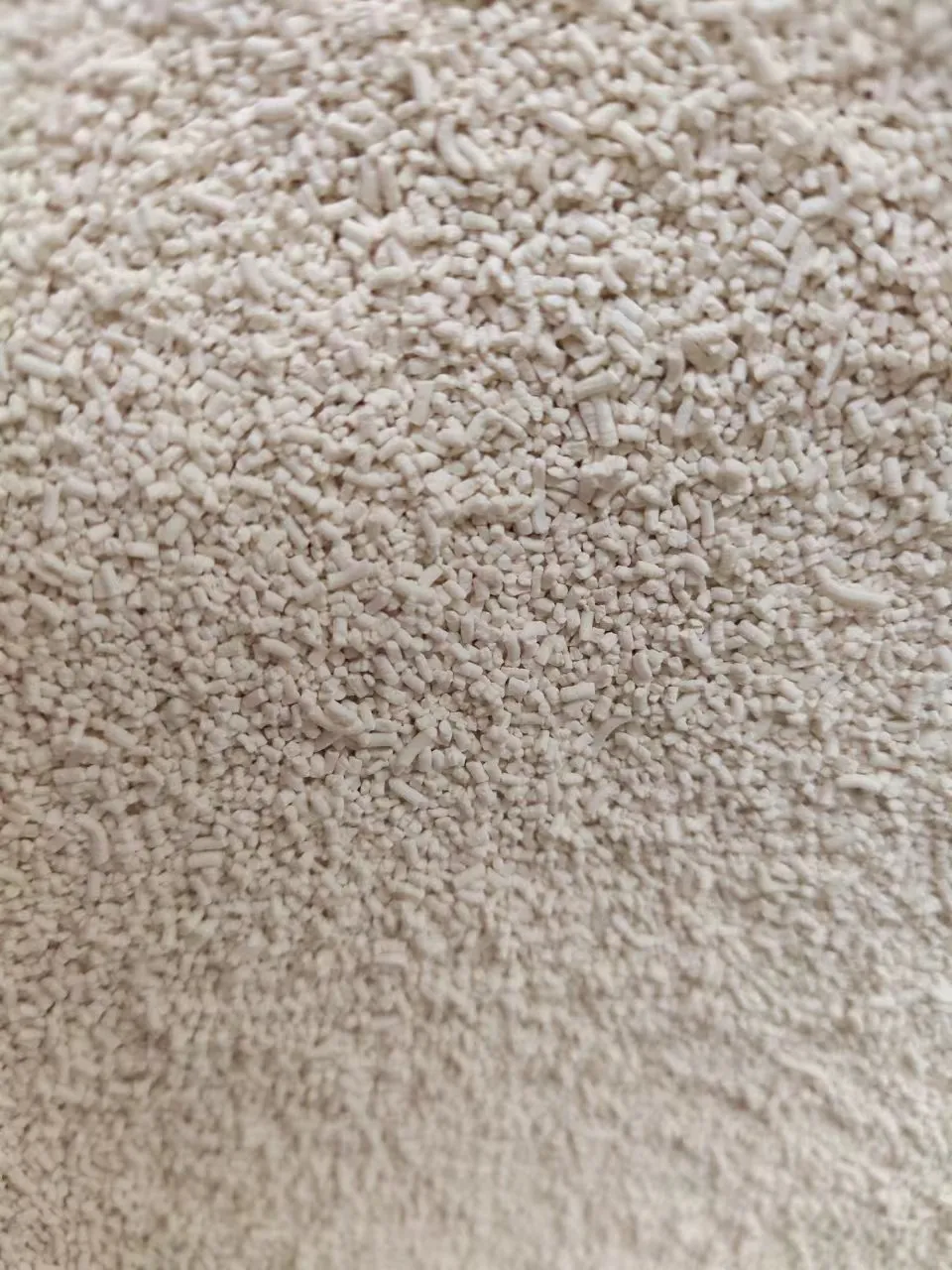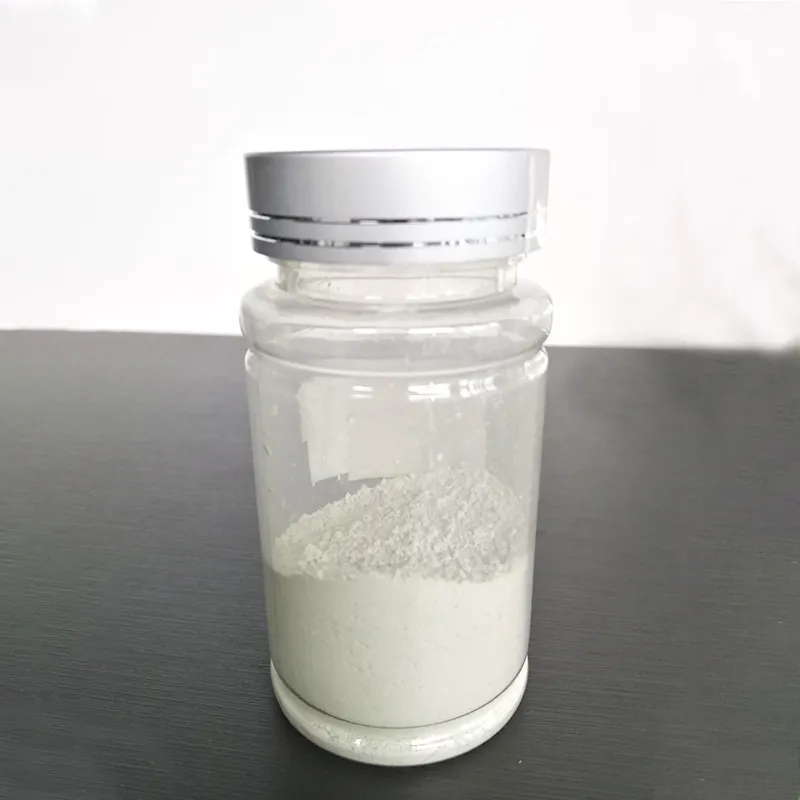
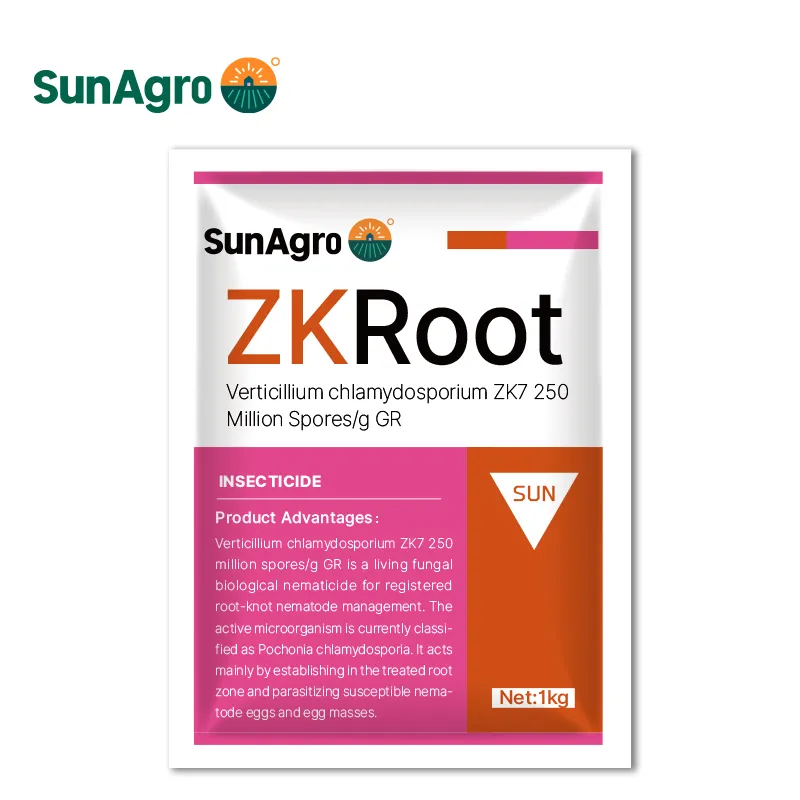
Verticillium chlamydosporium ZK7 250 Million Spores/g GR Biological Nematicide
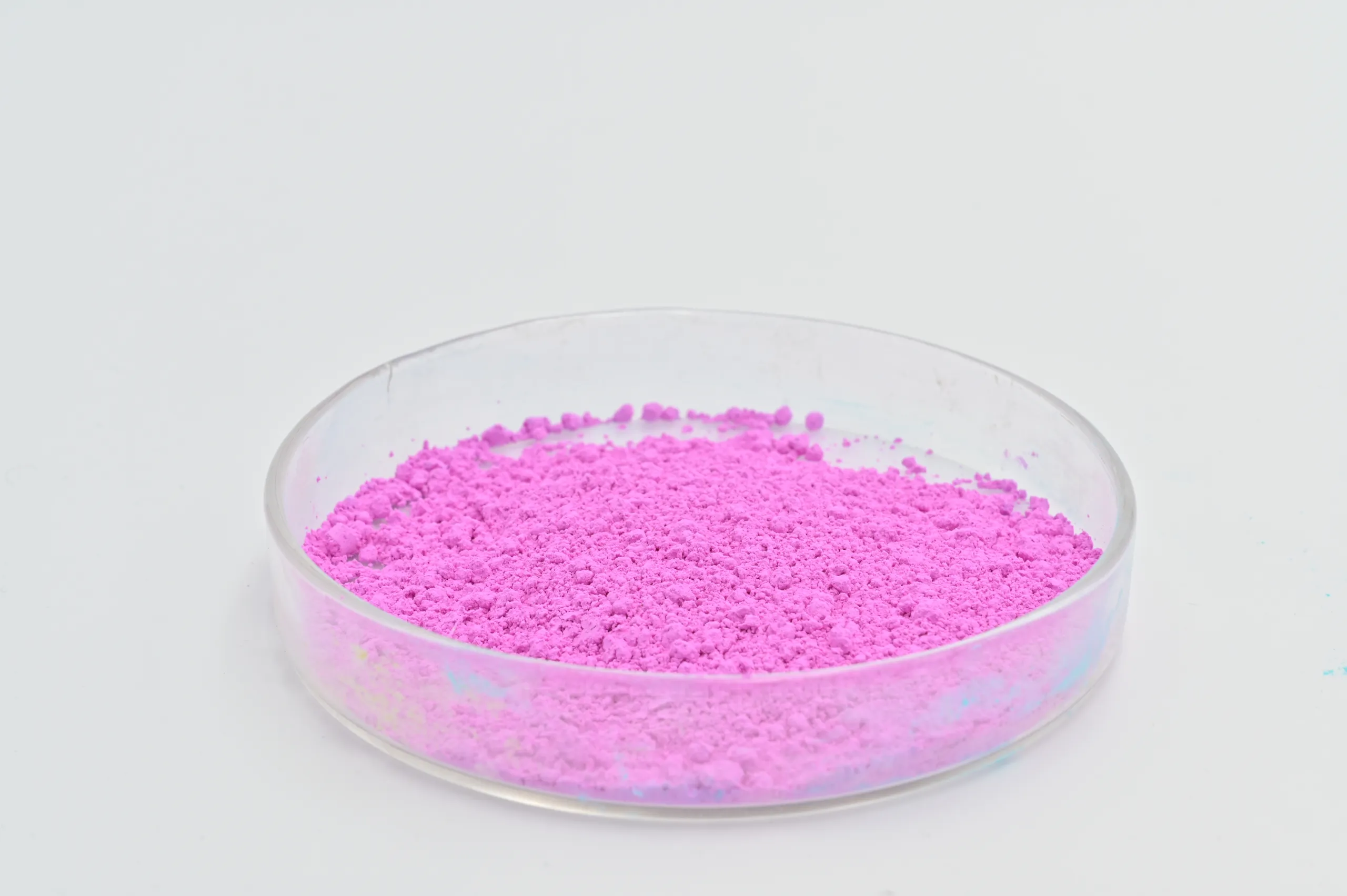
Verticillium chlamydosporium ZK7 250 million spores/g GR is a living fungal biological nematicide for registered root-knot nematode management.
The active microorganism is currently classified as Pochonia chlamydosporia. It acts mainly by establishing in the treated root zone and parasitizing susceptible nematode eggs and egg masses.
This granular formulation is positioned for preventive soil and root-zone programs. It does not provide the immediate knockdown expected from a conventional chemical nematicide.
POMAIS supplies this microbial formulation for importers, registration companies, biological crop protection distributors, nematicide channels and professional soil-management programs.
Final crops, nematode targets, application methods and rates must follow the approved destination-market label.
- Designed for Professional Buyers & Bulk Orders
- We support custom packaging, labeling, and formulation to meet your market needs.
- Export wholesale inquiries only.
- Please include destination country, business type (importer/distributor/registrant), and expected volume.
- Retail requests will not be processed.

About Verticillium chlamydosporium ZK7 250 Million Spores/g GR Biological Nematicide
| Item | Details |
|---|---|
| Registered Active Name | Verticillium chlamydosporium ZK7 |
| Current Scientific Name | Pochonia chlamydosporia |
| Content | 250 Million Spores/g |
| Alternative Expression | 2.5 × 10⁸ spores/g |
| Formulation | GR, Granules |
| Product Type | Microbial Biological Nematicide |
| Biological Direction | Nematophagous and egg-parasitic fungus |
| Main Target Direction | Root-knot nematodes |
| Main Biological Stage | Nematode eggs and egg masses |
| Treatment Zone | Soil and crop root zone |
| Application Direction | Hole, furrow or other registered soil placement |
| Performance Profile | Biological establishment rather than rapid chemical knockdown |
| Supply Support | Packaging, documents, viable-spore quality control and export coordination |
The spore-count basis, strain identity and shelf-life guarantee must follow the agreed specification and registration documents.
What Is Verticillium chlamydosporium ZK7?
Verticillium chlamydosporium ZK7 is a beneficial soil fungus used in biological nematode-management programs.
It is not the same organism as the plant-pathogenic Verticillium species commonly associated with vascular wilt diseases.
The active fungus is a nematophagous microorganism. Its main commercial value is associated with:
- Root-knot nematode management
- Parasitism of nematode eggs and egg masses
- Biological suppression of nematode reproduction
- Root-zone and rhizosphere establishment
- Preventive soil-treatment programs
- Integration with other nematode-management measures
The product should not be positioned as a conventional fungicide for foliar diseases.
Registered Name and Current Scientific Name
The product may appear under different scientific names in registration documents and technical literature.
| Name | Practical Use |
|---|---|
| Verticillium chlamydosporium ZK7 | Registered and commercial active identity |
| Pochonia chlamydosporia | Current scientific classification |
| Metacordyceps chlamydosporia | Taxonomic synonym found in some scientific databases |
| 厚孢轮枝菌 | Chinese registered common name |
For commercial documents, the active name should remain consistent with the destination-market registration.
Pochonia chlamydosporia can be included as the current scientific name without presenting it as a separate microorganism.
How the Fungus Acts Against Root-Knot Nematodes
The product contains fungal spores carried in a granular soil formulation.
After the granules are placed in suitable soil conditions, the biological process may be described as:
Granules enter the root zone → spores are released → viable spores germinate → fungal hyphae develop → hyphae contact nematode eggs and egg masses → eggs are parasitized → hatching and reproduction pressure are reduced
The fungus may colonize the rhizosphere and come into contact with nematode reproductive structures.
Fungal hyphae can attach to susceptible eggs, penetrate the egg surface and develop within the infected material. Extracellular enzymes, including protease- and chitinase-related activity, may contribute to degradation of the nematode egg structure.
This process is biological and develops over time.
The product should not be described as immediately killing every juvenile or adult nematode in the soil.
Main Target: Root-Knot Nematodes
The clearest target direction is root-knot nematodes, including registered Meloidogyne species.
Root-knot nematodes:
- Enter crop roots
- Establish feeding sites
- Cause root galling
- Disrupt water and nutrient uptake
- Reduce root efficiency
- Produce eggs in or around infected roots
- Build soil populations across repeated crop cycles
Verticillium chlamydosporium ZK7 is mainly positioned to interfere with the reproductive part of this cycle.
Its value is therefore stronger in preventive and population-management programs than in emergency rescue treatment after severe root damage has already developed.
Final nematode species claims must follow the exact product registration.
Focus on Nematode Eggs and Egg Masses
Root-knot nematode females produce egg masses containing numerous eggs.
These eggs contribute to the next generation of soil infestation.
The fungus is mainly relevant to:
- Exposed egg masses
- Eggs near infected roots
- Reproductive-stage nematode populations
- Root-zone biological suppression
- Reduction of future population pressure
The presence of fungal spores in a product does not guarantee contact with every nematode egg.
Correct placement, viable-spore quality and suitable soil conditions are necessary for meaningful biological activity.
Why It Is Not a Fast-Knockdown Nematicide
Chemical nematicides may act directly on mobile nematode stages after treatment.
A fungal biological nematicide behaves differently.
Verticillium chlamydosporium ZK7 requires:
- Viable spores
- Suitable soil moisture
- Suitable temperature
- Contact with the target zone
- Time for germination
- Fungal growth
- Contact with nematode eggs or egg masses
Visible crop recovery may not be immediate, especially where roots are already heavily damaged.
The product should not be judged only by rapid mortality of active juveniles.
More suitable evaluation points include:
- Root galling
- Egg-mass numbers
- Nematode reproduction
- Root condition
- New root development
- Crop establishment
- Population changes across the production cycle
Registered Use Direction
A Chinese registration example for this specification includes:
- Crop: Tobacco
- Target: Root-knot nematodes
- Application method: Hole application
This registration example should not be treated as a universal global label.
Additional crops, application methods and target nematodes can only be added where the destination-market registration supports them.
Claims for vegetables, fruit crops, nurseries, protected crops or other field crops should be reviewed individually before inclusion on a commercial label.
Best Application Timing
Biological nematicides normally perform best when they are applied before nematode pressure becomes severe.
Suitable timing directions may include:
- Before transplanting
- During planting
- At early root establishment
- Before rapid nematode reproduction
- During registered preventive soil-treatment programs
The product should be placed where developing roots and nematode egg masses are expected to occur.
Application after severe root destruction may not reverse existing damage.
The exact timing must follow the local product label.
Root-Zone Placement Matters
The formulation must reach the biological target zone.
Effective placement depends on:
- Crop root distribution
- Planting depth
- Application method
- Granule distribution
- Soil moisture
- Irrigation pattern
- Soil texture
- Root-zone temperature
Granules left on a hot, dry soil surface may not provide the same biological conditions as granules placed in moist soil near developing roots.
Application directions may include hole treatment, furrow placement or other locally registered soil methods.
These methods are not interchangeable.
The rate, depth and placement pattern must follow the approved label.
Hole Application
Hole application places the granules within the planting zone.
This method can help position the microorganism near:
- Transplant roots
- Developing root systems
- Nematode feeding sites
- Future egg-mass locations
The granules should be distributed according to the registered method rather than concentrated directly against sensitive plant tissue without label support.
Furrow and Soil Placement
Furrow or banded soil placement may be used in markets where it is registered.
Important considerations include:
- Uniform distribution
- Correct treatment width
- Planting depth
- Soil incorporation
- Moisture after application
- Contact with the future root zone
A hole-application rate should not be converted directly into a broadcast or furrow rate.
Soil Conditions Affect Biological Performance
Living microbial products are affected by the soil environment.
Important factors include:
- Soil moisture
- Soil temperature
- Aeration
- Soil texture
- Organic matter
- Soil pH
- Salinity
- Root activity
- Irrigation
- Microbial competition
- Chemical residues
- Placement uniformity
Extremely dry conditions may restrict spore germination and fungal growth.
Waterlogged soil may reduce aeration and create an unsuitable root environment.
Very high temperatures, prolonged direct sunlight or unsuitable chemical residues may reduce microbial viability.
The product should not be promoted as producing the same result in every soil type.
Moisture Management
Adequate soil moisture supports:
- Spore release
- Spore germination
- Fungal growth
- Root-zone establishment
- Contact with nematode reproductive structures
Excess irrigation should still be avoided where it causes:
- Waterlogging
- Anaerobic conditions
- Granule movement away from the target zone
- Root stress
- Uneven biological distribution
Irrigation after application should follow the local label and crop-production system.
Temperature and Storage History
Biological performance begins with product viability.
Exposure to unsuitable temperature during storage or transport may reduce the number of active spores available at application.
Before commercial use, buyers should confirm:
- Recommended storage temperature
- Maximum transport temperature
- Shelf life
- Viable-spore guarantee
- Production date
- Expiry date
- Storage conditions after opening
A package can appear physically normal even when biological viability has declined.
Compatibility With Fungicides
This product contains a living fungus.
Some fungicides may reduce:
- Spore viability
- Germination
- Fungal growth
- Root-zone establishment
Do not assume compatibility with every fungicide.
Before combined or sequential use, review:
- Active ingredient
- Application method
- Treatment timing
- Soil persistence
- Product concentration
- Laboratory compatibility data
- Local technical recommendations
Where compatibility information is unavailable, separate application timing or a limited test may be required.
Compatibility With Soil Fumigants
Soil fumigants are designed to suppress a wide range of soil organisms.
They may also affect beneficial fungal inoculants.
Do not apply Verticillium chlamydosporium ZK7 immediately before, during or after soil fumigation unless a validated program specifies the required interval.
Important considerations include:
- Fumigant active ingredient
- Application rate
- Soil aeration
- Plant-back interval
- Residual activity
- Recolonization timing
Biological application should begin only after conditions are suitable for survival of the microorganism.
Compatibility With Fertilizers and Biological Inputs
Compatibility depends on the exact product and use conditions.
Potential partner inputs include:
- Organic fertilizers
- Mineral fertilizers
- Bacillus-based products
- Other fungal biologicals
- Soil conditioners
- Humic substances
- Root-zone amendments
Do not assume automatic compatibility.
Strong acids, strong alkalis, oxidizing agents and disinfectants may reduce spore viability.
Tank mixing or direct granule blending should only be used where physical and biological compatibility have been confirmed.
GR Formulation Features
GR means granules.
This formulation is designed for registered soil placement rather than foliar spraying.
Important GR characteristics include:
- Granule appearance
- Particle-size distribution
- Flowability
- Carrier uniformity
- Moisture content
- Dust control
- Caking resistance
- Spore distribution
- Spore release from the carrier
- Package sealing
- Storage stability
The carrier should support practical application while protecting the microorganism during storage and transport.
Granule quality cannot be evaluated only by appearance. Biological activity and viable-spore content remain essential.
What Does 250 Million Spores/g Mean?
The specification indicates a declared spore concentration of:
250 million spores per gram
This may also be written as:
2.5 × 10⁸ spores/g
Buyers should confirm how this number is defined.
Important questions include:
- Does it represent total spores or viable spores?
- Is the value measured at production?
- Is it guaranteed at shipment?
- Is it guaranteed at the end of shelf life?
- Which counting method is used?
- Is germination tested separately?
- What is the accepted batch tolerance?
- How is strain identity confirmed?
The product page should not describe the count as a guaranteed end-of-shelf-life viable-spore value unless the specification clearly supports that statement.
Viable-Spore Quality Is More Important Than the Label Number Alone
A high declared spore count does not automatically confirm strong biological performance.
The spores must remain capable of germination.
Procurement evaluation should consider:
- Viable-spore count
- Germination rate where specified
- Strain identity
- Microbial purity
- Storage stability
- Moisture control
- Packaging protection
- Batch consistency
Two products with the same declared spores per gram may perform differently if their viability, carrier quality or storage history differs.
Quality Control
Quality control for this microbial nematicide should cover both the microorganism and the granular formulation.
Batch inspection may include:
- Strain identity
- Active microorganism identity
- Spore count
- Viable-spore count where specified
- Germination rate where specified
- Microbial purity
- Limits for contaminating microorganisms
- Moisture content
- Granule appearance
- Particle-size distribution
- Flowability
- Dust level
- Caking
- Carrier uniformity
- Spore distribution
- Storage stability
- Package sealing
- Batch traceability
Each batch should meet the agreed microbial and formulation specifications before shipment.
Storage and Shelf-Life Protection
Store the product in its sealed original packaging.
Keep it in a cool, dry and ventilated location.
Protect it from:
- High temperature
- Direct sunlight
- Moisture
- Water damage
- Chemical contamination
- Fungicides
- Disinfectants
- Strong oxidizing materials
- Damaged packaging
Do not store the product next to chemicals that may contaminate the granules or reduce fungal viability.
Storage temperature and shelf life must follow the approved label, TDS and product specification.
After opening, reseal the package and use the remaining product according to the storage instructions.
What This Product Does Not Do
Verticillium chlamydosporium ZK7 250 million spores/g GR is not:
- A fast chemical nematicide
- A soil fumigant
- A foliar insecticide
- A foliar fungicide
- A fertilizer
- A soil disinfectant
- A universal plant-growth product
- An immediate rescue treatment
- A product for every nematode species
- A guaranteed yield enhancer
- A guaranteed root-recovery product
- Automatically certified for organic production
- Harmless to every non-target organism under every condition
Its correct identity is:
A living fungal biological nematicide for registered root-knot nematode and root-zone management programs.
Comparison With Other Nematicide Directions
| Product Direction | Main Practical Position |
|---|---|
| Verticillium/Pochonia chlamydosporia | Living fungal product focused on nematode eggs, egg masses and reproduction pressure |
| Purpureocillium lilacinum | Fungal biological nematicide with strain-dependent activity against nematode stages |
| Bacillus-Based Nematicides | Bacterial rhizosphere products with strain- and metabolite-dependent activity |
| Fosthiazate | Chemical non-fumigant nematicide with faster direct activity |
| Fluopyram | Chemical soil-active nematicide with a different mode of action |
| Dazomet | Granular pre-plant soil fumigant precursor |
| Metam Sodium | Liquid pre-plant soil fumigant that generates MITC |
The correct product depends on:
- Nematode species
- Population pressure
- Crop
- Production system
- Treatment timing
- Registration
- Required speed of control
- Resistance and residue strategy
- Biological-program objectives
Biological and chemical products should not be considered automatically interchangeable.
Integrated Root-Knot Nematode Management
This microbial product is most suitable as one part of a complete nematode-management program.
A professional program may include:
- Soil and root diagnosis
- Nematode population testing
- Clean planting material
- Crop rotation
- Resistant varieties
- Sanitation
- Organic matter management
- Weed-host control
- Biological nematicides
- Registered chemical nematicides
- Pre-plant soil treatment where necessary
- Post-treatment monitoring
Heavy infestations may require multiple measures.
The product should not replace accurate nematode identification or field monitoring.
Registration and Compliance
Before import, promotion or use, local partners should confirm:
- Exact strain identity
- Registered active name
- Current scientific name
- Spore-count specification
- Viable-spore basis
- Formulation
- Registered crop
- Registered nematode
- Application method
- Application rate
- Treatment timing
- Soil placement
- Maximum application number
- Storage temperature
- Shelf life
- Microbial contaminant limits
- Label language
- Import permit
- Biological pesticide registration requirements
Research results from another strain should not be transferred automatically to the ZK7 product.
Claims for cyst nematodes or additional crops should only be included where the registered strain and destination-market label support them.
Packaging and Market Preparation
POMAIS supports packaging preparation according to microbial-product requirements and destination-market conditions.
Available packaging directions may include:
- Moisture-resistant bags
- Sealed pouches
- Inner liners
- Sacks
- Export cartons
- Pallet protection
- Batch coding
- Production dates
- Expiry dates
- Storage warnings
- Strain identification
- Spore-count declaration
- Multilingual label communication
Packaging must protect the granules from moisture, heat and contamination.
Final package size should follow:
- Registration requirements
- Distribution channel
- Application method
- Order volume
- Storage conditions
- Shipment method
Document Support
Available technical and shipment documents may include:
- COA
- SDS/MSDS
- TDS
- Product specification
- Strain identity information
- Spore-count specification
- Viable-spore information where available
- Germination data where specified
- Microbial purity data
- Moisture specification
- Storage conditions
- Shelf-life information
- Packing information
- Label reference
- Batch records
- Registration-related documents
- Shipment documents
Document requirements should be confirmed before production and shipment preparation.
FAQ
Why Choose POMAIS
POMAIS supplies microbial crop protection products for qualified importers, distributors, registration companies, biological-input channels and professional nematode-management programs.
For Verticillium chlamydosporium ZK7 250 million spores/g GR, we support:
- Clear strain identification
- Defined spore-count specifications
- Granular formulation quality control
- Microbial purity review
- Moisture-resistant packaging
- Storage and shelf-life communication
- Product documentation
- Multilingual label preparation
- Registration-related coordination
- Export shipment preparation
Our goal is to help buyers evaluate the product as a living biological formulation rather than only comparing the declared spores per gram.
Request Product
Please provide:
- Destination country
- Target crop
- Target nematode
- Registration status
- Required package size
- Storage conditions
- Label language
- Expected order volume
- Required microbial quality documents
We will review the requested specification and prepare a suitable Verticillium chlamydosporium ZK7 granular biological nematicide supply proposal.
Contact us!
We will reply to you within 24 hours on business days!