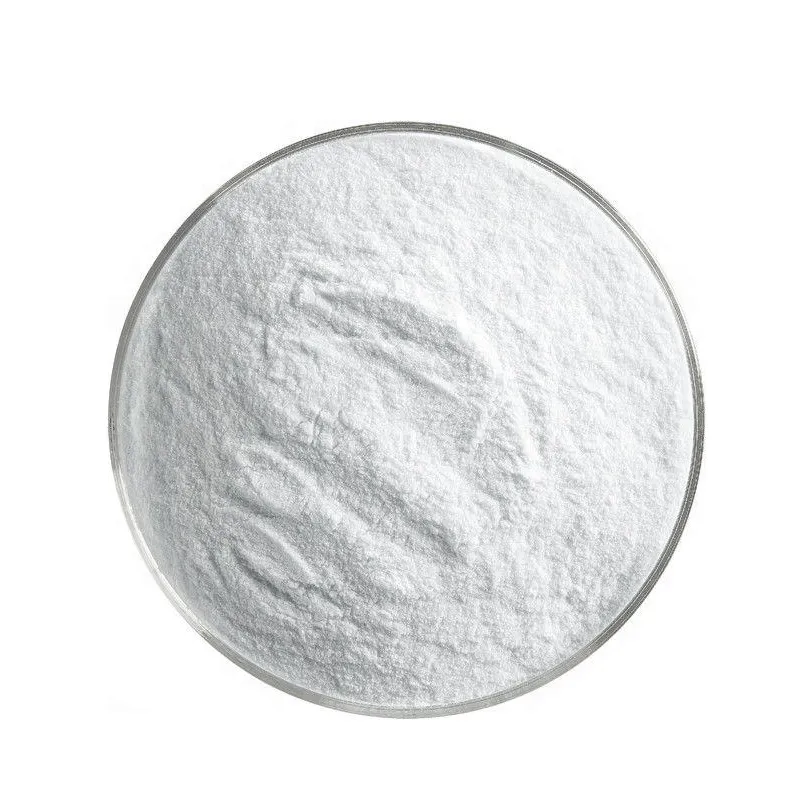
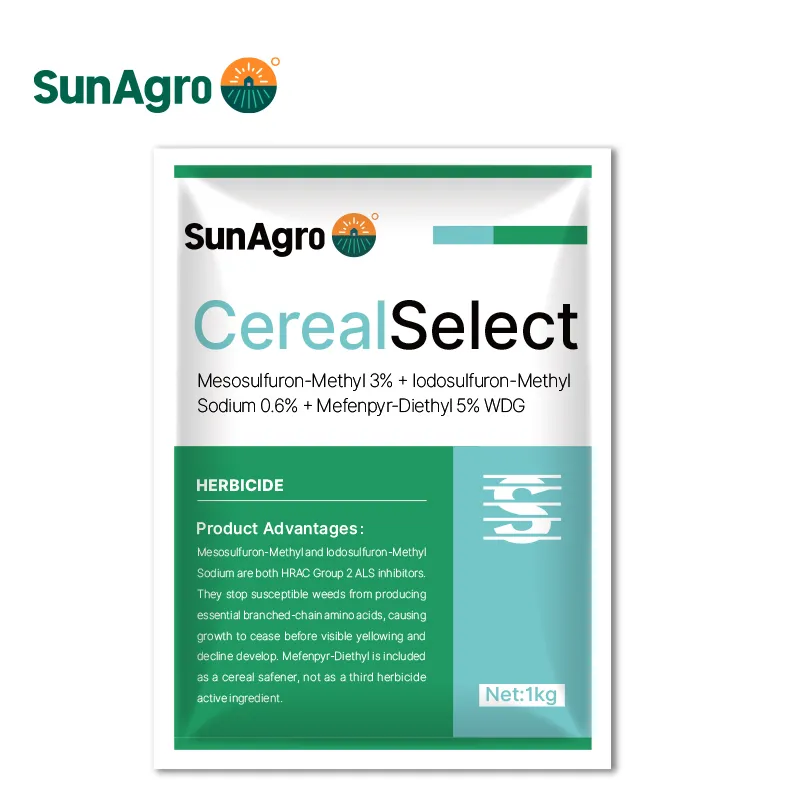
Mesosulfuron-Methyl 3% + Iodosulfuron-Methyl Sodium 0.6% + Mefenpyr-Diethyl 5% WDG
POMAIS Mesosulfuron-Methyl 3% + Iodosulfuron-Methyl Sodium 0.6% + Mefenpyr-Diethyl 5% WDG is a selective post-emergence herbicide developed for the control of selected annual grass weeds and broadleaf weeds in approved wheat programs.
Mesosulfuron-Methyl and Iodosulfuron-Methyl Sodium are both HRAC Group 2 ALS inhibitors. They stop susceptible weeds from producing essential branched-chain amino acids, causing growth to cease before visible yellowing and decline develop.
Mefenpyr-Diethyl is included as a cereal safener, not as a third herbicide active ingredient. It supports crop tolerance under approved use conditions but does not add another mode of action or eliminate the risks caused by excessive rates, spray overlap, crop stress or incorrect application timing.
We supply this WDG formulation for agrochemical importers, wheat-input distributors, registration companies and crop protection brands. Packaging, labels, technical documents and commercial specifications are reviewed according to the destination market.
- Designed for Professional Buyers & Bulk Orders
- We support custom packaging, labeling, and formulation to meet your market needs.
- Export wholesale inquiries only.
- Please include destination country, business type (importer/distributor/registrant), and expected volume.
- Retail requests will not be processed.

About Mesosulfuron-Methyl 3% + Iodosulfuron-Methyl Sodium 0.6% + Mefenpyr-Diethyl 5% WDG
| Product Attribute | Specification |
|---|---|
| Product Name | Mesosulfuron-Methyl 3% + Iodosulfuron-Methyl Sodium 0.6% + Mefenpyr-Diethyl 5% WDG |
| Herbicidal Active Ingredient 1 | Mesosulfuron-Methyl |
| Mesosulfuron-Methyl Content | 3% |
| Herbicidal Active Ingredient 2 | Iodosulfuron-Methyl Sodium |
| Iodosulfuron-Methyl Sodium Content | 0.6% |
| Safener | Mefenpyr-Diethyl |
| Mefenpyr-Diethyl Content | 5% |
| Formulation | WDG — Water-Dispersible Granule |
| Product Type | Selective post-emergence cereal herbicide |
| HRAC Group | Group 2 |
| Mode of Action | Acetolactate synthase inhibition |
| Primary Crop Direction | Wheat |
| Other Crop Directions | Rye, triticale or other cereals only where locally registered |
| Main Weed Direction | Annual grass weeds and selected annual broadleaf weeds |
| Application Timing | Post-emergence |
| Standard MOQ | Normally 1,000 kg |
| Available Documents | COA, SDS, TDS, product specification and available registration-supporting information |
| Packaging Support | Moisture-barrier sachets, bags, containers, labels and cartons |
| Supply Type | Bulk B2B supply for import, registration and distribution |
Final crops, varieties, target weeds, application rates, adjuvant requirements, treatment timings and rotational restrictions must follow the approved product label in the destination market.
What Is Mesosulfuron + Iodosulfuron WDG?
This product is a post-emergence cereal herbicide containing two sulfonylurea herbicidal active ingredients and one crop safener.
Its primary role is to control susceptible weeds after they have emerged in wheat fields.
The product is mainly positioned for:
- Annual grass weed management
- Selected broadleaf weed control
- Early post-emergence treatment
- Wheat-production systems
- Fields where Group 2 herbicides remain effective
- Programs requiring a dry WDG formulation
It is not a pre-emergence residual herbicide.
It should not be described as a three-mode-of-action product because Mefenpyr-Diethyl does not control weeds.
Both herbicidal components belong to the same HRAC group. The combination may broaden the weed spectrum within Group 2, but it does not provide two independent resistance-management mechanisms.
Importers developing a wider cereal portfolio can connect this product with relevant selective herbicide products.
How Does the Herbicide Work?
Mesosulfuron-Methyl Mode of Action
Mesosulfuron-Methyl belongs to HRAC Group 2.
It inhibits the acetolactate synthase enzyme, also known as ALS or AHAS.
This enzyme is required for the production of essential branched-chain amino acids, including:
- Valine
- Leucine
- Isoleucine
After susceptible weeds absorb the herbicide, amino acid production is disrupted.
The practical sequence is:
Foliar uptake → ALS inhibition → cell division stops → weed growth ceases → yellowing and decline develop
Mesosulfuron-Methyl is systemic. It can move from treated foliage toward active growing points in susceptible weeds.
Its primary commercial value in this premix is the control of selected annual grass weeds in wheat.
Iodosulfuron-Methyl Sodium Mode of Action
Iodosulfuron-Methyl Sodium is also an HRAC Group 2 ALS inhibitor.
It acts through the same broad biochemical mechanism as Mesosulfuron-Methyl but contributes a different activity profile against selected grass and broadleaf weeds.
Within the premix, it may support:
- Broader annual grass weed activity
- Additional control of selected broadleaf weeds
- More complete post-emergence weed-spectrum coverage
- Consistent activity across mixed susceptible populations
The two active ingredients remain part of the same resistance group.
Changing from Mesosulfuron-Methyl to Iodosulfuron-Methyl Sodium is not considered a mode-of-action rotation.
Combined Group 2 Activity
The combined herbicidal action can be understood as:
Mesosulfuron-Methyl provides strong grass-weed direction → Iodosulfuron-Methyl Sodium broadens selected grass and broadleaf activity → susceptible weeds stop growing after ALS inhibition
Visual symptoms do not normally appear immediately.
After application:
- Weed growth may stop first
- Young leaves may become pale
- Growing points may yellow
- Tissue decline develops gradually
- Complete control may require several days or longer
Cold weather, drought stress and advanced weed growth stages may slow visible symptom development.
The product should not be presented as a fast contact herbicide or an instant leaf-burning treatment.
What Does Mefenpyr-Diethyl Do?
Mefenpyr-Diethyl is a herbicide safener.
It is included to support cereal crop tolerance to the herbicidal active ingredients.
Safener Function
Mefenpyr-Diethyl helps the crop metabolize the herbicidal components more rapidly under approved conditions.
This creates a greater selectivity difference between:
- The protected cereal crop
- Susceptible grass and broadleaf weeds
The safener does not neutralize the herbicides inside the spray tank.
It supports crop metabolism after application.
Mefenpyr-Diethyl Is Not a Herbicide
Mefenpyr-Diethyl:
- Does not directly kill weeds
- Does not expand the weed spectrum
- Does not create a third mode of action
- Does not control resistant weeds
- Does not improve weed control by itself
- Does not make unregistered crops tolerant
The product therefore contains:
- Two herbicidal active ingredients
- One crop safener
- One herbicide mode-of-action group
What the Safener Cannot Prevent
Mefenpyr-Diethyl cannot fully protect the crop from:
- Excessive application rates
- Spray overlap
- Incorrect crop use
- Application outside the approved growth stage
- Severe frost
- Drought stress
- Waterlogging
- Root disease
- Serious nutrient deficiency
- Unsafe tank mixtures
- Incorrect adjuvants
- Sensitive varieties outside the registration data
Crop safety depends on the complete application program.
Target Grass and Broadleaf Weeds
This formulation is primarily positioned for annual grass weeds in wheat, with additional activity against selected annual broadleaf weeds.
Exact weed claims must follow the destination-market label.
| Weed Direction | Typical Examples | Product Positioning |
|---|---|---|
| Annual Grass Weeds | Black-grass, annual ryegrass, wild oats, windgrass and selected brome species | Primary commercial target |
| Small Annual Grasses | Annual meadow-grass and other labeled species | Early post-emergence control |
| Selected Broadleaf Weeds | Chickweed, cleavers, field pansy, mayweed species and shepherd’s purse | Additional spectrum support |
| Volunteer Crops | Volunteer oilseed rape or other labeled volunteers | Product-specific claim |
| Group 2-Resistant Weeds | Resistant black-grass, ryegrass or wild oats | Control may be poor or absent |
| Large or Tillered Grass Weeds | Advanced grass weeds | Reduced reliability |
Annual Grass Weeds
Annual grasses are the central use direction for this product.
Potential target directions may include:
- Black-grass
- Annual ryegrass
- Wild oats
- Windgrass
- Annual meadow-grass
- Selected brome species
- Other labeled cereal grass weeds
The best results are generally obtained when:
- The correct weed species is identified
- Weeds are young
- Weeds are actively growing
- The full registered rate is used
- Coverage is uniform
- Group 2 resistance is not present
- Weather conditions support active growth
Advanced tillering, drought stress or established resistance can reduce control.
Selected Broadleaf Weeds
Iodosulfuron-Methyl Sodium may extend the spectrum to selected annual broadleaf weeds.
Potential directions may include:
- Chickweed
- Cleavers
- Field pansy
- Mayweed species
- Shepherd’s purse
- Volunteer oilseed rape
- Other label-listed weeds
Broadleaf activity should not be generalized to every weed species.
Large, mature or resistant weeds may require a different treatment strategy.
Resistant Grass Weeds
The product should not be promoted for Group 2-resistant grass weeds.
If a population is resistant to ALS inhibitors, both Mesosulfuron-Methyl and Iodosulfuron-Methyl Sodium may provide insufficient control.
Possible resistance indicators include:
- Healthy weeds surviving among controlled weeds
- Repeated failure in the same field
- Previous heavy reliance on sulfonylurea herbicides
- Surviving black-grass or ryegrass producing seed
- Poor control under otherwise suitable conditions
Suspicious populations should be tested where resistance-testing services are available.
Suitable Crops and Market Positioning
The principal crop direction is wheat.
Other cereal uses should only be included where supported by the exact product registration.
Winter Wheat
Winter wheat is the strongest commercial positioning for this formulation.
The product may support approved programs for:
- Annual grass weed control
- Selected broadleaf weed control
- Early spring post-emergence applications
- Autumn post-emergence treatment where registered
- Resistance-integrated cereal programs
Use must consider:
- Wheat growth stage
- Variety
- Crop vigor
- Weed growth stage
- Temperature
- Soil moisture
- Previous herbicide use
- Resistance history
- Required adjuvant
For broader crop-program development, buyers can review our wheat weed management solutions.
Spring Wheat and Durum Wheat
Do not assume that a winter wheat registration automatically covers spring wheat or durum wheat.
Crop tolerance may differ according to:
- Wheat type
- Variety
- Growth pattern
- Environmental conditions
- Application timing
- Safener response
These uses should only appear on the final commercial label where supported by registration data.
Rye and Triticale
Some Mesosulfuron + Iodosulfuron products may be registered for rye or triticale.
However, crop authorization varies by formulation and country.
The product should not be promoted for rye or triticale unless:
- The exact 3% + 0.6% + 5% WDG formulation is registered
- Crop selectivity has been demonstrated
- The label includes the crop
- The application timing is defined
Barley and Oats
Barley and oats should not be added as default crop directions.
Different cereal species can vary significantly in their tolerance to ALS-inhibiting herbicides.
A wheat safener package does not automatically make the product safe for all cereal crops.
When Should the Herbicide Be Applied?
The product should be applied post-emergence, when the crop and weeds are within the approved growth stages.
Apply to Young, Actively Growing Weeds
Young weeds are generally easier to control because they have:
- Smaller root systems
- Fewer tillers
- More active growth
- Better foliar uptake
- Less stored energy
- Greater dependence on growing points
Waiting until grass weeds have developed multiple tillers can reduce reliability.
Confirm the Wheat Growth Stage
The approved label determines:
- Earliest crop stage
- Latest crop stage
- Seasonal application window
- Maximum number of applications
- Permitted autumn or spring use
- Required interval from other treatments
Do not apply based only on the weed stage.
The wheat crop must also be within the permitted growth window.
Apply Under Active-Growth Conditions
Performance is generally more reliable when:
- Weeds are actively growing
- Soil moisture is adequate
- Temperatures are suitable
- The crop is not severely stressed
- Heavy frost is not expected
- Rain will not remove the spray before the required interval
Cold Conditions
Low temperatures can slow:
- Herbicide uptake
- Herbicide movement
- ALS inhibition symptoms
- Weed yellowing
- Final decline
Slow symptom development does not automatically indicate treatment failure.
However, applications outside the approved temperature range may reduce both weed control and crop selectivity.
Drought and Water Stress
Drought-stressed weeds may have:
- Reduced leaf activity
- Thicker wax layers
- Slower growth
- Lower herbicide uptake
- Reduced translocation
Severely stressed wheat may also be more vulnerable to temporary crop effects.
Application Guidance
The following principles do not replace the registered product label.
1. Identify the Weed Species
Before treatment, confirm:
- Dominant grass weeds
- Broadleaf weeds
- Weed growth stage
- Tiller number
- Previous resistance problems
- Surviving weeds from earlier treatments
Do not select the product only because a field contains “grass weeds.”
Different grass species may respond differently.
2. Review Group 2 Resistance History
Check whether the field or region has documented resistance to:
- Mesosulfuron
- Iodosulfuron
- Sulfonylurea herbicides
- Other ALS inhibitors
Where resistance is established, choose a program with effective alternative modes of action.
3. Confirm Crop Condition
Avoid application to wheat under severe stress from:
- Frost
- Drought
- Waterlogging
- Nutrient deficiency
- Root disease
- Insect damage
- Extreme temperature changes
- Soil compaction
- Previous herbicide injury
4. Measure the WDG Accurately
This is a low-dose herbicide formulation.
Accurate measurement is essential.
Use:
- Calibrated scales
- Clean, dry measuring tools
- Correct package size
- Full product rate calculations
- Accurate field-area measurement
Do not estimate the amount by volume unless the label provides a validated volumetric method.
5. Prepare the Spray Tank Correctly
Where permitted by the label:
- Clean the spray tank.
- Fill part of the tank with clean water.
- Start agitation.
- Add the WDG product slowly.
- Allow the granules to wet and disperse.
- Add the required adjuvant in the approved sequence.
- Add compatible partners only where permitted.
- Complete filling with water.
- Maintain agitation during application.
- Use the mixture within the recommended period.
6. Apply Uniformly
Check:
- Nozzle condition
- Spray pressure
- Boom height
- Ground speed
- Water volume
- Droplet size
- Spray pattern
- Field boundaries
Uneven application may produce poor weed control or crop injury.
7. Avoid Spray Overlap
Overlap can increase:
- Crop yellowing
- Temporary stunting
- Selectivity risk
- Residue exposure
- Rotational-crop concerns
Pay close attention near field edges, headlands and obstacles.
Crop Selectivity and Injury Risks
Crop safety depends on the interaction between:
- The two herbicides
- Mefenpyr-Diethyl
- Wheat variety
- Crop stage
- Weather
- Application rate
- Adjuvant
- Tank-mix partners
- Crop health
How Mefenpyr Supports Wheat Tolerance
Mefenpyr-Diethyl helps the cereal crop metabolize the herbicidal components more quickly than susceptible weeds.
This may reduce the duration and intensity of herbicide exposure inside the crop.
It does not make the crop completely insensitive.
Temporary Crop Effects
Under some conditions, treated wheat may show temporary symptoms such as:
- Mild yellowing
- Short-term growth slowing
- Reduced vigor
- Leaf discoloration
Temporary symptoms may be more likely after:
- Cold conditions
- Large temperature changes
- Crop stress
- Spray overlap
- Strong adjuvants
- Complex tank mixtures
- Application near the edge of the crop window
The crop should be monitored according to the registered label and local agronomic guidance.
Conditions That Increase Injury Risk
| Risk Factor | Why It Matters |
|---|---|
| Frost Before or After Treatment | Reduces crop metabolism and safener response |
| Drought Stress | Weakens crop recovery and alters uptake |
| Waterlogging | Damages roots and reduces crop vigor |
| Nutrient Deficiency | Limits the crop’s ability to recover |
| Root Disease | Increases physiological stress |
| Spray Overlap | Increases the herbicide dose |
| Incorrect Adjuvant | May increase penetration and crop exposure |
| Unapproved Tank Mix | May reduce selectivity |
| Sensitive Variety | Crop tolerance may differ |
| Application Outside Label Timing | Increases crop-safety uncertainty |
WDG Formulation Features
WDG means Water-Dispersible Granule.
The granules are designed to wet, disintegrate and disperse in water, forming a spray suspension.
They do not necessarily dissolve completely like a soluble powder.
Practical Advantages of WDG
A WDG formulation may provide:
- Compact solid packaging
- Lower liquid leakage risk
- Efficient export storage
- Convenient small-pack distribution
- Accurate factory-controlled active ingredient ratios
- Reduced dependence on liquid bottles
- Easier carton and pallet planning
- Good suitability for moisture-barrier sachets
Key WDG Quality Parameters
| Quality Parameter | Buyer Relevance |
|---|---|
| Mesosulfuron-Methyl Content | Confirms the declared 3% content |
| Iodosulfuron-Methyl Sodium Content | Confirms the declared 0.6% content |
| Mefenpyr-Diethyl Content | Confirms the declared 5% safener content |
| Content Uniformity | Critical for a low-dose multi-component formulation |
| Wettability | Influences how quickly granules enter the spray water |
| Disintegration Time | Influences mixing efficiency |
| Suspensibility | Helps maintain uniform spray concentration |
| Wet Sieve Residue | Helps reduce nozzle-blockage risk |
| Persistent Foam | Influences spray-tank filling |
| Moisture Content | Affects stability and caking |
| Attrition Resistance | Reduces dust formation during transport |
| Bulk Density | Influences filling and package volume |
| Caking Resistance | Supports storage performance |
| Pack-Weight Accuracy | Essential for low-dose field application |
Content Uniformity
This formulation contains active components at relatively low percentages.
Uniform distribution inside every batch and package is therefore important.
Poor uniformity may result in:
- Inconsistent weed control
- Uneven safener delivery
- Crop-selectivity variation
- Pack-to-pack performance differences
- Registration non-compliance
Quality control should confirm all three components, not only the total product weight.
Moisture Protection
WDG granules can absorb moisture if packaging is inadequate.
Moisture exposure may cause:
- Caking
- Soft granules
- Slower disintegration
- Reduced flow
- Package damage
- Stability problems
Packaging should therefore use an appropriate moisture barrier.
WDG vs OD Formulation
POMAIS also supplies a liquid OD product containing Mesosulfuron-Methyl, Iodosulfuron-Methyl Sodium and Mefenpyr-Diethyl.
The two formulations serve similar weed-management directions but have different physical and commercial characteristics.
| Comparison Factor | 3% + 0.6% + 5% WDG | 10 + 2 + 30 g/L OD |
|---|---|---|
| Physical Form | Dry water-dispersible granule | Liquid oil dispersion |
| Herbicidal Active Ratio | 5:1 | 5:1 |
| Safener Specification | 5% | 30 g/L |
| Mixing Behavior | Granules wet, disintegrate and suspend | Oil dispersion dilutes in water |
| Packaging | Sachet, bag or solid-product container | Bottle or liquid container |
| Leakage Risk | No liquid leakage | Requires liquid packaging integrity |
| Main Quality Focus | Uniformity, wettability, disintegration and moisture control | Dispersion stability, viscosity and bottle compatibility |
| Storage Requirement | Protect from moisture | Protect from temperature extremes and separation |
| Registration Identity | Separate WDG registration | Separate OD registration |
| Buyer Positioning | Dry-formulation distribution channel | Liquid-formulation distribution channel |
The WDG and OD products cannot use the same application rate, label or product specification.
Buyers comparing dry and liquid formats can review our Mesosulfuron + Iodosulfuron OD herbicide.
Tank Mixing and Adjuvant Requirements
Some Mesosulfuron + Iodosulfuron labels require a specific surfactant, oil or adjuvant system.
The exact requirement must come from the registered label.
Do not assume that all adjuvants are interchangeable.
Adjuvant Selection
The wrong adjuvant may cause:
- Reduced weed control
- Excessive crop uptake
- Temporary crop injury
- Spray incompatibility
- Excessive foam
- Poor droplet behavior
Confirm:
- Adjuvant type
- Adjuvant rate
- Mixing order
- Water volume
- Temperature restrictions
- Crop condition
- Tank-mix partners
Tank-Mix Compatibility
Tank mixing may be influenced by:
- Water hardness
- Water pH
- Fertilizer salts
- Partner formulation
- Mixing order
- Adjuvant
- Spray temperature
- Number of products in the tank
Conduct a small compatibility test for unfamiliar mixtures.
Physical compatibility does not guarantee crop safety or biological performance.
Liquid Fertilizers
Do not assume the product can be mixed safely with liquid nitrogen or foliar fertilizers.
High salt concentration or fertilizer stress may increase crop injury.
Use only where the exact label and local recommendations permit the mixture.
Resistance Management
Mesosulfuron-Methyl and Iodosulfuron-Methyl Sodium are both HRAC Group 2 herbicides.
The premix therefore has one herbicide mode-of-action group.
Mefenpyr-Diethyl is a safener and does not provide a resistance-management mode of action.
Group 2 Resistance Risk
Repeated reliance on ALS-inhibiting herbicides can select resistant weed populations.
Resistance has been documented in important cereal grass weeds in multiple markets.
Potential high-risk weeds include:
- Black-grass
- Annual ryegrass
- Wild oats
- Brome species
- Other repeatedly treated cereal weeds
Resistance-Management Principles
- Confirm the weed species.
- Review field resistance history.
- Use the complete registered rate.
- Apply to young weeds.
- Avoid repeated Group 2 treatments.
- Use effective pre-emergence residual herbicides where registered.
- Rotate with herbicides from other HRAC groups.
- Rotate crops.
- Use competitive wheat varieties.
- Adjust sowing dates where agronomically suitable.
- Increase crop competition where practical.
- Prevent survivors from producing seed.
- Clean harvest and cultivation equipment between infested fields.
- Test suspicious weed populations.
Surviving Weeds
After treatment, inspect the field for:
- Healthy survivors
- Uneven control
- Species-specific failure
- Survivors in correctly treated areas
- New seed production
Do not repeatedly treat suspected resistant weeds with another Group 2 herbicide.
Changing the product name does not change the mode of action.
Rotational Crops and Soil Considerations
Sulfonylurea herbicide persistence can be influenced by:
- Soil pH
- Soil moisture
- Temperature
- Organic matter
- Application rate
- Rainfall
- Time between treatment and planting
Some rotational crops may be sensitive to residues.
Soil pH
High soil pH may slow the breakdown of some sulfonylurea herbicides.
This can increase the risk to sensitive rotational crops.
Do not publish one universal pH limit or plant-back interval without the exact product label.
Dry Conditions
Dry conditions may delay herbicide degradation.
Where rainfall is limited, residues may remain active longer than expected.
Plant-Back Restrictions
Rotational crop restrictions must be taken from the exact registered label.
They may differ for:
- Oilseed rape
- Sugar beet
- Legumes
- Maize
- Sunflower
- Vegetables
- Other sensitive crops
The buyer should confirm the intended crop rotation during registration and label development.
Equipment Cleaning
Spray equipment must be cleaned thoroughly after use.
Small residues of Group 2 herbicides may damage sensitive broadleaf crops treated later.
Cleaning should include:
- Spray tank
- Pumps
- Hoses
- Filters
- Nozzles
- Boom ends
- Induction systems
Follow the approved tank-cleaning procedure.
Simple water draining may not remove all residues.
Safety and Environmental Precautions
Handle the product according to the final SDS and approved label.
Operator Safety
- Wear the required protective clothing.
- Avoid skin and eye contact.
- Avoid inhaling granule dust or spray mist.
- Do not eat, drink or smoke during handling.
- Wash hands and exposed skin after use.
- Remove contaminated clothing.
- Keep unauthorized people away from the mixing area.
- Follow the approved re-entry interval.
- Do not reuse empty pesticide packaging.
WDG Dust Control
Although WDG products generally create less dust than wettable powders, damaged granules may still produce fine particles.
Avoid:
- Dropping bags unnecessarily
- Pouring from excessive height
- Handling broken packaging
- Working in strong wind
- Breathing dust during mixing
Protect Non-Target Plants
Spray drift may damage:
- Broadleaf crops
- Oilseed crops
- Sugar beet
- Vegetables
- Ornamentals
- Trees
- Natural vegetation
Follow:
- Wind-speed limits
- Droplet-size requirements
- Boom-height limits
- Buffer zones
- Temperature-inversion restrictions
Protect Water
Prevent the product from entering:
- Rivers
- Streams
- Lakes
- Wells
- Drainage systems
- Irrigation channels
- Wetlands
Follow all aquatic buffer and runoff restrictions stated on the label.
Label and Registration Requirements
This 3% + 0.6% + 5% WDG formulation requires its own product identity and registration support.
It must not use:
- A 3% + 0.6% + 9% WG label
- An OD product label
- Another safener specification
- Another crop list
- Another application rate
- Another adjuvant instruction
Information Required for Registration Review
Buyers should provide:
- Destination country
- Target wheat type
- Target weed species
- Required application season
- Preferred package size
- Label language
- Registration status
- Required adjuvant system
- Intended crop rotation
- Expected annual quantity
- Required technical documents
The COA, SDS, TDS, bottle or sachet label, carton and registration documents must use consistent information.
Packaging, Quality Control and Documentation Support
POMAIS supplies this formulation for bulk B2B procurement and distribution projects.
Packaging Options
Commercial packaging discussions may include:
- 100 g sachets
- 250 g sachets
- 500 g sachets
- 1 kg bags or containers
- Larger solid-product packaging
- Moisture-barrier inner layers
- Multilingual labels
- Retail cartons
- Master cartons
- Batch coding
- Expiry coding
- Shipping marks
- Pallet planning
Final package sizes depend on:
- Registered field rate
- Target farm size
- Distributor preference
- Pack-weight accuracy
- Moisture protection
- Filling-line feasibility
- Destination-market requirements
Quality-Control Focus
Quality-control checks may include:
- Mesosulfuron-Methyl content
- Iodosulfuron-Methyl Sodium content
- Mefenpyr-Diethyl content
- Content uniformity
- Physical appearance
- Wettability
- Disintegration time
- Suspensibility
- Wet sieve residue
- Persistent foam
- Moisture content
- Attrition resistance
- Bulk density
- Caking resistance
- Pack-weight accuracy
- Seal integrity
- Label verification
- Batch consistency
Available Documents
Commercial document support may include:
- COA — Certificate of Analysis
- SDS — Safety Data Sheet
- TDS — Technical Data Sheet
- Product Specification
- Packaging Specification
- Available stability data
- Available crop-selectivity information
- Available registration-supporting technical information
- Batch-related quality documents
- Commercial and shipping documents
Document availability depends on the destination market, registration pathway, cooperation stage and final commercial specification.
Frequently Asked Questions
Request Product Specifications
To evaluate a Mesosulfuron-Methyl 3% + Iodosulfuron-Methyl Sodium 0.6% + Mefenpyr-Diethyl 5% WDG project, please provide:
- Destination country
- Company type
- Required quantity
- Preferred package size
- Target wheat type
- Target grass weeds
- Target broadleaf weeds
- Required application season
- Required adjuvant system
- Current registration status
- Required label language
- Required technical documents
- Expected purchasing schedule
We will review formulation specifications, packaging feasibility, technical documentation, crop positioning and destination-market requirements before confirming the commercial proposal.
This product is supplied for professional B2B procurement, registration and wholesale distribution.
Contact us!
We will reply to you within 24 hours on business days!