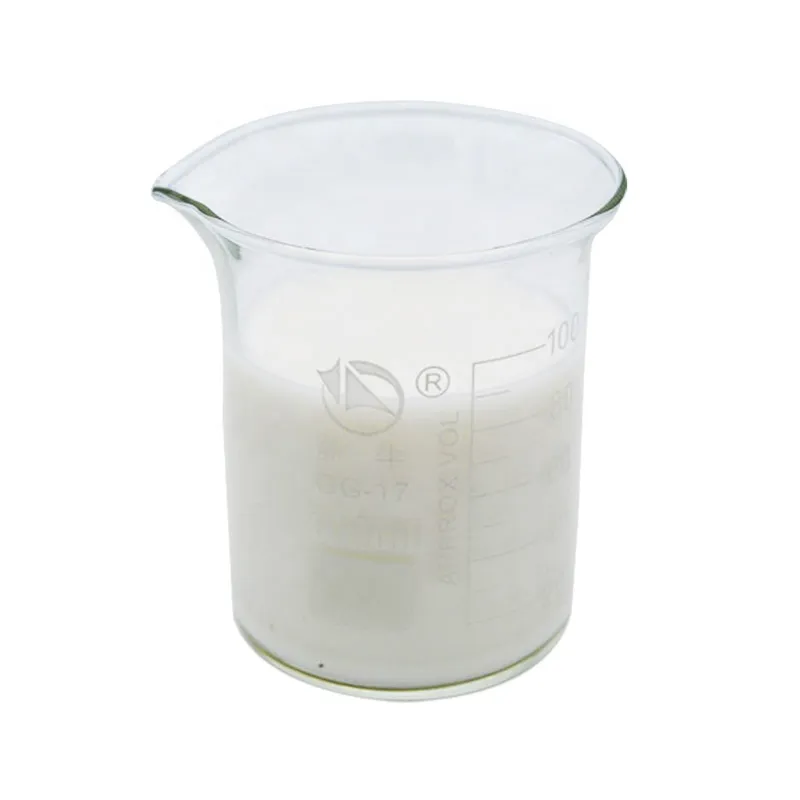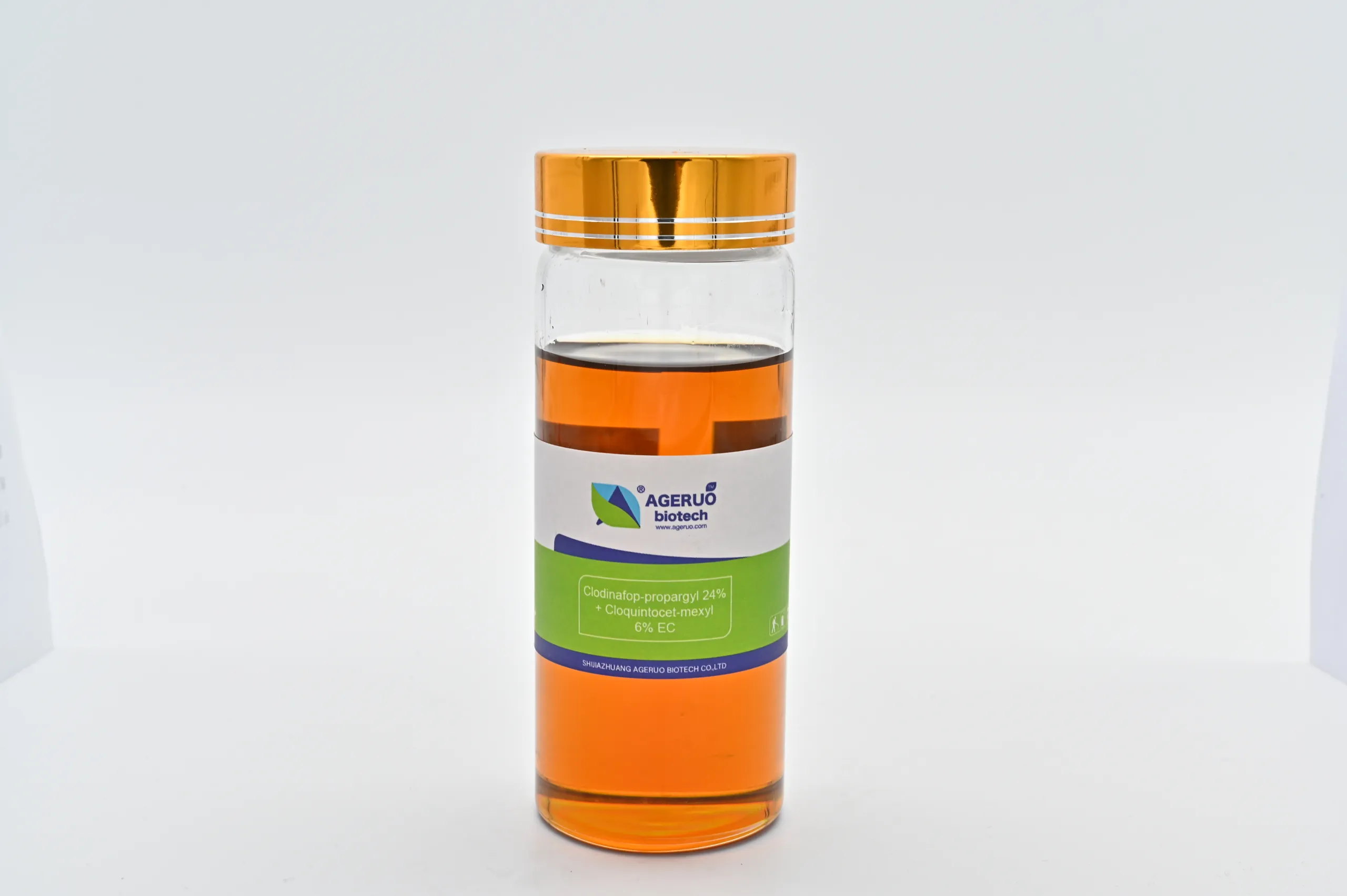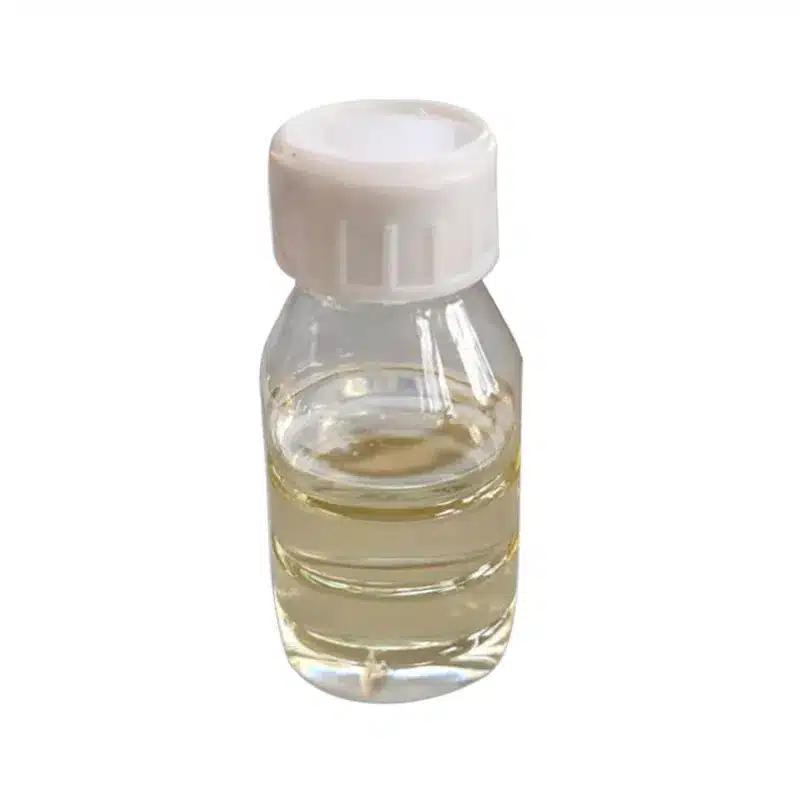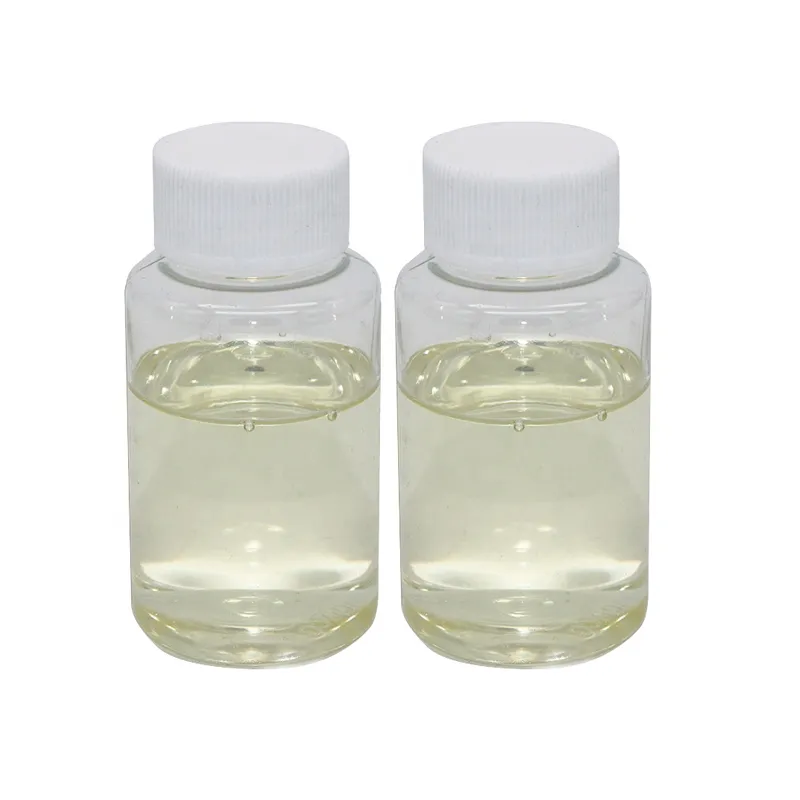
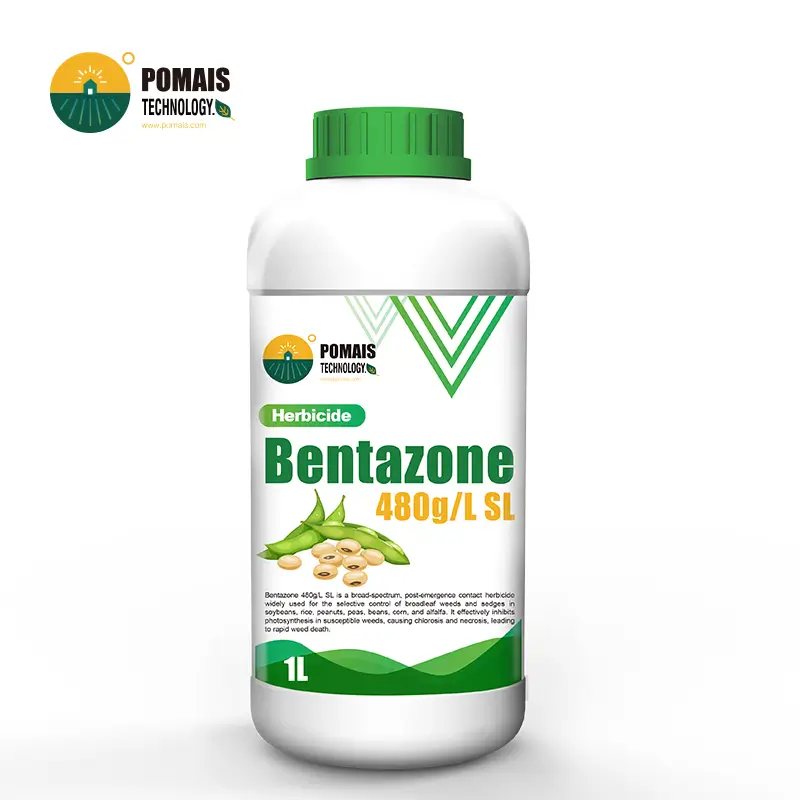
Bentazone 480 g/L SL Selective Post-Emergence Herbicide
Bentazone 480 g/L SL is a selective post-emergence contact herbicide used for control of selected broadleaf weeds and sedges in registered crops.
Bentazone belongs to HRAC/WSSA Group 6 and inhibits photosystem II activity in susceptible weeds. Because its activity is mainly contact-based rather than strongly systemic, good foliar coverage and early treatment of actively growing weeds are important for reliable control.
POMAIS supplies Bentazone 480 g/L SL for agricultural importers, distributors, registration companies, and private-label herbicide brands. Exact crop uses, weed claims, application rates, intervals, and restrictions must follow the registered label in the destination market.
- Designed for Professional Buyers & Bulk Orders
- We support custom packaging, labeling, and formulation to meet your market needs.
- Export wholesale inquiries only.
- Please include destination country, business type (importer/distributor/registrant), and expected volume.
- Retail requests will not be processed.

About Bentazone 480 g/L SL Selective Post-Emergence Herbicide
| Attribute | Product Information |
|---|---|
| Active Ingredient | Bentazone |
| Content | 480 g/L |
| Formulation | Soluble Concentrate (SL) |
| Herbicide Type | Selective post-emergence contact herbicide |
| HRAC/WSSA Group | 6 |
| Legacy HRAC Classification | C3 |
| Mode of Action | Photosystem II inhibition |
| Chemical Family | Benzothiadiazinone |
| Main Weed Spectrum | Selected broadleaf weeds and sedges |
| Grass Weed Control | No |
| Application Position | Post-emergence |
| Best Weed Stage | Small, actively growing weeds |
| Documentation | COA, SDS/MSDS, TDS |
| OEM / Private Label | Available |
| Packaging | Customized for destination-market requirements |
If the commercial product is formulated as a sodium salt equivalent, this should be stated according to the actual product specification, TDS, and registration dossier.
What Is Bentazone 480 g/L SL?
Bentazone is a selective herbicide used mainly after weeds have emerged.
Its commercial role is different from:
- Pre-emergence residual herbicides
- Non-selective burndown herbicides
- Systemic grass herbicides
- Long-residual soil herbicides
Bentazone is best understood as a foliar contact treatment for susceptible emerged broadleaf weeds and sedges.
This positioning is particularly important for distributors because Bentazone does not provide one-product control of every weed category.
Its strength lies in targeted post-emergence broadleaf and sedge management in crops that tolerate the treatment under registered conditions.
How Does Bentazone Work?
Bentazone is classified as a Group 6 photosystem II inhibitor.
HRAC Group 6 PSII Inhibition
Bentazone interferes with photosynthetic electron transport in susceptible weeds.
Once normal photosynthesis is disrupted, treated tissue experiences severe oxidative stress and loses normal cellular function.
Visible symptoms may include:
- Chlorosis
- Bronzing
- Leaf spotting
- Necrosis
- Progressive tissue collapse
The speed and severity of these symptoms depend on weed species, size, environment, and spray coverage.
Why Bentazone Is a Contact Herbicide
Bentazone acts mainly on the foliage that receives spray.
Movement within the plant is more limited than with strongly systemic herbicides.
This means:
spray coverage is part of the mode-of-action performance.
A leaf or growing point that receives little or no herbicide exposure may remain less affected.
This is particularly important in:
- Dense weed stands
- Large weeds
- Thick crop canopies
- Overlapping leaves
Why Early Treatment Matters
Small weeds are generally easier to cover completely.
As weeds become larger:
- More leaf area must be treated
- New growth can be shielded
- Crop canopy may interfere with spray penetration
- Regrowth risk can increase
Bentazone should therefore be positioned against small, actively growing weeds before they exceed the species-specific label stage.
Which Weeds Does Bentazone Control?
Bentazone controls selected broadleaf weeds and sedges where the species is included on the local label.
Typical weed groups may include:
| Weed Group | Typical Examples | Control Position |
|---|---|---|
| Amaranthus weeds | Pigweeds / amaranths where registered | POST broadleaf control |
| Chenopodium weeds | Common lambsquarters | Early POST |
| Smartweeds | Persicaria / Polygonum species where labeled | POST |
| Cocklebur | Common cocklebur where registered | POST |
| Sedges | Yellow nutsedge and other labeled sedges | POST |
| Other broadleaf weeds | Product- and market-specific | Check local label |
The exact weed spectrum should always be based on the registered product.
Do not assume that every broadleaf species is equally susceptible.
What Does Bentazone Not Control?
Understanding product limitations is important for correct market positioning.
Grass Weeds
Bentazone is not a grass herbicide.
It should not be positioned as a stand-alone solution for:
- Barnyardgrass
- Foxtails
- Ryegrass
- Crabgrass
- Wild oats
- Other grass weeds
Where both broadleaf weeds and grasses occur, a registered tank-mix or sequential program may be required.
Large or Mature Weeds
Large weeds can be more difficult to control because contact coverage becomes less complete.
A product that performs well against small weeds may give weaker suppression once the same species becomes large and branched.
Severely Stressed Weeds
Drought, temperature stress, or other growth limitations can reduce treatment performance.
Bentazone is generally better positioned when weeds are actively growing.
Future Weed Flushes
Bentazone should not be treated as a long-residual pre-emergence herbicide.
Its primary commercial role is controlling existing emerged weeds.
New seedlings that emerge after treatment may require another management tool or follow-up treatment according to the label.
Why Spray Coverage Matters With Bentazone
Coverage is one of the most important application factors for Bentazone.
Because the herbicide acts mainly through contact with foliage, exposed plant surfaces need adequate treatment.
Dense Weeds Can Reduce Coverage
When weeds are large or clustered:
- Lower leaves may be shielded
- Growing points may receive less spray
- Crop foliage can intercept droplets
This can lead to partial injury rather than complete control.
Small Weeds Are Better Targets
Early treatment improves the probability that:
- Most leaves are exposed
- Growing points receive herbicide
- Weed biomass is still limited
This is one reason weed stage should be considered before application.
Spray Volume and Droplet Management Are Product-Specific
The correct spray volume, nozzle setup, droplet spectrum, and application method should come from the exact product label and local agronomic program.
Do not use one global spray-volume recommendation for every Bentazone market.
Which Crops Use Bentazone?
Bentazone is registered in different crops around the world, but the crop list varies significantly by country and product.
Depending on destination-market registration, possible crop positions may include:
| Crop Position | Typical Use Logic |
|---|---|
| Soybean | Selective POST broadleaf and sedge control |
| Beans | Crop- and growth-stage-specific use |
| Peas | Registered POST programs |
| Peanuts | Selective POST weed management |
| Rice | Broadleaf and sedge management where labeled |
| Corn | Registered POST broadleaf programs |
| Other crops | Confirm local label and crop tolerance |
The fact that Bentazone may be registered in both soybean and rice illustrates an important principle:
crop selectivity is not determined simply by whether the crop is broadleaf or grass.
Soybean is a broadleaf crop.
Rice and corn are grasses.
Bentazone selectivity depends on factors including:
- Crop metabolism
- Crop tolerance
- Growth stage
- Application timing
- Formulation
- Adjuvant system
- Label restrictions
This is why crop registration must come before general assumptions about botanical type.
How Should Bentazone Be Applied?
A professional Bentazone program should focus on timing and coverage rather than one universal application rate.
Apply Post-Emergence
Bentazone is primarily used after target weeds are visible and actively growing.
Target Small Weeds
Treat weeds before they exceed the maximum stage or size stated on the registered label.
Ensure Thorough Foliar Coverage
Contact activity means the sprayed foliage is the primary treatment zone.
Avoid Severely Stressed Weeds
Poorly growing weeds may respond less consistently.
Follow Crop- and Weed-Specific Label Timing
Different weed species and crops can have different:
- Maximum weed size
- Crop growth-stage limits
- Application rate
- Number of treatments
- Interval restrictions
For this reason, POMAIS does not recommend transferring one general L/ha rate across all crops and markets.
Why Crop Selectivity Does Not Mean Zero Injury
Bentazone can be selective in labeled crops, but that does not mean visible crop response is impossible.
Temporary crop symptoms may occur under some conditions.
These can include:
- Leaf speckling
- Bronzing
- Temporary discoloration
- Localized tissue injury
Risk may be influenced by:
- Crop species
- Cultivar
- Crop growth stage
- Temperature
- Humidity
- Adjuvant
- Tank mix
- Application rate
A professional product page should therefore avoid statements such as:
“Bentazone does not harm crops.”
The more accurate principle is:
Bentazone provides selectivity in tolerant crops when the registered application conditions are followed.
Can Bentazone Be Tank Mixed?
Bentazone may be included in tank-mix programs where both products are registered and compatible.
One important reason is spectrum expansion.
Because Bentazone does not control grass weeds, some crop programs may combine it with a registered grass herbicide.
However, tank mixing must consider more than physical compatibility.
Check:
- Crop registration
- Weed spectrum
- Crop growth stage
- Herbicide compatibility
- Adjuvant requirements
- Crop injury risk
- Application timing
- Most restrictive label
Some herbicide combinations or adjuvant systems can increase crop phytotoxicity.
Therefore, Bentazone should not be marketed with a universal list of tank-mix partners.
The correct principle is:
Use only locally registered and agronomically compatible combinations.
Bentazone and Herbicide Resistance
Bentazone belongs to HRAC/WSSA Group 6.
Repeated dependence on one effective mode of action can select for resistant weed populations.
Resistance management should therefore include:
- Correct weed identification
- Review of field treatment history
- Appropriate application timing
- Effective labeled rates
- Rotation of effective modes of action
- Tank mixes with different effective modes where appropriate
- Prevention of survivor seed production
- Cultural and mechanical weed-control tools
Changing only the product brand does not constitute true mode-of-action rotation.
Why SL Formulation Quality Matters
SL means Soluble Concentrate.
A high-quality Bentazone 480 g/L SL formulation should maintain commercial consistency during:
- Manufacturing
- Filling
- International shipping
- Warehouse storage
- Dilution
- Field use
Important formulation considerations may include:
- Active-content consistency
- Appearance
- pH
- Solubility
- Dilution behavior
- Low-temperature stability
- Accelerated storage stability
- Packaging compatibility
Final specification values should come from the actual product TDS and COA.
Quality Control and Batch Documentation
For importers, quality control should be measurable.
Depending on the registered specification, Bentazone 480 g/L SL batch testing may include:
| QC Item | Why Buyers Check It |
|---|---|
| Active content | Confirms formulation consistency |
| Appearance | Detects physical abnormalities |
| pH | Supports formulation stability |
| Density where applicable | Helps verify batch consistency |
| Dilution behavior | Important for spray preparation |
| Low-temperature stability | Relevant to storage and transport |
| Accelerated storage stability | Supports shelf-life confidence |
| Packaging inspection | Reduces leakage and compatibility risk |
POMAIS can support suitable projects with:
- COA
- SDS / MSDS
- TDS
- Product specification
- Packaging information
- Registration-support documentation
The final testing specification should be confirmed before commercial production.
Packaging and Private Label Supply
Bentazone 480 g/L SL can be supplied for importer, distributor, and private-label programs.
Packaging should be selected according to:
- Destination market
- Pack-size demand
- Formulation compatibility
- Transport requirements
- Distributor channel
- Label language
- Registration requirements
Private-label support can include:
- Bottle selection
- Label artwork
- Multilingual labeling
- Outer cartons
- Batch coding
- Shipping marks
Packaging should always be evaluated for compatibility with the final formulation.
Safety and Environmental Considerations
Bentazone should be handled according to the SDS and local product label.
Avoid Off-Target Spray
Applications should minimize drift onto:
- Sensitive crops
- Non-target vegetation
- Water bodies
- Adjacent areas
Water Protection Matters
Bentazone has been subject to groundwater and water-quality considerations in some regulatory systems.
Local labels may therefore include restrictions related to:
- Soil
- Water
- Drainage
- Application zones
- Groundwater protection
These requirements should be followed in the destination market.
Product Hazard Classification Is Formulation-Specific
Do not assume that a historical WHO classification for Bentazone automatically describes the final 480 g/L SL formulation.
Commercial safety classification should come from the exact:
- SDS
- GHS classification
- Local registration
- Final formulation
How Should Importers Evaluate Bentazone 480 g/L SL?
A professional buyer should evaluate more than active concentration.
| Procurement Question | Why It Matters |
|---|---|
| What country will import the product? | Determines registration and label claims |
| Is 480 g/L the required specification? | Must match registration and market demand |
| Is Bentazone expressed as sodium salt or equivalent? | Technical specification must be clear |
| Which crops drive demand? | Crop registration determines commercial fit |
| Which weeds are important? | Bentazone controls selected broadleaf weeds and sedges |
| Are grass weeds also present? | Additional grass-control program may be needed |
| What weed stages are targeted? | Contact control favors small weeds |
| Which tank mixes are locally used? | Crop tolerance and registration matter |
| Which QC parameters are required? | Supports batch consistency |
| What packaging is preferred? | Must fit formulation and channel |
| Which documents are needed? | Import and registration requirements differ |
| What is the cost per treated hectare? | Better decision metric than price per liter |
Frequently Asked Questions
What is Bentazone 480 g/L SL?
It is a selective post-emergence contact herbicide used against selected broadleaf weeds and sedges in registered crops.
Is Bentazone a contact or systemic herbicide?
Bentazone is mainly a contact herbicide. Thorough foliar coverage is important for performance.
What HRAC group is Bentazone?
Bentazone belongs to HRAC/WSSA Group 6.
How does Bentazone work?
It inhibits photosystem II activity in susceptible weeds, causing photosynthetic disruption and tissue injury.
Does Bentazone control broadleaf weeds?
Yes, it controls selected susceptible broadleaf weed species where registered.
Does Bentazone control yellow nutsedge?
Yellow nutsedge is an important target in some registered Bentazone programs.
Does Bentazone kill grass weeds?
No. Bentazone is not a grass herbicide.
Can Bentazone be used in soybean?
Yes, Bentazone is registered in soybean in a number of markets, but local crop labels must be followed.
Can Bentazone be used in rice?
It may be used in registered rice weed-control programs, particularly for selected broadleaf weeds and sedges.
Can Bentazone be used in corn?
Some registered products include corn uses. Crop stage and local label restrictions should be checked.
Why is spray coverage important?
Bentazone acts mainly by contact on treated foliage, so poorly covered tissue may receive insufficient herbicide.
Is Bentazone better on small weeds?
Generally yes. Smaller actively growing weeds are easier to cover and are usually more suitable treatment targets.
Does Bentazone provide residual weed control?
Its primary role is post-emergence foliar control rather than long-term residual weed suppression.
Can Bentazone be tank mixed with grass herbicides?
In some registered crop programs, yes. Compatibility, crop tolerance, adjuvants, and both product labels must be checked.
Can Bentazone injure crops?
Temporary leaf speckling, bronzing, or other visible injury can occur under some conditions even in tolerant crops.
Is Bentazone safe for all broadleaf crops?
No. Crop safety depends on registration and crop tolerance, not simply whether the crop is a broadleaf species.
What documents can POMAIS provide?
Depending on the project, documentation can include COA, SDS/MSDS, TDS, specifications, packaging information, and registration-support materials.
Choose Bentazone by Crop, Weed Spectrum and Registration
Bentazone 480 g/L SL is best positioned as a Group 6 selective contact herbicide for post-emergence control of selected broadleaf weeds and sedges.
Its strongest use logic is:
- Confirm the target crop.
- Identify the weed species.
- Treat small actively growing weeds.
- Ensure adequate foliar coverage.
- Do not expect grass-weed control.
- Check crop tolerance and tank-mix restrictions.
- Follow the destination-market registration and label.
For agricultural importers, distributors, registration companies, and private-label brands, POMAIS can support Bentazone 480 g/L SL projects with:
- Product specification support
- Batch quality control
- COA, SDS/MSDS and TDS
- Customized packaging
- Multilingual labels
- Private-label production
- Registration-oriented documentation
The correct procurement question is not:
Is Bentazone a broad-spectrum herbicide?
It is:
Does Bentazone 480 g/L SL match the target crop, broadleaf and sedge spectrum, weed stage, spray program, formulation specification, and local registration in the destination market?
Contact us!
We will reply to you within 24 hours on business days!