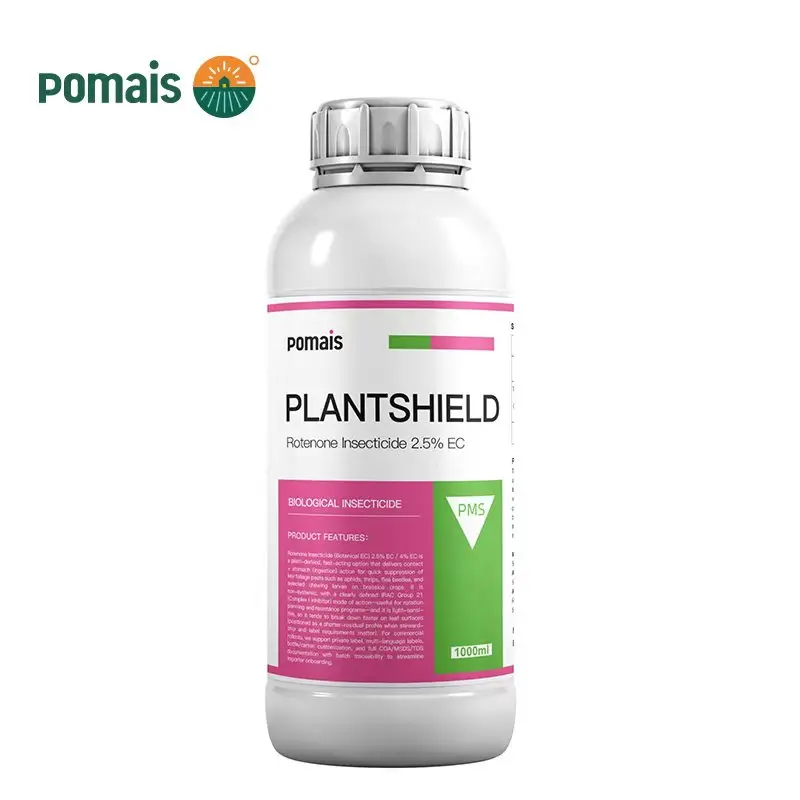
Rotenone Insecticide (Botanical EC) – 2.5% EC / 4% EC
If you are sourcing a plant-derived insecticide for cruciferous vegetables and other high-value crops where residue perception and rotation planning matter, Rotenone EC is positioned as a fast-acting, contact-and-ingestion solution for aphids, thrips, flea beetles, and selected leaf-feeding larvae. It is non-systemic, works best when pests are actively feeding, and is commonly selected for programs that need clear mode-of-action positioning and a low-residue profile on foliage due to rapid breakdown under light—while still requiring strict stewardship around water and non-target organisms.
- Designed for Professional Buyers & Bulk Orders
- We support custom packaging, labeling, and formulation to meet your market needs.
- Export wholesale inquiries only.
- Please include destination country, business type (importer/distributor/registrant), and expected volume.
- Retail requests will not be processed.

About Rotenone Insecticide (Botanical EC) – 2.5% EC / 4% EC
| Product name | Rotenone Insecticide (Botanical EC) |
| Active ingredient | Rotenone |
| CAS | 83-79-4 |
| Formulation | Emulsifiable Concentrate (EC) |
| Assay options | Rotenone 2.5% EC; Rotenone 4% EC |
| Mode of action | Mitochondrial electron transport inhibitor (Complex I) – IRAC Group 21 (Rotenone) |
| Primary targets | Aphids, thrips, flea beetles; selected chewing larvae (label-dependent) |
| Best-fit crops | Cabbage and other cruciferous vegetables; rapeseed and related brassica crops |
| Product behavior | Non-systemic; contact + stomach action; light-sensitive on plant surfaces |
| Key stewardship | Keep away from water bodies and aquaculture zones; manage drift/runoff risk |
| Documents | COA / MSDS / TDS available for importer onboarding |
| Private label | Multi-language label, bottle/carton customization, batch traceability support |
What Is Rotenone Insecticide?
Rotenone is a botanical (plant-derived) active ingredient historically used as an insect control agent. In commercial crop protection, it is typically positioned for pests that can be managed by contact exposure and ingestion on treated foliage, rather than systemic redistribution inside the plant. For distribution partners, the key is clarity: this is a professional-use insecticide active with a defined toxicological and environmental profile, and it should be marketed with stewardship-first messaging, especially around aquatic exposure.
Rotenone Mechanism of Action (MoA)
Rotenone’s core value proposition is that it has a well-defined mechanism: it inhibits mitochondrial electron transport at Complex I, disrupting cellular energy production in susceptible organisms. Practically, this translates into rapid loss of mobility and feeding, followed by mortality. From a resistance-management standpoint, this MoA clarity helps buyers place Rotenone EC properly in a rotation plan rather than treating it as a generic “natural” insecticide.
Target Pests and Crops
Strong-fit pest spectrum (your commercial focus)
- Aphids (sap-feeding colonies on tender foliage)
- Thrips (surface feeding and scarring risk)
- Flea beetles (shot-hole damage on brassica seedlings and leaves)
Additional fit (label- and market-dependent)
- Selected chewing larvae such as cabbage butterfly larvae and diamondback moth larvae, where your local label scope supports it and timing aligns with early larval stages.
Best-fit crop positioning
- Cruciferous vegetables (Brassica crops): cabbage and related crops
- Rapeseed / oilseed brassicas: where brassica pest pressure drives repeated intervention demand
Performance Profile: Fast Action vs. Rapid Breakdown on Foliage
Rotenone is often selected when buyers want quick insect suppression without relying on plant systemic movement. At the same time, it is widely recognized as light-sensitive on plant and soil surfaces, meaning it can oxidize and break down relatively quickly under field exposure—an important factor when positioning a short-residual / low-persistence profile on crops.
What this means for procurement conversations:
- Set expectations around program fit (timing and coverage matter more than “long residual” claims).
- Use label-governed language for persistence and intervals, because sunlight, rainfall, canopy density, and pest pressure can materially change field performance.
Compatibility and Stability Notes
Rotenone is commonly described as sensitive to light and oxidative conditions. In market-facing language, keep this practical:
- Store and handle as a light- and air-sensitive active where appropriate.
- Avoid communications that imply it is stable under all tank-mix conditions; instead, position compatibility as label-verified and market-specific.
If your buyers require a clean operational story, you can support it through:
- Label-ready guidance aligned with the destination market
- Batch documentation for consistency and compliance review
Safety and Stewardship
Rotenone’s biggest reputational and regulatory sensitivity is aquatic risk. Many authoritative references highlight that rotenone is highly toxic to fish and other aquatic life, which is why it has a long history of use as a piscicide in non-agricultural contexts. For an agricultural insecticide page, your positioning should be explicit:
- Keep application away from waterways, aquaculture areas, and drainage pathways
- Prevent drift and runoff exposure
- Use strictly in accordance with local label and regulations
- Communicate non-target warnings clearly (including pollinator and beneficial insect considerations where applicable)
This stewardship language increases trust with importers and distributors because it signals you understand risk = hazard × exposure and you can support responsible use.
Packaging, Private Label, and Importer Onboarding
Rotenone EC is typically purchased through distribution channels that need:
- A stable SKU story (2.5% EC vs 4% EC)
- Multi-language label development
- Consistent batch documentation and traceability
- Export-ready packaging coordination
We support private-label projects with:
- Label-ready content aligned to your destination requirements
- COA/MSDS/TDS preparation for downstream onboarding
- Packaging formats matched to your channel strategy (retail-size, professional pack, tender pack)
Quality Control and Documents You Will Receive
For importers and distributors, documentation is often the fastest path to a purchase decision. You can expect:
- COA (Certificate of Analysis) per batch
- MSDS and TDS for regulatory review and customer support workflows
- Batch traceability support to reduce claims risk and simplify audits
FAQ
What is rotenone?
Rotenone is a plant-derived active ingredient used as an insect control agent in certain crop protection products, commonly supplied in formulations such as EC for professional distribution.
How does rotenone work?
Rotenone inhibits mitochondrial electron transport at Complex I, disrupting energy production in susceptible pests. This mechanism is used in insecticide mode-of-action classification for rotation planning.
Is rotenone systemic?
No. Rotenone is generally positioned as non-systemic, acting mainly through contact exposure and ingestion on treated surfaces.
How long does rotenone last on crops?
Rotenone is widely described as light-sensitive on plant surfaces and can oxidize to less toxic products, so persistence is often limited and highly dependent on field conditions. Always rely on your local label for interval and residue requirements.
Is rotenone allowed in organic farming?
Do not assume so. Organic eligibility is jurisdiction-specific; in the U.S. organic framework, rotenone is treated as a prohibited substance for organic crop production.
Why do labels emphasize keeping rotenone away from water?
Because rotenone is highly toxic to fish and other aquatic organisms, exposure control and stewardship are essential.
Next Step: Get a Label-Ready Answer
If you are evaluating Rotenone 2.5% EC or 4% EC for distribution, send the details below and you will receive a label-ready response package:
- Destination country/region and your registration pathway
- Target crops and target pests (high-level is fine)
- Preferred assay: 2.5% EC or 4% EC
- Intended pack sizes, language requirements, and channel type (farm supply / distributor / tender)
You will get: a spec confirmation, document checklist (COA/MSDS/TDS), and a compliance-first positioning brief aligned to your market.