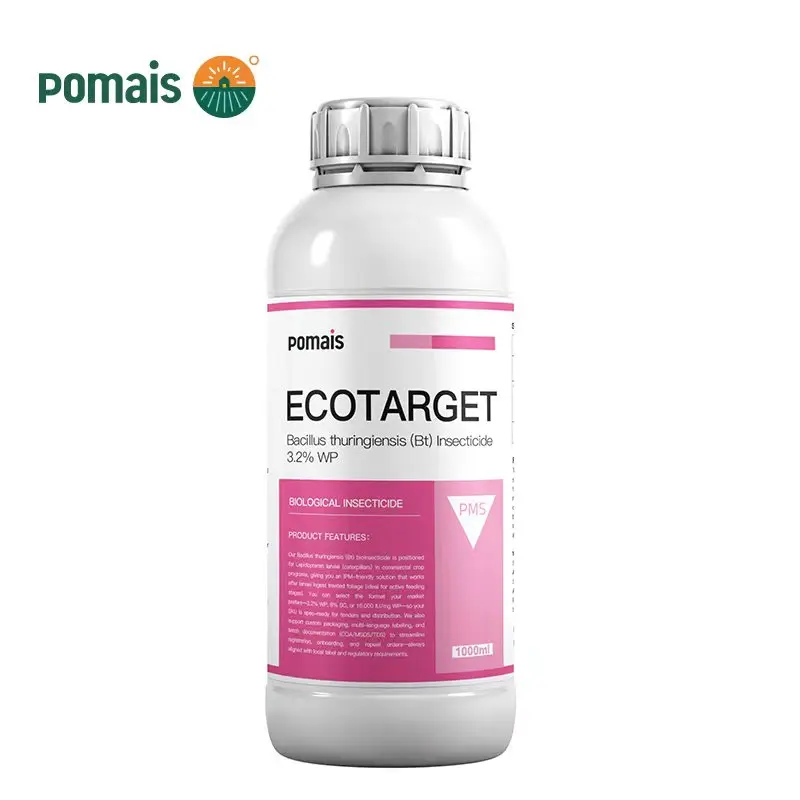
Bacillus thuringiensis (Bt) Insecticide 3.2% WP, 8% SC, 16,000 IU/mg WP
If you need a dependable Bt bioinsecticide for Lepidopteran larvae (caterpillars) in commercial crop programs, this product line is built for distribution: clear formulations, spec-friendly potency reference, and a performance profile that fits IPM-oriented procurement. Bt works after larvae ingest treated plant surfaces, making it best suited for active feeding stages rather than instant contact knockdown.
- Designed for Professional Buyers & Bulk Orders
- We support custom packaging, labeling, and formulation to meet your market needs.
- Export wholesale inquiries only.
- Please include destination country, business type (importer/distributor/registrant), and expected volume.
- Retail requests will not be processed.

About Bacillus thuringiensis (Bt) Insecticide 3.2% WP, 8% SC, 16,000 IU/mg WP
| Item | Specification |
|---|---|
| Active | Bacillus thuringiensis (Bt) |
| Formulations | 3.2% WP, 8% SC, 16,000 IU/mg WP |
| Target pest group | Lepidopteran larvae (caterpillars) |
| Crop fit (examples) | Cotton, rice, tobacco, maize, cabbage/leafy vegetables, apples and other orchard scenarios, radish/greens, sorghum |
| Product type | Live microbial biopesticide (spores + insecticidal proteins) |
| Compliance note | Always follow local registration requirements and label directions |
What Bacillus thuringiensis (Bt) Is
Bt is a naturally occurring soil bacterium used as a biopesticide. Commercial Bt products are commonly described as a system of spores and insecticidal proteins that are toxic to certain insect larvae when eaten. That “ingestion requirement” is the reason Bt is typically positioned for larval feeding stages and IPM-compatible programs.
Mode of Action
Bt acts primarily in the insect midgut. After susceptible larvae ingest Bt, the insecticidal proteins are activated in the gut environment, bind to specific sites, and contribute to midgut epithelial damage (often described as pore formation and cell lysis). The commercial takeaway is straightforward: larvae stop feeding, then die—so field results are usually observed over a short interval rather than instantly.
Target Pests
This Bt product line is positioned for Lepidopteran larvae, including (your declared scope):
- Cotton bollworm
- Cabbage caterpillars
- Diamondback moth
- Common armyworms and cutworm-type larvae (e.g., Spodoptera complex)
- Beet armyworm and related noctuid larvae
- Other leaf-feeding caterpillars such as loopers, inchworms, slug caterpillars
In many agricultural references, Bt var. kurstaki (Btk) is the most widely used Bt type for Lepidopteran larvae, while other Bt types are aligned to mosquitoes/gnats or beetle larvae.
Crop Fit and Use Scenarios
You can position this product across multiple cropping systems where caterpillars drive defoliation risk and quality loss:
- Field crops: cotton, rice, maize, sorghum
- Industrial crops: tobacco
- Vegetables: cabbage and leafy vegetables, radish/greens
- Orchards / tree crops: apples and similar orchard programs
From a procurement perspective, Bt is often adopted where buyers want a biological control tool that supports rotation planning and program-based caterpillar management.
Performance Expectations: Speed, Residual Window, and Temperature Sensitivity
Bt is best positioned as a program insecticide, not an instant knockdown product.
- Onset: Your field positioning of “noticeable results after about 2–3 days” matches how Bt is typically communicated—ingestion-driven activity that takes time to manifest.
- Residual: Your 7–10 day residual window can be presented as a practical expectation under stable conditions, while being clear that rainfall, sunlight, and other field factors can reduce persistence.
- Temperature: You noted performance becomes reliable above ~18°C and improves as feeding activity increases. The buyer-facing way to state this is: “Bt performs best in warm conditions when larvae are actively feeding.”
Use compliant language in-market: results vary with pest stage distribution, pest pressure, canopy coverage, and weather.
Formulation Options: 3.2% WP vs 8% SC vs 16,000 IU/mg WP
You offer three options to match distributor preferences and tender specs.
3.2% WP (Wettable Powder)
A practical choice for markets that prefer dry formulations and straightforward logistics. “Bt powder” language also matches common search behavior for WP-type Bt products.
8% SC (Suspension Concentrate)
A liquid-format option that fits conventional handling habits in many channels and can support premium line positioning depending on market expectations.
16,000 IU/mg WP (Potency-Anchored Option)
IU/mg is a recognized potency expression used for Bt standardization in comparative bioassays. The HD-1-S-1980 reference standard is widely cited at 16,000 IU/mg, which is why “16,000 IU/mg WP” works well as a spec anchor for buyers who evaluate Bt by potency units.
Professional note for procurement: potency is a valuable standardization tool, but it may not perfectly predict field performance across all target species and conditions—so it should be interpreted together with target-pest alignment and field context.
Quality Control and Documents You Receive
For importers and distributors, the real buying decision often comes down to batch consistency and documentation, not marketing claims. Your Bt line can be positioned with a documentation-first promise:
- COA for each batch (spec and traceability)
- MSDS and TDS for compliance review and downstream onboarding
- Export packaging coordination and label-ready support for multi-market distribution
FAQ
What is Bacillus thuringiensis (Bt)?
Bt is a soil bacterium used as a biopesticide. It produces proteins that are toxic to certain insect larvae when eaten, making it suitable for larval-stage control programs.
How does Bt kill caterpillars?
Susceptible larvae ingest Bt. Bt proteins act in the midgut, bind to specific sites, and contribute to midgut cell damage, leading to feeding cessation and death.
Why does Bt work more slowly than contact insecticides?
Bt is ingestion-driven and works through gut mechanisms rather than immediate contact knockdown. Visible results are typically observed after a short interval, especially when larvae are actively feeding.
What does 16,000 IU/mg mean?
It is a potency expression used in Bt standardization. The HD-1-S-1980 reference standard is widely cited at 16,000 IU/mg for comparative bioassays.
Is Bti (israelensis) the same as “Bt for caterpillars”?
No. Bti is positioned for larvae of mosquitoes, black flies, and fungus gnats. Caterpillar programs typically use different Bt types (commonly Btk-aligned).
Next Step: Get a Label-Ready Answer
To help you select the right formulation and build a compliant, sellable SKU for your market, send the basics below and you’ll receive a label-ready response package:
- Target country/region and registration pathway
- Target pests and crops (high-level is enough)
- Preferred formulation: 3.2% WP, 8% SC, or 16,000 IU/mg WP
- Packaging format and label language requirements
You’ll get a spec summary, documentation checklist (COA/MSDS/TDS), and a positioning recommendation aligned to your target pest group.