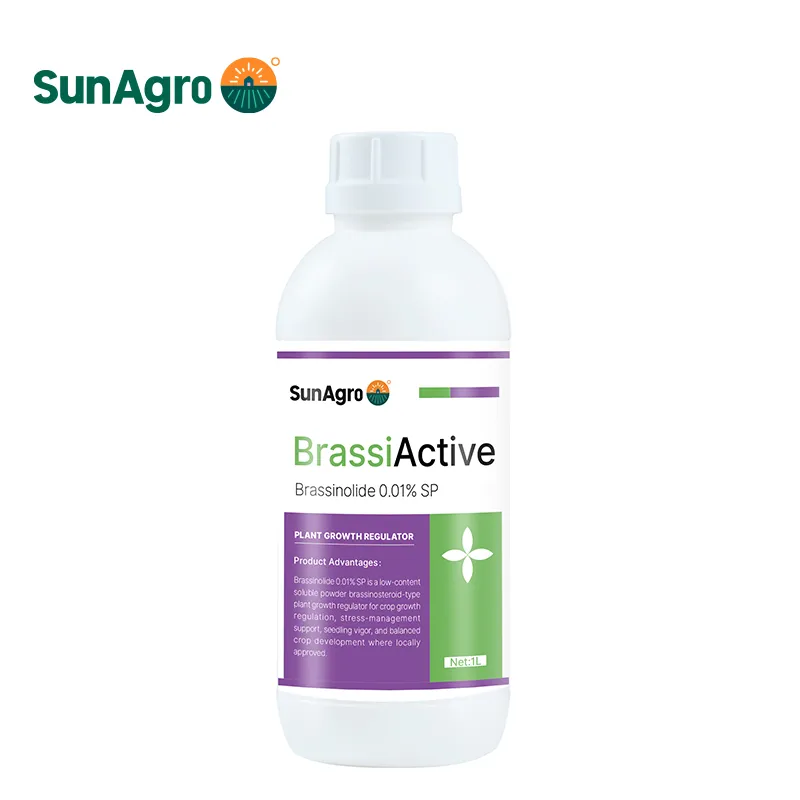
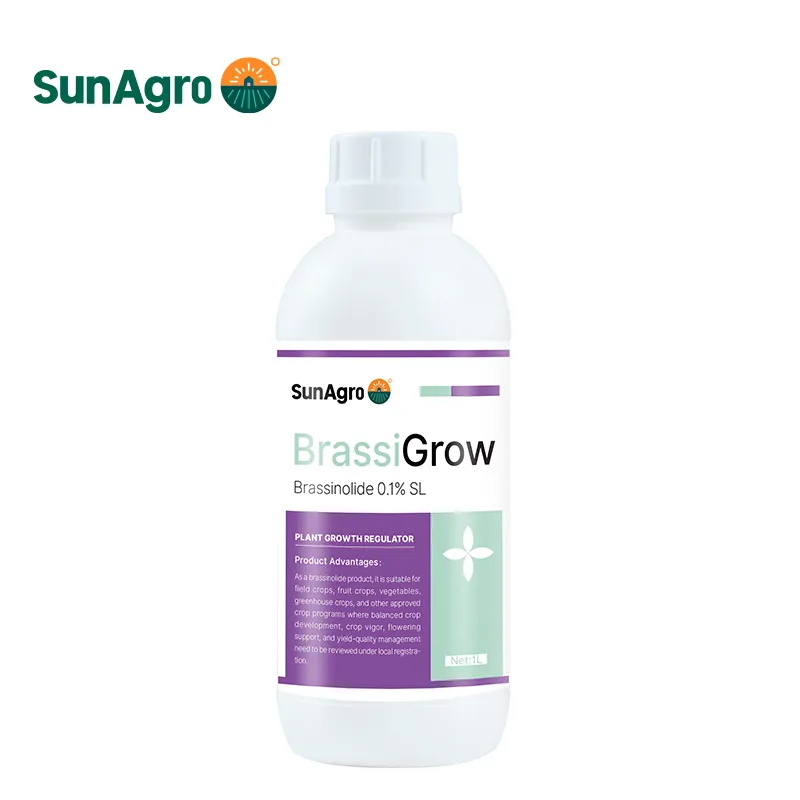
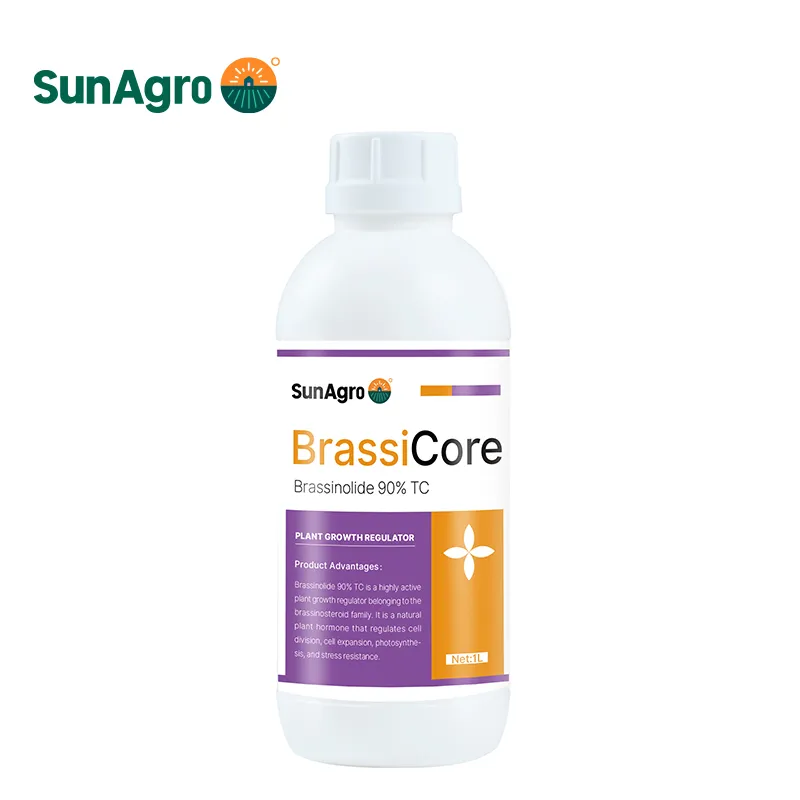
Brassinolide 0.1% SL, 0.01% SP, 90% TC
POMAIS supplies Brassinolide 0.1% SL and Brassinolide 0.01% SP as formulated plant growth regulator options for approved agricultural programs. These products are positioned to support crop growth, physiological activity and plant response to environmental stress when applied at the correct crop stage and label rate.
Brassinolide is not a fertilizer, insecticide or fungicide. It regulates plant physiological processes rather than directly supplying nutrients or controlling pests and diseases. Field performance depends on the exact active substance, formulation quality, crop condition, application timing, concentration and local growing environment.
For formulation manufacturers and registration partners, Brassinolide 90% TC is available as a technical material option for downstream product development. The exact active substance identity, assay, CAS number and specification must be confirmed before commercial supply because brassinolide, 24-epibrassinolide and related brassinosteroid products are not automatically interchangeable.
About Brassinolide 0.1% SL, 0.01% SP, 90% TC
| Product Attribute | Specification |
|---|---|
| Product Name | Brassinolide Plant Growth Regulator |
| Available Specifications | 0.1% SL, 0.01% SP and 90% TC |
| Exact Active Substance | Confirmed according to the technical specification and registration requirement |
| Product Category | Plant Growth Regulator |
| Formulation Types | Soluble Liquid, Soluble Powder and Technical Material |
| Main Agricultural Role | Regulation of crop growth and physiological processes |
| Primary Application Direction | Foliar or other approved application according to the local label |
| Direct Crop Use | 0.1% SL and 0.01% SP where registered |
| Technical Processing Use | 90% TC for downstream formulation development |
| Typical Crop Direction | Field crops, vegetables, fruit crops, ornamentals and specialty crops where approved |
| Standard MOQ | Normally 1,000 L for liquid formulations or 1,000 kg for solid products |
| Available Documents | COA, SDS, TDS, product specification and available registration-supporting information |
| Packaging Support | Bottles for SL, sachets or containers for SP, and industrial packaging for TC |
| Supply Type | Bulk B2B supply for importers, distributors, registration partners and formulators |
The exact product name must match the active substance stated in the COA, SDS, registration file and label. A product containing 24-epibrassinolide or another brassinosteroid should not be declared simply as brassinolide unless the documentation supports that naming.
What Is Brassinolide?
Brassinolide belongs to the brassinosteroid group of plant hormones. In agricultural products, it is used as a plant growth regulator to influence plant development and physiological activity.
Brassinosteroid signaling is associated with processes such as:
- Cell expansion
- Tissue development
- Root and shoot growth
- Leaf development
- Photosynthetic activity
- Reproductive development
- Plant response to environmental stress
The product does not directly provide nitrogen, phosphorus, potassium or micronutrients. It also does not directly kill insects, pathogens or weeds.
Its role is to support the plant’s own physiological processes. This is why results depend heavily on crop stage, plant health, application rate and the overall management program.
Importers developing a plant growth regulator portfolio should position brassinolide as a physiological regulation product rather than as a replacement for fertilizers, pesticides or irrigation management.
Brassinolide 0.1% SL vs 0.01% SP vs 90% TC
The three specifications serve different commercial purposes.
| Comparison Factor | Brassinolide 0.1% SL | Brassinolide 0.01% SP | Brassinolide 90% TC |
|---|---|---|---|
| Product Status | Finished formulation | Finished formulation | Technical material |
| Physical Form | Soluble liquid | Soluble powder | Concentrated technical material |
| Main Buyer | Importer, distributor or agricultural brand | Importer, distributor or agricultural brand | Formulator or registration company |
| Direct Crop Application | According to the approved label | According to the approved label | Not for direct field use |
| Typical Packaging | Bottle or drum | Sachet, bag or container | Industrial bag, drum or other technical packaging |
| Main Quality Focus | Solution stability, pH and packaging compatibility | Solubility, moisture and content uniformity | Assay, identity, impurities and batch consistency |
| Mixing Method | Measured and diluted in water | Dissolved or pre-dissolved according to the label | Used in formulation processing |
| Label Requirement | Product-specific label | Product-specific label | Technical specification rather than a crop-use label |
| Procurement Purpose | Ready-to-market liquid PGR | Ready-to-market soluble powder PGR | Downstream formulation development |
Brassinolide 0.1% SL
Brassinolide 0.1% SL is a liquid finished formulation. SL means Soluble Liquid, indicating that the formulated product is designed to form a solution when diluted correctly in water.
This option may be suitable for markets that prefer:
- Liquid agricultural products
- Bottle-based retail packaging
- Convenient volumetric measurement
- Straightforward spray-tank dilution
- Multilingual bottle labels
- Distributor-ready finished formulations
The quality assessment should focus on active ingredient content, solution appearance, pH, dilution stability, low-temperature behavior and compatibility with bottles, caps and induction seals.
Brassinolide 0.01% SP
Brassinolide 0.01% SP is a lower-concentration soluble powder formulation. SP means Soluble Powder, indicating that the product is designed to dissolve in water according to the approved mixing instructions.
This format may be suitable for markets requiring:
- Small sachet packaging
- Lightweight export cartons
- Powder-based agricultural inputs
- Flexible pack counts
- Low-volume retail units
- Easy distributor storage
The quality assessment should focus on active ingredient uniformity, solubility, moisture content, powder flow, caking resistance and sachet seal integrity.
Brassinolide 90% TC
Brassinolide 90% TC is a technical material intended for downstream formulation development.
It should not be sold or promoted as a direct-use crop product.
Typical buyers include:
- Pesticide formulation manufacturers
- Plant growth regulator factories
- Registration companies
- Local formulation partners
- Agricultural chemical brands with processing capability
Technical-material procurement requires confirmation of:
- Exact active substance
- Assay
- Identity
- Impurity profile
- Moisture
- Batch consistency
- Technical packaging
- Storage conditions
- Available analytical methods
Main Functions of Brassinolide in Plants
Supports Cell Expansion and Balanced Growth
Brassinolide participates in growth-related signaling inside the plant. It may support cell expansion and normal tissue development when applied at an appropriate concentration and growth stage.
This does not mean that higher concentrations produce stronger results. Excessive use may disturb normal growth or create an unbalanced plant response.
The objective should be controlled physiological regulation rather than maximum stimulation.
Supports Root and Seedling Development
Brassinolide may be used in programs designed to support early seedling vigor, root activity and transplant establishment.
Potential application stages may include:
- Nursery development
- Early vegetative growth
- Transplant recovery
- Root establishment
- Recovery from moderate environmental stress
Results still depend on adequate nutrition, water, temperature and root-zone conditions. Brassinolide cannot correct severe root disease, waterlogging or serious nutrient deficiency by itself.
Supports Photosynthesis and Crop Vigor
Healthy leaf development and physiological activity are important for crop growth.
Brassinolide may support plant processes associated with:
- Leaf expansion
- Chlorophyll maintenance
- Photosynthetic performance
- Biomass development
- Crop vigor
- Recovery of normal growth
The product should be used as part of a complete crop-management program rather than as a stand-alone yield solution.
For a deeper explanation of physiological responses, review how brassinolide affects plant growth and stress response.
Supports Plant Response to Abiotic Stress
Brassinosteroid plant growth regulators are often positioned in programs designed to help crops respond to non-living environmental stress.
Potential stress directions may include:
- High temperature
- Low temperature
- Drought
- Salinity
- Transplant stress
- Temporary water imbalance
- Moderate chemical or environmental stress
The product does not remove the stress source.
For example:
- It cannot replace irrigation during drought.
- It cannot remove salts from the soil.
- It cannot reverse frost injury after plant tissue has died.
- It cannot replace disease or pest control.
- It cannot correct severe fertilizer deficiency.
Its role is to support the plant’s physiological response where the crop remains capable of recovery.
How Brassinolide Works as a Plant Growth Regulator
Brassinolide acts through plant signaling pathways rather than by supplying nutrients directly.
After the active substance is recognized by plant receptors, it can influence growth-related signaling and gene activity. These processes may affect cell expansion, tissue differentiation, root development and plant response to environmental conditions.
The final crop response is influenced by:
- Exact brassinosteroid identity
- Product concentration
- Formulation quality
- Crop species
- Variety
- Growth stage
- Application timing
- Spray coverage
- Environmental conditions
- Nutrient status
- Water availability
- Existing crop stress
This is why one universal application program cannot be used for every crop and market.
Brassinolide should be positioned as a physiological regulator. It supports selected plant processes but does not replace the crop’s basic requirements for water, nutrition, light and pest management.
Brassinolide Use in Agriculture
Brassinolide may be used at different stages of crop production where supported by the registered label.
| Crop Stage or Program | Typical Application Objective |
|---|---|
| Seedling Establishment | Support early vigor, root activity and uniform development |
| Transplant Recovery | Support physiological recovery after transplanting |
| Vegetative Growth | Support leaf, stem and shoot development |
| Pre-Flowering Stage | Support balanced transition into reproductive development where approved |
| Flowering Stage | Support reproductive activity according to the crop label |
| Fruit Development | Support normal crop development and quality formation |
| Moderate Stress Periods | Support plant response to heat, cold, drought or salinity |
| Post-Stress Recovery | Support the return of normal physiological activity |
| Specialty-Crop Programs | Provide targeted PGR support based on local crop practices |
The correct application stage depends on the treatment objective.
A program designed for seedling establishment should not automatically use the same rate or timing as a program designed for fruit development.
For a broader crop-use explanation, review our guide to brassinolide use in agriculture.
Brassinolide Application Instructions
The following instructions describe general professional use principles. They do not replace the registered label.
Exact dilution, application rate, crop timing, spray interval and maximum number of treatments must follow the approved local product label.
Before Application
Confirm the exact product before preparing the spray solution.
Check:
- Active substance
- Concentration
- Formulation
- Target crop
- Crop stage
- Application objective
- Approved rate
- Water volume
- Label restrictions
- Weather conditions
Brassinolide 0.1% SL and Brassinolide 0.01% SP cannot be used at the same product rate simply because they contain the same type of plant growth regulator.
The difference in concentration must be included in the dosage calculation stated on the label.
Mixing Brassinolide 0.1% SL
Where permitted by the label:
- Fill part of the spray tank with clean water.
- Start suitable agitation.
- Measure the required quantity accurately.
- Add the soluble liquid to the tank.
- Add the remaining water.
- Maintain mixing until the solution is uniform.
- Apply within the recommended period.
Do not estimate the quantity by eye. Accurate measurement is especially important with low-dose plant growth regulator products.
Mixing Brassinolide 0.01% SP
Where permitted by the label:
- Use clean, dry measuring equipment.
- Measure the soluble powder accurately.
- Pre-dissolve the powder in a small quantity of clean water where required.
- Stir until the material has dissolved.
- Add the pre-mixed solution to the spray tank.
- Complete filling with water.
- Maintain suitable agitation during preparation and application.
Avoid introducing moisture into opened powder packaging because this may cause caking or reduce storage quality.
Foliar Application
When used as a foliar spray:
- Apply uniformly across the target plant tissue.
- Use calibrated spray equipment.
- Avoid excessive runoff.
- Do not apply in strong wind.
- Avoid application immediately before heavy rain unless the label permits it.
- Do not spray crops under severe heat or water stress unless specifically approved.
- Follow crop-specific timing.
- Avoid unnecessary overlap between spray passes.
Uniform coverage is generally more important than applying an excessive concentration.
After Application
After treatment:
- Record the product, batch, rate and application date.
- Monitor crop development.
- Do not repeat the application earlier than the label interval.
- Clean spray equipment properly.
- Dispose of unused spray mixture according to local requirements.
- Store remaining product in its original sealed package.
- Do not transfer the product into food or beverage containers.
When Should Brassinolide Be Used?
Application timing should match the crop-management objective.
Seedling Stage
Brassinolide may be used during seedling development where the label supports early-growth applications.
The purpose may be to support:
- Root activity
- Seedling vigor
- Uniform growth
- Transplant preparation
Do not use it to conceal poor nursery management, root disease or serious nutrient problems.
Vegetative Growth Stage
During vegetative development, the product may support leaf, stem and shoot growth.
Applications should be aligned with:
- Crop vigor
- Canopy development
- Nutrient availability
- Water conditions
- Target growth objective
Over-stimulation is not the objective. Balanced development is more important than excessive vegetative growth.
Flowering and Reproductive Stages
Some registered programs may include pre-flowering, flowering or early fruit-development applications.
The exact purpose and rate must be crop-specific.
Brassinolide should not be promoted as guaranteeing:
- Higher fruit set
- Complete prevention of flower drop
- Larger fruit on every crop
- Guaranteed yield improvement
These outcomes depend on pollination, nutrition, weather, crop variety and overall management.
Moderate Stress Periods
The product may be positioned before, during or after moderate abiotic stress where allowed by the label.
However, application should not replace corrective measures such as:
- Irrigation
- Drainage
- Shade management
- Soil improvement
- Nutrient correction
- Pest control
- Disease control
Plants with dead tissue, severe wilting, advanced root rot or irreversible frost injury may not respond as expected.
Brassinolide 0.1% SL Quality Focus
Important parameters may include:
| Quality Parameter | Procurement Importance |
|---|---|
| Active Ingredient Content | Confirms the declared concentration |
| Solution Appearance | Helps identify separation, precipitation or contamination |
| pH | Supports formulation and storage stability |
| Dilution Stability | Confirms behavior after mixing with water |
| Low-Temperature Stability | Important for transport and storage in colder markets |
| Heat Stability | Important for tropical and container-shipping conditions |
| Bottle Compatibility | Reduces leakage, deformation and interaction with packaging |
| Seal Integrity | Protects product quality during storage and transport |
Brassinolide 0.01% SP Quality Focus
Important parameters may include:
| Quality Parameter | Procurement Importance |
|---|---|
| Active Ingredient Uniformity | Helps maintain consistent performance across small packs |
| Solubility | Confirms the powder can be prepared correctly |
| Moisture Content | Excess moisture may cause caking or degradation |
| Powder Flow | Supports accurate filling and user handling |
| Caking Resistance | Important for long-term storage |
| Sachet Seal Quality | Prevents moisture entry and product loss |
| Pack Weight Control | Supports label accuracy and commercial consistency |
| Storage Stability | Confirms performance during the stated shelf life |
Brassinolide 90% TC Quality Focus
Technical-material buyers should assess:
| Quality Parameter | Procurement Importance |
|---|---|
| Assay | Confirms active substance concentration |
| Identity | Confirms the exact brassinosteroid supplied |
| Impurity Profile | Supports formulation and registration assessment |
| Moisture | May affect storage and formulation processing |
| Physical Appearance | Supports batch evaluation |
| Batch Consistency | Important for stable downstream formulation |
| Analytical Method | Supports incoming quality inspection |
| Technical Packaging | Protects the material during storage and transport |
Tank Mixing and Compatibility
Tank mixing should follow the product label and confirmed compatibility information.
Brassinolide should not be described as compatible with every fertilizer, pesticide or plant growth regulator.
Compatibility can be influenced by:
- Water pH
- Water hardness
- Temperature
- Mixing order
- Partner formulation
- Fertilizer concentration
- Adjuvants
- Number of products in the tank
- Crop sensitivity
- Spray-solution storage time
General Compatibility Principles
- Use clean water.
- Follow the recommended mixing sequence.
- Avoid strong acids or strong alkaline products unless compatibility is confirmed.
- Conduct a small jar test for unfamiliar mixtures.
- Maintain suitable agitation.
- Apply the mixture within the recommended period.
- Test crop safety on a small area where necessary.
- Do not mix products only to reduce application costs.
Physical compatibility does not guarantee biological compatibility or crop safety.
A mixture may remain physically uniform but still produce an undesirable crop response.
Label and Registration Requirements
There is no single global set of brassinolide instructions.
Every commercial product label must match the exact:
- Active substance
- Concentration
- Formulation
- Registration holder
- Destination country
- Crop list
- Application method
- Rate
- Spray interval
- Safety classification
- Packaging format
Brassinolide 0.1% SL and Brassinolide 0.01% SP require separate product specifications and labels.
A rate written for the 0.01% SP product cannot be copied directly to the 0.1% SL product.
Brassinolide 90% TC is supplied with a technical specification and industrial safety information. It is not supplied with a direct field-application label.
Information Required for Label Review
Before commercial supply, buyers should provide:
- Destination country
- Required active substance
- Required concentration
- Formulation
- Target crops
- Intended application stage
- Required packaging
- Label language
- Registration status
- Required technical documents
The sachet, bottle, carton, COA, SDS, TDS and registration documents must use consistent product information.
Packaging Options
Packaging should match the product format, market channel and registration requirements.
Packaging for Brassinolide 0.1% SL
Available discussions may include:
- Small retail bottles
- Standard agricultural bottles
- Larger commercial containers
- Induction seals
- Tamper-evident caps
- Measuring caps where appropriate
- Multilingual labels
- Retail cartons
- Master cartons
- Batch and expiry coding
Bottle material must be compatible with the final formulation.
Packaging for Brassinolide 0.01% SP
Available discussions may include:
- Small soluble-powder sachets
- Foil-laminate bags
- Multi-sachet retail boxes
- Larger bags or containers
- Moisture-resistant packaging
- Multilingual printing
- Batch coding
- Custom carton quantities
- Distributor information
- Barcode placement
Because the active ingredient concentration is low, accurate filling and content uniformity are important quality-control points.
Packaging for Brassinolide 90% TC
Technical-material packaging may include industrial bags, drums or other suitable containers based on:
- Material properties
- Order quantity
- Moisture protection
- Transport classification
- Destination requirements
- Formulator handling conditions
Technical material must be packed and labeled for industrial handling rather than direct agricultural retail use.
Quality Control and Documentation Support
Before confirming production, we review the product specification, formulation type, packaging material, label information and destination-market requirements.
Product and Packaging Checks
Quality-control items may include:
- Raw material identity
- Active ingredient content
- Physical appearance
- pH where applicable
- Solubility or dilution behavior
- Moisture where applicable
- Pack weight or fill volume
- Seal integrity
- Label accuracy
- Batch coding
- Carton quantity
- Pre-shipment packaging condition
Available Documents
Commercial document support may include:
- COA — Certificate of Analysis
- SDS — Safety Data Sheet
- TDS — Technical Data Sheet
- Product Specification
- Packaging Specification
- Available registration-supporting information
- Batch-related quality documents
- Commercial and shipping documents
Document availability depends on the exact active substance, formulation, destination market, registration pathway and cooperation stage.
Safety and Storage
Brassinolide products must be handled according to the approved label or technical-material safety instructions.
Safety for 0.1% SL and 0.01% SP
- Avoid unnecessary skin and eye contact.
- Do not inhale spray mist or powder.
- Wear the protective equipment stated on the label.
- Do not eat, drink or smoke during handling.
- Wash hands after use.
- Keep away from children and unauthorized users.
- Prevent contamination of food and animal feed.
- Do not reuse empty containers.
- Dispose of packaging according to local regulations.
Storage for Formulated Products
Store the products:
- In original sealed packaging
- In a cool and dry warehouse
- Away from direct sunlight
- Away from excessive heat
- Away from freezing conditions where relevant
- Away from moisture
- Away from food and feed
- Under secure pesticide-storage conditions
Opened SP packaging should be resealed promptly to reduce moisture exposure.
Safety for Brassinolide 90% TC
Technical material requires industrial handling controls.
Buyers should:
- Use suitable protective equipment.
- Control dust or direct exposure.
- Handle the material in a suitable processing environment.
- Prevent unauthorized access.
- Follow the technical SDS.
- Store it in secure industrial packaging.
- Never apply the technical material directly to crops.
Frequently Asked Questions
Request Brassinolide Product
To evaluate a Brassinolide 0.1% SL, 0.01% SP or 90% TC project, please provide:
- Destination country
- Company type
- Exact active substance required
- Required formulation
- Required concentration
- Estimated order quantity
- Preferred package size
- Target crops
- Intended application stage
- Required label language
- Current registration status
- Required technical documents
We will review the active substance specification, formulation availability, packaging feasibility, documentation requirements and destination-market conditions before confirming the commercial proposal.
Brassinolide products are supplied for professional B2B procurement, registration, formulation processing and wholesale distribution.
Contact us!
We will reply to you within 24 hours on business days!