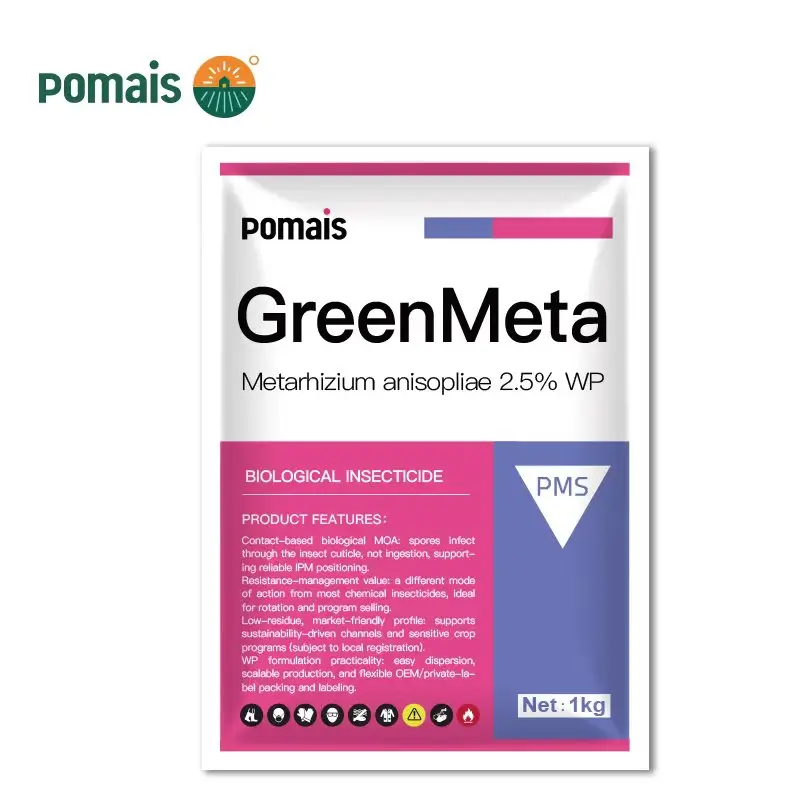
Metarhizium anisopliae Bio-Insecticide 2.5% WP, 10 Billion CFU/g OD, 5 Billion CFU/g SC
If you need a biocontrol-grade insecticide that fits modern IPM programs, Metarhizium anisopliae is a proven entomopathogenic fungus used worldwide as a biopesticide. It works through a contact infection cycle—spores attach to the insect cuticle, germinate, penetrate, and then colonize the host—so it is best positioned as a program tool rather than an instant knockdown product.
We supply three commercial formats to match distribution preferences and field conditions: 2.5% WP, 10 Billion CFU/g OD, and 5 Billion CFU/g SC.
- Designed for Professional Buyers & Bulk Orders
- We support custom packaging, labeling, and formulation to meet your market needs.
- Export wholesale inquiries only.
- Please include destination country, business type (importer/distributor/registrant), and expected volume.
- Retail requests will not be processed.

About Metarhizium anisopliae Bio-Insecticide 2.5% WP, 10 Billion CFU/g OD, 5 Billion CFU/g SC
| Product type | Metarhizium anisopliae biopesticide / fungal insecticide (entomopathogenic fungus) |
| Available formulations | 2.5% WP (wettable powder) · 10B CFU/g OD (oil dispersion) · 5B CFU/g SC (suspension concentrate) |
| Potency expression | CFU / viable spores (conidia)—batch verified by COA |
| Best-fit positioning | Soil/ground-dwelling pest programs; targeted contact infection approach |
| Commercial deliverables | COA (viable spore count), SDS/MSDS, TDS / “ficha técnica” on request, stability statement, private label support |
What is Metarhizium anisopliae?
Metarhizium anisopliae is a naturally occurring fungus that infects and kills insects and certain mites. In agriculture and vector management, it is used as a fungus-based insecticide (mycoinsecticide) because it can suppress pest populations through biological infection rather than chemical poisoning.
How Metarhizium anisopliae Works (Mode of Action)
A buyer-friendly way to explain the mode of action is the infection cycle. This structure also matches how high-ranking educational pages describe entomopathogenic fungi.
1) Spore contact and adhesion
The process starts when conidia (spores) contact the insect surface and adhere. Adhesion is mediated by surface forces and fungal secretions that stabilize attachment.
2) Germination and penetration of the cuticle
Under suitable conditions, spores germinate, form penetration structures, and breach the insect cuticle using a combination of mechanical pressure and cuticle-degrading enzymes (commonly described as proteases, chitinases, and lipases).
3) Internal colonization and mortality (not instant knockdown)
After penetration, the fungus proliferates in the host, leading to reduced mobility, feeding disruption, and death over time. This is why Metarhizium is typically positioned as program-based biological control, not “same-day” knockdown.
4) Sporulation and secondary cycling (when conditions allow)
In favorable environments, the fungus can sporulate on the host, supporting secondary cycling. This supports the “program” narrative, especially in soil/ground scenarios.
Target Pest Groups and Where This Product Fits Best
Metarhizium anisopliae is most commercially compelling when you position it by pest ecology (soil/ground exposure) rather than listing every insect on earth.
Primary commercial fit: soil and ground-dwelling pests
Metarhizium is widely positioned for pests that frequently contact treated soil or surfaces where conidia can persist and transfer.
Termite control: research-supported, project-dependent
Your keyword cluster includes “metarhizium anisopliae termite control.” Termites are susceptible in laboratory settings, but field success can be limited by termite social behaviors and colony-level defenses—so the correct market language is project-based, label-led termite management, not guaranteed control.
Tick control: clear evidence exists (strain and delivery matter)
Metarhizium-based products have been evaluated for tick management, including residential and livestock contexts. Outcomes depend on strain identity, formulation, and exposure pathways, and non-target considerations should be addressed transparently.
Mosquito control: a specialist use-case (evidence exists, positioning must be careful)
Metarhizium anisopliae has been investigated for mosquito control (including field persistence against adult mosquitoes and formulation-driven performance). This is best positioned as vector-management potential subject to registration and program design, not as a default agricultural claim.
Performance drivers you should state on-page
Because this is a living biopesticide, performance is influenced by temperature, humidity/moisture, and UV/rain exposure. Setting this expectation improves buyer trust and reduces misuse-driven complaints.
Formulation Selector: WP vs SC vs OD
Formulation choice is one of the strongest conversion levers on a Metarhizium product page because it connects biology to real distribution and field outcomes.
2.5% WP (Wettable Powder)
A baseline SKU for broad distribution: stable logistics, straightforward storage, and familiar handling for many markets.
5 Billion CFU/g SC (Suspension Concentrate)
A liquid format that fits channels preferring easier measuring and mixing routines, while keeping the product within a standard “SC” workflow.
10 Billion CFU/g OD (Oil Dispersion)
OD is defined as a stable suspension of active ingredient(s) in an organic fluid intended for dilution with water. In entomopathogenic fungi, oil-based formulations are frequently discussed because formulation affects rain-off loss, coverage, and persistence on treated surfaces—making OD a premium positioning option.
Formulation comparison table (buyer-friendly)
| What buyers optimize for | WP 2.5% | SC 5B CFU/g | OD 10B CFU/g |
|---|---|---|---|
| Distribution simplicity | Strong | Strong | Medium |
| “Premium formulation” story | Medium | Medium | Strong |
| Performance narrative under rain/coverage challenges | Medium | Medium | Strong (formulation-dependent) |
| Portfolio strategy | Baseline | Convenience liquid line | Premium / differentiated line |
Identity, Strain Naming, and Why It Matters in Procurement
Metarhizium taxonomy and strain naming can vary across registrations. For example, some commercial labels describe Metarhizium brunneum as “formerly known as Metarhizium anisopliae.” This is normal in the marketplace and is best handled with strain-level documentation and consistent COA language.
On request, we provide strain identity statements aligned to your documentation needs and destination market.
Safety, Bees, and Stewardship Messaging
Buyers often ask about bees and non-targets. The correct position is “risk depends on strain and exposure,” supported by published work and long-running safety discussions for Metarhizium products.
- A well-cited review discusses Metarhizium anisopliae as generally presenting minimal risk to vertebrates and the environment when used appropriately.
- Specific studies evaluating exposure scenarios (e.g., bumble bees with certain commercial strains) report safe outcomes under tested conditions, but this should not be marketed as universal safety across all strains and all exposures.
Recommended on-page stewardship line:
Use only as directed by the approved label and local regulations. Avoid unnecessary exposure to pollinators and beneficial insects during sensitive periods where relevant.
Quality Control and Documents You Will Receive
For distributors and brand owners, the purchasing decision depends on repeatable viability + paperwork completeness:
- Batch COA: viable spore count (CFU/conidia), key release parameters
- SDS/MSDS and TDS (technical data sheet / “ficha técnica” on request)
- Stability and storage statement aligned to packaging and transport realities
- Private label support: multi-language labels, export packing coordination, batch traceability
This is how you reduce claims risk and protect your channel reputation.
FAQ
What is Metarhizium anisopliae used for in agriculture?
It is used as a biocontrol agent / biopesticide to suppress certain insect pests through fungal infection by contact, typically positioned as a program input rather than a quick knockdown tool.
How does Metarhizium anisopliae kill insects?
Conidia adhere to the insect cuticle, germinate, penetrate the cuticle, and then colonize the host internally, leading to mortality over time.
What do “spores” and “CFU” mean when buying Metarhizium anisopliae?
They refer to viable infective units (conidia/CFU). Procurement should rely on a batch COA that verifies viability at release.
Which formulation should I choose: WP, SC, or OD?
Choose based on your channel and field narrative: WP for baseline distribution, SC for liquid convenience, and OD for a premium formulation story—especially where coverage and persistence under challenging conditions are part of the buyer’s decision.
Is Metarhizium anisopliae effective for termite control?
It has been widely studied for termite biocontrol, but real-world success depends on termite behavior and delivery strategy. Position it as project-based and label-led rather than a guaranteed stand-alone solution.
Can it be used for tick control?
Metarhizium-based products have been evaluated for tick control; performance and non-target profile depend on strain and exposure pathways.
Is Metarhizium anisopliae safe for bees?
Risk is strain- and exposure-dependent. Published studies include assessments with commercial strains under defined conditions; always follow label directions and stewardship guidance.
Request Specifications and Pricing
If you are looking to buy Metarhizium anisopliae, request a quote, or compare formulations, send these details and you will receive a label-ready specification package:
- Destination country/region
- Target pest groups (e.g., soil pests, termites, ticks, vectors)
- Preferred formulation: 2.5% WP, 5B CFU/g SC, or 10B CFU/g OD
- Packaging format and label language requirements
- Documents needed (COA, SDS/MSDS, TDS)