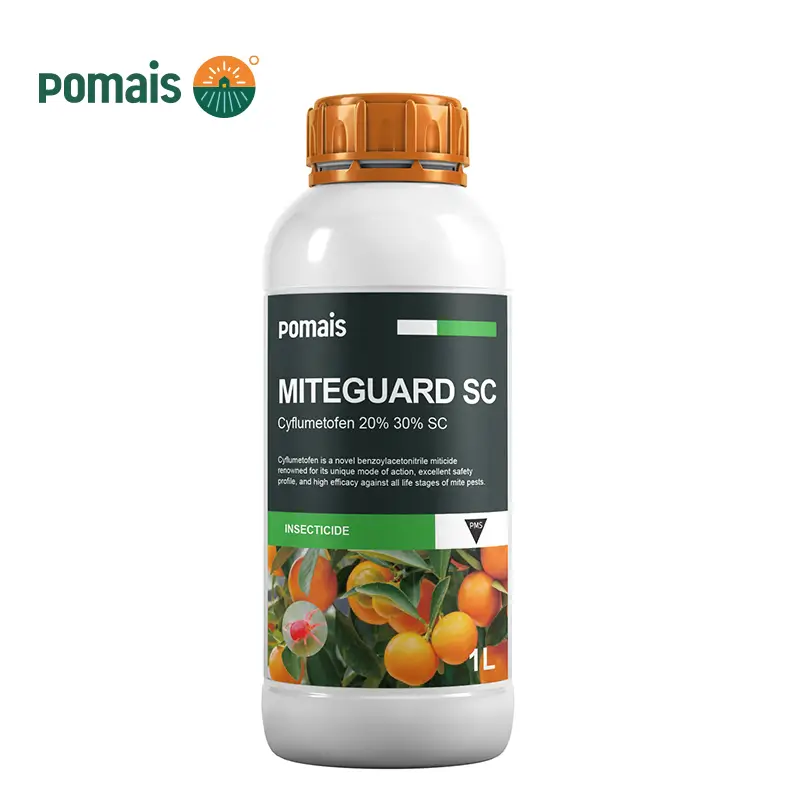
Cyflumetofen 20% 30%SC Miticide Pesticide
Selective Group 25A control for spider mites
Deliver fast, selective knockdown of tetranychid spider mites with cyflumetofen—an IRAC Group 25A mitochondrial complex II inhibitor designed for modern IPM programs. The 20% SC formulation provides clean dispersion and uniform deposition on labeled crops, with a profile that’s notably friendly to predatory mites and other beneficials.
What you can expect
- Distinct MoA for rotation (25A): mitochondrial complex II electron transport inhibition helps break resistance cycles.
- Selective & IPM-ready: strong activity on mobile stages with useful impact across life stages, while showing favorable safety to beneficials.
- Broad crop fit where registered: fruit & nuts, vegetables, tea, ornamentals (open field and protected).
- Commercially proven strength: 20% SC is a widely marketed format for red spider mites and related species.
- Designed for Professional Buyers & Bulk Orders
- We support custom packaging, labeling, and formulation to meet your market needs.
- Export wholesale inquiries only.
- Please include destination country, business type (importer/distributor/registrant), and expected volume.
- Retail requests will not be processed.

About Cyflumetofen 20% 30%SC Miticide Pesticide
| Active ingredient | Cyflumetofen |
| CAS No. | 400882-07-7 |
| IRAC / MoA | Group 25A — mitochondrial complex II electron-transport inhibitor |
| Chemical class | Benzoylacetonitrile acaricide |
| Formulation | 20% SC (suspension concentrate) |
| Target pests | Spider mites (Tetranychidae) |
| Documents | COA / MSDS / TDS |
| Shelf life | 2–3 years (unopened, typical) |
| Storage | Cool, dry, ventilated; protect from heat/sun & freezing |
| Label languages (OEM) | EN / ES / FR / AR / RU |
| Pack sizes | 100 mL / 250 mL / 500 mL / 1 L;bulk 5–20 L |
Mechanism of action
Cyflumetofen is a modern, selective acaricide for spider mites (Tetranychidae). Chemically a benzoylacetonitrile, it is classified by IRAC as Group 25A—a mitochondrial complex II electron-transport inhibitor. By blocking electron flow in mite cells, it disrupts ATP production, leading to rapid loss of mobility and death. This distinct site of action delivers strong activity on mobile stages (nymphs and adults) with useful impact across life stages, and it is well-suited to IPM because of its favorable profile to predatory mites and other beneficials where labels permit.
What this MoA means for real programs
- Distinct rotation slot: Group 25A is separate from abamectin (6), bifenazate (20D), hexythiazox/clofentezine (10A), spiromesifen/spirodiclofen (23), etc.—useful for breaking resistance cycles.
- IPM-friendly selectivity: Labels and manufacturer data emphasize good safety to key beneficials and predatory mites, helping preserve biological control.
- Contact performance: Works primarily by contact on exposed mites; thorough coverage and label-compliant application conditions are important to realize full efficacy.
- Broad crop fit (country-specific): Commonly positioned on fruit, nuts, vegetables, tea, and ornamentals where registered.
Use only on crops/sites and at timings permitted by the locally registered label. Labels and local regulations supersede any general guidance.
Formulation Line-up
Primary SKU — Cyflumetofen 20% SC (suspension concentrate).
Built for modern IPM programs, the 20% SC delivers clean dispersion and uniform foliar deposition on labeled crops while maintaining a profile that is friendly to predatory mites and other beneficials. It is a widely marketed commercial strength for spider-mite control programs.
Why 20% SC works for distributors
- Program fit: Contact performance on tetranychid mites with long residual, suited to fruit, nuts, vegetables, tea, and ornamentals where registered.
- Operational ease: Stable re-suspension and predictable sprayability under standard agitation. (See local labels for water volume and droplet guidance.)
- Market familiarity: Multiple markets list 20% SC products for spider-mite use patterns (e.g., national compendia and distributor offerings).
Context (not sold on this page): higher-strength SC references
Some labels feature 300 g/L SC positioned for eggs, nymphs, and adults across various crops; availability and use patterns are country-specific.
Formulation strengths, crops, adjuvant rules, intervals, and PHI/REI are defined by the locally registered label. Do not generalize instructions across countries.
Target Pests
Dial cyflumetofen 20% SC to the mite pressures that matter. Its spectrum centers on tetranychid spider mites, with strong activity on mobile stages and useful impact across life stages where labels allow.
Primary tetranychid targets (representative)
- Two-spotted spider mite (Tetranychus urticae) — broad crop relevance in open field and protected systems.
- European red mite (Panonychus ulmi) — pome fruit, tree fruit.
- Citrus red mite (Panonychus citri) — citrus.
- McDaniel spider mite (Tetranychus mcdanieli) — fruit crops.
- Pacific spider mite (Tetranychus pacificus) — grapes, nut crops.
- Spruce spider mite (Oligonychus ununguis) — ornamentals/forestry nurseries (label-dependent).
Additional species cited on labels/compendia (market-dependent)
Banks grass mite (Oligonychus pratensis), Brown almond mite (Bryobia rubrioculus), Texas citrus mite (Eutetranychus banksi), Strawberry/turkestani spider mite (T. turkestani), Willamette spider mite (Eotetranychus willamettei), and others. Confirm your national label before claims.
Program tips
- Treat at first sign or threshold to maximize knockdown and residual; ensure thorough coverage for contact performance.
- Leverage its distinct IRAC 25A slot to rotate away from other miticide classes when resistant populations are suspected.
Actual pest lists and allowed crops vary by country and product. The registered local label governs claims, timings, and any adjuvant rules.
Registered Crops & Use Scenarios
Where it’s commonly registered
- Fruit & nuts: pome/stone fruit, citrus, grapes, almonds and other tree nuts, strawberries.
- Vegetables: tomatoes and broader fruiting vegetables (e.g., peppers), plus cucumbers; several markets also include greenhouse uses.
- Other labeled sectors (by country): tea and ornamentals appear in manufacturer literature and some national portfolios.
Program settings (how it’s positioned)
- Open-field orchards & vineyards: contact performance on exposed mites in tree fruit and grape canopies—apply at or just below local action thresholds for best results.
- Row/bed crops & protected cultivation: tomatoes, strawberries, cucumbers and peppers in open field and, where permitted, greenhouses; thorough coverage is critical for contact miticides.
- Resistance-managed slot: a distinct IRAC 25A rotation partner to diversify programs built around 10A/20D/23/6 classes.
Crop lists, timing windows, adjuvant rules, and PHI/REI vary by country and label. Always follow the locally registered product label; it supersedes general guidance.
Application Guidance
Apply only where the product is registered and follow the approved label. The points below align use with best practice—without prescribing country-specific rates.
Timing & thresholds
- Treat at the first sign of mite activity or just below locally recommended action thresholds to maximize knockdown and residual performance.
Coverage (contact miticide)
- Cyflumetofen is a contact miticide with no systemic/translaminar/vapor action—spray both sides of leaves evenly with sufficient water volume to reach the mites.
Adjuvants & water (label-dependent)
- Follow the registered label for adjuvants; some labels restrict adjuvant type or require specific handling (e.g., use only a permitted NIS and avoid injurious concentrations).
Mixing & compatibility
- Shake/redisperse SCs, perform a jar test with partners, maintain agitation, and clean tanks/lines after use per label hygiene directions.
Environmental stewardship & drift
- Observe buffer zones and drift control: avoid applications during inversions, variable winds, or outside label wind-speed guidance; direct spray away from non-target areas.
Intervals, maximum uses & rotations
- Respect minimum retreatment intervals and maximum applications per crop/season; many labels cap apps and require rotation to non-25A miticides to slow resistance.
REI/PHI & records
- Follow label REI/PHI for each crop. Keep application logs (field, conditions, partners, lot numbers) to support audits and program refinement.
Specific crops, adjuvants, spray volumes, intervals, and PHI/REI are country- and label-dependent. Your national label always supersedes general guidance.
Selectivity & Beneficials
Cyflumetofen is a selective miticide targeted to tetranychid spider mites with a profile that is notably favorable to predatory mites and other beneficials, making it a strong fit for IPM programs where labels permit. Manufacturer and regulatory materials highlight that it delivers mite control while minimizing impact on non-target arthropods relative to many older chemistries.
Why it’s considered IPM-friendly
- Distinct MoA (IRAC 25A). As a mitochondrial complex II electron-transport inhibitor, it offers a unique rotation slot compared with common miticide classes, helping preserve biological control partners.
- Favorable non-target profile (context-dependent). Multiple sources describe very selective activity on spider mites with little or no effect on non-target arthropods, supporting use where conservation of beneficials matters. Always verify local label and conditions.
- Life-stage performance with contact action. Labels and regulatory reviews describe activity across mite life stages (eggs, nymphs, adults) in some markets; because it is contact (not systemic or translaminar), thorough coverage is essential to realize that selectivity and performance.
Non-target/beneficial impacts depend on crop, timing, coverage, and local conditions. Always follow the locally registered label and stewardship guidance.
Resistance Management (IRAC-aligned)
Build rotations that do not treat successive mite generations with the same MoA and that conserve beneficials—this is core IRAC guidance and widely echoed across extension programs.
Program principles
- Rotate MoA groups. Alternate Group 25A with non-25A miticides effective on the same species; organize sprays in windows/blocks so consecutive generations aren’t exposed to the same MoA.
- Respect label-defined limits. Follow your national label for maximum applications per crop/season and minimum retreatment intervals; many labels explicitly require rotation away from 25A after a spray.
- Hit thresholds early; ensure coverage. Treat at or just below local action thresholds and deliver full coverage (contact miticide) to reduce survivors—survivors drive resistance.
- Avoid flaring mites. Broad-spectrum insecticides can suppress natural enemies and aggravate mite problems; prioritize selective tools and IPM tactics.
- Document & review. Keep field records (date, conditions, partners, lot numbers) and adjust rotations if reduced sensitivity is suspected; consult local guidance.
Why this matters
- IRAC and regulatory dossiers emphasize that cyflumetofen’s unique MoA and selectivity make it an important resistance-management tool—especially where other classes have declining efficacy.
MoA rotations, seasonal caps, intervals, adjuvants, and crop uses are country-specific. The local registered label and national guidance always supersede general advice.
Packaging & OEM / Private Label
- Pack sizes (liquid): 100 mL, 250 mL, 500 mL, 1 L retail;5–20 L bulk;IBC on request
- Closures & seals: induction/foil liner;tamper-evident caps;child-resistant options (where required)
- Artwork workflow: dielines → artwork upload → color-match proof → print → mass production
- Label languages: EN / ES / FR / AR / RU(additional languages on request)
- Traceability: GS1 barcode、QR batch code、production date & lot ID on label/carton
- Export packing: UN-fit jerricans or bottles + export cartons、shrink-wrap、corner guards;destination-specific pallet plans
- Storage notes: keep away from heat and protect from direct sunlight; segregate from food/feed; final storage conditions per local label/SDS.
- Lead time & MOQ: typical 20–30 days after artwork approval & deposit;MOQ aligned to pack size and destination rules
Quality & Certificates
- QC controls: HPLC assay(a.i. %)、appearance、SG/viscosity(SC)、stability screen(heat/cold)、fill-volume accuracy
- In-process safeguards: automated dosing & mixing with deviation alarms;retain in-process samples for traceability
- Finished-goods validation: drop test & 24 h inversion leak test for liquid SKUs;label adhesion & scuff tests
- Documentation: COA / MSDS(SDS) / TDS(per batch);stability summary;registration support pack (where applicable)
- Certificates: ISO / SGS support;country-specific dossiers on request
- Storage compliance: follow the SDS and national label for storage & handling (e.g., away from heat and sunlight).
Market Fit by Region
- MENA: high-temperature logistics planning;Arabic/French labels;orchards, citrus, grapes & protected vegetables are common label contexts(country-specific)。
- Central Asia: RU/EN labels;greenhouse & open-field vegetables and orchards; observe cold-weather storage and seasonal shipping windows
- Sub-Saharan Africa: strong spider-mite pressure in orchards & vegetables;training packs on contact coverage and MoA rotation help reduce resistance risk
- South America: broad fruit & veg demand;Spanish/Portuguese labels;dossier coordination for local registrations
- North America / EU (context): labels highlight contact action, life-stage breadth, and compatibility with beneficials; some markets include greenhouse uses. Always verify your national label.
Crop lists, PHI/REI, adjuvants, intervals, and aerial/greenhouse provisions are country- and label-specific. Your local registered label supersedes general guidance.
FAQ
Q1. Which IRAC group is cyflumetofen, and what’s the site of action?
IRAC Group 25A (beta-ketonitriles): a mitochondrial complex II electron-transport inhibitor used as a distinct rotation slot versus other miticide classes.
Q2. Is Cyflumetofen 20% SC systemic or translaminar?
No. It’s a contact miticide; thorough two-sided leaf coverage and adequate water volume are essential.
Q3. Is it compatible with beneficials/predatory mites for IPM?
Manufacturer and labels emphasize selectivity and compatibility with beneficial mites/insects, supporting IPM programs where permitted.
Q4. Is a 20% SC formulation recognized by regulators/markets?
Yes. Cyflumetofen 20% SC appears in national compendia and approvals (e.g., India’s PPQS listing for red spider mites). Always follow your local registered label.
Q5. How should I handle storage and transport?
Follow the SDS/label: keep away from heat, protect from direct sunlight, segregate from food/feed, and observe local rules.
Q6. Do I need to rotate modes of action?
Yes. IRAC and regulatory reviews stress rotating 25A with non-25A miticides and respecting label caps/intervals to slow resistance.
Get a Quote — Share your target country, crops, pack sizes, label languages, annual volume, and preferred ship window.
Request Spec Pack — We’ll send COA/MSDS/TDS, a stability summary, and sample label templates for review.