
Metarhizium Anisopliae Uses in Agriculture
Metarhizium anisopliae is used in agriculture as a biological insect-control fungus for managing soil and foliar pest pressure in crop systems where growers want more than short-term knockdown. In practice, it is most valuable when you match the right strain and formulation to the target pest, apply it under favorable moisture and light conditions, and use it as part of a broader pest-management program rather than as a last-minute rescue treatment.
One important update matters before you go deeper: in current taxonomy, many strains historically discussed under “Metarhizium anisopliae” are now understood within a broader M. anisopliae species complex, which includes related taxa such as M. brunneum, M. robertsii, and others. That does not make the older keyword wrong for search or commercial discussion, but it does mean strain identity matters when you evaluate efficacy, registration, and field fit.
What Is Metarhizium Anisopliae?
Metarhizium anisopliae is an entomopathogenic fungus, meaning it infects insects rather than weeds or plant diseases. It is not a chemical insecticide. Its spores attach to the insect cuticle, germinate, form infection structures, penetrate the outer layer, and then colonize the insect internally. Proteases, chitin-degrading activity, and other enzymes help drive cuticle breakdown and host invasion before the fungus eventually sporulates again from the cadaver under suitable conditions.
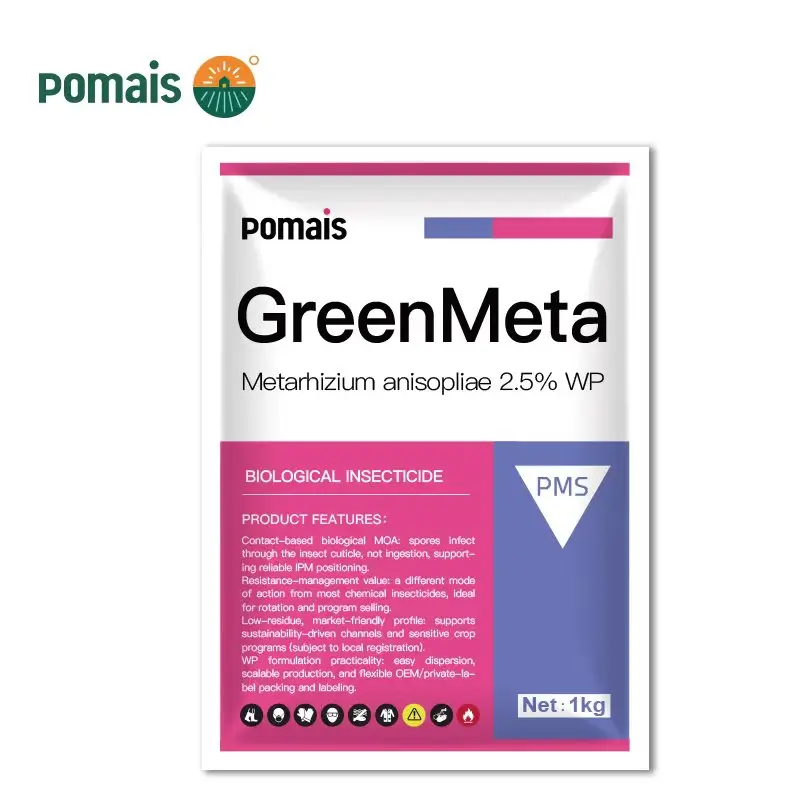
That infection route explains both its strength and its limitation. The strength is biological persistence and a distinct mode of action. The limitation is speed: it does not behave like a contact pyrethroid or a fast systemic cleanup spray. You are working with a living organism whose performance depends heavily on strain biology, host stage, formulation, placement, and field environment.
Main Metarhizium Anisopliae Uses in Agriculture
Metarhizium has a broad host range. Cornell notes that Metarhizium species are known to attack more than 200 arthropod species across over 50 families, including pests of agricultural importance. U.S. product-label examples cited by Cornell include root weevils, flies, gnats, thrips, locusts, grasshoppers, ticks, and various beetles, although actual allowed uses always depend on the specific strain and country registration.
In agriculture, the most practical uses fall into three buckets: soil-associated pest management, protected-cropping pest programs, and integrated field programs where you want to lower pressure over time rather than chase immediate visual knockdown. It is especially relevant where pest life stages are exposed in soil or on plant surfaces long enough for spores to contact and infect them.
Where It Fits Best
| Use scenario | Typical target group | Why Metarhizium fits | Practical note |
|---|---|---|---|
| Soil-directed pest management | White grubs, root-feeding larvae, some weevils, soil-stage flies and other exposed preimaginals | Soil is a more favorable environment than exposed foliage for fungal survival and contact | Placement into the pest zone matters more than broad surface coverage |
| Greenhouse and nursery programs | Thrips, gnats, flies, some beetle larvae, root weevils | Humidity and exposure can be managed better than in open fields | Controlled environments usually improve consistency |
| Field IPM programs | Locusts, grasshoppers, selected caterpillar or sap-feeding systems depending on strain | Useful where you want a non-chemical or resistance-management complement | Expect program value, not instant cleanup |
| Seed or rhizosphere-oriented use | Early pest pressure in some row-crop systems | Research shows potential for stand support and pest suppression in certain systems | Suitability is formulation- and crop-specific |
This is the commercial reality: Metarhizium is strongest where the pest is reachable, environmental stress is manageable, and the use pattern is preventive or program-based rather than purely reactive.
How Metarhizium Works in the Field
Field success is not driven by the laboratory mechanism alone. It is driven by whether spores remain viable long enough to reach the pest, germinate, and complete infection. UV exposure is one of the biggest constraints on exposed applications. Frontiers reports that even four hours of UV-B can significantly reduce colony development, conidial viability, and germination in Metarhizium spp., which is one reason open-field foliar performance often looks less stable than greenhouse or soil-directed use.
Moisture also matters. USDA’s review on fungal entomopathogens as endophytes notes that commercial field performance is often limited by susceptibility to UV light and low moisture. The broader Metarhizium review also points to humidity, radiation, soil type, and general climatic conditions as key determinants of pathogenicity, virulence, and dispersal potential.
This is why you should think of Metarhizium as a systems tool, not a miracle tool. If the field is hot, bright, and dry, or if the target stage is hidden where spores cannot reach it, results will be inconsistent. If the target stage is exposed in moist soil, under canopy shade, or inside a controlled greenhouse program, your probability of success improves.
How to Use Metarhizium Anisopliae Effectively
The first rule is simple: match the application to the pest’s location. Physical contact is required for the fungus to work. For olive fruit fly soil-stage control, for example, field researchers emphasized that exposed preimaginal stages in soil are suitable targets, while inaccessible eggs, larvae, or pupae protected elsewhere are not. That same principle carries across crop protection more broadly.
The second rule is timing. Because sunlight and dry conditions reduce fungal performance, late-day application and moisture-favorable timing are usually stronger strategic choices than bright midday sprays. That does not mean every late-afternoon spray will succeed, but it aligns better with what the biology requires.
The third rule is expectation management. Metarhizium is best used to suppress populations, reduce pest survival, and support an IPM program. It is not the best fit when you need immediate visual cleanup from a severe outbreak in a harsh foliar environment. Recent Frontiers commentary also stresses that entomopathogenic fungi can complement synthetic control and, under some circumstances, approach comparable efficacy, but formulation quality and application strategy are critical to making that happen at scale.
Metarhizium Anisopliae Application Methods
Soil drench or soil-directed spray
This is often the most logical application path because Metarhizium is a soil-associated fungus and many of its strongest agricultural targets spend part of their life cycle in or near the soil. Soil placement can improve survival relative to exposed foliage and can align better with pests such as root weevils, grubs, and soil-stage fruit fly targets.
Foliar spray
Foliar use can work, especially in greenhouse and nursery settings or where canopy conditions favor fungal survival, but open-field foliar performance is more exposed to UV and desiccation stress. That makes coverage, timing, and weather alignment far more important than with conventional fast-acting sprays.
Seed treatment or seed-associated placement
Seed-associated use is not the default answer for every crop, but there is credible evidence that it can support stand establishment and yield in some systems. A widely cited corn study concluded that seed treatment with M. anisopliae may increase stand density and yield when used in a wireworm-control context, and more recent wheat work reported improvements in germination and crop performance after seed priming. Those findings are promising, but they are system-specific and should not be generalized into a blanket claim for every crop.
Formulation matters
Formulation is not a minor detail. In field work on M. brunneum persistence in soil, the fungus remained detectable for more than 250 days, and oil-dispersion formulations maintained higher levels in soil than wettable powder or encapsulated microsclerotia in that study. Researchers attributed part of the difference to formulation behavior and retention. In practical terms, “Metarhizium” is never just the fungus name; it is the combination of strain, propagule type, carrier, and delivery method.
Application Method by Scenario
| Application method | Best for | Main strength | Main limitation |
|---|---|---|---|
| Soil drench / directed soil application | Soil-dwelling or soil-stage pests | Better protection from UV and more direct placement | Weak if the pest stage is not in the treated zone |
| Foliar spray | Exposed foliar pests in favorable canopy conditions | Easier canopy coverage in protected cropping | High UV and low humidity can sharply reduce consistency |
| Seed treatment / seed priming | Early-stage pest pressure in selected crops | Can support early protection and stand establishment | Crop-, formulation-, and study-specific |
| Granular / carrier-based delivery | Localized soil or substrate use | Better placement around root or substrate zones | Not universal across all crop systems |
The operational point is straightforward: do not ask one application method to solve every pest scenario. Start with where the pest lives and when it is exposed.
Why Metarhizium Sometimes Works Well in One Field and Poorly in Another
This is where many articles stay too generic. Field variability usually comes from five factors.
First, strain identity. The taxonomy around the M. anisopliae complex is more complicated than older articles suggest, and virulence differences between closely related taxa matter in practice.
Second, formulation quality. Oil dispersion, wettable powder, and other propagule systems do not behave the same way in the field.
Third, environment. UV, humidity, and temperature can shift conidial survival and infection success dramatically.
Fourth, pest biology. If the target stage is hidden, short-lived, or poorly exposed, contact will be weak.
Fifth, positioning in the program. Metarhizium performs better when it is built into a management sequence than when it is treated as a single-shot rescue answer.
Benefits and Limits in Agriculture
The main value of Metarhizium in agriculture is strategic rather than cosmetic. It gives you a biological mode of action that can support IPM, help diversify pest-management programs, and reduce dependence on a purely chemical rotation. Recent peer-reviewed summaries also note that entomopathogenic fungi can complement synthetic insecticides and, in some situations, deliver comparable control performance while supporting more sustainable production systems.
The limit is equally clear. It is not automatically a replacement for conventional insecticides in every crop, climate, or infestation level. USDA’s review highlights how UV and low moisture continue to constrain adoption in field use, and current research still focuses heavily on formulation improvement, UV protection, and more resilient isolates to close the gap between laboratory promise and commercial field consistency.
Safety and Compatibility
Safety claims around biocontrol fungi should stay precise. EPA’s U.S. record for strain F52 supports a tolerance exemption for residues on food commodities when used according to good agricultural practices, and the agency found no acute oral, dermal, pulmonary, or injection toxicity/pathogenicity in the required mammalian studies for that strain. At the same time, the same record notes moderate eye irritation in rabbits, which is why operator protection and label compliance still matter. “Biological” does not mean “ignore handling discipline.”
Compatibility also needs nuance. Because Metarhizium is a living fungus, tank-mix assumptions and program timing should be validated against the product label and local recommendations. Broad statements such as “safe with everything” are not technically sound. The better operating rule is to protect fungal viability, protect placement, and align the biology with the rest of the crop-protection program.
Frequently Asked Questions
What is Metarhizium anisopliae used for in agriculture?
It is used as a biological insect-control agent for selected soil and foliar pests, especially where the target stage is reachable and environmental conditions support fungal survival. Commonly discussed targets include root weevils, beetles, gnats, flies, thrips, locusts, and other arthropods depending on strain and label.
How do you use Metarhizium anisopliae effectively?
You get the best fit when you match the application method to the pest location, apply under lower-UV and moisture-favorable conditions, and build it into an IPM program instead of treating it as a one-time rescue spray.
Can Metarhizium be applied to both soil and foliage?
Yes, but the two use patterns behave differently. Soil-directed use generally offers a more favorable environment for persistence, while foliar use is more exposed to UV and desiccation stress.
Is Metarhizium fast-acting?
Not in the same way as a conventional knockdown insecticide. Its value is suppression, infection, and program support over time. That is why expectation setting is essential when you position it in the field.
Does taxonomy really matter for practical agriculture?
Yes. The modern M. anisopliae species complex includes several related taxa, and strain identity can influence virulence, formulation development, regulatory status, and field fit. In commercial and technical evaluation, “Metarhizium” is not specific enough by itself.
Final Take
Metarhizium anisopliae is one of the most useful biological insect-management tools in agriculture when you use it for the job it is actually built to do. It is strongest in well-targeted, biologically realistic programs: exposed pest stages, favorable moisture, manageable UV, the right formulation, and a clear role inside IPM. If you expect it to behave like a high-speed chemical rescue spray, you will likely underrate it. If you use it where biology, placement, and timing align, it becomes a serious agricultural tool rather than just an interesting biological option.
Hot Products
Hot news
Recommended news
FAQ