
Bacillus thuringiensis for Cabbage Worms
If you are evaluating bacillus thuringiensis for cabbage worms, the short answer is yes: Bt can be a strong fit for brassica caterpillar control when the target is a small, actively feeding larva on treated foliage. That is why extension and IPM sources repeatedly recommend caterpillar-specific Bt for imported cabbageworm and cabbage looper in cabbage and related crops. The same sources also explain why results can disappoint: Bt must be eaten, coverage must be good, and performance drops when larvae are already large or when foliage residues break down too quickly. For buyers, that means product success depends on pest fit, timing fit, and formulation fit, not on the letters “Bt” alone.
What Does Bacillus thuringiensis Do to Cabbage Worms?
Bacillus thuringiensis for cabbage worms works as a caterpillar-specific microbial insecticide, not as a broad contact knockdown. In practical terms, the target larva needs to feed on treated plant tissue. Once ingested, the Bt toxins disrupt the insect digestive system, so feeding slows and the caterpillar declines over time rather than collapsing immediately on contact. That is one reason experienced growers sometimes underestimate a good Bt treatment in the first 24 hours and overestimate a weak one in poor coverage conditions. If the larva does not consume enough treated tissue, control will be inconsistent even when the product itself is sound.
Which Cabbage Worms Respond Best to Bt?
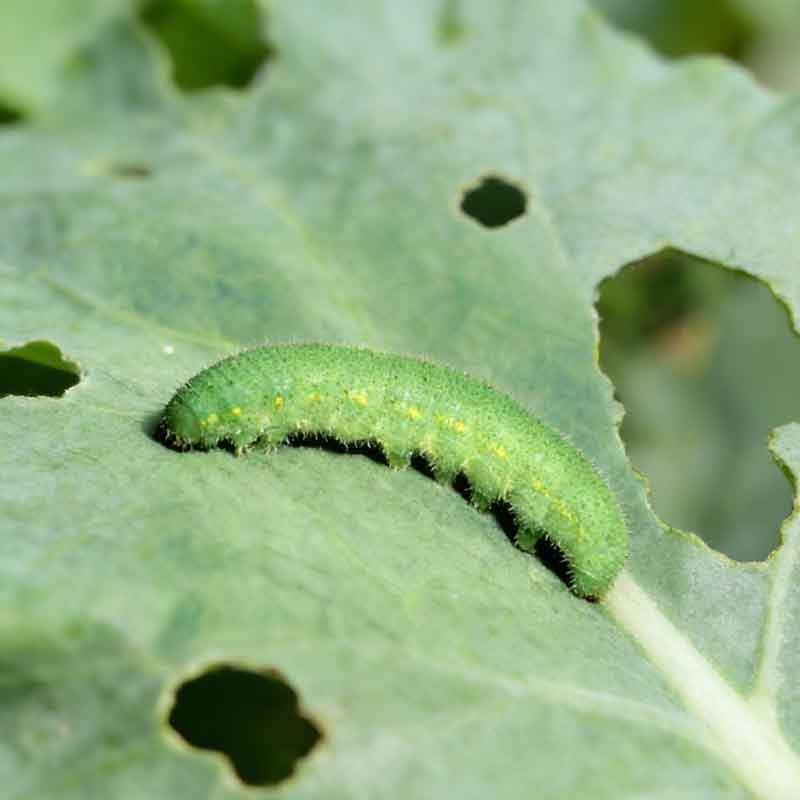
When people search for “cabbage worms,” they often mean more than one pest. In brassica production, the main caterpillar complex commonly includes imported cabbageworm, cabbage looper, and diamondback moth. Extension sources describe imported cabbageworm and cabbage looper as especially relevant in many cabbage and home-garden brassica situations, while diamondback moth is often a major commercial brassica pest. That distinction is important because buyers should not assume that one label claim automatically means equal field fit across the full caterpillar complex.
For the exact topic bacillus thuringiensis for cabbage worms, the strongest practical fit is usually with young imported cabbageworm and young cabbage looper larvae. UC IPM states that caterpillar-specific Bt is very effective against cabbage looper and imported cabbageworm, especially on early instars. Utah State also notes that Bt kurstaki is especially effective on young imported cabbageworm caterpillars. Wisconsin Extension makes the same point for small imported cabbageworms. That alignment across multiple extension systems gives you a clear commercial message: if your customer’s pressure is dominated by small cabbageworms feeding openly on brassica foliage, Bt is a credible, marketable option.
Imported Cabbageworm vs. Cabbage Looper
Imported cabbageworm is closely tied to brassicas and can move into the head area as feeding intensifies. Cabbage looper is also a frequent brassica caterpillar, but it has a broader host range and can appear in more mixed vegetable settings. From a buyer’s standpoint, both pests can sit under the same sales conversation for Bt, but the agronomic context can differ. A brassica-focused customer with clear imported cabbageworm pressure is different from a customer dealing with a wider caterpillar spectrum across multiple hosts. Your content should therefore position Bt first around target pest fit, not just around “organic” or “biological” language.
When Bacillus thuringiensis for Cabbage Worms Works Best
Bt performs best when you catch the infestation early, while larvae are still small and actively feeding. That pattern is consistent across UC IPM, Utah State, Wisconsin Extension, and Pacific Northwest guidance. In practice, that means the product is strongest as an early-pressure management tool, not as a rescue option once large larvae have already chewed into the canopy or moved into tighter feeding sites. Buyers who understand this point usually make better portfolio decisions, because they position Bt as a program product rather than as a last-minute clean-up product.
Coverage also matters more than many customers expect. Bt is a foliage treatment that depends on ingestion, so weak spray distribution directly weakens field performance. Oregon State guidance is very clear on this: thorough coverage is important, and repeat applications may be necessary. The same source notes that sunlight inactivates Bt on foliage and that evening applications can improve performance. Even without discussing field-use instructions in detail, the commercial implication is straightforward: if a customer is farming under intense sunlight, frequent wash-off risk, or dense foliage conditions, the buyer should evaluate not only the active strain but also the formulation quality, residue persistence expectations, and label clarity for repeat coverage logic.
Performance Conditions at a Glance
| Field Situation | Expected Bt Performance | Why It Changes | Buyer Question |
|---|---|---|---|
| Small, early-instar cabbageworms | Strong | Young larvae feed readily and are more susceptible | Is the product positioned for early caterpillar stages? |
| Large, mature larvae | Weaker | Larger larvae are harder to suppress with Bt | Does your customer expect rescue control or early control? |
| Dense foliage with poor coverage | Inconsistent | Untreated leaf area reduces ingestion | What formulation and spray guidance support uniform coverage? |
| High sunlight and weathering | Shorter residue life | Bt on foliage can degrade faster | How often does the market typically need re-treatment? |
| Mixed caterpillar pressure | Variable | Not every pest complex behaves the same | Which brassica caterpillars are listed or supported? |
The table above is the commercial core of this topic. Bacillus thuringiensis for cabbage worms is not just a product claim. It is a fit decision built around larval stage, feeding behavior, canopy exposure, and residue life on leaf surfaces.
Why Bt Sometimes Fails on Cabbage Worms
The most common reason Bt disappoints is simple: the target larvae did not eat enough treated tissue early enough. Minnesota Extension states this point clearly in another caterpillar context—Bt needs to be ingested to be effective. Oregon State adds the operational detail that it is ineffective if larvae do not eat plant tissue treated with Bt. So when growers say, “We used Bt and it did not work,” the correct follow-up is usually not “Which brand?” but “What stage were the larvae in, and how well was the foliage actually covered?”
A second reason is larval size. Multiple extension sources state that Bt is most effective on small larvae and can be much less reliable once caterpillars are already bigger. A third reason is residue decline. Sunlight can inactivate Bt on foliage, and repeat applications may be needed. A fourth reason is pest complexity. If the field problem is not mainly imported cabbageworm or cabbage looper, or if the program also has resistant diamondback moth pressure in certain production areas, the result may not match the buyer’s expectations. Wisconsin has noted that diamondback moth resistance to Bt has been documented in parts of the United States, which is one more reason to avoid lazy “one product fits all caterpillars” positioning.
For your article, this section is where you win trust. Instead of promising too much, you explain the real fit boundaries. That is stronger commercial writing because professional buyers do not want flattering copy; they want fewer complaints, fewer returns, and fewer mismatches between label story and field reality.
Btk or Aizawai: What Should Buyers Compare?
In the market, buyers often encounter Bacillus thuringiensis var. kurstaki and Bacillus thuringiensis var. aizawai in caterpillar control discussions. Extension and Pacific Northwest sources reference both kurstaki and aizawai for caterpillar management and repeatedly note that both are strongest on younger larval stages. EPA also describes aizawai strains as targeted against lepidopteran moth larvae after ingestion. For your page, the key commercial angle is not to oversimplify strain selection into a slogan. The right approach is to tell buyers to compare the strain against the target pest set, crop use pattern, and local registration reality.
For the specific topic bacillus thuringiensis for cabbage worms, Btk is often the name buyers already recognize in cabbageworm conversations because extension pages mention Bt kurstaki directly for imported cabbageworm. At the same time, other extension references list kurstaki or aizawai for imported cabbageworm and cabbage looper, especially when targeting early instars. The practical conclusion is measured and commercially useful: when a customer asks which Bt type to buy, you should move the discussion toward which brassica caterpillars dominate, what crop claims are needed, and how the formulation will perform under the target field conditions.
How to Evaluate a Bt Product for Brassica Programs
A buyer comparing Bt products for cabbage worms should review more than the microorganism name. First, check whether the product clearly states the Bt subspecies or strain positioning. Second, check whether the label or technical sheet aligns with the intended brassica pest use. Third, review the formulation type, because handling, suspension stability, packaging fit, and storage expectations all affect channel performance. Fourth, check whether the supplier can support the market with clear documentation, label-ready wording, and crop-pest positioning that does not create confusion in the distribution chain.
You should also assess the product as part of a program, not in isolation. UC IPM emphasizes caterpillar-specific Bt partly because it preserves natural enemies better than broader options. That matters commercially. In many markets, growers want selective products that can fit residue-sensitive vegetable programs or biological positioning without undermining beneficial insects. So the question is not only “Will it kill cabbage worms?” The stronger question is “Will it fit the brassica program my customer is actually running?”
Buyer Checklist for Comparing Bt Products
| Evaluation Point | Why It Matters | What You Should Ask |
|---|---|---|
| Bt subspecies / strain | Different products are positioned differently in the market | Which strain is declared, and what target pests are supported? |
| Target brassica pests | “Cabbage worms” may include more than one species | Which brassica caterpillars are directly addressed? |
| Crop-use fit | Market claims must match crop reality | Is the product positioned for cabbage and related brassicas? |
| Formulation quality | Handling and field consistency affect repeat orders | How stable is the formulation in storage and transport? |
| Documentation | Importers and distributors need cleaner execution | Can the supplier provide COA, TDS, MSDS, and label support? |
| Program fit | Selectivity can matter as much as efficacy | Is the product promoted as a targeted caterpillar tool within IPM? |
This kind of checklist improves conversion quality because it filters out weak-fit demand and attracts buyers who understand category value.
Where Bt Fits in an IPM Program for Brassicas
Bt belongs in an IPM conversation because it is selective, caterpillar-focused, and most useful when scouting and timing are already in place. UC IPM specifically recommends caterpillar-specific Bt to avoid damaging natural enemy populations. Extension resources also pair Bt with broader practices such as monitoring, sanitation, and exclusion. That combination is commercially relevant. Buyers who sell Bt successfully usually do not position it as a stand-alone miracle. They position it as a precise tool inside a brassica caterpillar management program.
FAQ: Bacillus thuringiensis for Cabbage Worms
Does Bacillus thuringiensis kill cabbage worms completely?
It can provide strong suppression of small, actively feeding cabbageworm larvae, but field performance depends on larval stage, treated foliage ingestion, and coverage quality. Extension guidance consistently presents Bt as very effective on early instars rather than as a universal clean-out tool under all conditions.
Is Bt better for imported cabbageworm or cabbage looper?
Both imported cabbageworm and cabbage looper are commonly listed as good Bt targets, especially at early larval stages. The right answer for your customer depends on which pest is dominant and how early the treatment window is reached.
Why does Bt fail on cabbage worms in some fields?
The main reasons are late timing, larger larvae, poor leaf coverage, and faster-than-expected residue decline on foliage. Oregon State specifically notes that sunlight inactivates Bt on foliage and that repeat applications may be necessary.
Is Bacillus thuringiensis for cabbage worms suitable for biological or organic-leaning programs?
Many Bt products are widely recognized in biological and selective caterpillar control programs, and some formulations are approved for organic use in certain markets. The exact fit still depends on the local label, certification framework, and crop registration in the buyer’s destination market.
Should buyers compare Btk and aizawai before sourcing?
Yes. Market naming often focuses on Btk, but extension and regulatory materials also reference aizawai in lepidopteran control. Buyers should compare strain positioning, target pest fit, crop use fit, and documentation support before making a sourcing decision.
Work with POMAIS on Your Biological Insecticide Line
If you are expanding a biological insecticide portfolio for brassica caterpillar control, the stronger commercial move is not to ask for “a Bt product” in the abstract. It is to define the target pest mix, crop focus, pack-size strategy, label language needs, and documentation expectations first. That gives you a cleaner product match and a better downstream sales story. With POMAIS, you can align product communication, packaging options, and supply support around the real market question your customers are asking: when does bacillus thuringiensis for cabbage worms actually deliver reliable value?
Hot Products
Hot news
Recommended news
FAQ