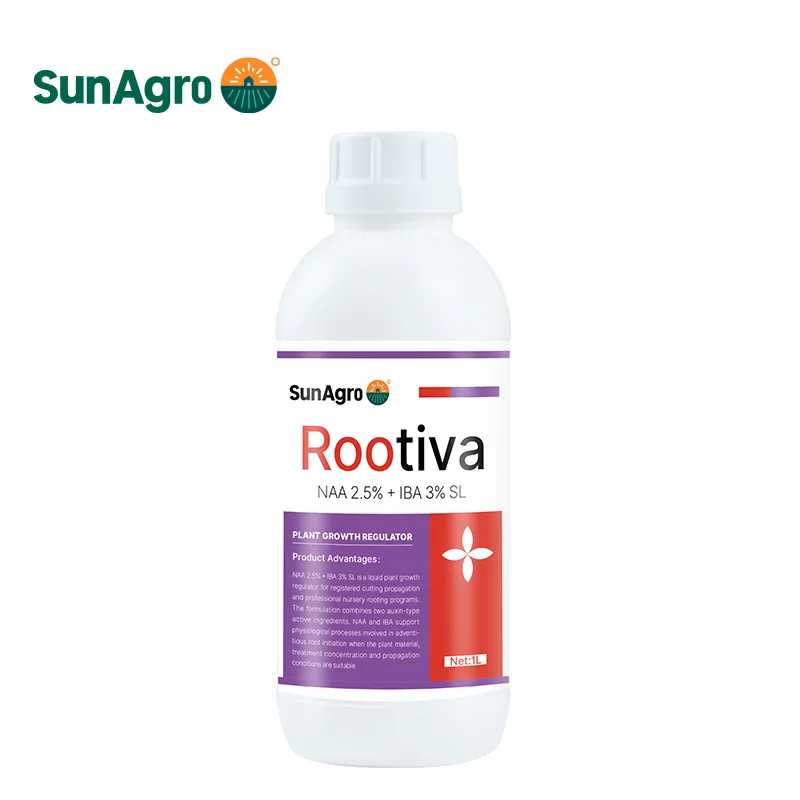
NAA 2.5% + IBA 3% SL Rooting Plant Growth Regulator
NAA 2.5% + IBA 3% SL is a liquid plant growth regulator for registered cutting propagation and professional nursery rooting programs.
The formulation combines two auxin-type active ingredients. NAA and IBA support physiological processes involved in adventitious root initiation when the plant material, treatment concentration and propagation conditions are suitable.
POMAIS supplies this finished SL formulation for plant growth regulator importers, distributors, registration companies, nursery-input suppliers, horticultural channels and professional propagation projects.
The final crop range, treatment method, dilution rate and contact time must follow the approved destination-market label.
- Designed for Professional Buyers & Bulk Orders
- We support custom packaging, labeling, and formulation to meet your market needs.
- Export wholesale inquiries only.
- Please include destination country, business type (importer/distributor/registrant), and expected volume.
- Retail requests will not be processed.

About NAA 2.5% + IBA 3% SL Rooting Plant Growth Regulator
| Item | Details |
|---|---|
| Active Ingredient 1 | NAA, 1-Naphthaleneacetic Acid |
| Content | 2.5% |
| Active Ingredient 2 | IBA, Indole-3-Butyric Acid |
| Content | 3% |
| Formulation | SL, Soluble Concentrate |
| Product Type | Plant Growth Regulator |
| Hormone Direction | Dual-Auxin Rooting Regulator |
| Main Use Direction | Cutting propagation and root initiation |
| Main Market Direction | Professional nurseries and horticultural propagation |
| Treatment Direction | Cutting-base dipping or soaking where registered |
| Product Boundary | Not a fertilizer or guaranteed rooting product |
| Supply Support | Packaging, documents, quality control and export coordination |
The chemical form and content basis of NAA and IBA must follow the agreed product specification and registration documents.
What Is NAA 2.5% + IBA 3% SL?
NAA 2.5% + IBA 3% SL is an agricultural liquid rooting regulator containing two synthetic auxin-type active ingredients.
Its main commercial direction is the treatment of propagation material before planting into a suitable rooting substrate.
The product may be used in registered programs involving:
- Cutting propagation
- Cutting-base treatment
- Nursery plant multiplication
- Ornamental propagation
- Woody and semi-woody cuttings
- Other approved horticultural rooting programs
This product should not be presented as a general-purpose growth stimulant for every crop and growth stage.
Dual-Auxin Rooting Formulation
NAA and IBA both belong to the auxin plant growth regulator direction.
They do not provide two unrelated modes of action.
The correct positioning is:
A dual-auxin liquid formulation for registered cutting propagation and root-initiation programs.
The combination provides two auxin-type components in one finished product.
It should not be described as automatically stronger or more effective than an IBA-only formulation. Final performance depends on the plant species, variety, cutting maturity, treatment method and growing conditions.
How NAA and IBA Support Root Initiation
Adventitious roots form from plant tissues that do not normally function as roots.
A simple rooting process is:
Cutting-base treatment → Auxin response → Root primordium development → Adventitious root formation → Early root establishment
NAA and IBA may support the physiological response involved in this process.
The product does not create roots independently of the plant.
Successful propagation also depends on:
- Healthy stock plants
- Suitable cutting material
- Correct moisture
- Adequate oxygen
- Suitable temperature
- Clean rooting media
- Good drainage
- Correct humidity
- Disease control
- Post-treatment management
Role of IBA
IBA is widely used in professional plant propagation.
Its main function in the formulation is to support adventitious root initiation in suitable cutting material.
IBA may fit registered programs involving:
- Softwood cuttings
- Semi-hardwood cuttings
- Hardwood cuttings
- Herbaceous cuttings
- Ornamental propagation
- Nursery crop production
- Vine and shrub propagation
The response varies by species and variety.
IBA should not be described as guaranteeing successful rooting in every difficult-to-root plant.
Role of NAA
NAA is a synthetic auxin plant growth regulator.
In a rooting formulation, it provides additional auxin-type activity at the treated cutting base.
NAA response can be sensitive to concentration and exposure time.
Excessive treatment may contribute to:
- Heavy callus formation
- Delayed root emergence
- Root inhibition
- Cutting-base injury
- Uneven root development
Accurate measurement and controlled treatment are therefore important.
Main Use Direction: Cutting Propagation
Cutting propagation is the primary application direction for NAA 2.5% + IBA 3% SL.
Depending on local registration, the product may be positioned for professional propagation of:
- Ornamental plants
- Nursery crops
- Shrubs
- Vines
- Selected woody plants
- Selected herbaceous plants
- Other approved propagation materials
The treatment is normally directed at the lower part of the cutting.
The treated material must then be placed in a clean, suitable and well-managed rooting environment.
Softwood Cuttings
Softwood cuttings are taken from young, actively growing shoots.
They normally have tender tissues and can absorb treatment quickly.
Important considerations include:
- High sensitivity to excessive concentration
- High sensitivity to long contact time
- Rapid water loss
- Dependence on humidity control
- Need for clean propagation conditions
A treatment suitable for mature woody cuttings may damage tender softwood material.
Semi-Hardwood Cuttings
Semi-hardwood cuttings are taken from partly matured shoots.
They are common in nursery, shrub, vine and ornamental propagation.
Their response can depend on:
- Collection season
- Shoot maturity
- Stock-plant condition
- Cutting position
- Variety
- Rooting temperature
Treatment directions for softwood cuttings should not be copied automatically to semi-hardwood material.
Hardwood Cuttings
Hardwood cuttings are taken from mature, lignified shoots.
They may:
- Absorb the treatment differently
- Require a different concentration
- Require a different contact time
- Take longer to initiate roots
- Respond differently by species
A hardwood treatment should not be used on tender cuttings without crop-specific confirmation.
Herbaceous Cuttings
Herbaceous cuttings come from soft, non-woody plants.
They may respond quickly, but they can also be sensitive to excessive auxin exposure.
Important factors include:
- Cutting age
- Stem condition
- Leaf area
- Water loss
- Root-zone temperature
- Mist frequency
- Disease pressure
- Treatment concentration
A limited trial is recommended when the plant response is not already established.
Treatment Methods Are Different
Different propagation methods require different concentrations and contact times.
They must not be treated as interchangeable.
Quick Dip
A quick dip normally treats the lower cutting base for a short period.
The treatment may use a more concentrated solution than an extended soak.
Important controls include:
- Dipping depth
- Contact time
- Solution concentration
- Solution cleanliness
- Crop sensitivity
Longer contact with a quick-dip concentration may cause injury.
Extended Basal Soak
An extended basal soak treats the cutting base for a longer period.
It normally requires a different concentration from a quick dip.
The soaking time, treatment depth and solution strength must follow the approved label.
Other Registered Propagation Methods
Other treatment methods should only be included where they are supported by the product registration.
A cutting-base dip, long soak, root dip and root-zone application are different methods. Their rates and exposure times must not be exchanged.
Rooting Performance Depends on Propagation Conditions
A rooting regulator is only one part of a complete propagation program.
Root formation can be affected by:
- Plant species
- Variety
- Stock-plant health
- Cutting maturity
- Cutting position
- Collection season
- Cutting length
- Leaf number
- Leaf area
- Rooting substrate
- Drainage
- Humidity
- Irrigation
- Root-zone temperature
- Air temperature
- Light level
- Sanitation
- Disease pressure
- Post-treatment care
Poor-quality cuttings, waterlogged media or unsuitable temperatures can reduce rooting even when the product is applied correctly.
Limited Trial Before Commercial Treatment
A limited trial should be completed when:
- A new plant species is introduced
- A new variety is used
- The cutting type changes
- A different concentration is planned
- The treatment method changes
- A new substrate is used
- Environmental conditions change
- The product has not been used in the production system before
The trial may evaluate:
- Rooting percentage
- Time to root initiation
- Root number
- Root length
- Root distribution
- Root strength
- Callus formation
- Cutting survival
- Basal injury
- Uniformity
Commercial treatment should only be expanded after the response is acceptable.
More Product Does Not Mean Better Rooting
Auxin response is concentration-dependent.
A concentration that is too low may not provide the required response.
A concentration that is too high may cause:
- Excessive callus
- Root inhibition
- Basal tissue damage
- Delayed root development
- Weak roots
- Uneven rooting
- Cutting decline
Longer dipping time also increases total exposure.
The approved concentration and contact time should be followed carefully.
What This Product Does Not Do
NAA 2.5% + IBA 3% SL is not:
- A fertilizer
- A micronutrient
- A fungicide
- An insecticide
- A seed disinfectant
- A universal seed treatment
- A flowering regulator
- A fruit-thinning product
- A fruit-drop-control product
- A universal transplant treatment
- A guaranteed rooting solution
- A replacement for suitable propagation conditions
- A laboratory tissue-culture reagent
Its main identity should remain clear:
A liquid auxin rooting regulator for registered cutting propagation programs.
NAA + IBA Compared With IBA Alone
| Product Direction | Main Positioning |
|---|---|
| NAA + IBA SL | Dual-auxin liquid rooting formulation |
| IBA Single Active | Focused IBA rooting regulator |
| NAA Single Active | Auxin regulator with rooting or other crop-specific uses depending on registration |
| 6-BA + IBA | Cytokinin and auxin combination with different shoot-and-root positioning |
| IBA Powder | Dry rooting formulation for cutting-base treatment |
| Soluble IBA Formulation | Liquid preparation for approved rooting methods |
NAA + IBA should not be described as universally stronger than IBA alone.
The correct product depends on the crop, cutting type, propagation method and local registration.
Difference Between NAA + IBA and 6-BA + IBA
These two combinations have different physiological positioning.
NAA + IBA
Both active ingredients are auxin-type regulators.
The main direction is:
- Root initiation
- Cutting propagation
- Adventitious root formation
- Professional rooting programs
6-BA + IBA
6-BA is a cytokinin, while IBA is an auxin.
This combination may be positioned around a different balance between shoot-related and root-related growth responses.
The two products should not be presented as interchangeable.
SL Formulation Features
SL means soluble concentrate.
NAA 2.5% + IBA 3% SL is supplied as a liquid concentrate for dilution before registered use.
Important formulation characteristics include:
- NAA content
- IBA content
- Active ingredient chemical form
- Liquid appearance
- Homogeneity
- Dilution stability
- Solution appearance
- pH
- Density
- Low-temperature stability
- Heat-storage stability
- Crystallization control
- Container compatibility
- Sealing performance
- Leakage control
The formulation should not be described as a fully water-based free-acid solution unless this is supported by the product specification.
Application Guidance
Use this product only where locally registered.
Before treatment, confirm:
- Plant species
- Variety
- Cutting type
- Cutting maturity
- Intended treatment method
- Approved dilution
- Contact time
- Treatment depth
- Substrate condition
- Propagation environment
- Worker-protection requirements
Recommended operating principles include:
- Select healthy propagation material.
- Prepare clean cutting bases.
- Measure the product accurately.
- Use clean water where dilution is required.
- Follow the approved mixing order.
- Treat only the required part of the cutting.
- Control contact time carefully.
- Prevent contamination of the treatment solution.
- Transfer treated cuttings into suitable rooting media.
- Record the treatment and rooting response.
There is no universal dilution rate for all plant species and cutting types.
Water Quality and Solution Preparation
Water quality may affect solution preparation.
Important factors include:
- Water pH
- Water hardness
- Water temperature
- Cleanliness
- Suspended solids
- Mixing order
- Use period after dilution
- Contamination from plant material
Prepare only the volume required for the treatment period.
Do not continue using heavily contaminated dipping solution unless the approved instructions allow it.
Compatibility
Do not assume automatic compatibility with:
- Fertilizers
- Micronutrients
- Fungicides
- Disinfectants
- Biological products
- Wetting agents
- Other plant growth regulators
- Substrate additives
A physically clear mixture does not confirm crop safety or biological compatibility.
Before a new combination is used:
- Review the approved label
- Check physical compatibility
- Conduct a small mixing test
- Treat a limited number of cuttings
- Observe rooting and plant safety
Crop Safety and Over-Application Risk
Incorrect use can affect cutting tissues and root development.
Possible risks include:
- Cutting-base burn
- Excessive callus
- Root inhibition
- Delayed root formation
- Uneven root systems
- Weak roots
- Reduced cutting survival
- Poor transplant performance
Risk may increase with:
- Excessive concentration
- Excessive contact time
- Tender plant material
- High temperature
- Poor drainage
- Contaminated solution
- Damaged cuttings
- Sensitive varieties
The approved treatment should be followed exactly.
Worker and Environmental Protection
Use the product according to the approved label and SDS.
Important precautions include:
- Wear required personal protective equipment.
- Avoid skin and eye contact.
- Avoid inhaling mist or droplets.
- Prepare treatment solutions in a controlled area.
- Prevent spills.
- Do not contaminate surface water.
- Manage used treatment solution correctly.
- Clean equipment according to local requirements.
- Dispose of containers according to local regulations.
- Keep the product away from children, livestock and food materials.
Registration and Compliance
Before import, promotion or use, local partners should confirm:
- Product registration
- Active ingredient identity
- Active ingredient chemical form
- Approved plant group
- Approved propagation method
- Cutting type
- Treatment concentration
- Contact time
- Maximum number of treatments
- Food or non-food crop status
- Residue requirements where applicable
- Worker-safety instructions
- Environmental precautions
- Label language
- Import documentation
- Packaging requirements
The crop claims and use directions from an IAA + NAA product must not be transferred to this NAA + IBA formulation.
Final product claims must follow the approved destination-market label.
Storage and Transport
Store NAA 2.5% + IBA 3% SL in sealed original containers.
Keep the product in a cool, dry and ventilated location.
Avoid:
- Freezing
- Excessive heat
- Direct sunlight
- Leakage
- Container damage
- Contamination
- Long-term storage under unsuitable conditions
Before use, inspect:
- Liquid appearance
- Homogeneity
- Separation
- Crystallization
- Container seal
- Leakage
Storage and transportation must follow the SDS and local regulations.
Packaging and Market Preparation
POMAIS supports packaging preparation according to product specification, destination market and order requirements.
Available directions may include:
- Bottles
- Drums
- Export cartons
- Induction seals
- Inner protection
- Batch coding
- Production-date coding
- Carton marks
- Multilingual label communication
- Destination-market packaging
Packaging materials must remain compatible with the SL formulation during storage and transport.
Document Support
Available product and shipment documents may include:
- COA
- SDS/MSDS
- TDS
- Product specification
- Active ingredient identity
- Chemical form information
- Formulation information
- Packing details
- Label reference
- Batch information
- Physical and chemical data where available
- Shipment documents
- Registration-related documents where applicable
Document requirements should be confirmed before production.
Quality Control
Quality control focuses on active ingredient content and liquid formulation stability.
Batch review may include:
- NAA content
- IBA content
- Chemical form of each active ingredient
- Liquid appearance
- Homogeneity
- pH
- Density
- Dilution stability
- Solution appearance
- Low-temperature stability
- Heat-storage stability
- Crystallization
- Container sealing
- Leakage inspection
- Carton inspection
- Batch traceability
- Shipment-document review
Each batch should meet the agreed product specification before shipment.
Related Plant Growth Regulator Products
Related product directions may include:
- Plant growth regulator formulations
- IBA rooting plant growth regulator
- NAA plant growth regulator
- 6-BA and IBA formulations
- Rooting regulators for cutting propagation
- Nursery propagation products
Product selection should follow the target response, plant material, treatment method and local registration.
FAQ
Why Choose POMAIS
POMAIS supplies plant growth regulator products for qualified importers, distributors, registration companies, nursery channels, horticultural suppliers and agricultural brands.
For NAA 2.5% + IBA 3% SL, we support:
- Clear dual-active specifications
- Finished SL formulation supply
- Chemical-form confirmation
- Batch quality control
- Packaging preparation
- Product documentation
- Multilingual label communication
- Registration-related coordination
- Export shipment preparation
Our goal is to help buyers position the product correctly for professional cutting propagation and nursery rooting programs.
Request NAA 2.5% + IBA 3% SL
Please share:
- Destination country
- Target plant
- Cutting type
- Intended treatment method
- Registration status
- Required package size
- Expected order volume
We will review the requested specification and prepare a suitable supply proposal.
Contact us!
We will reply to you within 24 hours on business days!