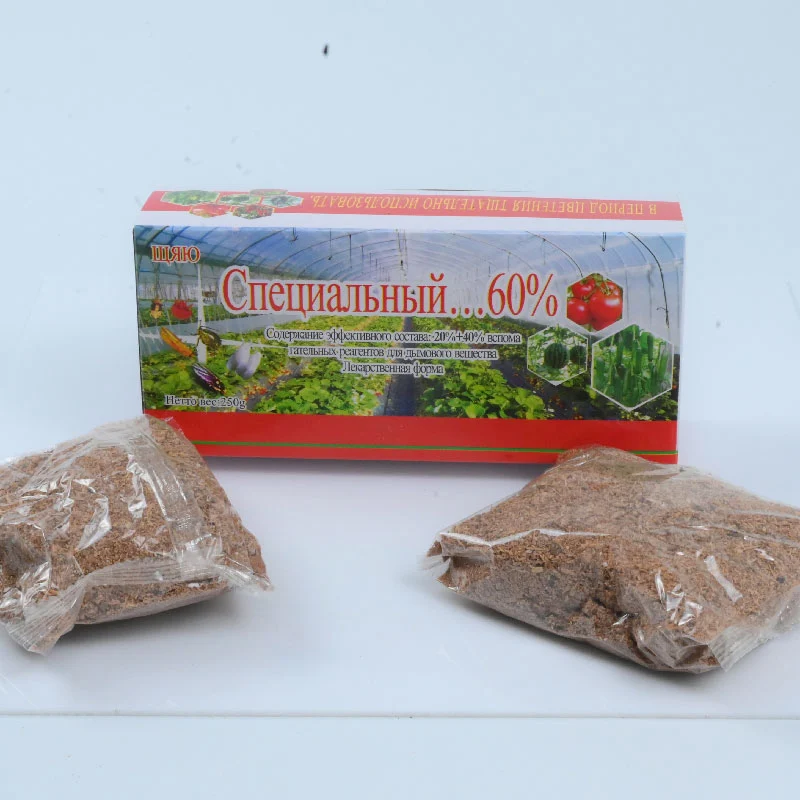
Downy Mildew Chemical Control | Chlorothalonil 10% + Cymoxanil 10% FU
Our Chlorothalonil 10% + Cymoxanil 10% FU fumigant delivers dual-action protection and early-curative control—specially made for greenhouses and tunnels. The smoke spreads evenly through the canopy, coating both sides of every leaf for full protection where sprays can’t reach.
Dual protection — preventive + curative
Smoke formulation — no water, no residue, no missed spots
Perfect for humid, enclosed environments
OEM labels & full documents (COA/MSDS/TDS) available
- Designed for Professional Buyers & Bulk Orders
- We support custom packaging, labeling, and formulation to meet your market needs.
- Export wholesale inquiries only.
- Please include destination country, business type (importer/distributor/registrant), and expected volume.
- Retail requests will not be processed.

About Downy Mildew Chemical Control | Chlorothalonil 10% + Cymoxanil 10% FU
| Product Type | FU Fumigant (smoke generator) for greenhouse and tunnel crops |
| Active Ingredients | Chlorothalonil 10% + Cymoxanil 10% |
| Chemical Group | Chloronitrile (multi-site protectant) + Cyanoacetamide-oxime (locally systemic) |
| CAS Numbers | Chlorothalonil: 1897-45-6 |
| Mode of Action | Dual function — Chlorothalonil forms a protective barrier on leaf surface; Cymoxanil moves inside leaf tissue to stop early infection |
| Target Pathogen | Downy mildew (Oomycete fungi) on vegetables, cucurbits, leafy greens, herbs |
| Form & Appearance | Solid smoke unit; releases fine white smoke that settles on both sides of leaves |
| Physical Nature | Non-flammable under normal handling; low vapor pressure; stable under proper storage |
| Water Solubility | Low (chlorothalonil) / high (cymoxanil) — ensures balance of persistence and quick action |
| Stability | Stable in acidic–neutral conditions; avoid high temperature and strong alkaline environment |
| Shelf Life | About 2 years in original sealed packaging |
| Storage | Keep in a cool, dry, well-ventilated place away from fire and moisture |
| Regulatory Note | For enclosed or semi-enclosed facilities only; follow local registration and label directions |
Downy Mildew
What it is
Downy mildew is a fast-moving oomycete disease. It attacks leaves first, reducing photosynthesis and plant vigor.
How to recognize it
- Top of leaf: pale-yellow “angular” spots, blocked by veins.
- Underside: grey-white to violet fuzz early in the morning (sporangia).
- Progress: lesions join together → leaves dry and drop.
When it explodes
- Cool to mild temperatures with high humidity/condensation at night.
- Long leaf-wetness, dense canopy, poor airflow, overhead irrigation late in the day.
Why growers care
- Rapid yield loss and poor fruit set/quality.
- Spray blind spots (leaf underside, inner canopy) make control difficult.
- Repeated single-site fungicides can drive resistance.
Where it’s common
Greenhouses and plastic tunnels with cucurbits, tomatoes/peppers, leafy greens, herbs, nurseries—especially during humid weeks.
Control logic (principle only)
- Prevent new infections on the surface.
- Hit early latent infections inside the leaf.
- Combine chemistry with ventilation, de-humidification, and sanitation to shorten leaf-wetness time.
Mechanism — How It Controls Downy Mildew
Dual action for two moments of the disease.
- Chlorothalonil (10%) — multi-site protectant (FRAC M05):
Forms a uniform surface shield on leaves. It blocks spore germination and new infections on contact. Because it works at multiple sites, resistance builds up slowly. - Cymoxanil (10%) — locally systemic/early-curative (FRAC 27):
Moves through the leaf (translaminar) after deposit. It targets very early, latent infections inside tissues, helping stop lesions right after infection begins.
Why the combo works
- Surface + inside: Chlorothalonil stops new spores; cymoxanil suppresses infections that already slipped in.
- Coverage match with FU smoke: The fumigant plume reaches leaf undersides and inner canopy, giving both actives the contact they need to work.
- Rotation-friendly: Pairs a multi-site active with a single-site one, fitting neatly into FRAC-based programs to reduce resistance pressure.
What this means in practice (principle only)
- Start when risk is forecasted or at first symptoms.
- Keep it in a rotation/sequence with other FRAC groups approved in your market.
- Always combine with humidity control, airflow, and sanitation to shorten leaf-wetness time.
FU Formulation Advantage — Smoke that Reaches Every Leaf
What makes FU special
FU stands for fumigant unit or smoke generator. Unlike spray formulations, it does not need water or spraying equipment. Once ignited in a greenhouse or plastic tunnel, the unit releases fine white smoke particles that spread evenly through the air and settle gently on all leaf surfaces—including the undersides and inner canopy where spray droplets often miss.
Key advantages for growers and distributors
- 1. Full canopy coverage
The smoke circulates and deposits on both sides of the leaves, ensuring every layer of dense foliage receives protection. This solves the “spray shadow” problem common in greenhouse crops. - 2. No water, no blockage
In humid seasons or when spraying is impractical, FU offers a dry application that avoids wet foliage, spray drift, and nozzle clogging. - 3. Labor and time saving
Operators simply place the unit at designated points, ignite it safely, and close the house. The smoke treatment works on its own—no spray lines or manual coverage needed. - 4. Uniform dosage by air dispersion
The formulation is engineered for even diffusion through the greenhouse volume, producing a homogeneous concentration of active particles that reach every plant. - 5. Compatible with IPM programs
The smoke method integrates easily into weekly protection programs as a night-time preventive or early-curative step, especially when conventional spraying must be paused due to weather.
How to use (principle only)
- Designed for enclosed or semi-enclosed greenhouses—not for open fields.
- Activate according to label instructions, ensure ventilation after treatment and observe REI (re-entry interval).
- Keep ignition sources and personnel safety equipment as directed on label.
The FU system combines chemical efficacy with engineering efficiency — making it one of the most practical ways to protect greenhouse crops during high humidity periods.
Application Scenarios, Target Crops & What It Controls
Where FU works best
- Greenhouses / plastic tunnels with cool–humid nights and long leaf-wetness.
- Dense canopies where sprays miss leaf undersides and inner layers.
- When spraying is hard (rainy weeks, labor shortage, nozzle clogging, wet foliage).
Target crops (facility grown)
- Cucurbits: cucumber, melon, pumpkin, zucchini.
- Leafy greens: lettuce, spinach, arugula, mixed salad greens.
- Herbs: basil, parsley, coriander (cilantro), dill.
- Allium seedlings/young plants: onion, leek nurseries.
- Nursery & propagation areas: trays/seedlings under covers.
Diseases this program is built for
- Downy mildew caused by oomycetes (e.g., Pseudoperonospora, Bremia, Peronospora) on the crops above.
- Works on the two critical moments:
- Preventing new infections on leaf surfaces (chlorothalonil).
- Suppressing very early, latent infections inside leaves (cymoxanil).
Not the focus
- Open-field use (wind dispersion lowers effect).
- Non-oomycete foliar diseases (e.g., many true fungi or bacteria) unless your local label explicitly includes them.
- Grapevines in open air and ornamentals outdoors—outside the intended FU setting.
When to trigger a treatment (principle only)
- Before a forecasted humid spell, or
- At first visible signs in the crop, or
- When spray access is temporarily limited; run FU as the night-time step in your rotation, then return to your approved spray program.
Quick matrix (guidance only, follow your label)
| Crop group | Typical downy mildew agent | FU helpful in greenhouse? |
|---|---|---|
| Cucurbits (cucumber, melon, etc.) | Pseudoperonospora spp. | Yes |
| Leafy greens (lettuce, spinach) | Bremia / Peronospora spp. | Yes |
| Herbs (basil, etc.) | Peronospora spp. | Yes |
| Onion/Allium nurseries | Peronospora destructor | Yes |
| Open-field crops | — | No (not intended) |
Always follow the local label for target crops and pathogens approved in your market.
Resistance Management & IPM Integration
Goal: keep downy mildew pressure low all season by rotating FRAC groups and cutting the leaf-wetness window with smart greenhouse practices.
How to keep chemistry effective (principle only)
- Rotate FRAC groups: Pair this product (M05 + 27) with other approved groups in your market—e.g., 40, 43, 45, 49, 21, 33.
- Limit overuse of single-site actives: Avoid repeating any one FRAC group in close sequence; be cautious with FRAC 11 (QoI) where resistance is common.
- Use at the right moment: Start before forecasted risk or at first symptoms; keep it as a program step, not a standalone fix.
Greenhouse IPM — shorten leaf wetness, lower inoculum
- Humidity & airflow: Night de-humidification, timely ventilation, gentle heating if needed to pass dew point.
- Irrigation timing: Water early in the day so foliage dries before night.
- Canopy management: Spacing, pruning/leaf removal to open the canopy; avoid persistent shade pockets.
- Sanitation: Remove infected residues; keep benches, tools, trays clean.
- Planting material: Use clean transplants; prefer tolerant/less susceptible cultivars when available.
- Monitoring: Scout undersides and inner canopy; follow local weather alerts; log disease pressure and interventions.
Program logic (illustrative—follow your label)
| Stage | Objective | Chemistry concept | Cultural support |
|---|---|---|---|
| Preventive | Block new infections | Include M05 barrier; rotate with 40/49/21/33 | Ventilation, early-day irrigation |
| First signs | Stop early latent lesions | Add 27 (early-curative) within label | Remove first infected leaves |
| High pressure | Hold the line, slow cycles | Alternate approved single-site FRAC groups; avoid repeats | Night de-humidification, canopy opening |
| Recovery/close-out | Reduce inoculum carryover | Return to multi-site barrier where allowed | Sanitation, crop hygiene, clean-out |
IPM = chemistry + environment + hygiene. Each part lowers disease cycles and preserves product life.
Compliance & Safety (Principles Only)
Use domain
- Enclosed or semi-enclosed facilities only (greenhouses, tunnels, propagation rooms).
- Not intended for open field.
Label priority
- Follow the product label and local regulations for permitted crops, pathogens, and any national restrictions (note: chlorothalonil is restricted/limited in some regions).
People & site safety
- PPE as per label (protect eyes/skin; avoid inhalation of smoke).
- Ignition and placement strictly per label. Keep away from external ignition sources.
- Ventilation & REI: After treatment, ventilate fully and observe the re-entry interval before workers return.
- Keep non-targets (people, pets, beneficial organisms) out of the treated area until REI ends.
Storage & transport
- Store cool, dry, ventilated, away from heat/flame and moisture; keep sealed in original packs.
- Segregate from food/feed/seed; handle per MSDS guidance.
Environmental care
- Prevent smoke/particulate from escaping to outside environments; no drainage into water bodies.
- Dispose of residues/empties per local hazardous-waste rules.
Risk perspective
- Risk = Hazard × Exposure. This product controls hazard at multiple sites (chlorothalonil) plus early curative (cymoxanil); your job is to minimize exposure with correct site selection, PPE, ventilation, and REI compliance.
When in doubt, default to the most conservative instruction on the local label or authority guidance.
OEM & Customization — Labels, Packs, and Documents Ready for Your Market
What you can customize
- Label & artwork: multilingual (Arabic / French / Russian / Spanish / English), brand logo, color, layout, QR/barcode, batch & traceability fields.
- Packaging: small consumer packs or pro-size cartons; moisture-protected inner + export-grade outer; palletized per destination rules.
- Document kit: COA / MSDS / TDS / Stability report (cold/heat), draft labels by language, outer/inner pack specs, batch QC summary.
- Market fit: units/phrasing aligned to local rules; HS code & ingredient declaration per destination.
Service flow (simple & fast)
- Brief → target market, languages, pack sizes, branding.
- Artwork → we propose label layout + compliance placeholders for your review.
- Verification → batch QC + stability check; print proof for approval.
- Production → automated filling & sealing, lot coding, pallet plan.
- Dispatch → export docs + photo set of finished goods.
Typical commercial terms
- MOQ: from 1,000 kg equivalent (FU units consolidated).
- Lead time: 20–30 days after artwork & compliance confirmation.
- Incoterms: EXW / FOB / CIF / DDP.
- Traceability: lot number + mfg date; retain samples per SOP.
Why buyers choose this
- Fewer back-and-forths: one set of files covers specs, QC and labels.
- Region-ready: languages + outer pack markings tailored for customs/warehouse.
- Consistent batches: automated process + HPLC assay per lot.
Quality Control & Production Strength
What you can count on
- Certified process: ISO/SGS-audited facility with SOP-driven manufacturing and traceable batch records.
- Automated production: Closed-loop batching, blending, and filling to reduce variability and human error.
- Assay & identity: HPLC test per batch for both actives (chlorothalonil, cymoxanil) with defined specs and impurity limits.
- Stability assurance: Cold/heat stability checks (accelerated and real-time) with retention samples kept per SOP.
- Packaging validation: Drop test and 24-hour inversion to verify leak-proof performance before shipment.
- Traceability: Lot number, manufacturing date, and barcode/QR options; internal retain samples for every lot.
- Documentation set: COA, MSDS, TDS, Stability summary, and photo pack of finished goods.
- Change control & CAPA: Formal procedures for deviations, non-conformances, and continuous improvement.
Why it matters
Consistent assay + proven stability + export-safe packaging = fewer registration issues, smoother customs clearance, and reliable field performance for your distributors and growers.
Market Adaptation & Regional Fit
Designed for diverse greenhouse climates
The Chlorothalonil 10% + Cymoxanil 10% FU fumigant is optimized for humid, cool-to-mild environments where downy mildew pressure is strong. It performs consistently across multiple regions:
- Middle East: Handles night-time humidity in covered vegetable tunnels; stable under high day temperatures.
- Central Asia: Works well for cucumbers, melons, and greenhouse herbs under fluctuating spring–autumn humidity.
- Africa: Effective in coastal and highland greenhouses where warm days meet cool, moist nights.
- South America: Matches protected-crop systems with high humidity and limited spray access during rainy periods.
Regional advantages
- Multilingual labeling: Arabic, French, Russian, and Spanish ready for local markets.
- Flexible logistics: Vertical supply chain and export experience to >30 countries; typical lead time 20–30 days.
- Documentation fit: COA/MSDS/TDS and Stability Reports customized to importer requirements.
- Registration support: Assistance with dossiers, labeling adaptation, and sample testing when needed.
Why distributors prefer it
- Product aligns with existing FRAC rotation programs and climate-driven IPM.
- Compact smoke unit simplifies transport and storage.
- Proven packaging integrity ensures zero leakage through customs and warehouse handling.