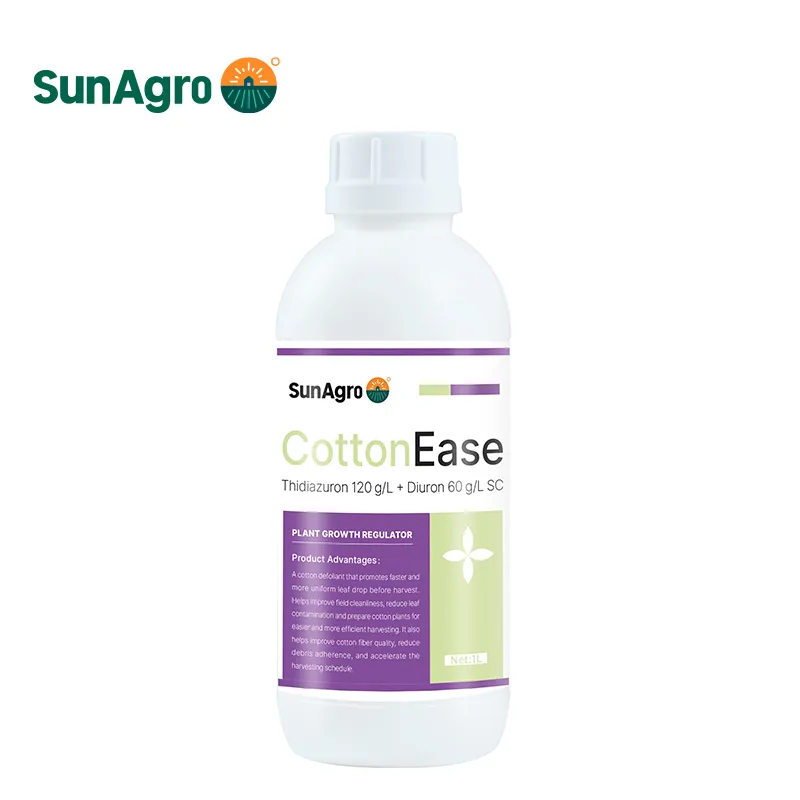
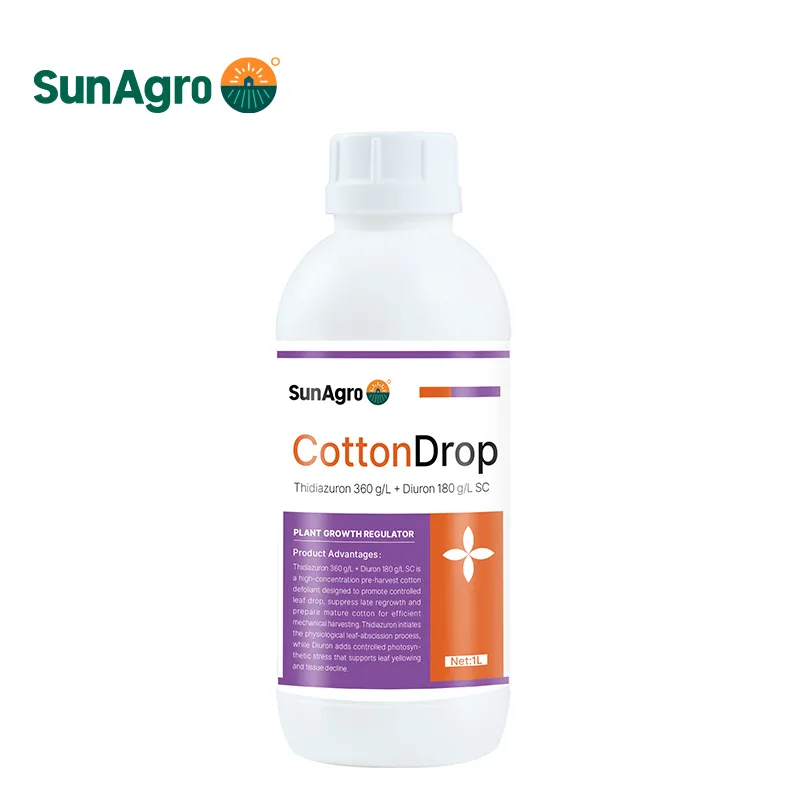
Thidiazuron 360 g/L + Diuron 180 g/L SC Cotton Defoliant
POMAIS Thidiazuron 360 g/L + Diuron 180 g/L SC is a high-concentration pre-harvest cotton defoliant designed to promote controlled leaf drop, suppress late regrowth and prepare mature cotton for efficient mechanical harvesting.
Thidiazuron initiates the physiological leaf-abscission process, while Diuron adds controlled photosynthetic stress that supports leaf yellowing and tissue decline. The combination helps reduce green leaf material within the canopy without positioning the product as a general cotton herbicide.
With a total active ingredient content of 540 g/L, this formulation is intended for professional cotton-production programs requiring lower formulated-product volume, precise application control and efficient logistics. It is supplied for importers, distributors, registration companies and large commercial cotton-input channels.
- Designed for Professional Buyers & Bulk Orders
- We support custom packaging, labeling, and formulation to meet your market needs.
- Export wholesale inquiries only.
- Please include destination country, business type (importer/distributor/registrant), and expected volume.
- Retail requests will not be processed.

About Thidiazuron 360 g/L + Diuron 180 g/L SC Cotton Defoliant
| Product Attribute | Specification |
|---|---|
| Product Name | Thidiazuron 360 g/L + Diuron 180 g/L SC |
| Active Ingredient 1 | Thidiazuron |
| Thidiazuron Content | 360 g/L |
| Active Ingredient 2 | Diuron |
| Diuron Content | 180 g/L |
| Total Active Ingredient Content | 540 g/L |
| Active Ingredient Ratio | 2:1 |
| Formulation | SC — Suspension Concentrate |
| Product Type | Cotton defoliant / pre-harvest harvest aid |
| Main Crop | Cotton |
| Primary Functions | Leaf defoliation and regrowth suppression |
| Application Window | Mature cotton before harvest |
| Application Method | Ground application; aerial application only where registered |
| Typical Market Positioning | Mechanized cotton-production and harvest programs |
| Standard MOQ | Normally 1,000 L |
| Available Documents | COA, SDS, TDS, product specification and available registration-supporting information |
| Packaging Support | Bottles, larger containers, labels, cartons and export packing |
| Supply Type | Bulk B2B supply for import, registration and distribution |
Exact application rates, cotton maturity requirements, harvest intervals, treatment numbers and application methods must follow the approved product label in the destination market.
What Is Thidiazuron + Diuron Cotton Defoliant?
Thidiazuron 360 g/L + Diuron 180 g/L SC is a concentrated cotton harvest-aid product used before picking.
Its purpose is to help remove mature cotton leaves from the plant so that the crop canopy becomes more suitable for harvesting.
The product may support:
- More uniform leaf drop
- Reduced green leaf material
- Suppression of terminal regrowth
- Better access for mechanical pickers
- Lower leaf contamination pressure
- More predictable harvest preparation
- Reduced need to transport larger volumes of formulated product
This product should not be confused with a conventional cotton weed-control herbicide.
Although Diuron is also used as a herbicide active ingredient in other products, its role in this formulation is to support the cotton defoliation process. The final product is designed for mature cotton plants, not for controlling weeds between cotton rows.
It should also not be described as a stand-alone boll-opening product. Its main role is defoliation and regrowth management.
For a wider view of crop-input and harvest programs, buyers can review our cotton crop protection and harvest solutions.
How Does Thidiazuron + Diuron Work?
The two active ingredients support cotton defoliation through complementary biological effects.
Thidiazuron Promotes Physiological Leaf Abscission
Thidiazuron is the main physiological defoliation component in the formulation.
After application to mature cotton, it changes the plant’s hormonal balance around the leaf petiole. This supports the formation of a natural separation zone, known as the abscission layer.
As this layer develops:
- Nutrient movement into the leaf decreases
- The leaf begins to senesce
- The connection between the leaf and stem weakens
- The leaf separates from the plant
This is different from simply burning or drying the leaf surface.
The objective is controlled leaf separation rather than rapid tissue destruction.
Thidiazuron also helps suppress new vegetative growth at the top of the plant. This can reduce the development of fresh leaves after the initial defoliation treatment.
Diuron Supports Leaf Yellowing and Controlled Dry-Down
Diuron inhibits photosystem II in green leaf tissue.
Within this cotton defoliant formulation, it adds controlled photosynthetic stress that supports:
- Leaf yellowing
- Chlorophyll decline
- Tissue senescence
- Reduced leaf activity
- More complete defoliation response
Diuron is not included to control field weeds in this use pattern.
Its role is to strengthen and accelerate the response initiated by Thidiazuron.
Combined Defoliation Effect
The technical logic of the premix is:
Thidiazuron promotes natural leaf separation → Diuron increases physiological stress in the leaf → mature leaves yellow, decline and drop → the cotton canopy becomes more suitable for harvest
The field objective is not maximum leaf burning.
Excessively rapid tissue desiccation can cause leaves to dry while still attached to the plant. This is sometimes described as leaf sticking and may increase leaf trash during mechanical picking.
A successful program should balance:
- Leaf yellowing
- Abscission
- Controlled dry-down
- Regrowth suppression
- Harvest timing
- Cotton lint protection
Main Benefits in Cotton Harvest Programs
More Uniform Leaf Drop
Uniform defoliation allows more of the cotton canopy to reach a harvest-ready condition at the same time.
This can reduce the presence of green leaves in the upper, middle and lower parts of the plant.
Uniformity still depends on:
- Cotton maturity
- Canopy density
- Spray coverage
- Weather
- Application rate
- Crop stress
- Variety
- Field uniformity
Reduced Green Leaf Material
Green leaves may stain cotton lint or increase unwanted plant material during picking and ginning.
Reducing green leaf tissue can support cleaner harvest conditions, but the product should not be presented as guaranteeing a particular lint grade.
Final cotton quality also depends on:
- Variety
- Boll maturity
- Weather
- Picker settings
- Harvest timing
- Storage
- Ginning practices
Regrowth Suppression
Late-season cotton may continue producing new leaves and shoots, particularly under warm conditions or after irrigation.
Thidiazuron helps suppress this regrowth, supporting a more stable harvest window.
Regrowth suppression is especially relevant in:
- Long-season cotton areas
- Irrigated production
- Rank cotton
- Fields with high nitrogen availability
- Warm autumn conditions
- Delayed harvest programs
Better Preparation for Mechanical Picking
Leaf removal improves access to open cotton bolls.
A more open canopy may support:
- Improved picker access
- Reduced green leaf contact
- More consistent machine operation
- Lower plant-material intake
- Better coordination of large harvest areas
Mechanical harvest performance still depends on machine calibration, crop condition and harvest timing.
When Should the Product Be Applied?
Application timing is the most important decision in a cotton defoliation program.
The product should only be applied after the crop and harvestable bolls have reached adequate maturity.
Assess Cotton Boll Maturity First
Do not base the treatment decision only on the amount of green leaf material.
Before application, assess:
- The maturity of the uppermost harvestable bolls
- Boll firmness
- Resistance to compression
- Resistance to cutting
- Seed development
- Cotton-fiber development
- Percentage of open bolls
- Expected harvest date
Local extension guidance and the registered product label should define the accepted maturity test.
A green boll may look large but still be physiologically immature.
Applying too early can interrupt normal boll and seed development.
Suitable Application Window
The treatment window should align with:
- Adequate boll maturity
- A confirmed harvest plan
- Suitable temperature
- Acceptable humidity
- Limited rainfall risk
- Sufficient time before picking
- Local pre-harvest interval requirements
Defoliation should be planned backward from the expected harvest date.
The required number of days between application and picking varies with:
- Temperature
- Variety
- Crop condition
- Application rate
- Product label
- Weather after treatment
Risks of Applying Too Early
Premature application may cause:
- Reduced boll weight
- Incomplete seed maturity
- Lower fiber development
- Interrupted boll filling
- Yield loss
- Excessive stress on immature plants
- Reduced response from upper bolls
- Unacceptable crop injury
Thidiazuron + Diuron should not be used to force an immature crop into harvest.
Risks of Applying Too Late
Late application may result in:
- Insufficient time for leaf drop
- Green leaves remaining at picking
- Harvest delays
- Higher leaf trash
- Increased exposure to low temperatures
- Rain interrupting the harvest window
- The need for an additional treatment
- Reduced value from regrowth suppression
The best timing balances boll maturity with the expected weather and mechanical-harvest schedule.
Weather and Crop Conditions
Cotton defoliation is a physiological process. Weather and plant condition can strongly influence the response.
| Field Condition | Expected Influence |
|---|---|
| Warm Day and Night Temperatures | Generally support faster physiological activity and leaf drop |
| Higher Relative Humidity | Often supports a more active defoliation response |
| Healthy, Turgid Leaves | Usually respond more predictably |
| Low Night Temperatures | May slow leaf yellowing, abscission and regrowth suppression |
| Drought-Stressed Cotton | May absorb and respond to the treatment less effectively |
| Rank or Dense Cotton | Requires stronger canopy penetration and coverage |
| Very Waxy Leaves | May reduce spray retention and uptake |
| Excessively Hot Conditions | May increase the risk of rapid desiccation or crop stress |
| Rain Soon After Treatment | May reduce spray retention according to the label’s rainfastness requirement |
| Strong Wind | Increases drift risk and reduces coverage uniformity |
Low-Temperature Conditions
Cool weather slows cotton metabolism and the development of the leaf-abscission layer.
Possible results include:
- Slower yellowing
- Delayed leaf drop
- Less regrowth suppression
- Uneven canopy response
- Longer time before harvest
Do not assume that increasing the rate will completely overcome unsuitable weather.
Drought-Stressed Cotton
Leaves on drought-stressed cotton may be:
- Less physiologically active
- More waxy
- Less receptive to foliar treatment
- More likely to dry rather than detach properly
Where the label and harvest plan permit, cotton should be in a suitable physiological condition before treatment.
Rank Cotton
Dense, actively growing cotton can be difficult to cover.
A rank canopy may require:
- Higher approved water volume
- Suitable nozzles
- Better canopy penetration
- Careful ground speed
- Attention to lower leaves
- Strong agitation
- Accurate rate control
Application Guidance
The following information describes general professional application principles and does not replace the approved product label.
1. Confirm Boll Maturity
Assess boll and seed maturity before scheduling the treatment.
Do not rely only on:
- Calendar date
- Percentage of open bolls
- Leaf color
- Customer harvest pressure
The top harvestable bolls must be sufficiently mature.
2. Review the Weather Window
Check the forecast for:
- Day and night temperatures
- Rain
- Wind
- Humidity
- Frost risk
- Expected picking conditions
Select a treatment period that provides enough time for the crop to respond before harvest.
3. Inspect the Cotton Canopy
Evaluate:
- Plant height
- Canopy density
- Leaf condition
- Regrowth
- Drought stress
- Disease pressure
- Insect damage
- Boll distribution
- Field uniformity
Uneven fields may not be ready for one uniform application date.
4. Calibrate Application Equipment
Before treatment, confirm:
- Nozzle condition
- Spray pressure
- Water volume
- Ground speed
- Boom height
- Spray pattern
- Tank agitation
- Flow rate
- Field-area calculation
A high-concentration formulation requires accurate measurement.
Small metering errors may create a larger difference in the delivered active ingredient than with a lower-concentration product.
5. Achieve Full Canopy Coverage
Spray should reach:
- Upper leaves
- Middle canopy
- Lower leaves
- Inner plant surfaces
- Regrowth areas
- Dense sections of the field
Poor lower-canopy coverage can result in green leaves remaining near the open bolls.
6. Avoid Overlap
Spray overlap may cause:
- Excessive leaf desiccation
- Leaf sticking
- Crop injury
- Increased drift
- Uneven harvest preparation
- Unnecessary residue
Pay particular attention near:
- Field edges
- Turning areas
- Obstacles
- Irregular boundaries
- Previously treated strips
7. Maintain Agitation
Thidiazuron 360 g/L + Diuron 180 g/L SC contains suspended active ingredient particles.
Agitation should continue:
- During tank filling
- While adding the product
- During transport to the field
- Throughout application
- After operational interruptions
8. Follow the Approved Product Rate
Do not estimate the rate by converting directly from a lower-concentration formulation.
Although 360 + 180 SC contains three times the total active ingredient concentration of 120 + 60 SC, the registered rate must be taken from the exact high-concentration product label.
Ground vs Aerial Application
Aerial application should only be discussed where the destination-market label permits it.
| Comparison Factor | Ground Application | Aerial Application |
|---|---|---|
| Coverage Potential | Higher water volume and stronger canopy penetration | Depends on flight conditions and droplet management |
| Field Capacity | Moderate | High |
| Drift Risk | Lower when properly managed | Requires stricter drift management |
| Water Volume | Normally higher | Normally lower |
| Lower-Canopy Coverage | Easier to improve with correct equipment | More challenging in dense cotton |
| Large-Field Efficiency | Suitable for accessible fields | Suitable for large or difficult fields where registered |
| Regulatory Requirements | Product-label specific | Strictly product-label specific |
Ground Application
Ground equipment can provide better control over:
- Spray volume
- Boom height
- Nozzle selection
- Droplet size
- Canopy penetration
- Field boundaries
However, tall or rank cotton may reduce ground-equipment access.
Aerial Application
Aerial application can improve operational speed across large cotton areas.
It also requires careful control of:
- Wind speed
- Temperature inversions
- Flight height
- Droplet size
- Sensitive neighboring crops
- Water volume
- Canopy density
- Buffer areas
A product registered only for ground application must not be promoted for aerial use.
Is Thidiazuron + Diuron a Boll Opener?
No. This formulation is primarily a cotton defoliant and regrowth-suppression product.
Its main functions are:
- Promoting leaf drop
- Reducing green leaf material
- Suppressing new vegetative growth
- Preparing mature cotton for harvest
It is not a dedicated boll opener.
Ethephon is commonly used in products designed to promote cotton boll opening and crop maturation.
Where the approved local label permits, a cotton defoliant and an Ethephon boll opener may be integrated into the same harvest program.
The decision depends on:
- Boll maturity
- Percentage of open bolls
- Weather
- Harvest date
- Product-label instructions
- Tank-mix compatibility
- Crop condition
An immature boll should not be forced into opening simply to accelerate the harvest schedule.
Thidiazuron 360 + Diuron 180 vs 120 + 60 SC
Both products contain Thidiazuron and Diuron at a 2:1 ratio, but they are separate commercial formulations.
| Comparison Factor | 360 g/L + 180 g/L SC | 120 g/L + 60 g/L SC |
|---|---|---|
| Total Active Ingredient Content | 540 g/L | 180 g/L |
| Active Ingredient Ratio | 2:1 | 2:1 |
| Concentration Positioning | High concentration | Standard concentration |
| Formulated Product Volume | Lower at an equivalent approved active dose | Higher |
| Metering Sensitivity | Higher | Lower |
| Storage and Freight Volume | Lower | Higher |
| Container Requirement | Fewer containers for the same approved active dose | More containers |
| SC Stability Requirement | More technically demanding | Moderate |
| Target Channel | Large-scale and high-concentration cotton markets | Standard distributor and retail channels |
| Application Rate | Product-specific | Product-specific |
| Registration | Separate registration | Separate registration |
The high-concentration product may provide logistical advantages, but it is not automatically more effective in the field.
Field performance depends on:
- The approved active ingredient dose
- Boll maturity
- Weather
- Coverage
- Application timing
- Cotton condition
- Equipment calibration
Buyers requiring a conventional commercial concentration can review our standard-concentration cotton defoliant.
High-Concentration SC Formulation Features
SC means Suspension Concentrate.
In this formulation, fine particles of Thidiazuron and Diuron are dispersed in a liquid carrier.
Because the total active ingredient loading is high, physical formulation control is especially important.
Key Quality Parameters
| Quality Parameter | Buyer Relevance |
|---|---|
| Thidiazuron Content | Confirms the declared 360 g/L concentration |
| Diuron Content | Confirms the declared 180 g/L concentration |
| Suspension Stability | Helps prevent uneven active ingredient distribution |
| Redispersibility | Confirms the formulation can return to a uniform state after storage |
| Particle Size Distribution | Influences storage, sprayability and crop coverage |
| Wet Sieve Residue | Helps reduce nozzle blockage risk |
| Viscosity | Influences pouring, pumping and filling |
| pH | Supports formulation and storage stability |
| Persistent Foam | Affects mixing and spray-tank operation |
| Pourability | Important for accurate handling and low container residue |
| Low-Temperature Stability | Important for cold-market storage and transport |
| Heat Stability | Important for warm climates and container shipping |
| Packaging Compatibility | Reduces leakage, deformation and seal failure |
Suspension Stability
High active loading increases the need for effective dispersants, wetting agents and rheology control.
Poor suspension stability may result in:
- Hard sediment
- Uneven concentration
- Difficult redispersion
- Nozzle blockage
- Inaccurate application
- Product remaining in the container
- Inconsistent performance between the beginning and end of the tank
Redispersibility
Some settling can occur during storage.
The product should return to a uniform suspension after the approved shaking or agitation procedure.
Hard sediment that cannot be redispersed may indicate an unacceptable storage or formulation problem.
Packaging Compatibility
Bottle, cap, seal and label systems should be tested against the high-concentration SC formulation.
Packaging assessment should include:
- Leakage
- Cap security
- Induction-seal performance
- Bottle deformation
- Label adhesion
- Product residue around the closure
- Pouring behavior
- Long-term storage
- High-temperature transport
- Freeze-thaw exposure where relevant
Mixing and Continuous Agitation
Correct mixing is necessary to deliver a uniform concentration across the treated field.
General Mixing Procedure
Where permitted by the product label:
- Inspect and clean the spray tank.
- Fill the tank partly with clean water.
- Start agitation.
- Shake or circulate the product container where required.
- Measure the required amount accurately.
- Add the product slowly to the agitated water.
- Add approved tank-mix partners in the correct order.
- Complete filling with water.
- Maintain continuous agitation.
- Apply the mixture within the approved period.
Do Not Allow the Spray Mixture to Stand
If the spray mixture remains stationary:
- Suspended particles may settle
- Active ingredients may become unevenly distributed
- Early and late tank applications may deliver different doses
- Deposits may form in lines and nozzles
- Tank cleaning may become more difficult
Re-agitate the spray mixture fully after any operational interruption.
Prepare Only the Required Volume
Avoid storing diluted product in the spray tank overnight unless the label specifically permits it.
Prepare only the quantity required for the scheduled treatment area.
Spray Equipment Cleaning
Spray equipment should be cleaned immediately after application.
Residues that dry inside:
- Tanks
- Pumps
- Hoses
- Filters
- Nozzles
- Boom sections
may become difficult to remove.
Thidiazuron residues may affect sensitive crops treated later with the same equipment.
General Cleaning Principles
- Drain the tank fully.
- Rinse the tank with clean water.
- Circulate the rinse water through lines and nozzles.
- Clean filters and screens separately.
- Use the label-approved cleaning procedure.
- Repeat rinsing where required.
- Dispose of rinsate according to local regulations.
- Do not release wash water into irrigation canals or surface water.
Do not rely only on draining the tank.
A small remaining volume may still contain enough product to affect a sensitive crop.
Tank Mixing and Harvest Program Integration
The product may be integrated with other approved cotton harvest aids where the local label supports the program.
Potential partners may include:
- Ethephon-based boll openers
- Other registered cotton defoliants
- Approved adjuvants
- Crop oils where permitted
- Locally registered desiccants
Questions to Confirm Before Tank Mixing
- Are both products registered for the same cotton stage?
- Are the bolls sufficiently mature?
- Is the mixture physically compatible?
- Is the crop already under heat or drought stress?
- Could the combination dry the leaves too quickly?
- Is there a risk of leaf sticking?
- What is the required pre-harvest interval?
- Which label has the most restrictive instruction?
Excessive Desiccation Risk
A highly aggressive mixture under hot, dry conditions may cause leaves to dry before the abscission layer fully develops.
This can result in:
- Dry leaves remaining attached
- Increased leaf trash
- Reduced harvest cleanliness
- Uneven canopy preparation
The objective is controlled leaf drop, not maximum tissue burn.
Drift and Sensitive Crop Protection
Thidiazuron-containing spray must be kept away from non-target crops and vegetation.
Drift may affect the growth of sensitive plants.
Particular care may be required near:
- Vegetables
- Grapes
- Citrus
- Orchards
- Ornamentals
- Nurseries
- Young crops
- Leafy vegetables
- Residential gardens
- Natural vegetation
Drift-Management Measures
- Follow label wind-speed limits.
- Avoid temperature inversions.
- Use suitable droplet sizes.
- Maintain the correct boom or flight height.
- Keep required buffer zones.
- Shut off spray near field boundaries.
- Avoid spraying toward sensitive crops.
- Monitor weather throughout application.
- Do not apply when wind direction is unstable.
Temperature Inversions
A temperature inversion can trap fine droplets above the field and allow them to move away from the intended treatment area.
Do not apply during an inversion where prohibited by the label.
Common signs may include:
- Ground fog
- Smoke moving horizontally
- Very calm air
- Dust remaining suspended
- Cooler air near the soil surface
Label and Registration Requirements
There is no single global label for Thidiazuron 360 g/L + Diuron 180 g/L SC.
Every commercial label must match the exact:
- Active ingredient contents
- SC formulation
- Registration holder
- Manufacturer
- Destination country
- Cotton maturity criteria
- Application rate
- Water volume
- Application method
- Weather restrictions
- Pre-harvest interval
- Maximum treatment number
- Tank-mix instructions
- Drift requirements
- Rotational-crop restrictions
- Packaging size
The 360 + 180 SC product cannot use the label of the 120 + 60 SC formulation.
The active ingredient ratio may be the same, but the concentration, product rate, physical specification and registration identity are different.
Information Required for Label Review
Importers and registration partners should provide:
- Destination country
- Cotton-production region
- Required package size
- Ground or aerial application requirement
- Label language
- Current registration status
- Typical harvest window
- Expected annual volume
- Required technical documents
- Proposed tank-mix partners
The bottle, carton, COA, SDS, TDS and registration documents must contain consistent product information.
Safety and Operator Protection
The product must be handled according to the final SDS and approved label.
General Safety Requirements
- Wear the required protective clothing.
- Use chemical-resistant gloves where specified.
- Protect the eyes and face during mixing.
- Avoid skin contact.
- Do not inhale spray mist.
- Do not eat, drink or smoke during handling.
- Wash hands and exposed skin after use.
- Remove contaminated clothing.
- Keep unauthorized people away from treated areas.
- Follow the approved re-entry interval.
- Do not reuse empty pesticide containers.
The final hazard classification depends on the complete formulation, not only on the active ingredient names.
Environmental Precautions
Prevent contamination of:
- Rivers
- Lakes
- Streams
- Wells
- Irrigation canals
- Drainage systems
- Fish ponds
- Non-target vegetation
Runoff Management
Do not apply when:
- Soil is saturated
- Heavy rain is expected
- Water is flowing through the field
- Drainage channels cannot be protected
- Spray could enter surface water
- Buffer-zone requirements cannot be maintained
Non-Target Plant Protection
Thidiazuron can affect plant growth and leaf retention.
Avoid drift or runoff onto neighboring crops and natural vegetation.
Container and Waste Disposal
- Follow local container-rinsing requirements.
- Do not reuse empty containers.
- Prevent rinsate from entering water.
- Dispose of unused product according to local regulations.
- Use approved pesticide-container collection programs where available.
Storage and Transport
Store Thidiazuron 360 g/L + Diuron 180 g/L SC:
- In its original sealed packaging
- In a cool, dry and ventilated warehouse
- Away from direct sunlight
- Away from excessive heat
- Away from freezing conditions where relevant
- Away from food and animal feed
- Away from incompatible chemicals
- In a secure pesticide-storage area
- Under conditions stated in the SDS
Before Shipment
Inspect:
- Container condition
- Cap security
- Induction seal
- Leakage
- Label adhesion
- Batch coding
- Fill volume
- Carton strength
- Shipping marks
- Pallet condition
Transport classification must be confirmed according to the final formulation, packaging size, SDS, shipping route and destination-country requirements.
Packaging, Quality Control and Documentation Support
POMAIS supplies Thidiazuron 360 g/L + Diuron 180 g/L SC for bulk import, registration and distribution projects.
Packaging Options
Commercial packaging discussions may include:
- 1 L bottles
- 5 L containers
- 10 L containers
- 20 L containers
- Larger drums where commercially and technically suitable
- Induction seals
- Tamper-evident closures
- Multilingual labels
- Retail cartons
- Master cartons
- Batch and expiry coding
- Shipping marks
- Pallet and container planning
Final packaging depends on:
- Order quantity
- Formulation compatibility
- Registration requirements
- Transport conditions
- Target-market preference
- Filling-line feasibility
Product Quality Control
Quality-control checks may include:
- Thidiazuron content
- Diuron content
- Product identity
- Physical appearance
- Suspension stability
- Redispersibility
- Particle-size distribution
- Wet sieve residue
- Viscosity
- pH
- Persistent foam
- Pourability
- Low-temperature stability
- Heat stability
- Packaging compatibility
- Fill-volume control
- Seal integrity
- Label verification
- Batch consistency
Available Documents
Commercial document support may include:
- COA — Certificate of Analysis
- SDS — Safety Data Sheet
- TDS — Technical Data Sheet
- Product Specification
- Packaging Specification
- Available stability information
- Available registration-supporting technical information
- Batch-related quality documents
- Commercial and shipping documents
Document availability depends on the destination market, registration pathway, cooperation stage and final commercial specification.
Frequently Asked Questions
Request Thidiazuron + Diuron SC Specifications
To evaluate a Thidiazuron 360 g/L + Diuron 180 g/L SC project, please provide:
- Destination country
- Company type
- Required quantity
- Preferred package size
- Cotton-production region
- Ground or aerial application requirement
- Expected harvest period
- Required label language
- Current registration status
- Required technical documents
- Expected purchasing schedule
We will review formulation specifications, packaging compatibility, document availability, production planning and destination-market requirements before confirming the commercial proposal.
Thidiazuron 360 g/L + Diuron 180 g/L SC is supplied for professional B2B procurement, registration and wholesale distribution.
Contact us!
We will reply to you within 24 hours on business days!