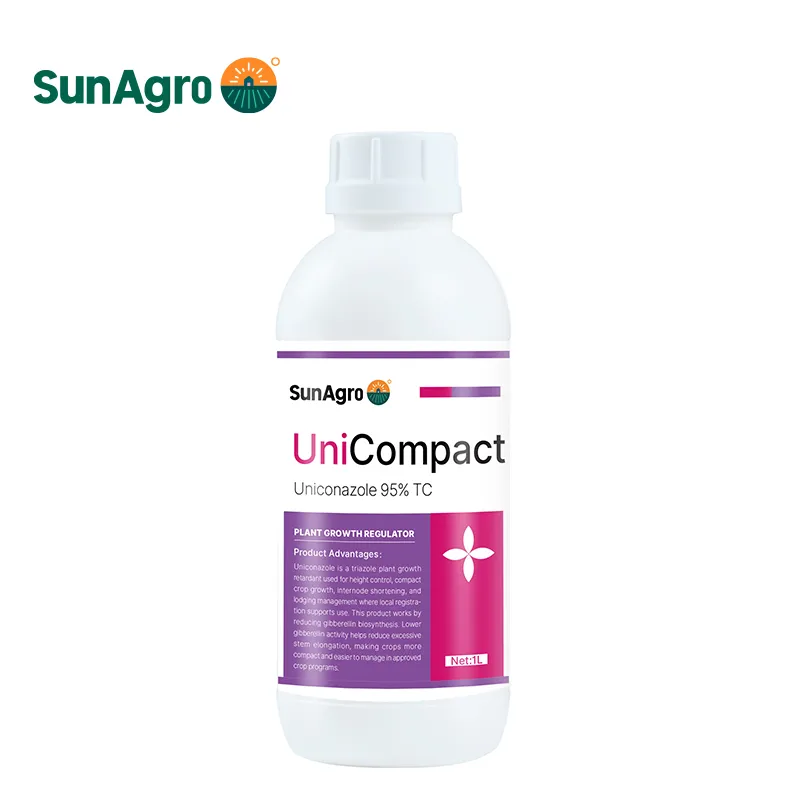
Uniconazole 95% TC and 5% WP Plant Growth Retardant
Uniconazole 95% TC and 5% WP is a triazole plant growth retardant used for height control, compact crop growth, internode shortening, and lodging management where local registration supports use.
This product works by reducing gibberellin biosynthesis. Lower gibberellin activity helps reduce excessive stem elongation, making crops more compact and easier to manage in approved crop programs.
POMAIS supplies Uniconazole in 95% TC and 5% WP. The 95% TC specification is mainly used as technical-grade material for formulation and registration-oriented supply. The 5% WP specification is a finished wettable powder formulation for local plant growth regulator product channels.
Uniconazole should be positioned as a plant growth retardant, not as a fertilizer, pesticide, general growth promoter, or guaranteed yield-increase product. It is a dose-sensitive and crop-stage-sensitive PGR, so product communication must remain clear, practical, and label-based.
POMAIS supplies Uniconazole products for importers, distributors, registration companies, agrochemical channels, and local market partners who need plant growth regulator supply with packaging communication, documents, batch quality control, and export coordination.
- Designed for Professional Buyers & Bulk Orders
- We support custom packaging, labeling, and formulation to meet your market needs.
- Export wholesale inquiries only.
- Please include destination country, business type (importer/distributor/registrant), and expected volume.
- Retail requests will not be processed.

About Uniconazole 95% TC and 5% WP Plant Growth Retardant
| Item | Details |
|---|---|
| Active Ingredient | Uniconazole |
| Available Specifications | 95% TC, 5% WP |
| Formulation Type | TC technical material, WP wettable powder |
| Product Type | Plant Growth Regulator / Plant Growth Retardant |
| Chemical Direction | Triazole-type PGR |
| Mode of Action Context | Gibberellin biosynthesis inhibition |
| Main Positioning | Height control, compact growth, internode shortening, and lodging management |
| Crop Direction | Field crops, ornamentals, nursery crops, fruit crops, and approved crop programs |
| Product Boundary | Not a fertilizer, insecticide, fungicide, or herbicide |
| Supply Support | Packaging communication, documents, batch QC, and export coordination |
What Is Uniconazole?
Uniconazole is a triazole-type plant growth regulator used mainly as a plant growth retardant.
Its main value is not to stimulate rapid crop growth. Its value is to control excessive vegetative growth, reduce plant height, shorten internodes, and support compact plant architecture where locally approved.
In crop production, excessive elongation can increase lodging risk, reduce field uniformity, affect plant structure, or create management problems in nursery and ornamental production. Uniconazole can be positioned for these situations when local registration and label directions support use.
This product should not be written as a simple crop booster. It is also not a fertilizer, insecticide, fungicide, or herbicide. Its strongest and most accurate product identity is:
Uniconazole is a triazole plant growth retardant for height control and compact growth management.
How Uniconazole Works
Uniconazole works by inhibiting gibberellin biosynthesis.
Gibberellins are plant hormones associated with stem elongation and internode growth. When gibberellin biosynthesis is reduced, excessive shoot elongation can be controlled, and plants may show shorter internodes and more compact growth.
This makes Uniconazole useful in approved programs where crop height control, vegetative growth management, compact seedlings, ornamental plant size control, or lodging management is needed.
The effect is highly dependent on crop, variety, growth stage, application timing, formulation, and local label use. Excessive or poorly timed use may cause over-suppression of growth, delayed development, or overly compact plants.
For this reason, Uniconazole should always be described as a dose-sensitive and crop-stage-sensitive plant growth retardant.
Mode of Action: Gibberellin Biosynthesis Inhibition
Uniconazole belongs to the plant growth retardant category because it reduces gibberellin-related growth activity.
| Technical Point | Product Meaning |
|---|---|
| Active Ingredient | Uniconazole |
| PGR Type | Triazole plant growth retardant |
| Mode of Action | Inhibits gibberellin biosynthesis |
| Plant Response | Reduced stem elongation and shorter internodes |
| Growth Effect | Compact plant architecture and height control |
| Use Boundary | Dose-sensitive and crop-stage-sensitive |
| Market Direction | Lodging management and vegetative growth control |
This mode of action separates Uniconazole from growth-promoting PGRs such as GA3, cytokinin-type products, and auxin-type rooting regulators.
Uniconazole should be used as part of a planned plant growth regulation program, not as a general crop improvement product.
Main Use Direction: Height Control and Lodging Management
The main product direction is height control and compact growth management.
Uniconazole can be positioned in crop programs where excessive vegetative growth needs to be managed. It may also support lodging management by reducing excessive plant height and improving plant structure where locally approved.
| Use Direction | Product Positioning |
|---|---|
| Height control | Helps reduce excessive plant height where approved |
| Internode shortening | Supports compact plant architecture |
| Lodging management | Useful where excessive elongation increases lodging risk |
| Vegetative growth control | Helps manage overly vigorous crop growth |
| Ornamental compact growth | Relevant to nursery and ornamental channels where registered |
| Approved crop programs | Final crop scope must follow local label |
This product should not be promoted as guaranteed lodging prevention. It can support lodging management, but final field performance depends on crop type, variety, growth stage, crop density, nutrition, weather, field management, and approved label use.
Suitable Crop Directions
Uniconazole has broad plant growth regulation potential, but final crop scope must follow local registration and approved labels.
Field Crops
For field crops, Uniconazole may be positioned for height control, lodging management, and excessive vegetative growth control where locally approved.
In crops where plant height, stem elongation, or lodging risk can affect management, a growth retardant product may help support a more compact crop structure. However, it should not replace proper nutrition, irrigation, crop density management, or agronomic planning.
Ornamentals and Nursery Crops
Uniconazole is commonly associated with ornamental and nursery height-control programs.
In ornamental crops, compact growth, uniform plant size, and transport-friendly plant architecture can be important for market quality. Uniconazole may be positioned for ornamental crop size management where local registration supports use.
For nursery crops and seedlings, product communication should remain careful. Different species and varieties may respond differently, and over-application may lead to excessive growth suppression.
Fruit Crops
For fruit crop programs, Uniconazole may be positioned for vegetative growth control, canopy management, and crop structure regulation where approved.
This direction should not be confused with fruit enlargement or fruit set promotion. Uniconazole is not a fruit growth stimulant. Its main role is growth retardation and vegetative balance management.
Seedling and Transplant Programs
For seedling and transplant programs, Uniconazole may support compact seedling production and controlled elongation where locally approved.
This direction can be useful in markets where seedlings need to remain compact, uniform, and easy to transport. However, crop species, seedling stage, rate, and timing must follow local label directions.
Available Specifications: 95% TC and 5% WP
POMAIS supplies Uniconazole in two main specification directions.
| Specification | Best-Fit Market Use |
|---|---|
| Uniconazole 95% TC | Technical material for formulation development and registration-oriented supply |
| Uniconazole 5% WP | Finished wettable powder formulation for local PGR product channels |
The right choice depends on registration format, formulation plan, packaging request, local crop channel, and distributor preference.
Uniconazole 95% TC
Uniconazole 95% TC is technical-grade material.
This specification is mainly suitable for formulation companies, registration companies, and qualified local partners that need technical material for formulation development, local registration projects, or technical procurement.
95% TC should not be positioned as a direct field-use product. Its value is in technical material supply, formulation preparation, registration communication, and local plant growth regulator product development.
For procurement, buyers usually focus on active content, material appearance, active identity confirmation, moisture control, packing seal, batch COA, storage condition, and shipment document consistency.
Uniconazole 5% WP
Uniconazole 5% WP is a finished wettable powder formulation for registered plant growth regulator markets.
WP means wettable powder. This formulation is suitable for local channels that need a dry PGR product for height control, compact growth, vegetative growth management, and lodging management programs where approved.
The value of 5% WP is finished formulation convenience. It can fit sachets, bags, cartons, export cartons, batch coding, carton marks, and multi-language label communication.
For quality control, WP formulation performance should focus on active ingredient content, powder appearance, wettability, suspension performance, moisture control, caking prevention, package sealing, and carton protection.
Choosing the Right Uniconazole Specification
Uniconazole specifications should be selected according to procurement purpose and market format.
| Market Need | Recommended Option |
|---|---|
| Technical material procurement | 95% TC |
| Formulation development | 95% TC |
| Registration-oriented active material supply | 95% TC |
| Local PGR product development | 95% TC |
| Finished WP PGR product | 5% WP |
| Distributor-ready product channel | 5% WP |
| Sachet, bag, or carton packaging | 5% WP |
| Height-control PGR product line | 5% WP |
For technical projects, 95% TC is the right direction. For finished product distribution, 5% WP is more suitable where local registration supports wettable powder PGR products.
Application Guidance
Use Uniconazole only where locally approved.
This product should be used only on registered crops, approved growth stages, and label-supported use directions. It should be positioned as a plant growth retardant, not as a fertilizer, pesticide, or growth-promoting PGR.
Final dose, dilution, timing, application method, crop stage, tank-mix direction, and use restriction must follow the approved local label.
Because Uniconazole is highly active and dose-sensitive, excessive use should be avoided. Over-application may cause excessive growth suppression, delayed development, or crop appearance problems.
No specific rate, timing, crop stage, application frequency, or tank-mix instruction should be used without an approved local label.
Crop Response and Use Boundary
Crop response may vary by crop species, variety, growth stage, application timing, nutrition status, weather, formulation quality, and approved local use.
Uniconazole can help manage excessive vegetative growth, but it should not be promoted as a guaranteed lodging-control product or guaranteed yield-improvement product.
It should also not be used as a replacement for fertilizer, irrigation, crop density management, pest control, disease control, weed control, or professional crop management.
Responsible product communication should be clear:
Uniconazole is a plant growth retardant for controlled growth programs, not a universal crop performance solution.
Compatibility and Program Positioning
Uniconazole may be positioned within crop height-control, lodging-management, ornamental compact-growth, or vegetative growth control programs where local labels allow use.
However, compatibility should never be assumed.
Before tank mixing or combined use, local partners should check tank-mix compatibility, crop safety, water quality, pH, formulation stability, application timing, and local label restrictions.
Uniconazole should not be described as a universal synergist for fertilizers, pesticides, or other plant growth regulators. Its use should remain crop-specific, label-dependent, and program-based.
Registration and Compliance
Registration and product identity should be handled carefully for Uniconazole products.
Before market promotion or field use, local partners should check local registration status, approved crop scope, label claims, application method, crop stage, use restrictions, crop safety precautions, residue requirements where applicable, label language, import documents, and destination-country rules.
For food crops, local partners should pay attention to residue and harvest-related requirements where applicable. For ornamentals and nursery crops, crop species and variety sensitivity should be reviewed carefully.
POMAIS supports qualified market partners with product documents and supply communication for local registration and distribution cooperation. Final registration, label approval, crop claims, and field use directions must follow local regulations.
Storage and Transport
Store Uniconazole products in sealed original packaging under suitable storage conditions.
The products should be kept in a cool, dry, and ventilated place. Avoid moisture, direct sunlight, high temperature, freezing, leakage, package damage, and long-term exposure to unsuitable storage conditions.
For Uniconazole 95% TC, storage attention should focus on material appearance, active content stability, moisture control, packing seal, batch label, and COA consistency.
For Uniconazole 5% WP, storage attention should focus on powder appearance, wettability, suspension performance, moisture protection, caking prevention, package sealing, and carton protection.
Transport and storage should follow SDS and local regulatory requirements.
Packaging Support
POMAIS supports packaging communication for Uniconazole 95% TC and 5% WP according to market needs and order requirements.
For 95% TC, packaging can be arranged for technical material handling, batch identification, storage protection, and export shipment requirements.
For 5% WP, packaging directions may include sachets, bags, cartons, export cartons, batch coding, carton marks, and multi-language label communication.
Packaging plans can be adjusted according to product specification, registration direction, destination market, distribution channel, and shipment requirement.
Document Support
POMAIS can support procurement, import communication, registration preparation, and shipment coordination with relevant product documents.
Document support may include COA, SDS/MSDS, TDS, product specification, packing information, label reference, batch information, shipment documents, and registration support documents where applicable.
For Uniconazole products, active identity confirmation, concentration basis, formulation specification, and batch COA are especially important for registration and procurement review.
Quality Control
Quality control for Uniconazole products focuses on active ingredient content, product identity, formulation appearance, stability, packaging integrity, and shipment readiness.
For Uniconazole 95% TC, batch review should include active ingredient content, material appearance, moisture attention, identity confirmation, packing seal, batch COA consistency, batch record management, and shipment document review.
For Uniconazole 5% WP, batch review should include active ingredient content, powder appearance, wettability, suspension performance, moisture control, caking attention, bag sealing, carton inspection, batch record management, and shipment document review.
Each batch should be checked according to product specification, packaging requirements, and export requirements before shipment.
FAQ
Why Choose POMAIS
POMAIS supplies crop protection and plant growth regulator products for importers, distributors, registration companies, agrochemical channels, and local market partners.
For Uniconazole 95% TC and 5% WP, POMAIS supports product specification communication, packaging planning, document preparation, batch quality control, and export coordination.
This supply model is suitable for partners who need clear product identity, practical formulation options, stable batch quality, and document support for local registration and distribution cooperation.
Partner with POMAIS for Uniconazole Supply
If you are sourcing Uniconazole 95% TC or 5% WP, POMAIS can support your project with product specification, packaging communication, document preparation, quality control, and export coordination.
Please share your destination country, target crop market, registration direction, formulation preference, packaging request, and expected order volume. Our team will provide a suitable supply proposal based on your procurement needs.
Contact us!
We will reply to you within 24 hours on business days!