Chlormequat Chloride 98% TC, 50% SL and 80% SP
Chlormequat Chloride, commonly referred to as Chlormequat or CCC, is a plant growth regulator used in cereal lodging control programs where local registration supports use.
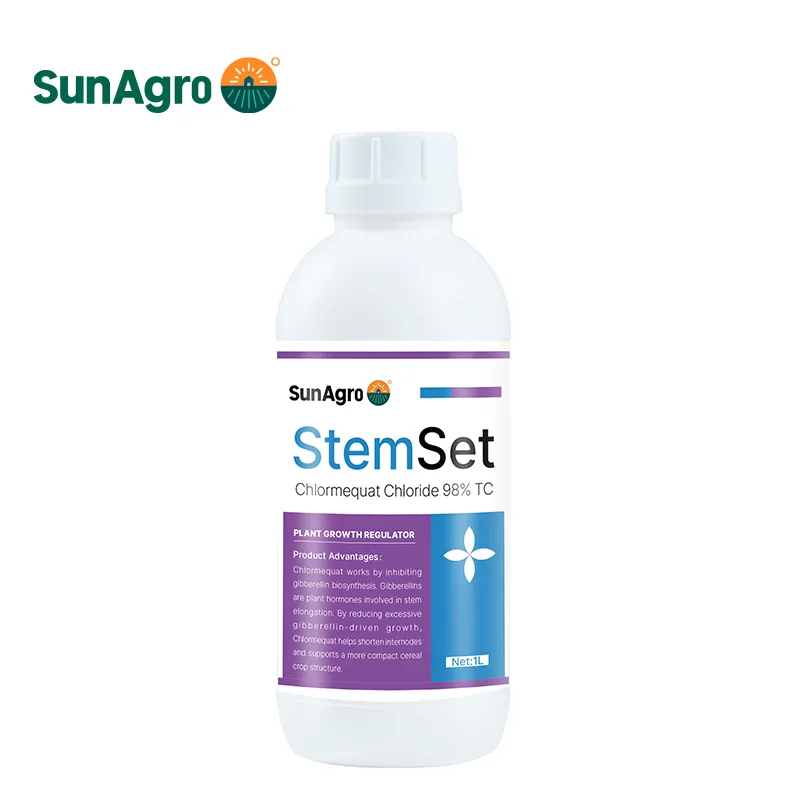
SunAgro supplies Chlormequat Chloride in 98% TC, 50% SL, and 80% SP. The 98% TC specification is mainly used as technical material for formulation and registration-oriented supply. The 50% SL and 80% SP specifications are finished formulation options for local plant growth regulator product channels.
Chlormequat should be positioned as a plant growth retardant for plant height management and lodging resistance. It should not be presented as a fertilizer, insecticide, fungicide, herbicide, or universal yield-increase product.
For qualified importers, distributors, registration companies, agricultural retailers, cereal crop channels, and local market partners, Chlormequat Chloride offers a clear product direction: shorter internodes, stronger stems, and better lodging management in approved cereal crop programs.
- Designed for Professional Buyers & Bulk Orders
- We support custom packaging, labeling, and formulation to meet your market needs.
- Export wholesale inquiries only.
- Please include destination country, business type (importer/distributor/registrant), and expected volume.
- Retail requests will not be processed.

About Chlormequat Chloride 98% TC, 50% SL and 80% SP
| Item | Details |
|---|---|
| Active Ingredient | Chlormequat Chloride |
| Common Names | Chlormequat, CCC |
| Product Type | Plant Growth Regulator |
| Product Positioning | Plant growth retardant for lodging control |
| Mode of Action Context | Inhibits gibberellin biosynthesis and reduces stem elongation |
| Available Specifications | 98% TC, 50% SL, 80% SP |
| Main Crop Direction | Wheat, barley, rye, oats, triticale, and approved cereal crops |
| Main Function | Shorter internodes, stronger stems, improved lodging resistance |
| Market Direction | Cereal crop growth regulation programs |
| Supply Support | SunAgro branded product supply, packaging communication, documents, and batch quality control |
What Is Chlormequat Chloride?
Chlormequat Chloride is a plant growth regulator used to manage crop architecture in cereal production.
In practical cereal crop programs, excessive stem elongation can increase lodging risk. Lodging may reduce harvest efficiency, affect grain quality, and create field management challenges. Chlormequat helps manage this risk by reducing plant height and supporting stronger stem structure where local label approval allows use.
This product is more accurately positioned as a plant growth retardant. Its role is not to directly feed the crop. It regulates plant growth by influencing stem elongation and crop stand structure.
How Chlormequat Works
Chlormequat works by inhibiting gibberellin biosynthesis.
Gibberellins are plant hormones involved in stem elongation. By reducing excessive gibberellin-driven growth, Chlormequat helps shorten internodes and supports a more compact cereal crop structure.
In the field, this means the crop may develop shorter and stronger stems under suitable conditions. This can help reduce lodging risk in cereal crops where the product is locally registered and correctly used.
Chlormequat does not work like a fertilizer, pesticide, or foliar nutrient. Its value comes from growth regulation. For this reason, it should be used as part of a planned cereal lodging management program, not as a general crop improvement input.
Chlormequat Mode of Action
Chlormequat Chloride is mainly positioned as a gibberellin-inhibiting plant growth regulator.
| Mode of Action Context | Commercial Meaning |
|---|---|
| Gibberellin inhibition | Reduces excessive plant height |
| Reduced stem elongation | Helps shorten internodes |
| Stronger crop stand | Supports lodging resistance |
| Plant growth retardant activity | Used for crop architecture management |
| Cereal growth regulation | Supports harvest and field management where approved |
This mode of action gives Chlormequat a clear role in cereal crop programs. It is used to manage crop height and lodging pressure, especially in fields with dense crop stands, high nitrogen input, strong vegetative growth, or lodging-sensitive varieties.
Field performance depends on crop variety, growth stage, nutrition level, weather, crop density, lodging pressure, and approved local use directions.
Main Use Direction: Cereal Lodging Control
The main agricultural direction for Chlormequat is cereal lodging control.
In wheat, barley, rye, oats, triticale, and other approved cereal crops, lodging can reduce harvest efficiency and crop quality. Chlormequat helps manage this risk by supporting shorter internodes and stronger stems.
| Use Direction | Product Positioning |
|---|---|
| Cereal lodging control | Helps improve lodging resistance where approved |
| Plant height management | Reduces excessive stem elongation |
| Stem strengthening | Supports a stronger cereal crop stand |
| Internode shortening | Helps manage crop architecture |
| Harvest management | Supports more stable crop structure before harvest |
| Approved crop programs | Final crop scope must follow local registration and label |
Chlormequat should not be promoted with absolute claims such as complete lodging prevention or guaranteed yield increase. It supports lodging management, but final results depend on crop condition and local application practice.
Suitable Crop Directions
Chlormequat should be written as a cereal crop plant growth regulator, not as a universal PGR for all crops.
Wheat
In wheat programs, Chlormequat is mainly positioned for plant height management and lodging resistance. It may be used in winter wheat or spring wheat programs where local registration allows use.
The key value is stronger crop architecture. For wheat markets with high lodging pressure, Chlormequat can be part of a planned growth regulation program together with variety selection, nitrogen management, crop density control, and harvest planning.
Barley
Barley can be sensitive to lodging under strong vegetative growth, dense planting, or high fertility conditions.
Chlormequat is positioned to help reduce excessive stem elongation and support stronger stems in approved barley programs. The final use direction depends on crop type, growth stage, local label, and market practice.
Rye, Oats and Triticale
For rye, oats, triticale, and other approved cereal crops, Chlormequat may be used in lodging management programs where registration supports use.
These crops should be discussed carefully. The product should not be promoted for crops, varieties, or growth stages not covered by the approved local label.
Ornamentals and Other Approved Crops
In some markets, Chlormequat may also be used in ornamental or horticultural plant height management programs where locally registered.
However, this product page should keep cereal lodging control as the main commercial direction. Ornamentals and other use cases should remain secondary and registration-dependent.
Available Specifications: 98% TC, 50% SL and 80% SP
SunAgro supplies Chlormequat Chloride in three specification options. The active ingredient direction is the same, but each specification serves a different procurement purpose.
| Specification | Best-Fit Market Use |
|---|---|
| Chlormequat Chloride 98% TC | Technical material for formulation and registration-oriented supply |
| Chlormequat Chloride 50% SL | Finished soluble liquid formulation for cereal lodging control markets |
| Chlormequat Chloride 80% SP | High-loading soluble powder formulation for dry product channels |
The right choice depends on your registration format, cereal crop market, formulation preference, packaging plan, storage condition, and local distribution channel.
Chlormequat Chloride 98% TC
Chlormequat Chloride 98% TC is technical-grade active ingredient material.
This specification is mainly suitable for formulation companies, registration companies, and qualified local market partners that need Chlormequat technical material for formulation development or registration-oriented projects.
98% TC should not be positioned as a direct field-use product. Its value is in active ingredient supply, formulation preparation, product registration communication, and local PGR product development.
For technical material procurement, buyers usually focus on active ingredient content, technical material appearance, batch COA, moisture control, packing seal, storage condition, and shipment document consistency.
Chlormequat Chloride 50% SL
Chlormequat Chloride 50% SL is a soluble liquid formulation for cereal lodging control markets where locally registered.
SL means soluble liquid. This formulation is suitable for markets that prefer liquid plant growth regulator products. It can be positioned for cereal crop channels, agricultural retail distribution, and local crop growth regulation programs where approved.
The value of 50% SL is practical formulation convenience. It is suitable for bottles, drums, cartons, export cartons, and liquid product channels. For many distributors, liquid formulations are easier to position in established cereal crop programs.
For procurement, quality attention should focus on active ingredient content, liquid appearance, formulation stability, packaging seal, leakage control, carton protection, and batch document consistency.
Chlormequat Chloride 80% SP
Chlormequat Chloride 80% SP is a high-loading soluble powder formulation.
SP means soluble powder. This formulation is suitable for markets that prefer dry PGR products, compact packaging, and high-specification product positioning.
Compared with 50% SL, 80% SP serves a different formulation and logistics direction. It can be practical for sachets, bags, cartons, and export cartons, especially in markets where dry formulation handling and storage are preferred.
80% SP should not be described as automatically better than 50% SL. The better choice depends on registration format, packaging plan, storage condition, distribution channel, and local user preference.
For procurement, quality attention should focus on active ingredient content, powder appearance, solubility or dilution performance, moisture control, anti-caking attention, package sealing, and carton protection.
Choosing the Right Chlormequat Specification
Chlormequat specifications should be selected according to procurement purpose and market format.
| Market Need | Recommended Option |
|---|---|
| Technical material for formulation | Chlormequat 98% TC |
| Registration-oriented active ingredient supply | Chlormequat 98% TC |
| Local formulation development | Chlormequat 98% TC |
| Finished liquid PGR product | Chlormequat 50% SL |
| Mature liquid distribution channel | Chlormequat 50% SL |
| High-loading soluble powder product | Chlormequat 80% SP |
| Dry formulation market positioning | Chlormequat 80% SP |
| Bottles, drums, or liquid packs | Chlormequat 50% SL |
| Sachets, bags, or cartons | Chlormequat 80% SP |
| SunAgro branded PGR product line | 50% SL / 80% SP |
For buyers building a local cereal crop PGR portfolio, 50% SL is suitable for liquid finished product channels. 80% SP is suitable for high-loading dry formulation channels. 98% TC is more suitable for formulation and technical procurement projects.
Application Guidance
Use Chlormequat only where it is locally approved.
Chlormequat should be applied only on registered crops, approved growth stages, and label-supported use directions. It should be positioned as a plant growth retardant for lodging control, not as a fertilizer, pesticide, or general crop stimulant.
Field use should consider crop variety, crop growth stage, nitrogen level, crop density, lodging pressure, weather condition, and crop stress. These factors can influence crop response and final lodging management results.
No specific dosage, dilution ratio, application frequency, crop timing, tank-mix instruction, or harvest interval should be used without an approved local label.
Crop Safety and Use Boundary
Chlormequat should be used as part of a planned cereal growth regulation program.
Crop response may vary by variety, growth stage, nitrogen input, soil fertility, crop density, weather condition, water status, and lodging pressure. A strong crop stand does not depend on Chlormequat alone. It also depends on agronomic management.
If used too early, too late, under unsuitable crop stress, or outside local label directions, Chlormequat may not deliver the expected result. Responsible product positioning should avoid absolute claims.
Chlormequat should not be promoted as a product that guarantees lodging prevention, yield increase, stronger stems in all fields, or safe use on every crop and growth stage.
Registration and Residue Compliance
Chlormequat is used on cereal crops, so registration and residue compliance are important.
Before market promotion or field use, local partners should check local registration status, approved crop scope, label claims, application method, pre-harvest interval, MRL requirements, grain destination, residue testing expectations, packaging label language, and import requirements.
For grain markets, destination-market compliance can be important. Chlormequat use should be evaluated together with local residue limits, export grain standards, and approved label restrictions.
SunAgro supports qualified market partners with product documents and supply communication for local registration and distribution cooperation. Final registration, label approval, crop claims, and field use directions must follow local regulations.
Storage and Transport
Store Chlormequat products in sealed original packaging under suitable storage conditions.
Products should be kept in a cool, dry, and ventilated place. Avoid moisture, direct sunlight, high temperature, package damage, leakage, and damp storage. Keep products away from food, feed, seed, and incompatible materials. Transport and storage should follow SDS and local regulatory requirements.
For Chlormequat 98% TC, storage attention should focus on technical material appearance, active ingredient stability, moisture control, packing seal, batch label, and COA consistency.
For Chlormequat 50% SL, storage attention should focus on liquid appearance, formulation stability, bottle or drum sealing, leakage control, carton protection, and temperature exposure.
For Chlormequat 80% SP, storage attention should focus on powder appearance, solubility or dilution performance, moisture protection, anti-caking control, package sealing, and carton protection.
Packaging Support
SunAgro supports packaging communication for Chlormequat 98% TC, 50% SL, and 80% SP according to market needs and order requirements.
Chlormequat 98% TC can be supplied in technical material packaging suitable for qualified formulation and registration partners. Packaging can be aligned with technical material handling, shipment protection, batch identification, and destination-market requirements.
Chlormequat 50% SL can be supplied in liquid formulation packaging, including bottles, drums, cartons, export cartons, batch coding, carton marks, and multi-language label communication.
Chlormequat 80% SP can be supplied in dry formulation packaging, including sachets, bags, cartons, export cartons, batch coding, carton marks, and market-oriented label communication.
Final packaging plans can be adjusted according to product specification, registration direction, cereal crop channel, distribution model, and shipment requirement.
Document Support
SunAgro can support procurement, import communication, registration preparation, and shipment coordination with relevant product documents.
Document support may include COA, SDS/MSDS, TDS, product specification, packing information, label reference, batch information, shipment documents, and registration support documents where applicable.
For Chlormequat 98% TC, technical specification, active ingredient analysis, and batch COA are especially important for formulation and registration-oriented buyers.
For Chlormequat 50% SL, liquid formulation specification and packaging information are important for import and distribution communication.
For Chlormequat 80% SP, soluble powder specification, dilution performance reference, and packing details can support market preparation and procurement review.
Quality Control
Quality control for Chlormequat products focuses on active ingredient content, formulation appearance, stability or solubility performance, moisture control, packaging integrity, and shipment readiness.
For Chlormequat 98% TC, batch review should focus on active ingredient content, technical material appearance, moisture attention, packing seal, batch COA consistency, batch record management, and shipment document review.
For Chlormequat 50% SL, batch review should focus on active ingredient content, liquid appearance, formulation stability, packaging seal, leakage control, carton protection, batch record management, and shipment document review.
For Chlormequat 80% SP, batch review should focus on active ingredient content, powder appearance, solubility or dilution performance, moisture and caking attention, package sealing, carton inspection, batch record management, and shipment document review.
Each batch should be checked according to product specification, packaging requirements, and export requirements before shipment.
FAQ
What is Chlormequat Chloride?
Chlormequat Chloride, also known as Chlormequat or CCC, is a plant growth regulator used to reduce plant height and improve lodging resistance in cereal crops where locally approved.
Is Chlormequat a plant growth regulator?
Yes. Chlormequat is a plant growth regulator. More specifically, it is positioned as a plant growth retardant for crop height and lodging management.
How does Chlormequat work?
Chlormequat works by inhibiting gibberellin biosynthesis. This reduces excessive stem elongation, shortens internodes, and helps cereal crops develop stronger stems.
What is Chlormequat used for?
Its main agricultural direction is lodging control and plant height management in cereal crops such as wheat, barley, rye, oats, and triticale where approved.
Is Chlormequat a fertilizer?
No. Chlormequat is not a fertilizer or nutrient source. It regulates plant growth and crop architecture.
Is Chlormequat a herbicide?
No. Chlormequat should not be promoted as a weed-control herbicide. It is a plant growth regulator used for crop height management and lodging control.
What is the difference between 98% TC, 50% SL and 80% SP?
Chlormequat 98% TC is technical material for formulation and registration-oriented supply. Chlormequat 50% SL is a soluble liquid finished formulation. Chlormequat 80% SP is a high-loading soluble powder formulation.
Is Chlormequat 80% SP better than 50% SL?
Not necessarily. 80% SP and 50% SL serve different formulation and market needs. The right choice depends on registration format, packaging plan, storage condition, distribution channel, and local market preference.
Can Chlormequat prevent lodging completely?
No product should be promoted as a complete lodging guarantee. Chlormequat can support lodging resistance where approved, but field performance depends on variety, crop density, nitrogen level, weather, growth stage, and field management.
What crops can Chlormequat be used on?
Common crop directions include wheat, barley, rye, oats, triticale, and other approved cereal crops. Final crop scope must follow local registration and approved label instructions.
Can SunAgro supply Chlormequat documents?
Yes. SunAgro can support COA, SDS/MSDS, TDS, product specification, packing information, label reference, batch information, shipment documents, and registration support documents where applicable.
Why Choose SunAgro
SunAgro supplies SunAgro branded crop protection and plant growth regulator products for qualified importers, distributors, registration companies, agricultural retailers, crop protection channels, and local market partners.
For Chlormequat Chloride, SunAgro supports 98% TC, 50% SL, and 80% SP specification supply. Our support covers product specification communication, packaging planning, document preparation, batch quality control, and export coordination.
This supply model is suitable for partners who need clear specifications, stable product quality, practical packaging options, and document support for local registration and distribution cooperation.
Partner with SunAgro for Chlormequat Chloride Supply
If you are sourcing Chlormequat Chloride in 98% TC, 50% SL, or 80% SP, SunAgro can support your project with product specification, packaging communication, document preparation, quality control, and export coordination.
Please share your destination country, target cereal crop market, registration direction, formulation preference, packaging request, and expected order volume. Our team will provide a suitable supply proposal based on your procurement needs.
Contact us!
We will reply to you within 24 hours on business days!