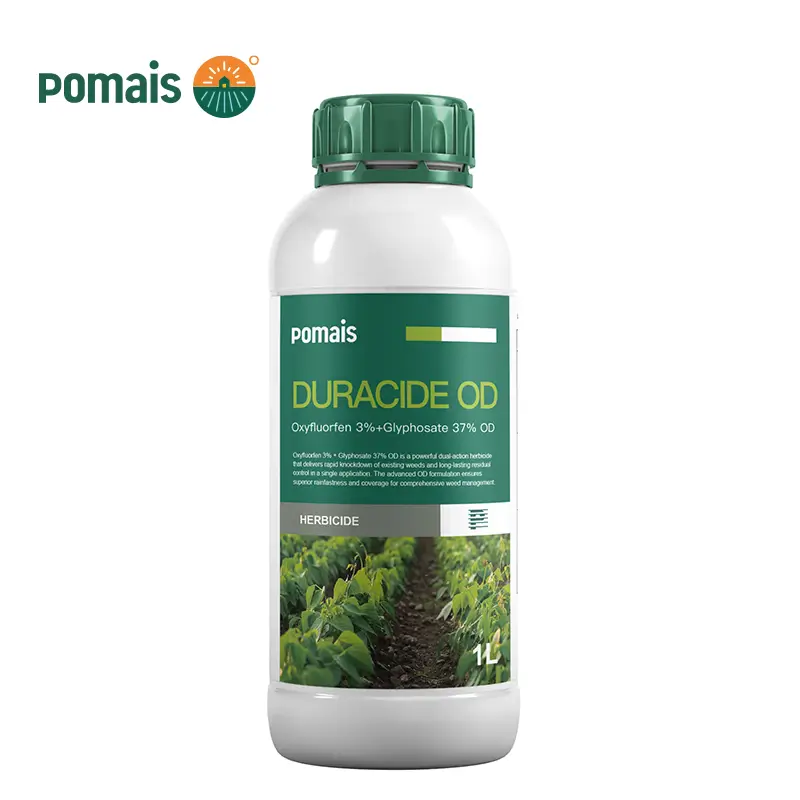
Oxyfluorfen 3% + Glyphosate 37% OD Herbicide
One pass. Two actives. Broad-spectrum control. Residual-plus system in a single OD formulation.
Oxyfluorfen 3% + Glyphosate 37% OD is a next-generation directed spray herbicide combining two powerful modes of action in an oil-dispersion (OD) formulation. This dual-action solution delivers both immediate knock-down and extended residual control of broadleaf and grassy/sedge weeds — making it an optimal choice for high-value crops, non-crop sites and industrial grounds where precision, speed and duration matter.
- Designed for Professional Buyers & Bulk Orders
- We support custom packaging, labeling, and formulation to meet your market needs.
- Export wholesale inquiries only.
- Please include destination country, business type (importer/distributor/registrant), and expected volume.
- Retail requests will not be processed.

About Oxyfluorfen 3% + Glyphosate 37% OD Herbicide
| Active / Parameter | Oxyfluorfen | Glyphosate |
|---|---|---|
| Molecular formula | C₁₅H₁₁ClF₃NO₄ | C₃H₈NO₅P |
| Molecular weight | 361.70 g/mol | 169.07 g/mol |
| Melting point | ~84-85 °C | ~184.5 °C |
| Density / Specific gravity | ~1.49 g/cm³ | ~1.704 g/cm³ (20 °C) |
| Water solubility | ~0.11 mg/L at 25 °C | Highly soluble in water |
| Vapor pressure | ~2×10⁻⁶ mmHg (extremely low) | Decomposes at ~187 °C (no standard boiling point) |
- Balanced dual actives: Oxyfluorfen at 3% provides contact and residual broadleaf control; Glyphosate at 37% offers systemically absorbed, non-selective weed control across annual and perennial spectra.
- OD formulation advantage: The oil-dispersion type enhances wetting, coverage and rainfastness—especially important for directed applications under tree canopies or in narrow weed-strips.
- Flexible application scenarios: Ideal for orchard or vineyard floor strips, industrial yards, roadway edges, and other borderline sites where drift, non-target crop contact and downtime must be minimized.
- Efficiency & cost-effectiveness: The combined form reduces the need for multiple separate treatments — supporting faster operational turn-around and streamlined logistics.
- Resistance strategy friendly: By including two distinct modes of action, the product aligns with integrated weed-management (IWM) practices and supports resistance-mitigation goals.
For distributors and crop managers seeking a high-performance, broad-spectrum, directed-spray herbicide that minimizes operational complexity while delivering robust weed control — this product is positioned as a premium offering. It enables professional operators to deliver strong results with fewer passes, less drift-risk, and greater predictability across tough weed situations.
Mode of Action
The dual-active formulation of Oxyfluorfen 3% + Glyphosate 37% OD combines two distinct and complementary herbicide mechanisms, delivering both rapid contact burn and systemic transport to growing weeds.
Oxyfluorfen (PPO inhibitor)
- Oxyfluorfen belongs to the diphenyl ether chemical family and operates by inhibiting the enzyme protoporphyrinogen oxidase (PPO).
- The inhibition of PPO leads to an accumulation of protoporphyrinogen IX and conversion to protoporphyrin IX, which under light exposure generates reactive oxygen species (ROS). These ROS cause severe lipid peroxidation and cell-membrane collapse, resulting in rapid necrosis of foliage tissues.
- Because action is contact-based and light-dependent, its initial effect is rapid (hours to days) but the translocation within the plant is minimal—thus it works best when foliage contact is achieved.
- In addition to foliar contact, Oxyfluorfen provides soil-surface residual activity: a barrier effect can persist for several months under favourable conditions, affecting seedlings as they emerge.
Glyphosate (EPSPS inhibitor)
- Glyphosate is a non-selective, systemic herbicide whose mode of action is inhibition of the enzyme 5-enolpyruvylshikimate-3-phosphate synthase (EPSPS), a key enzyme in the shikimate pathway for the biosynthesis of aromatic amino acids (phenylalanine, tyrosine, tryptophan).
- Once absorbed primarily through foliage, glyphosate is translocated throughout the plant—including to growing meristems and root zones—and disrupts protein synthesis, growth and metabolic pathways, eventually causing plant death over days to weeks.
- Because glyphosate blocks a pathway ubiquitous in plants (and absent in animals), it has broad-spectrum activity; however it lacks significant soil residual activity (i.e., little barrier effect).
Combination Advantages
- The two mechanisms act complementarily: Oxyfluorfen provides fast-acting contact burn and residual barrier for seedlings, while glyphosate captures existing vegetation via systemic movement.
- This dual-action helps tackle both emerging seedlings (via residual contact) and established perennial or difficult-to-reach weeds (via systemic uptake).
- From a resistance-management (IRM) perspective, combining a PPO-inhibitor (HRAC/ WSSA Group 14) with an EPSPS-inhibitor (Group 9) helps delay selection pressure on a single mode of action, thereby supporting long-term efficacy.
- The OD (oil-dispersion) formulation further enhances foliar uptake and contact efficiency, optimizing the functional expression of both actives.
Target Weeds & Weed Issues
The Oxyfluorfen 3% + Glyphosate 37% OD formulation offers a robust spectrum of weed control by combining two active ingredients that address both emerging seedlings and established vegetation. The following summaries highlight the major weed categories and specific challenges this product is designed to overcome.
Broadleaf Weeds
- The Oxyfluorfen component is effective both pre-emergence and early post-emergence against a range of annual broadleaf weeds. Examples include pigweed (Amaranthus spp.), lambsquarters (Chenopodium album), groundsel (Senecio vulgaris), smartweed (Polygonum spp.), wild mustard (Sinapis arvensis), among others.
- In situations where rapid seedling emergence is occurring (for example, after tillage or during inter-row cropping operations), the residual activity of oxyfluorfen offers a barrier that helps suppress newly germinating broadleaf weeds before they become visible.
- The glyphosate component supports the control of established broadleaf weeds — including perennial and tough species — by systemic uptake and whole-plant action. As the Glyphosate factsheet states: “controls broadleaf weeds and grasses”.
Grass & Sedge Weeds (Grassy/Non-Broadleaf)
- The oxyfluorfen component also offers activity against certain seedling grasses and sedges when applied early (pre-emergence or very young post-emergence). For instance, barnyardgrass, large crabgrass, and other annual grasses are listed under major weeds controlled.
- The glyphosate element addresses grasses and sedges broadly — from annuals to perennials — via its systemic mode of action and non-selective character. Reference: “Glyphosate is a non‐selective herbicide… applied to the leaves of plants to kill both broadleaf plants and grasses.”
- This dual-mechanism allows the product to better tackle mixed-weed infestations (i.e., fields or non-crop areas where broadleaf + grass/sedge weeds co-occur).
Resistance & Tough Problem Weeds
- Resistance to glyphosate alone is well documented — e.g., more than 40 weed species worldwide show glyphosate resistance.
- By combining a Group 9 herbicide (glyphosate) with a Group 14 herbicide (oxyfluorfen), the formulation enhances resistance-management potential and restores efficacy in situations where glyphosate alone has become compromised.
- The product is particularly valuable where broadleaf weeds show reduced response to glyphosate-only treatments and where seedling flushes after tillage or field operations produce “hard to hit” weeds.
Practical Weed Problem Scenarios
- In orchard or vineyard floor strips: frequent flushes of Portulaca (purslane), Chenopodium, Amaranthus and Cyperus sedges may occur post-harvest or during vine canopy thinning. This formulation covers those scenarios by providing early residual plus systemic control.
- In non-crop/industrial sites: mixed populations of broadleaf weeds and grasses (e.g., crabgrass, foxtails, Elliott’s sedge) often persist through low-maintenance turf or bare ground; this product suite addresses both live vegetation and emerging seedlings.
- In rotational cropping or pre-seeding fallow strips: where seedbanks are high, and multiple cohorts of weeds emerge, the residual effect of oxyfluorfen gives window of suppression followed by glyphosate activity on surviving plants.
Formulation & Blend Advantages
The Oxyfluorfen 3% + Glyphosate 37% OD product leverages a carefully engineered oil-dispersion (OD) formulation, which confers multiple performance, handling and operational benefits compared with conventional water-based formulations.
OD (Oil Dispersion) Formulation Basics
An OD formulation is essentially a stable suspension of solid active-ingredient particles in a non-aqueous oil medium that, when diluted, forms a fine oil-in-water emulsion or dispersion.
In technical terms, ODs allow actives that might be water-insoluble or sensitive in aqueous media to be effectively delivered via an oil matrix, improving spray performance and formulation stability.
Key Advantages for the Field
- Better leaf coverage & adhesion: The oil medium enhances droplet spreading, adhesion to plant surfaces and uptake into the foliage cuticle.
- Improved rain-fastness and reduced wash-off: Oil-based sprays are more resistant to being washed away by early rainfall, protecting the active ingredients until uptake occurs.
- Reduced drift and finer deposition control: Because oil dispersions can form larger, more stable droplets and better lamella behaviour, spray drift tends to be reduced compared with lighter water-based formulations.
- Enhanced stability for sensitive actives: For active ingredients that are moisture‐sensitive or poorly soluble in water, OD enables formulation in a stable oil medium.
- Simplified tank mix and application logistics: The built-in adjuvant effect of the oil matrix may reduce the need for additional adjuvants, improving operational efficiency and reducing labour/complexity.
Why This Matters for Your Product
- Dual‐active blend synergy is supported: With two distinct actives (one contact/residual, one systemic), the OD format ensures optimal delivery of both — better adhesion for contact-action Oxyfluorfen, and efficient uptake for systemic Glyphosate.
- Directed spray applications: In orchard floors, vineyard strips, non-crop zones or tight canopies, where drift, canopy contact and wash-off risk are higher, the OD format offers operational robustness.
- Compliance & safety benefits: Oil-dispersion formulations often exhibit lower volatility and reduced flammability compared to some older solvent-based concentrates, and can help meet more stringent regulatory/handling requirements.
Summary
By choosing the OD formulation for this dual‐active herbicide product, your customers gain a high-performance formulation that supports better control outcomes, improved reliability under challenging field conditions, and smoother deployment in professional spray operations.
Application Scenarios & Use Recommendations
The dual-active OD formulation (Oxyfluorfen 3% + Glyphosate 37%) is designed for flexible deployment across both agricultural and non-crop settings. The following outlines several key scenarios and best practice recommendations that align with efficient, safe and compliant operations.
Key Use Scenarios
- Orchards & Vineyards (Tree/Plantation Crops): Directed floor-spray or strip-spray beneath trees, vines and shrubs. Ideal for row-middles, alleyways or beneath canopy zones where mechanical cultivation is restricted. Because the product includes residual (via Oxyfluorfen) and systemic (via Glyphosate) activity, it is well suited for post-harvest or dormant-season applications when green canopy contact risk is low.
- Industrial/Non-Crop Zones: Urban yards, warehouse yards, storage areas, road shoulders, embankments, rail-sidings: places where vegetation control must be reliable, low-maintenance and drift/loss-risk must be minimized. The OD format helps adhesion and rain-fastness in such challenging sites.
- Pre-plant or Fallow/Resting Ground: In preparation for new planting or when a fallow period is planned, this product can help suppress weed flushes, provide residual suppression and target established weeds in one pass—simplifying turn-over operations.
- Mixed-Weed Pressure Sites: Where both broadleaf plus grasses/sedges co-occur (for example, orchard under-storey with sedge infestation + pigweed flush), the dual-active blend gives a more integrated control profile.
Best Practice Use Recommendations
- Directed Application Only: Always aim spray toward the soil or weed foliage beneath the crop canopy; avoid contact with crop green tissues, buds or stems with active growth. Ensure shields, spray guards or boom-deflectors are used to minimize drift onto desirable plants.
- Timing & Weed Stage: For optimum effect, apply when weeds are at younger growth stages: seedlings or early leaf stages (for Oxyfluorfen residual component) and when existing vegetation is actively growing (for Glyphosate uptake). For example, small seedlings flush or weed-free soil surface are ideal.
- Soil/Surface Preparation: Where using for residual control, ensure soil surface is clean and minimally disturbed after application to preserve the herbicidal barrier. For example, Oxyfluorfen is most effective when applied to weed-free soil and remain undisturbed.
- Adjuvants & Spray Volume: While the OD formulation inherently aids uptake, ensure good spray volume and coverage. Where local label allows, consideration of a non-ionic surfactant may further improve post-emergence activity. For example, some Oxyfluorfen labels specify surfactant use for emerged weeds.
- Avoid Drift & Off-Target Contact: Because the formulation has residual and contact components, any unintended contact with non-target plants, especially crops or ornamentals, can cause injury. Ensure wind speeds are low, no spraying during inversion layers, and spray shields are operative.
- Rain/Foliage-Conditions: While the OD formulation improves rain-fastness, for best results apply when weeds are healthy, actively growing and not under drought or severe stress. Also wait for spray to settle before rainfall when possible; heavy rainfall immediately after may reduce surface-residual performance.
- Compatibility & Tank-Mixing: If local label permits, the product may be tank mixed or used in sequence with other herbicides, but always follow the most restrictive label instructions for any partner product. Especially when targeting complex weed suites or resistance issues.
- Equipment & Calibration: Use low-drift nozzles, ensure the boom height is appropriate (in orchard/plantation settings often low boom directed application is preferred), ensure even distribution along the row/strip, and avoid overlap or excessive application which may increase risk to non-target plants.
Summary Call-Out
Use this product when you face: a weed complex of broadleaf + grasses/sedges, need both immediate knock-down and residual suppression, operate in drift-sensitive or crop-sensitive zones, or carry out non-crop vegetation control tasks with professional standards. With correct equipment, timing, and compliance to label, you can streamline weed management into fewer passes with higher reliability.
Crop Safety & Environmental Risk Management
Ensuring safe use and minimizing off-target or environmental impact are essential when deploying the Oxyfluorfen 3% + Glyphosate 37% OD product.
Crop Safety Highlights
- The formulation is non-selective, which means any green tissue of crops, ornamentals or native plants can be damaged if spray contacts them. It is critical that applications are made as directed sprays onto soil or weed foliage, and not toward crop green parts.
- Oxyfluorfen in particular is phytotoxic to plant foliage and must not contact desirable plants. Its label clearly states “avoid accidental spray contact or drift with established crops”.
- For tree, vine or horticultural crops, applications are safest when green tissue is dormant or less active (for example during post-harvest or dormancy), and when tree trunks/leaves are shielded. Crop tolerance must always be verified for the exact variety and site.
Environmental Risk Management
- Oxyfluorfen poses high toxicity to aquatic organisms and must not be allowed to drift into water bodies or sensitive habitats.
- Soil runoff, sediment transport and erosion may carry active ingredients off-site—especially on coarse soils and steeper slopes.
- Because glyphosate is less persistent in soil, the major residual risk lies with the oxyfluorfen component: soil disturbance (e.g., tillage) may reduce its residual effect and increase risk of off-site movement.
Best Practices for Risk Mitigation
- Always calibrate equipment and use low-drift nozzles and boom shields; avoid spraying during inversions, high winds or adjacent to water bodies.
- Use buffer zones adjacent to waterways or non-target habitats; adhere to label-specified setback distances.
- Avoid soil disturbance after application if residual control is intended; maintain stable soil surface for best residual effect.
- Monitor weather: delay application if heavy rain is expected immediately after spraying, as this may compromise residual efficacy or increase runoff risk.
- Provide training and documentation to operators, ensure PPE and re-entry intervals (REIs) are respected, and keep records for compliance.
Resistance Management (IRM)
In weed-management landscapes today, resistance risk is a major concern; the Oxyfluorfen 3% + Glyphosate 37% OD blend is designed to support integrated resistance mitigation.
Mechanism-diversification Advantage
- Glyphosate is a Group 9 herbicide (EPSPS inhibitor) and resistance to it has been documented in many weed species globally.
- Oxyfluorfen is a Group 14 herbicide (PPO inhibitor) with a different mode of action; including it in the blend reduces reliance on glyphosate alone and thus helps delay selection of glyphosate-resistant populations.
- Studies indicate that combining oxyfluorfen and glyphosate improves efficacy compared with glyphosate alone, supporting the “two-actives” logic in resistance mitigation.
Implementation Recommendations
- Rotate fields and weed-control systems: integrate the product into a broader programme that includes cultural, mechanical and biological components (not herbicide alone).
- Avoid repeated applications of the same mechanism; limit use of group 9 or group 14 herbicides in successive years without change.
- Monitor weed species and populations for signs of reduced sensitivity or survival after treatment; maintain field logs of treatments and outcomes.
- In areas known to have resistant weed populations, use this blend early (when weeds are small) and add follow-up programmes (e.g., mechanical removal, alternate herbicide modes).
Note to Distributors & Growers
Emphasise to clients that “herbicide tool” = part of system, not stand-alone solution. Marketing should reflect that the product’s value includes resistance-strategy benefit, not just one-pass convenience.
Packaging Specifications & Commercial Support
From a B2B vantage point (distributors, importers, formulators), clear packaging options and supporting documentation strengthen market appeal.
Packaging & Formulation Details
- Suggested standard pack sizes might include 1 L, 5 L, 20 L and 200 L drums, with customization available (OEM/white-label) based on region and regulation.
- As an OD (oil-dispersion) concentrate, the product should be shipped and stored in sealed, labelled containers, kept away from direct heat/sunlight, and tested for stability (e.g., cold-storage/heat-shock).
Documentation & Certification
- Provide COA (Certificate of Analysis) for each batch, plus MSDS (Material Safety Data Sheet), and TDS (Technical Data Sheet) showing formulation specs.
- Offer multi-language labels and registration support: many markets require local language labels, local use-registrations, and supporting residue/eco-toxicity data.
- Offer branding flexibility: private-label options, small-pack market (e.g., specialty growers), tailored marketing assets (catalogues, spray-guides) to support distributor sales.
Logistics & Supply Chain Advantage
- Emphasise short lead times (20–30 days typical for your network), high reliability (99% on-time rate) and vertical integration (manufacturing, QC, logistics) – as per your company’s advantages.
- Highlight global export-experience: your team’s fluency in English/Russian and presence in Middle East, South America, Africa, Russia & Central Asia helps with regulatory/transport/double-clearance workflows.
Commercial Messaging for Distributors
- “Single-tank, broad-spectrum herbicide with residual and systemic control” as a premium offer.
- Provide “application-ready” marketing: shelf-talker, technical flyer, regional case study, resistance-management selling points.
- Offer “sample label & registration dossier” package to help distributor localise quickly.
FAQ
Q1: Is the product safe for all crops?
A1: No. This is a non-selective herbicide formulation. If spray contacts green crop tissues (leaves, stems, buds), injury may occur. Applications must be directed to soil or weed foliage and avoid desirable plant parts.
Q2: How long is the residual/soil-barrier effect?
A2: The residual effect is mainly provided by the Oxyfluorfen component. Under favourable conditions it may suppress weed seedlings for several weeks to months. The Glyphosate component provides systemic knock-down of existing weeds but contributes little or no long-term soil barrier effect.
Q3: Can the product handle both broadleaf and grassy/sedge weeds?
A3: Yes. The combination of Oxyfluorfen (effective on many broadleaf and some sedge/grass seedlings) plus Glyphosate (broad-spectrum, systemic on grasses, sedges and broadleaf) makes the formulation suitable for mixed weed populations.
Q4: What about weed resistance—does this product help?
A4: Yes—it supports resistance-management. The dual modes of action (PPO inhibitor + EPSPS inhibitor) reduce reliance on a single mechanism and help manage populations less responsive to glyphosate-only treatments. That said, it must be used as part of a broader integrated weed management (IWM) programme.
Q5: Is immediate rainfall after application a concern?
A5: Because the formulation is oil-dispersion (OD), uptake and rain-fastness are better than many water-based options. However, heavy rainfall shortly after application may reduce the residual barrier effect (especially from Oxyfluorfen). Best practice: apply when no heavy rain is expected shortly after, and avoid disturbing soil surface if residual is required.
Q6: What packaging and support documentation are available for distribution/wholesale?
A6: Typical pack sizes include 1 L, 5 L, 20 L, and 200 L drums, with customizable OEM/white-label options. Documentation includes Certificate of Analysis (COA), Material Safety Data Sheet (MSDS), Technical Data Sheet (TDS), multi-language labels, registration support and marketing assets.
Q7: Can this product be used in certified organic production?
A7: No. The active ingredients (Oxyfluorfen and Glyphosate) are synthetic herbicides and are not approved for certified organic production systems.