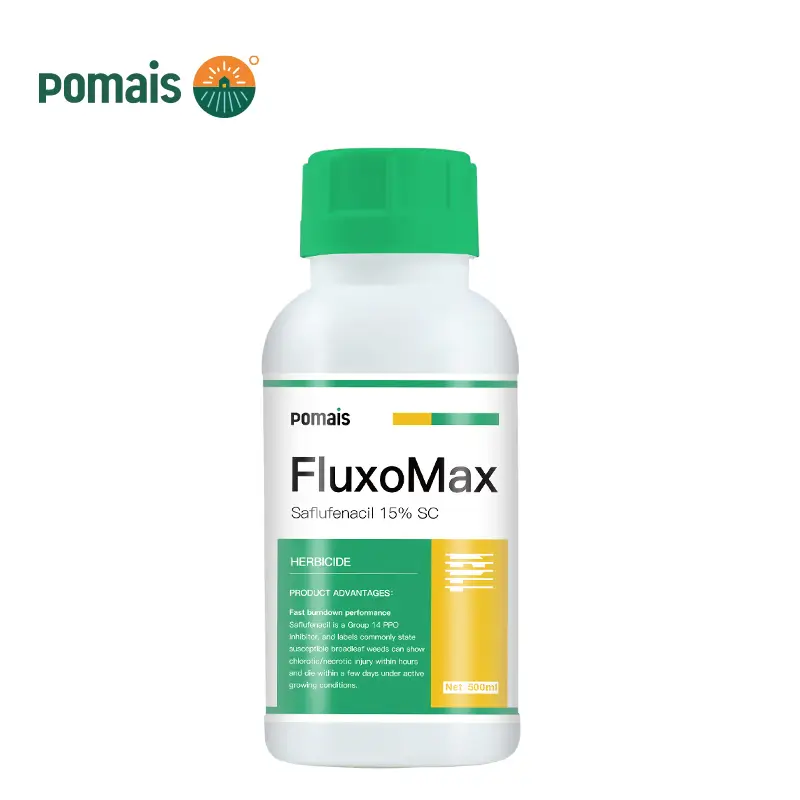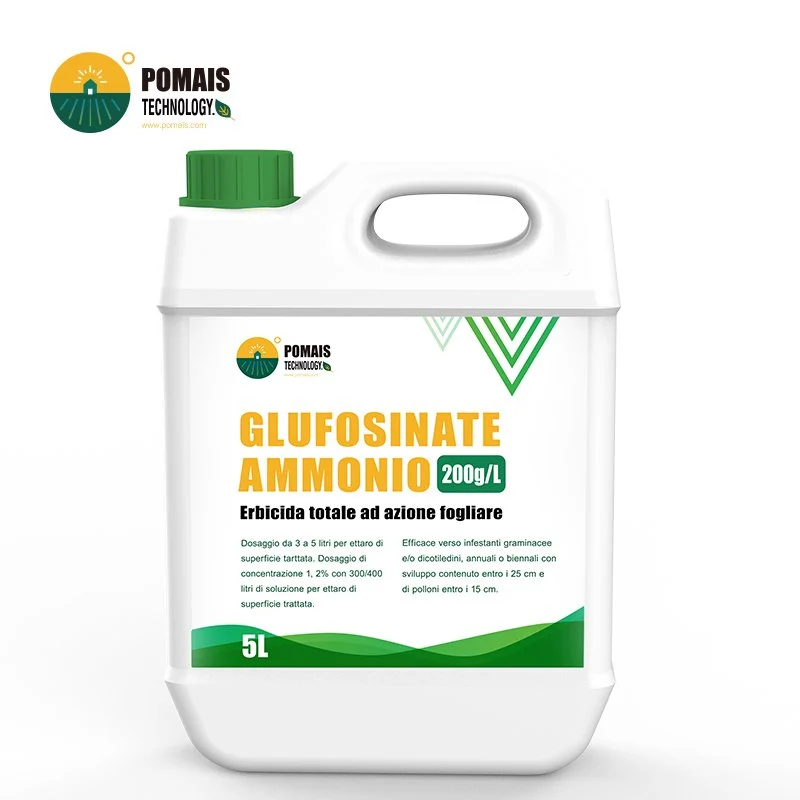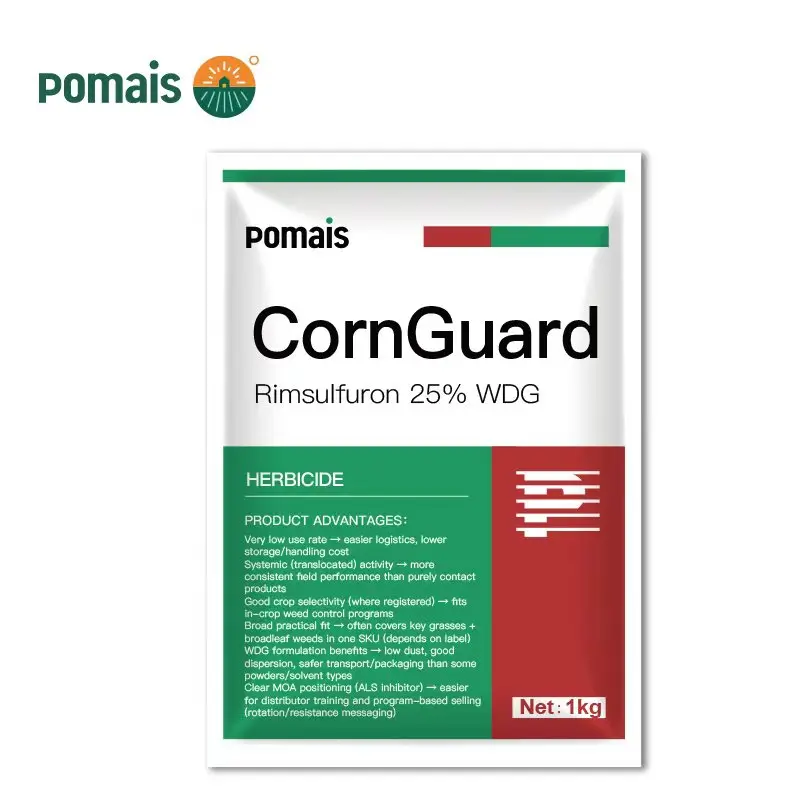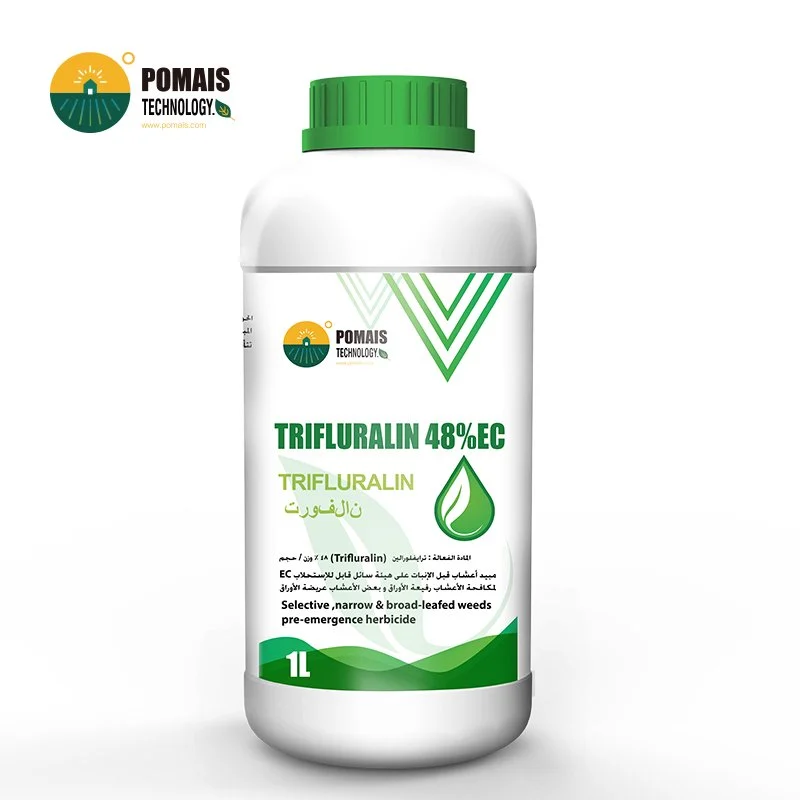
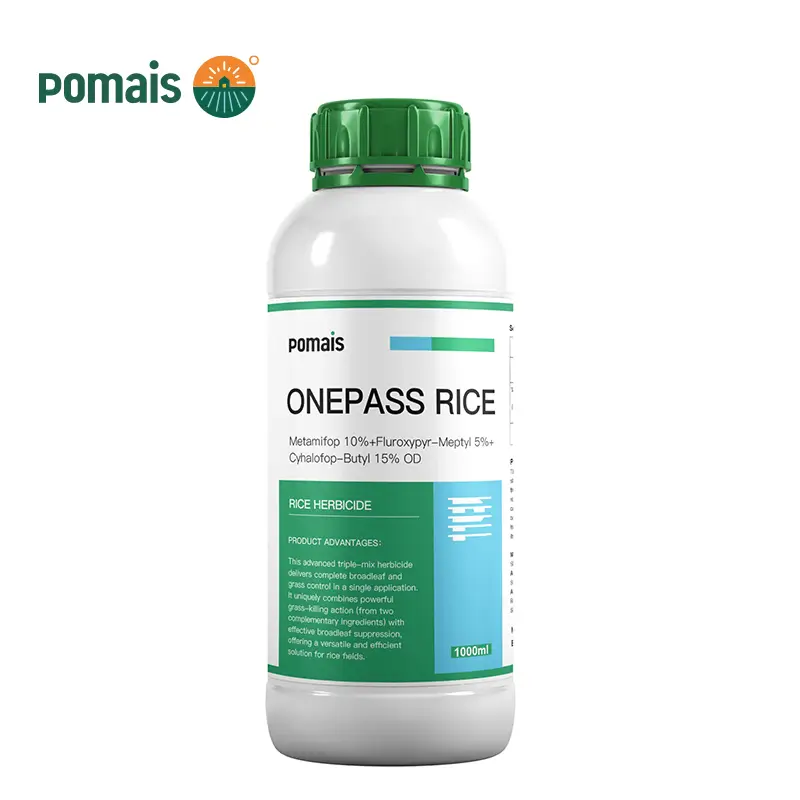
Metamifop 10% + Fluroxypyr-Meptyl 5% + Cyhalofop-Butyl 15% OD
Total A.I. 30% | Rice Weed Control Positioning | OD Formulation for Commercial Channels
If you are sourcing a rice herbicide for import and distribution, you need clarity in three areas from the first screen: active content, where it fits in rice systems, and whether the supplier can deliver trade-ready execution (documents, packaging, consistent batches). This triple-active OD (oil dispersion) formulation is positioned for rice fields, including direct-seeded rice, with spectrum language typically centered on annual weeds in rice programs (label-dependent).
MOQ: Standard orders from 1 MT
Samples: Special projects may request small free samples (case-by-case)
Lead time: Confirm case-by-case after production scheduling, packaging, and label approval
Documents: Full set available (COA / MSDS / TDS / label template / export documents)
Packaging: Standard export bottles/jerrycans/drums, plus custom capacities for your channel strategy
- Designed for Professional Buyers & Bulk Orders
- We support custom packaging, labeling, and formulation to meet your market needs.
- Export wholesale inquiries only.
- Please include destination country, business type (importer/distributor/registrant), and expected volume.
- Retail requests will not be processed.

About Metamifop 10% + Fluroxypyr-Meptyl 5% + Cyhalofop-Butyl 15% OD
| Product Type | Herbicide (Rice weed management positioning) |
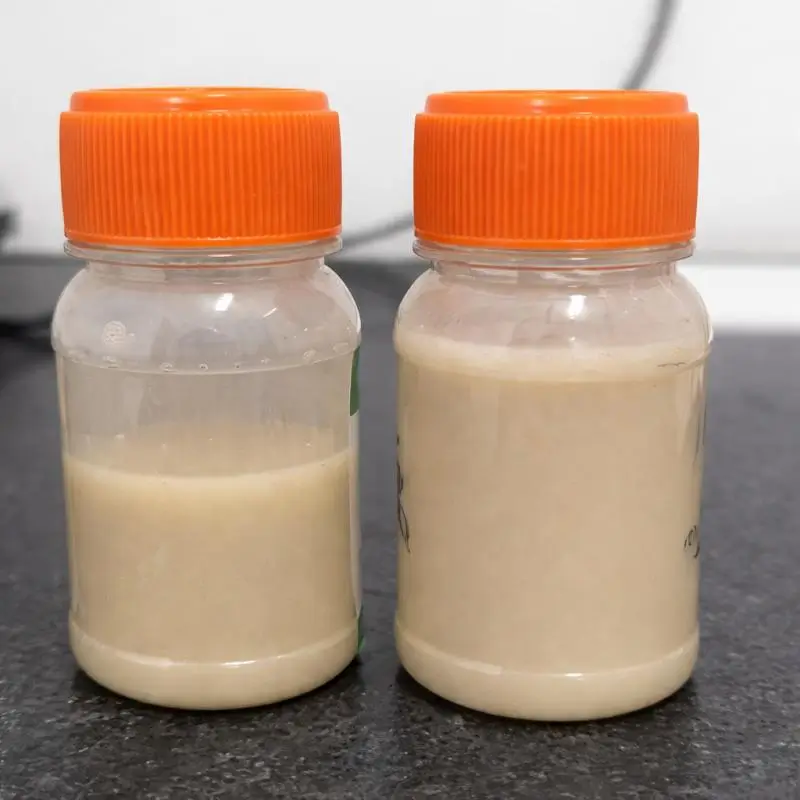
| Formulation | OD (Oil Dispersion) |
| Total Active Ingredients | 30% |
| Active Ingredients (%) | Metamifop 10% + Fluroxypyr-Meptyl 5% + Cyhalofop-Butyl 15% |
| Concentration (g/L) | Available upon request (recommended for tender files and registration alignment) |
| Primary Use Position | Rice fields, including direct-seeded rice (label-dependent) |
| Target Spectrum (Category-Level) | Annual weeds in rice programs; spectrum statements must follow local label |
| MOQ | 1 MT (standard) |
| Samples | Small free samples for special projects (case-by-case) |
| Packaging Options | 100 mL / 250 mL / 500 mL / 1 L / 5 L / 10 L / 20 L; 200 L drum; custom capacity available |
| Documentation Pack | COA (per batch), MSDS, TDS, label template, export documents |
| Lead Time | Case-by-case—confirm during quotation after packaging & label approval |
Metamifop 10% + Fluroxypyr-Meptyl 5% + Cyhalofop-Butyl 15% OD
This is a triple-active OD rice herbicide designed for commercial portfolio placement. The combination is built around a simple procurement logic: distributors want a product that can be positioned for grass-weed control language while also adding broadleaf-spectrum support through a complementary mode of action—without making the page a use guide.
On competitor pages for this same combination, the positioning is typically described as “complementary actives” for **annual weeds in direct-seeded rice fields.”
Compliance boundary: final claims, crop stage, rates, and restrictions are jurisdiction-specific. This page supports product identification and procurement evaluation. Always follow the approved local label and regulations.
Where It Fits in Rice Programs
Rice systems, including direct-seeded rice
Direct-seeded rice is frequently mentioned in market-facing descriptions for this formula, because weed pressure and the need for efficient post-emergence positioning tend to be higher in those systems (label-dependent).
Weed spectrum language (category-level, label-dependent)
For procurement and distributor training, the spectrum should be framed at category level:
- Annual grass weeds positioning (core demand driver in rice)
- Broadleaf weed support as a complementary angle (expected due to fluroxypyr chemistry class; local label defines the exact list)
This keeps the page commercially clear while remaining compliant.
Mode of Action Positioning
Buyers evaluate mode of action (MoA) because it affects resistance-risk language, distributor training, and portfolio differentiation.
- ACCase inhibitors (HRAC Group 1 / WSSA Group 1) are widely used for post-emergence grass control positioning.
- Auxin mimics (HRAC Group 4) include fluroxypyr (and related chemistries) and are typically used for broadleaf-spectrum positioning.
Stewardship statement (tender-safe): rotate or alternate herbicide MoA groups and integrate non-chemical practices where appropriate, consistent with local label and extension guidance.
Why OD Formulation Matters for Trade and Channel Execution
For importers and brand owners, formulation choice impacts more than field performance—it influences storage stability expectations, handling consistency, and downstream complaint risk.
OD is often selected for commercial channels because it supports:
- Distribution practicality: long logistics chains and variable warehouse conditions require stable, consistent product behavior across lots.
- User experience consistency: more predictable handling helps distributors reduce returns and complaints.
- Private label scalability: standardized OD specs plus COA-per-batch improves onboarding with large distributor networks.
Packaging Options for Distributors and Private Label
You can standardize packaging for quick rollout, or tailor capacities to match your pricing ladder and retail/distributor channel needs.
Recommended export pack range:
- Bottles: 100 mL, 250 mL, 500 mL, 1 L
- Jerrycans: 5 L, 10 L, 20 L
- Drums: 200 L
- Custom bottle/drum capacities available (based on your destination market and channel plan)
OEM/private label support:
- Multilingual label drafts based on your destination market
- Artwork proof workflow and carton marking alignment
- Batch coding consistent with COA and packing lists
- Packing configuration designed for distributor handling
Documentation Pack
A complete documentation set reduces your onboarding time with customs, distributors, and internal compliance teams.
Available upon request:
- COA (per batch)
- MSDS
- TDS
- Label template for localization
- Export documentation aligned with your shipping requirements
Boundary statement: we support documentation readiness and label preparation; final registration outcomes depend on local authority review and the importer’s submission pathway.
Quality Assurance and Batch Consistency
The most expensive risk in distribution is inconsistency over time. A professional supply setup should support:
- COA-per-batch aligned with shipment lots
- Batch traceability across bottles, cartons, and documents
- Retained samples for dispute resolution
- Release controls to prevent off-spec shipments
If you are building a long-term rice herbicide line, these controls matter as much as the label itself.
Safety, Storage, and Stewardship
Specific hazard classification can vary by jurisdiction, so safety language should remain label-aligned.
- Handling: avoid eye contact and unnecessary skin exposure; use appropriate PPE during handling and transfer.
- Environmental protection: prevent contamination of waterways; follow local restrictions around aquatic areas where applicable.
- Storage/transport: store cool, dry, ventilated, protected from rain; keep away from ignition sources; store locked and separated from food, beverages, feed, and seed.
If exposure or discomfort occurs, stop contact and seek medical advice with the product label.
FAQ
What is the total active content?
Total active ingredients are 30%: Metamifop 10% + Fluroxypyr-Meptyl 5% + Cyhalofop-Butyl 15%.
Is it positioned for direct-seeded rice?
Yes, this combination is commonly described for direct-seeded rice field weed control positioning, subject to local label approvals.
Do you provide g/L concentration?
Yes. Provide your destination market and documentation requirements, and we will supply the concentration details in the technical file.
What documents can you provide?
COA per batch, MSDS, TDS, label template, and export documents.
What is your MOQ and sample policy?
Standard MOQ is 1 MT. Special projects may request small free samples (case-by-case).
What packaging formats can you supply?
Standard export bottles, jerrycans, and drums, plus custom capacities for your channel plan.
How do you manage batch-to-batch risk?
Through COA-per-batch, traceability, retained samples, and shipment-lot release controls.
What lead time should we plan for?
Lead time is confirmed case-by-case after production scheduling, packaging selection, and label approval.
Get a Procurement-Ready Offer
To receive a quotation and full document pack, share:
- Destination market
- Label language(s)
- Target pack sizes
- Estimated annual demand and preferred shipping window