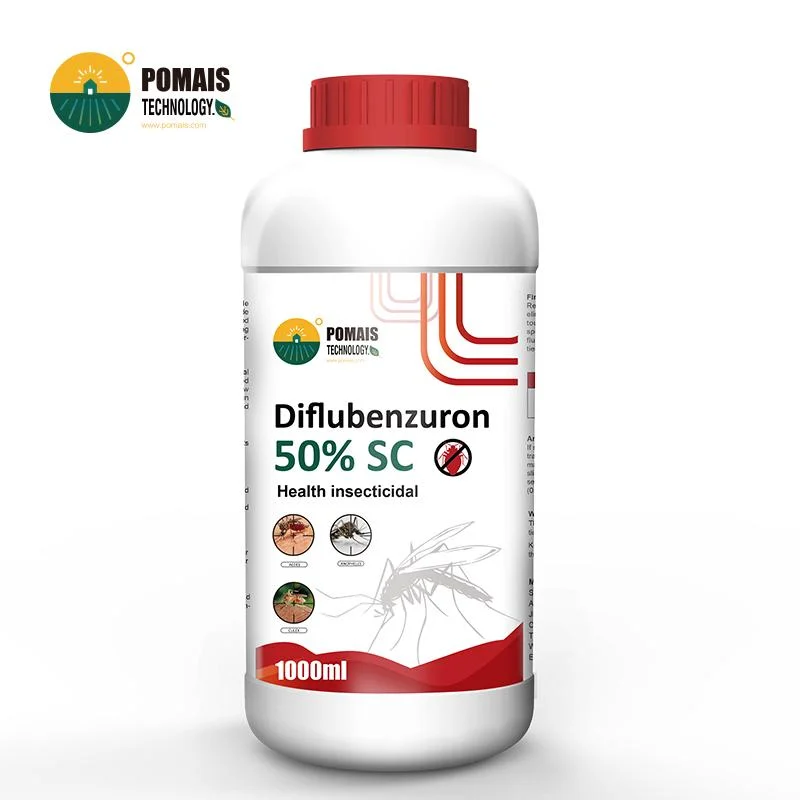
Diflubenzuron 50% SC | Public Health Pest Control
Mosquitoes, Flies, Gnats, and Aquatic Larvae
Diflubenzuron 50% SC is a suspension concentrate formulation designed for advanced insect control in public health applications. As a chitin synthesis inhibitor belonging to the benzoylurea class, it targets larval stages of insects by disrupting their molting process, leading to effective population suppression in urban, residential, and aquatic environments.
This product is highly effective against a range of nuisance and disease-vector insects, including mosquito larvae (Culex, Aedes, Anopheles), house flies, sand flies, fungus gnats, midges, and aquatic insects that breed in stagnant water. It is widely used in vector control programs around water treatment facilities, drainage systems, ponds, animal shelters, and waste areas. Additionally, Diflubenzuron is suitable for integrated mosquito management (IMM) and long-term larval source reduction.
While primarily formulated for public health use, Diflubenzuron 50% SC may also be applied in limited agricultural or veterinary contexts, such as in cattle lice or termite management, depending on local regulations and label guidelines.
- Designed for Professional Buyers & Bulk Orders
- We support custom packaging, labeling, and formulation to meet your market needs.
- Export wholesale inquiries only.
- Please include destination country, business type (importer/distributor/registrant), and expected volume.
- Retail requests will not be processed.

About Diflubenzuron 50% SC | Public Health Pest Control
| Parameter | Details |
|---|---|
| Product Name | Diflubenzuron 50% SC |
| Active Ingredient | Diflubenzuron, 500 g/L |
| Formulation Type | Suspension Concentrate (SC) |
| Mode of Action | Inhibits chitin synthesis in larval exoskeleton development |
| Chemical Classification | Benzoylurea Insecticide |
| CAS Number | 35367-38-5 |
| Molecular Formula | C14H9ClF2N2O2 |
| Appearance | White to off-white liquid |
| Target Use | Public health larviciding and sanitary pest control |
| Brand | POMAIS (OEM/Private Label Available) |
| Shelf Life | 2 years when stored in cool, dry conditions |
Mode of Action: Disrupts Insect Molting by Inhibiting Chitin Synthesis
Diflubenzuron 50% SC acts by interrupting the chitin biosynthesis process, an essential step for insect exoskeleton development. As an insect growth regulator (IGR), it does not kill insects immediately upon contact or ingestion. Instead, it targets the larval stage, preventing successful molting and leading to death before reaching adulthood.
This selective mode of action is especially effective against insects that breed in aquatic or moist environments, such as mosquito larvae and midges. Once applied to water surfaces or moist breeding areas, diflubenzuron is absorbed by the larvae, inhibiting the formation of their cuticle. Without proper exoskeleton development, the insects fail to molt and die before they can reproduce.
Key characteristics of diflubenzuron’s mechanism:
- Class: Benzoylurea (Group 15 insecticide under IRAC classification)
- Primary Target: Larval stages of holometabolous insects (complete metamorphosis), including mosquitoes, gnats, and house flies
- Action Site: Interferes with chitin synthase enzyme during molting
- Non-Adulticidal: Does not affect adult mosquitoes or flies directly, minimizing impact on non-target organisms
- Resistance Management: Suitable for integration into rotation programs with adulticides to delay resistance development
This larvicidal approach supports long-term vector control strategies by reducing future insect populations and complementing adult control methods in public health campaigns.
Application Scenarios and Target Pests: Urban Vector Control and Aquatic Larval Management
Diflubenzuron 50% SC is engineered for precise insect control in public health environments where larval breeding habitats must be eliminated to reduce disease transmission and nuisance infestations. Its effectiveness against a broad range of sanitary pests makes it a reliable solution in municipal, residential, commercial, and semi-rural settings.
Primary Public Health Applications
| Application Site | Target Insects | Purpose |
|---|---|---|
| Storm drains, gutters, septic tanks | Mosquito larvae (Culex spp., Aedes spp., Anopheles spp.) | Dengue, malaria, Zika, and filariasis prevention |
| Ponds, fountains, fish farms | Midge larvae, mosquito larvae | Aquatic pest control in stagnant or slow-moving water |
| Livestock facilities, poultry farms | House fly larvae (Musca domestica) | Reduction of fly populations, improved hygiene |
| Compost piles, manure pits | Fungus gnats, flies | Breeding site interruption, odor and infestation reduction |
| Sewage treatment sites | Drain flies (Psychodidae) | Sanitary pest control and public nuisance reduction |
Additional Uses (Limited, Region-Specific)
- Termite bait systems: Sometimes incorporated in advance termite bait formulations for structural pest control
- Veterinary applications: Diflubenzuron may be included in cattle feed to control internal parasites such as lice or fly larvae, and in certain cases, used for horses and livestock
- Ornamental fish environments: Applied under strict regulation for koi ponds or aquarium pest control, avoiding harmful exposure to fish species
Note: Always refer to local regulations and product labels when applying diflubenzuron in aquatic or animal-related contexts.
Diflubenzuron’s selective action against larval stages ensures targeted control with reduced impact on beneficial insects and minimal environmental disturbance, making it an ideal choice for integrated vector management in urban ecosystems.
Usage Instructions and Recommended Dosage: Effective Larval Control in Public Health Programs
Diflubenzuron 50% SC should be applied directly to mosquito breeding sites or organic waste areas where larval development occurs. Its suspension concentrate formulation ensures easy dilution and consistent dispersion across water or moist surfaces, offering long-term residual control.
Recommended Application Rates
| Application Site | Dosage Range | Application Interval | Remarks |
|---|---|---|---|
| Clean water (ponds, tanks, reservoirs) | 0.1–0.2 mL/m² of water surface | Every 2–4 weeks | Apply evenly to stagnant water surfaces where larvae are visible |
| Polluted or organic-rich water (sewage, drains) | 0.2–0.3 mL/m² | Every 2–3 weeks | Increase dosage to compensate for high organic content |
| Animal farms (manure pits, wet litter) | 20–30 mL diluted in 10 L water per 100 m² | As needed, based on pest pressure | Spray directly onto manure piles, corners, and fly breeding sites |
| Aquatic systems (under veterinary approval) | As per regulatory limits | Subject to safety checks | Used only when allowed for koi ponds, aquaculture, etc. |
Application Method
- Dilution: Mix with clean water before spraying. Use mechanical or knapsack sprayers with fine nozzles for even coverage.
- Timing: Apply in early morning or late afternoon to avoid evaporation and maximize larval contact.
- Repeat Applications: Depending on infestation level, environmental conditions, and water exchange rate, repeat every 2–4 weeks.
Important Notes
- Do not apply to flowing water or areas that drain directly into natural ecosystems unless specifically authorized.
- Avoid over-application to reduce unnecessary environmental exposure.
- Ensure larvae are present before application for best efficacy; this product does not kill adult insects.
Product Advantages and Technical Highlights: Long-Lasting, Targeted Control for Public Health Pest Programs
Diflubenzuron 50% SC provides a unique combination of selective action, long residual activity, and safety for public health pest control programs. Its formulation and active ingredient profile are optimized to meet the demands of vector control professionals in both urban and semi-rural settings.
Key Advantages
- Selective Larvicide with Minimal Non-Target Impact
Diflubenzuron targets larval stages of disease-vectoring insects without affecting humans, pets, or beneficial species such as pollinators. It does not harm fish when used according to labeled instructions, making it suitable for sensitive water bodies and animal habitats under regulation. - Low Resistance Risk
As a chitin synthesis inhibitor (Group 15 IGR), diflubenzuron works differently from pyrethroids and organophosphates. It is suitable for rotation programs or resistance management where adulticide resistance is already present. - Extended Residual Control
One application can remain effective for up to 3–4 weeks, depending on water quality and environmental conditions, reducing labor and operational costs in long-term vector control campaigns. - High Formulation Stability
The 50% SC formulation offers superior suspension properties, ensuring consistent application and reduced clogging in spraying equipment—critical for large-scale municipal programs. - Versatile Usage Across Multiple Sanitation Contexts
Whether applied in drains, animal farms, ponds, waste treatment areas, or other breeding sites, Diflubenzuron 50% SC adapts to various application demands while maintaining high efficacy. - Environmentally Responsible Profile
With no knockdown effect and no adult toxicity, it aligns well with Integrated Vector Management (IVM) and sustainable pest control strategies, especially in ecologically sensitive environments.
OEM/ODM and Packaging Support: Tailored Solutions for Global Vector Control Markets
As a professional manufacturer and supplier of public health insecticides, we offer full OEM and ODM services for Diflubenzuron 50% SC to meet the needs of distributors, government tenders, and private label clients across different countries and regulatory environments.
Customization Capabilities
- Labeling and Branding: Support for multi-language labels, custom logos, color schemes, and brand design for both institutional and retail markets.
- Regulatory Documents: COA, SDS, MSDS, WHO-style specifications, and full dossier support available for registration and compliance.
- Barcode & QR Code Integration: For tracking, anti-counterfeiting, or supply chain traceability.
Available Packaging Sizes
| Packaging Type | Standard Volume Options |
|---|---|
| HDPE Bottles (Screw Cap/Measuring Cup) | 100 mL, 250 mL, 500 mL, 1 L |
| Jerry Cans (Sealed Cap) | 5 L, 10 L, 20 L |
| Bulk Industrial Packaging | 200 L drums, 1000 L IBC tanks (on request) |
| Label Language | English, Spanish, French, Arabic, Russian, etc. |
Whether you’re supplying government mosquito control campaigns or serving private pest control companies, we ensure that each batch is professionally packaged, labeled, and compliant with your target market’s standards.
We also provide small trial batch runs for field evaluation or product sampling upon request.
Safety and Environmental Information: Low-Toxicity Profile with High Public Use Safety
Diflubenzuron 50% SC is recognized for its low mammalian toxicity and minimal ecological disruption, making it suitable for large-scale use in public spaces, urban sanitation programs, and sensitive environments such as aquaculture-adjacent zones.
Toxicological Profile
| Target | Toxicity Level | Notes |
|---|---|---|
| Humans | Low (Oral LD50 > 4,640 mg/kg in rats) | No neurotoxicity, no acute dermal toxicity under normal use |
| Livestock & Pets | Safe when used as directed | Avoid direct ingestion or inhalation during mixing |
| Aquatic Organisms (Fish, Koi) | Low risk at labeled doses | Can be used near ornamental ponds and fish habitats with caution |
| Bees and Pollinators | Not hazardous (non-contact mode) | No effect on adult bees under field conditions |
| Birds | Practically non-toxic | No accumulation or feeding effect observed |
Environmental Compatibility
- Biodegradability: Diflubenzuron degrades in soil and water under natural conditions.
- Bioaccumulation: Low potential; not persistent in animal tissues or aquatic systems.
- Runoff Risk: Minimal when used in contained, targeted applications (e.g., ponds, drains).
Safety Guidelines for Operators
- Wear protective gloves, goggles, and long-sleeved clothing when mixing and applying.
- Do not inhale vapors or come into direct contact with concentrate.
- Wash hands and face thoroughly after use.
- Store product in original container, tightly closed, in a cool, dry, and locked facility.
Note: Diflubenzuron is not classified as a WHO Class I or II hazardous pesticide and is permitted for use in many urban vector control campaigns globally. Always follow national regulatory guidelines and labeled instructions for safe handling.
Storage and Transportation: Safe Handling and Long-Term Stability
Diflubenzuron 50% SC should be stored and transported under controlled conditions to preserve product integrity, ensure user safety, and comply with international regulatory standards. Its physical and chemical stability under proper storage makes it suitable for both short-term distribution and long-term stockpiling for vector control campaigns.
Storage Guidelines
- Storage Temperature: Keep in a cool, dry, well-ventilated place. Ideal temperature: 5–30°C (41–86°F).
- Light Sensitivity: Store away from direct sunlight and UV exposure to maintain formulation stability.
- Humidity Control: Avoid excessive moisture and prevent freezing to protect emulsion quality.
- Shelf Life: Up to 24 months from the date of manufacture when stored in original, sealed packaging under recommended conditions.
Transportation Instructions
| Requirement | Description |
|---|---|
| Transport Classification | Not classified as a UN hazardous substance under normal shipping volumes |
| Packaging | Use tightly sealed HDPE bottles or drums, with leak-proof caps and tamper-evident seals |
| Labeling | Product label must include hazard pictograms, batch number, production date, and expiration date |
| Regulatory Compliance | Conforms to GHS, FAO, and national pesticide transport guidelines |
| Container Stability | Resistant to vibration, temperature fluctuations, and stacking pressure during transport |
Handling Precautions
- Keep out of reach of children and unauthorized personnel.
- Do not store near food, animal feed, or potable water supplies.
- In case of container damage or leakage, isolate the area and follow local environmental safety procedures.
By following these best practices, distributors and large-scale users can ensure the product remains safe, effective, and compliant throughout the supply chain.
Frequently Asked Questions (FAQ)
Q1: Is Diflubenzuron 50% SC safe to use around humans and animals?
Yes, when used according to the product label, Diflubenzuron 50% SC is considered low in toxicity for humans, pets, and livestock. However, standard personal protective equipment (PPE) should always be used during application, and the product should be kept away from direct human or animal contact during and immediately after spraying.
Q2: Can Diflubenzuron 50% SC be applied in areas with fish or ornamental ponds?
Yes, diflubenzuron is classified as low risk to fish at recommended doses. It can be used around koi ponds, fish tanks, or aquaculture areas, provided that direct overdosing is avoided. Always check local regulations before applying in aquatic environments.
Q3: How long does it take to see results after application?
Diflubenzuron does not provide immediate knockdown but begins to affect larvae at the next molting cycle, typically within 24–72 hours depending on insect species and environmental temperature. Complete interruption of the life cycle may take 1–2 weeks.
Q4: Does it kill adult mosquitoes or flies?
No, Diflubenzuron only targets the larval stages. It should be used as part of a broader Integrated Vector Management (IVM) strategy alongside adulticides for comprehensive pest control.
Q5: Can this product be tank-mixed with other insecticides?
In most cases, diflubenzuron is compatible with other larvicides or microbial insecticides (e.g., Bti), but a jar test is recommended before large-scale mixing. Do not mix with strongly acidic or alkaline products.
Q6: Is there any risk of insect resistance?
While resistance to chitin inhibitors is relatively rare, it is still advisable to rotate with other classes of insecticides (e.g., pyrethroids, organophosphates) to minimize resistance development in mosquito and fly populations.
Partner with POMAIS: Reliable Manufacturer for Diflubenzuron-Based Public Health Solutions
As a trusted supplier of vector control insecticides, POMAIS provides full-spectrum support to importers, distributors, and institutional buyers seeking high-quality Diflubenzuron 50% SC products tailored to public health programs.
We understand the complexity of sanitary pest management and offer not only stable and effective formulations, but also the documentation, customization, and technical assistance needed to succeed in diverse regulatory and operational environments.
Why Choose Us?
- Professional Production: ISO-certified facilities, strict quality control, and batch-level traceability
- OEM/ODM Capabilities: Private labeling, multilingual packaging, and custom branding available
- Regulatory Support: COA, SDS, MSDS, and registration dossiers for global compliance
- Logistics Efficiency: Reliable delivery to Africa, Asia, Middle East, South America, and Eastern Europe
- Field-Proven Solutions: Products tested and applied in real public health campaigns
Get in Touch
Whether you are managing a government tender, launching your own brand, or seeking a new supply partner, we are ready to support your project.
Contact us to request samples, pricing, or registration documents.