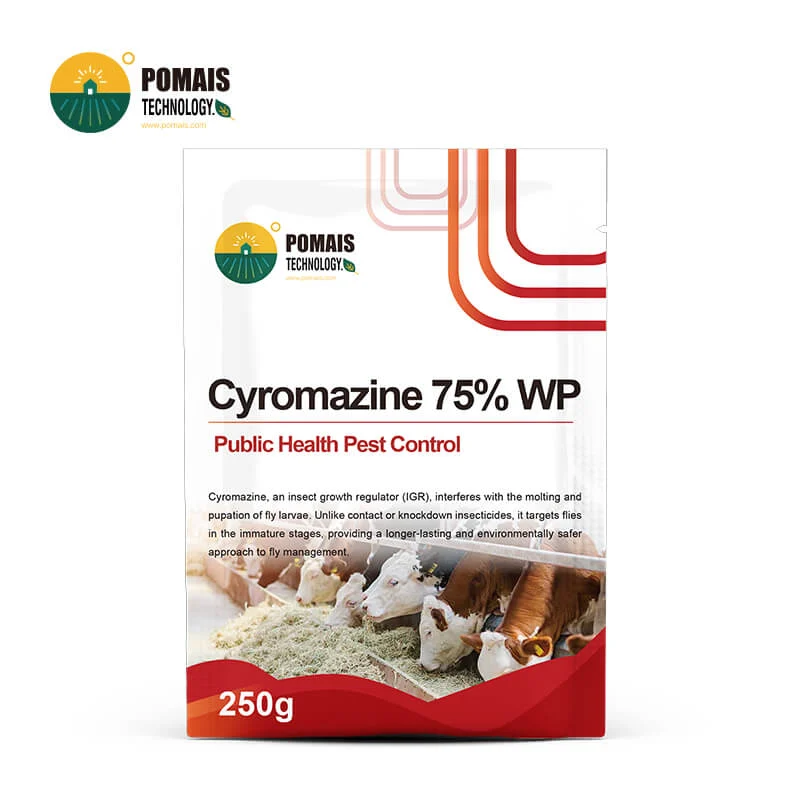
Cyromazine 75% WP / 50% WP | Public Health Pest Control
Targeted Fly Control for Poultry, Livestock, and Hygiene Programs
POMAIS Cyromazine 75% WP / 50% WP is a water-dispersible powder insect growth regulator (IGR) designed for effective control of fly larvae in animal housing and waste areas. With its systemic and selective action, Cyromazine is widely used in poultry farms, sheep stations, dairy operations, and public sanitation zones to prevent fly development at the breeding stage.
As a trusted partner for B2B customers worldwide, we offer:
- Multiple concentrations (75% WP / 50% WP) to meet regulatory or efficacy preferences
- Full OEM and private label packaging support
- Technical registration documents including COA, MSDS, GLP, and ICAMA files
- Logistics support for bulk, tender, and branded packaging orders
Whether you’re targeting cyromazine fly control in poultry manure or looking for a larvicide solution with low resistance risk, our formulations are designed for practical field application and global market distribution.
- Designed for Professional Buyers & Bulk Orders
- We support custom packaging, labeling, and formulation to meet your market needs.
- Export wholesale inquiries only.
- Please include destination country, business type (importer/distributor/registrant), and expected volume.
- Retail requests will not be processed.

About Cyromazine 75% WP / 50% WP | Public Health Pest Control
| Product Name | Cyromazine 75% WP / 50% WP |
| Active Ingredient | Cyromazine |
| Formulation Type | WP (Wettable Powder) |
| Mode of Action | Insect Growth Regulator – inhibits molting and pupation |
| Target Pests | Fly larvae (Musca domestica, Stomoxys calcitrans, Fannia spp.) |
| Application Areas | Poultry houses, livestock barns, sheep farms, public sanitation sites |
| Recommended Dosage | 75% WP: 250–500 g / ton manure or 100 m² 50% WP: 400–800 g / ton manure or 100 m² |
| Reapplication Interval | Every 7–14 days depending on fly pressure |
| Packaging Options |
|
| Shelf Life | 24 months (sealed, dry storage, 5°C–30°C) |
| OEM Support |
|
| Export Services |
|
Why Cyromazine WP Is Trusted for Fly Larval Control
Cyromazine, an insect growth regulator (IGR), interferes with the molting and pupation of fly larvae. Unlike contact or knockdown insecticides, it targets flies in the immature stages, providing a longer-lasting and environmentally safer approach to fly management.
POMAIS offers two concentrations—75% WP and 50% WP—to accommodate national regulatory requirements and application scale. These formulations are ideal for both routine farm fly control and large-scale hygiene programs.
Key Benefits
- Targeted mode of action: Disrupts the fly life cycle by inhibiting larval development, preventing emergence of adult flies
- Residual effectiveness: Active in manure and bedding material for weeks after application, reducing the need for frequent treatment
- Selective and safe: Safe for use in poultry, sheep, and livestock environments with minimal impact on adult animals or humans
- Resistance management tool: Offers a chemical class alternative in rotation programs to combat resistance to pyrethroids or organophosphates
- Cost-efficient: Requires low dosage for broad treatment areas; fewer retreatments needed due to persistent activity
Applicable Industry Segments
- Cyromazine in Poultry: Controls fly breeding in litter, under cages, and manure pits without affecting birds
- Cyromazine in Sheep: Used as part of integrated sheep blowfly prevention (especially in premix or feed treatment form)
- Cyromazine for Hygiene: Applied in public waste handling zones, latrines, compost sites, and slaughter facilities to limit fly outbreaks at larval stages
Mode of Action – Insect Growth Regulation Targeting Larval Development
Cyromazine is not a conventional insecticide. Instead of attacking the nervous system of adult insects, it functions as an insect growth regulator (IGR) by interfering with normal molting processes during the larval stage of flies.
1. Biochemical Disruption
- Cyromazine is absorbed through larval cuticle or ingested via manure
- It alters chitin synthesis, which is essential for the formation of exoskeletons
- Larvae fail to complete molting or pupation, leading to their death before adulthood
This mechanism ensures that flies are controlled before they become visible or capable of spreading disease.
2. Target-Specific and Environmentally Stable
- Highly specific to Diptera (flies), minimizing effects on beneficial or non-target insects
- Active in organic matter, bedding, or manure, making it especially useful in poultry houses and livestock barns
- Not rapidly degraded by heat or sunlight, ensuring prolonged residual activity
3. Advantage for Resistance Management
Because Cyromazine targets insect development rather than adult nerve receptors, it is less prone to resistance buildup compared to contact neurotoxins like pyrethroids or carbamates. It is often used in rotation programs as a resistance-breaking active ingredient.
By acting on the immature stages of flies, Cyromazine WP formulations support long-term, sustainable control strategies in both agricultural and public health settings.
Target Pests and Use Sites – Precision Larval Control Across Animal Housing and Public Hygiene Areas
Cyromazine WP formulations are specifically engineered for the disruption of fly larval development in a range of environments where organic waste or animal manure accumulates. Its high selectivity ensures effectiveness where it matters most—at the breeding source.
1. Target Pests
The product is primarily designed to control the larval stages of:
- Houseflies (Musca domestica)
- Stable flies (Stomoxys calcitrans)
- Lesser houseflies (Fannia spp.)
- Other dipteran larvae breeding in manure or wet organic substrates
Note: Cyromazine is not intended for adult fly knockdown but as a preventive larvicide.
2. Primary Use Environments
| Sector | Recommended Application Areas |
|---|---|
| Poultry production | Under cages, litter zones, manure belts, deep pit systems |
| Livestock housing (beef/dairy) | Calf pens, bedding material, composting zones |
| Sheep farming | Manure accumulation areas (in powder or feed premix format) |
| Public health | Garbage dumps, latrines, compost areas, slaughterhouse perimeters |
| Integrated fly control programs | IPM frameworks using larviciding + adult knockdown strategies |
3. Additional Industry Applications
- Cyromazine in Poultry: Reduces fly pressure around broiler and layer operations, improving animal welfare and air quality
- Cyromazine in Sheep: Supports blowfly strike prevention as part of oral or topical insect growth regulation
- Cyromazine for Municipal Hygiene: Applied during vector season to limit fly breeding in urban waste environments
By placing Cyromazine at key breeding sites, fly pressure can be cut off at the source, reducing the frequency of adult emergence and providing long term, systemic hygiene for both the farming business and the urban environment.
Application Method and Recommended Dosage – Practical Guidelines for Field Use
Cyromazine WP formulations are designed for ease of integration into both routine sanitation protocols and targeted fly management programs. Whether used in poultry houses, livestock barns, or public waste zones, proper application ensures maximum larvicidal effect and long-term fly suppression.
1. Application Methods
A. Direct Manure Treatment
- Mix the required dose of Cyromazine WP with water and apply uniformly over manure or bedding materials
- Can be applied using a backpack sprayer or low-pressure pump
- Avoid application on excessively dry or heavily crusted manure
B. Slurry and Waste Zones
- Apply to semi-liquid waste in pits or compost heaps where larvae actively develop
- Stir or agitate the surface slightly to allow bait to penetrate upper layers
C. Feed or Premix Use (for sheep or specific formulations)
- In some countries, Cyromazine is registered for use as oral larvicide premix
- Apply only where permitted and under veterinary guidance
2. Recommended Dosage
| Formulation | Application Rate |
|---|---|
| 75% WP | 250–500 g per ton of manure or per 100 m² litter area |
| 50% WP | 400–800 g per ton of manure or per 100 m² litter area |
| Re-treatment | Every 7–14 days, depending on fly pressure and hygiene |
| Water volume | Dilute in 20–50 L of water per 100 m² for uniform spray |
Note: Do not apply more than once per week unless otherwise advised. Avoid applying directly to live animals.
3. Best Practice Tips
- Apply during early morning or cooler hours to avoid rapid drying
- Use after manure removal or at early stages of accumulation for best effect
- Combine with adult fly control tools (e.g., bait stations, residual sprays) for full lifecycle management
Packaging and OEM Options – Flexible Supply and Branding for Global Distributors
At POMAIS, we understand that professional pest control products require not only performance but also market adaptability. That’s why we provide scalable packaging solutions and full OEM support for Cyromazine 75% WP and 50% WP, tailored to your brand, your regulations, and your logistics preferences.
1. Standard Packaging Formats
Retail and operational sizes:
- 100g / 250g / 500g / 1kg aluminum foil bags or composite pouches
- Printed with standard English label or white-label format for rebranding
- With resealable zippers and moisture protection (for hot/humid environments)
Bulk packaging for tenders and industrial users:
- 5kg / 10kg / 25kg fiber drums or HDPE-lined cardboard drums
- Internal moisture barrier liners and tamper-evident sealing
- Carton and palletized loading for sea transport
2. OEM & Private Label Customization
We offer:
- Multilingual labeling (English, French, Spanish, Arabic, Portuguese, etc.)
- Custom packaging design with your logo, color scheme, and regulatory text
- Optional features:
- QR codes or barcode tracking
- GLP registration support labels
- Anti-counterfeit holograms or seal tapes
OEM support includes:
- Product photography for catalogs
- Regulatory-compliant layout templates
- Custom label dimensions to fit your preferred bottle/bag style
3. Export & Delivery Services
- Export-optimized packaging to comply with FAO, WHO, and local pesticide laws
- Delivery from Chinese main ports (Tianjin, Qingdao, Shanghai)
- FCL and LCL shipment support
- Mixed loading with other agrochemical or public health products
- Lead time: 7–15 days depending on quantity and packaging complexity
All shipments are accompanied by:
- COA, MSDS, TDS, Certificate of Origin
- Support for SGS or BV third-party inspection
- Assistance in product registration and customs clearance
Whether you’re supplying national ministries, local veterinary chains, or resellers in competitive markets, POMAIS delivers the flexibility to help you scale and comply across borders.
Storage and Safety Information – Safe Handling and Environmental Responsibility
To ensure the integrity of Cyromazine 75% WP / 50% WP, and protect users, animals, and the surrounding environment, all applications must follow proper storage guidelines, personal protection standards, and local environmental regulations.
1. Storage Conditions
- Store in original, tightly sealed packaging
- Keep in a cool, dry, and well-ventilated area, away from direct sunlight
- Recommended storage temperature: 5°C–30°C
- Avoid exposure to humidity or sources of water
- Do not store with feed, food, veterinary medicines, or flammable materials
Shelf life: Up to 24 months under standard storage conditions
2. Safe Handling Instructions
- Wear chemical-resistant gloves, mask, and protective clothing during application
- Do not eat, drink, or smoke during handling
- Prevent contact with eyes, skin, and respiratory tract
- Always wash hands and arms thoroughly with soap and water after use
- In case of accidental exposure, refer to first aid measures below
3. First Aid Measures
| Exposure Type | Response |
|---|---|
| Skin Contact | Rinse thoroughly with soap and water; remove contaminated clothing |
| Eye Contact | Rinse eyes immediately with clean water for at least 15 minutes |
| Inhalation | Move to fresh air; seek medical attention if symptoms persist |
| Ingestion | Do not induce vomiting; contact a physician immediately |
Ensure Material Safety Data Sheet (MSDS) is available at all operational locations.
4. Environmental Protection Guidelines
- Do not allow product or residue to enter waterways, sewers, or drains
- Avoid over-application, especially in areas with poor runoff control
- Collect and dispose of any unused product and empty packaging according to local hazardous waste regulations
- Triple-rinse empty packaging before disposal or recycling (where allowed)
- Do not reuse containers for other materials
POMAIS ensures that all products are delivered with comprehensive safety documentation and support materials for compliance with occupational and environmental standards across international markets.
Export Support & Documentation – Full Compliance for Global Registration and Delivery
At POMAIS, we understand that international pesticide distribution demands more than just quality products. It requires precise documentation, regulatory transparency, and logistics coordination tailored to your target market. We provide comprehensive export support for Cyromazine 75% WP / 50% WP to ensure smooth clearance and efficient deployment.
1. Export Documentation Included
Every shipment is accompanied by a complete set of export-compliant documents, including:
- Certificate of Analysis (COA)
- Material Safety Data Sheet (MSDS)
- Technical Data Sheet (TDS)
- Certificate of Origin (CO)
- Packing List and Commercial Invoice
- Bill of Lading (B/L)
These documents can be issued in English or local language as required.
2. Registration & Compliance Support
We offer assistance for national registration processes in agriculture, veterinary use, and public health sectors:
- ICAMA-based technical registration dossier
- GLP-compliant toxicology, residue, and stability data (available upon request)
- Packaging label support in compliance with FAO, WHO, and local pesticide authority guidelines
- Sample submission and test batch supply for regulatory trials
Our team is experienced in supporting regulatory approval in regions including:
- Africa (e.g., Kenya, Nigeria, South Africa)
- Asia (e.g., Bangladesh, Vietnam, Philippines)
- LATAM (e.g., Peru, Colombia, Guatemala)
- Middle East (e.g., Iraq, Jordan, Saudi Arabia)
3. Third-Party Inspection and Quality Assurance
- SGS, BV, or CCIC inspection services can be arranged before shipment
- Batch traceability with test reports and production date documentation
- Optional photo documentation of packaging and loading for shipment confirmation
4. Logistics and Shipping Coordination
- Shipment types supported: FCL, LCL, air freight, courier express
- Port options: Tianjin, Qingdao, Shanghai
- Consolidation of multiple agrochemical SKUs in one container
- Flexible incoterms: FOB, CIF, CFR, DDP available upon request
- Delivery lead time: 7–14 working days, depending on packaging and volume
We also offer document legalization (e.g., Embassy stamping) for markets that require consular-attested export paperwork.
POMAIS is committed to providing not only a high-quality cyromazine product, but also the regulatory and export reliability needed to support long-term growth in competitive international markets.
Frequently Asked Questions (FAQ)
1. What is Cyromazine used for?
Cyromazine is an insect growth regulator (IGR) used to control fly larvae in manure, bedding, and organic waste. It prevents larvae from maturing into adult flies, making it highly effective in poultry, livestock, and sanitation environments.
2. What’s the difference between Cyromazine 75% WP and 50% WP?
Both are water-dispersible powders with the same active ingredient.
- 75% WP: Higher concentration for professional or large-scale operations
- 50% WP: Moderate strength for routine field use or regulatory preferences
Dosage is adjusted accordingly, but both are equally effective when applied as directed.
3. How does Cyromazine work?
Cyromazine disrupts molting in fly larvae by interfering with chitin synthesis. This prevents the larvae from developing into adult flies, effectively breaking the breeding cycle without killing adult insects.
4. Can Cyromazine be used in poultry houses?
Yes. Cyromazine is widely used in poultry operations, particularly in litter treatment beneath cages and in deep-pit manure systems. It is safe for birds when used according to label instructions.
5. Is Cyromazine safe for animals and humans?
Yes, when used properly:
- It is non-toxic to mammals, birds, and humans at labeled concentrations
- It should not be ingested, inhaled, or applied to live animals unless in approved formulations
- Always wear protective gloves and avoid direct contact with eyes or skin
6. How often should Cyromazine be applied?
- Typically, every 7–14 days during peak fly breeding season
- Apply after manure removal or at early waste accumulation stages
- Repeat more frequently in high-pressure or poorly ventilated environments
7. What is the shelf life?
24 months from manufacturing date, when stored in sealed, dry packaging under cool conditions (5–30°C).
8. Is this product registered in my country?
We support international clients with:
- ICAMA registration documents
- GLP toxicology data
- Custom label designs to comply with local laws
Contact us with your country’s requirements—we can assist in registration preparation and compliance.
9. What packaging options are available?
We offer:
- Retail: 100g, 250g, 500g, 1kg pouches
- Bulk: 5kg, 10kg, 25kg drums
- OEM customization with multilingual labels, private branding, and barcoding is available.
10. Can Cyromazine be used in sheep?
Yes. In some markets, Cyromazine is formulated for oral or topical use to prevent blowfly strike in sheep. However, this requires special registration and veterinary supervision. The WP formulation is intended for manure treatment only.
Marketing Advantages & Cooperation Strategy – Scalable Fly Control Solutions for Veterinary and Hygiene Markets
Cyromazine 75% WP / 50% WP offers a reliable, long-acting larvicide solution for large-scale sanitation programs, integrated pest management (IPM) systems, and livestock operations worldwide. Its proven efficacy, broad registration potential, and operational simplicity make it a strong fit for government tenders, private label programs, and large distributor networks.
1. Key Marketing Advantages
- Targeted control at source: Interrupts fly development in manure and bedding, reducing visible adult populations and associated health risks
- Highly selective mode of action: Minimizes environmental and non-target impact, suitable for sensitive agricultural and urban sites
- Extended residual effect: Maintains efficacy for days to weeks after application, improving labor efficiency and reducing frequency of treatment
- Low resistance risk: Ideal for rotational strategies where adulticide resistance has emerged
- Widely accepted active ingredient: Cyromazine is registered or approved in many regions for animal housing sanitation and waste treatment
2. Suitable for the Following Customer Segments
- Public health and environmental authorities targeting vector-borne disease prevention
- Poultry and livestock producers needing fly control in intensive operations
- Veterinary supply chains distributing larvicide programs to farms or feed mills
- Tender contractors and NGOs managing rural sanitation or urban pest control
- Importers and private-label pesticide companies looking for compliant IGR solutions
3. Cooperation Models
We support:
- OEM production and exclusive regional distribution rights
- Flexible volume pricing for recurring or seasonal programs
- Full documentation support for local registration and compliance
- Joint promotional efforts, including sample kits, technical guides, and trade event support
Whether you are introducing cyromazine to a new market or adding it to an established hygiene product line, we offer technical, regulatory, and operational support to help your business scale.
4. Long-Term Strategic Value
- Part of a comprehensive fly control portfolio, alongside adulticides, traps, and repellents
- Enhances your offering in the growing sectors of IPM, biosecurity, and low-toxicity control
- Supported by reliable manufacturing capacity, short lead times, and compliance with international trade protocols
Cyromazine 75% WP / 50% WP is not just a product—it’s a platform for delivering measurable hygiene outcomes, lower operational burden, and long-term value to customers across the livestock and public sanitation sectors.