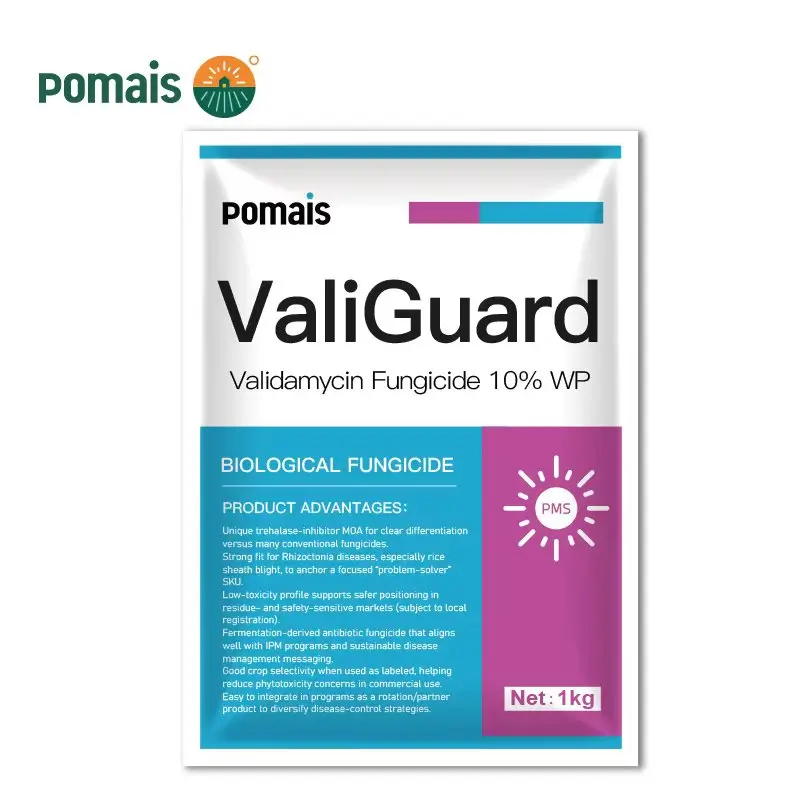
Validamycin Fungicide 3% AS, 5% AS, 10% WP, 20% WP
If you manage Rhizoctonia-driven diseases—especially rice sheath blight—Validamycin is one of the most targeted tools you can add to your portfolio. It’s a microbe-derived antibiotic fungicide produced by fermentation (Streptomyces hygroscopicus) and is best positioned as a fungistatic, hyphae-growth “brake”: it suppresses hyphal extension and reduces pathogen virulence rather than relying on rapid, broad-spectrum kill.
- Designed for Professional Buyers & Bulk Orders
- We support custom packaging, labeling, and formulation to meet your market needs.
- Export wholesale inquiries only.
- Please include destination country, business type (importer/distributor/registrant), and expected volume.
- Retail requests will not be processed.

About Validamycin Fungicide 3% AS, 5% AS, 10% WP, 20% WP
| Active ingredient | Validamycin A (validamycin) |
| CAS No. | 37248-47-8 |
| Source | Fermentation-derived from Streptomyces hygroscopicus |
| Mode of action | Non-systemic trehalase inhibitor (carbohydrate utilization in fungi) |
| FRAC group | BM02 |
| Best-fit target | Rhizoctonia diseases, especially rice sheath blight |
| Formulations you can supply | 3% AS, 5% AS, 10% WP, 20% WP |
| Typical positioning | Program use for prevention and early-stage disease suppression (label-led) |
Validamycin
Validamycin A is a micro-organism derived substance used as a fungicide/antibiotic in crop protection. In practical field language, it’s the product you select when you want strong Rhizoctonia coverage and a clear, defensible mechanism rather than a generic “broad-spectrum” story.
Mode of Action: Trehalase Inhibition
Validamycin is best known as a trehalase inhibitor. Trehalase is a key enzyme involved in trehalose metabolism, which connects to energy and stress physiology in fungi. In crop protection, the business takeaway is simple: Validamycin slows hyphal extension and reduces disease spread momentum, helping you stabilize the situation when Rhizoctonia pressure rises.
Why it’s often described as fungistatic: Multiple technical sources emphasize that Validamycin commonly reduces virulence / hyphal expansion rather than acting as a classic fungicidal “wipeout.” That’s also why it fits well in disciplined programs and rotation planning.
Target Crops and Diseases
Primary target disease
- Rice sheath blight caused by Rhizoctonia spp. (core global positioning)
Broader “Rhizoctonia disease” positioning (market-dependent claims)
Regulatory/technical databases list Validamycin A for sheath blight caused by Rhizoctonia species and indicate typical target hosts such as rice, potatoes, vegetables, soft fruit, sugar beet, and cotton. Final claim language should follow your destination-country registration and approved label.
Additional program mentions you may see in the market
Some literature discusses use for Rhizoctonia-associated diseases beyond rice (e.g., wheat sharp eyespot and other Rhizoctonia problems). Treat these as label-led, country-specific expansions rather than universal claims.
Formulation Options: How to Choose AS vs WP
Your four SKUs let you match local channel habits and tender requirements without changing the active.
| Formulation | Best fit for | Why buyers choose it |
|---|---|---|
| 3% AS | High-volume distribution where liquid convenience is preferred | Fast handling, easy mixing routines, familiar to many retail/pro channels |
| 5% AS | Same as above, with a stronger concentration option | Improves logistics efficiency per unit while keeping a liquid format |
| 10% WP | Regions that prefer powder formats or want freight-efficient solids | Warehouse-friendly, tender-friendly, stable handling in many climates |
| 20% WP | Portfolio builders who want higher-strength powder lines | More concentrated WP option for cost and logistics optimization |
Positioning guidance: Keep your messaging focused on disease program fit, not “instant cure.” Validamycin is strongest when buyers use it to control spread and protect yield potential in Rhizoctonia risk windows.
Program Fit and Rotation Logic
- Clear resistance-management language: Validamycin is listed under FRAC BM02 in reference databases, supporting rotation planning narratives alongside other fungicide groups (always follow local guidance).
- What to expect operationally: Because the product is typically described as fungistatic, it is well suited to prevention and early-stage intervention where slowing pathogen expansion protects crop performance and buys time for the rest of the program to work.
Safety and Stewardship
This page should set expectations professionally:
- Use only as directed by the approved label and local regulations.
- AERU/PPDB hazard alerts include a classification note indicating high bee toxicity under a specific rule-based alert, so responsible stewardship and exposure management around pollinators is essential (label-led timing, drift control, and site discipline where relevant).
Quality, Documentation, and Supply Deliverables
When you source Validamycin for distribution or brand programs, the decision usually comes down to batch reliability + documentation readiness. You can request:
- COA (batch confirmation)
- SDS/MSDS and TDS (technical data sheet / “ficha técnica” on request)
- Private label support: multi-language label layout, export packaging coordination, and SKU mapping across AS/WP formats
Validamycin A is produced commercially via fermentation using high-yielding Streptomyces hygroscopicus strains, which supports a consistent manufacturing narrative for procurement and registration workflows.
FAQ
What is Validamycin used for?
It is mainly used for Rhizoctonia diseases, especially rice sheath blight, and is commonly positioned for soil-borne pathogen scenarios.
How does Validamycin work?
It is a trehalase inhibitor and is typically described as fungistatic, suppressing hyphal extension and reducing virulence rather than acting as a fast “kill” fungicide.
Is Validamycin systemic?
Reference databases describe the mode of action as non-systemic. Your label wording should follow local registration language for your specific formulation and market.
Which formulation should I choose: AS or WP?
Choose based on your channel and logistics:
- AS for liquid convenience and high-throughput handling
- WP for freight-efficient solids and tender-style procurement
Both options keep the same core trehalase-inhibitor positioning; the decision is operational.
What documents can you provide for importer onboarding?
Typical deliverables include COA, SDS/MSDS, and TDS, plus private label support for multilingual packaging and market-ready claim language.
Request a Specification Pack
To receive a quote-ready response for Validamycin 3% AS / 5% AS / 10% WP / 20% WP, share:
- Destination country/region (registration pathway)
- Target crop(s) and target disease focus (e.g., rice sheath blight)
- Preferred formulation(s) and packaging format
- Documentation requirements (COA, SDS/MSDS, TDS)
We will reply with a formulation recommendation, documentation checklist, and a shipment-ready supply proposal aligned to your market.