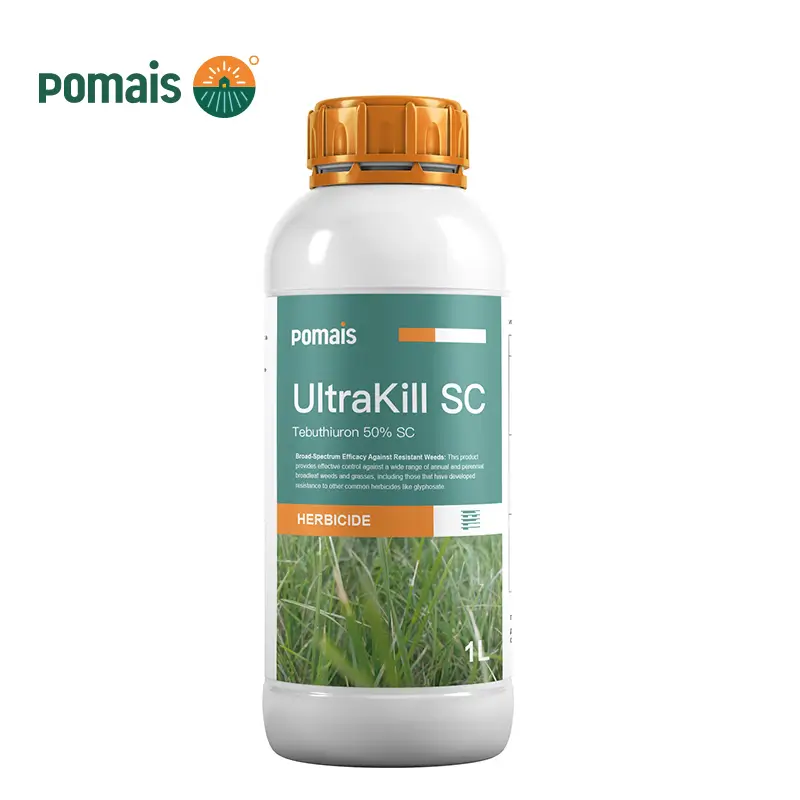
Tebuthiuron 50% SC Herbicide
Long-Lasting Brush and Woody Weed Control
Tebuthiuron 50% SC is a suspension concentrate herbicide designed for non-selective, soil-applied, long-term control of woody plants, brush and deep-rooted perennial weeds in non-cropland situations. It is based on the active ingredient Tebuthiuron (CAS 34014-18-1), a urea-type herbicide known for its strong root uptake activity and multi-year residual effect in the soil.
This product is typically used in rangeland, permanent pasture, roadsides, railways, utility and powerline corridors, industrial sites and other non-agricultural areas where customers need long-term vegetation management rather than short-term knockdown. After application to the soil, Tebuthiuron is absorbed mainly through the roots and moves upward in the plant, gradually killing shrubs, woody species and persistent weeds over time.
From a procurement point of view, Tebuthiuron 50% SC offers:
- A concentrated, flowable formulation that is easy to handle, measure and mix
- A broad spectrum on woody and brush vegetation in non-cropland
- Multi-year control, reducing retreatment frequency and labour cost
Regulatory status varies by region, so the product is generally positioned for markets where Tebuthiuron is registered for rangeland and rights-of-way use (for example, certain countries in the Americas and Oceania), and always used strictly according to the local label and environmental regulations.
- Designed for Professional Buyers & Bulk Orders
- We support custom packaging, labeling, and formulation to meet your market needs.
- Export wholesale inquiries only.
- Please include destination country, business type (importer/distributor/registrant), and expected volume.
- Retail requests will not be processed.

About Tebuthiuron 50% SC Herbicide
| Product name | Tebuthiuron 50% SC |
| Active ingredient | Tebuthiuron |
| Active content | 500 g/L (50% w/v) |
| CAS number | 34014-18-1 |
| Chemical group | Substituted urea herbicide |
| Appearance | Off-white to light brown, homogeneous suspension |
| Formulation type | Suspension Concentrate (SC) |
| Density (20 °C) | 1.10–1.20 g/mL (typical) |
| pH (25 °C) | 5.0–8.0 |
| Suspensibility | ≥ 90% (CIPAC method) |
| Wet sieve test (75 μm) | ≤ 2.0% residue |
| Viscosity | Within standard range for pumping & pouring |
| Storage stability | Stable under accelerated and ambient tests; no phase separation |
| Packaging options | 1 L / 5 L / 10 L / 20 L HDPE bottles or drums (OEM available) |
| Intended use | Non-crop brush, woody plant & perennial weed control (where registered) |
Tebuthiuron 50% SC Herbicide
Tebuthiuron is a non-selective, soil-active herbicide from the urea family, developed specifically for long-term vegetation control in non-crop areas. It is formulated in this product as a 50% suspension concentrate (SC), providing a stable, flowable liquid that is easy for professional users to dose and apply.
Unlike many post-emergence contact herbicides, Tebuthiuron works primarily through the soil and plant root system. After application to the soil surface, rainfall or soil moisture carries the active ingredient into the root zone. Susceptible plants absorb Tebuthiuron through their roots, and the molecule is then translocated upward in the xylem. As it accumulates, it disrupts photosynthesis and other vital metabolic processes, leading to gradual decline and death of the plant.
Functionally, Tebuthiuron is positioned as a broad-spectrum, non-selective brush and woody plant herbicide. It does not differentiate between individual broadleaf species or grasses; instead, it targets the entire plant community where applied. For this reason, it is used mainly in rangeland, permanent pasture, rights-of-way and industrial or utility sites, not in conventional arable cropping systems.
Because Tebuthiuron is both persistent in soil and highly effective against deep-rooted, woody and perennial species, Tebuthiuron 50% SC is selected by professional vegetation managers when the objective is multi-year control with reduced retreatment intervals, rather than short-lived top growth suppression.
Mode of Action – How Tebuthiuron 50% SC Works
Tebuthiuron is a systemic, soil-applied photosynthesis inhibitor. It belongs to the substituted urea class of herbicides and acts mainly by disrupting photosystem II in susceptible plants.
After application to the soil surface and movement into the root zone with moisture:
- The active ingredient is absorbed through the roots of shrubs, woody plants and deep-rooted perennial weeds.
- It is then translocated upward via the xylem with the transpiration stream, moving into stems, branches and foliage.
- Inside the plant, Tebuthiuron binds to the photosystem II complex, blocking electron transport and energy conversion during photosynthesis.
- As a result, the plant’s ability to produce energy and essential metabolites is gradually shut down, leading to chlorosis, loss of vigor, dieback and eventual death of sensitive species.
Because Tebuthiuron acts primarily through the soil and root uptake, the visible symptoms do not appear immediately. Instead, users normally see:
- Slow, progressive decline over weeks to months, especially in established shrubs and woody species
- Top growth yellowing and browning, followed by branch dieback
- Long-term suppression of re-sprouting and regrowth due to residual activity in the treated root zone
From a vegetation management perspective, this mode of action delivers multi-year control of problem brush and woody plants with a single correctly timed application. At the same time, it also explains why:
- Tebuthiuron is treated as a non-selective, soil-active herbicide – any rooted vegetation in the treated area may be affected.
- Regulatory labels impose strict limits on application rate, soil type and application area to manage the risk of off-target movement and long-term persistence.
In practice, Tebuthiuron 50% SC is often positioned as a strategic tool in rangeland and rights-of-way programs, where the goal is to reduce woody plant dominance and maintain open, manageable vegetation with fewer follow-up treatments.
Target Weeds and Brush Spectrum
Tebuthiuron 50% SC is designed for broad-spectrum control of woody plants, brush and deep-rooted perennial weeds in non-crop environments. It is not a selective product for fine-tuning individual species; instead, it is used where you want to reset or dramatically thin out the vegetation complex in a defined area.
In typical rangeland, pasture and rights-of-way programs, Tebuthiuron is used against:
- Woody shrubs and small trees
Species such as mesquite, acacia, various thorny shrubs and other woody invaders that dominate grazing land or encroach along fence lines and power corridors. - Brush and scrub communities
Mixed stands of brush, scrub and woody weeds that reduce access, interfere with infrastructure, or compete with desirable grass cover in rangeland. - Deep-rooted perennial weeds
Perennial broadleaf and some grassy species with extensive root systems that are difficult to remove with short-residual, foliar-only herbicides. - Mixed woody–herbaceous vegetation in non-cropland
Vegetation complexes on roadsides, railways, utility rights-of-way and industrial or energy sites, where long-term bare or semi-bare conditions are required for safety and access.
Because Tebuthiuron works through the soil and root zone, all sensitive vegetation with roots in the treated area can be affected, including:
- Established shrubs and trees
- Seedlings and saplings emerging after treatment
- Undesirable grasses and broadleaf weeds within the treated pattern
For professional users and vegetation managers, the key positioning is:
- Use Tebuthiuron 50% SC when the objective is long-term brush and woody plant control across a defined non-crop area, not selective removal of a few species.
- Carefully define treatment boundaries and respect label restrictions on rate, soil type and slope to minimize off-target impact on desirable vegetation outside the target zone.
Formulation & Product Strengths of Tebuthiuron 50% SC
Tebuthiuron 50% SC is a high-loading suspension concentrate specifically designed for professional vegetation management in non-crop areas. Compared with dry formulations such as WG or DF, the SC format provides a ready-to-measure, flowable liquid that is easier to handle in many operational settings.
Key formulation characteristics:
- High active content (500 g/L Tebuthiuron)
The 50% SC formulation delivers a concentrated dose of Tebuthiuron, allowing vegetation managers to achieve required rates with lower product volume and more efficient logistics. - Stable suspension system
The product is formulated with carefully selected wetting and dispersing agents to keep Tebuthiuron particles evenly suspended in the liquid phase. With normal agitation, the suspension remains uniform during storage and use, supporting consistent dose delivery in the field. - Flowable, easy-to-measure liquid
As a suspension concentrate, Tebuthiuron 50% SC can be poured and measured directly, simplifying handling compared with dusty powders or granules. This is particularly valuable for professional contractors who need fast, clean dosing during operations. - Good coverage and distribution in treated patterns
When used in accordance with the local label and recommended application pattern, the SC formulation supports even distribution of the active ingredient across the soil surface. This helps to build a more uniform Tebuthiuron layer in the root zone, contributing to consistent brush and woody plant control within the treated area. - Designed for professional non-crop programs
Tebuthiuron 50% SC is positioned for use by experienced vegetation managers, utility contractors and rangeland service providers who are familiar with non-selective soil-active herbicides and operate under strict regulatory frameworks.
Positioning versus WG/DF formulations
While Tebuthiuron is also widely available in 80% WG and 80% DF formats, the SC formulation offers a different profile:
- SC advantages
- Liquid handling, no dust, easy measuring
- Convenient for tank-based professional application systems
- Attractive for customers who prefer liquids over dry products
- WG/DF advantages
- Higher active concentration per unit weight
- Often favored in some markets for aerial broadcasting or dry spreading systems
Tebuthiuron 50% SC allows distributors and importers to complement existing Tebuthiuron WG/DF products with a liquid option that fits the needs of specific customers and application methods in their territory.
Recommended Application Guidelines for Tebuthiuron 50% SC
Tebuthiuron 50% SC is intended for professional use in non-crop areas where long-term control of brush, woody plants and persistent weeds is required. Application must always follow the registered label in the destination country, but the general positioning can be described as follows.
Application timing
Tebuthiuron performs best when applied under the following general soil and weather conditions:
- Soil not frozen and not waterlogged
Applications are typically made when the soil is workable, not frozen and not saturated, so the active ingredient can move gradually into the root zone. - Adequate moisture for movement into the root zone
Rainfall or soil moisture after application is needed to move Tebuthiuron from the soil surface into the rooting zone of target vegetation. In arid and semi-arid regions, timing is often aligned with the expected rainy period. - Flexible seasonal window (spring or autumn)
Depending on local label and climate, Tebuthiuron may be applied in spring or autumn, as long as soil conditions and vegetation status fit the label requirements.
Because Tebuthiuron is root-absorbed and slow-acting, control develops gradually after treatment and may continue to increase over months as the active ingredient is taken up by target plants.
Application methods
Subject to local label authorisation, Tebuthiuron 50% SC can be positioned for use in several professional application systems:
- Aerial broadcast (aircraft)
In large rangeland or rights-of-way programmes, Tebuthiuron may be applied by aircraft to achieve broad, uniform soil coverage across extensive areas, using equipment and patterns specifically authorised on the label. - Ground broadcast (vehicle-mounted equipment)
Utility contractors and vegetation management teams may use truck- or ATV-mounted spray or spreading equipment to treat roadsides, powerline corridors, pipeline routes, industrial sites and other defined non-crop zones. - Spot or pattern treatments (manual or semi-mechanised)
In some programmes, Tebuthiuron is used in spot, strip or block patterns to selectively reduce woody plant density in rangeland, or to treat around fence lines, structures or specific infrastructure. The pattern, spacing and treated area must follow the local label and program design.
Tebuthiuron 50% SC should never be applied through irrigation systems unless explicitly authorised by the label, and it must not be used on conventional cropland or in situations where roots of desirable trees or crops extend into the treated soil.
Integration into vegetation management programmes
In practice, Tebuthiuron 50% SC is usually built into a long-term vegetation management plan, not used as a one-off emergency treatment. Typical positioning includes:
- Rangeland and pasture improvement
Used as part of a programme to reduce woody plant dominance and allow grasses to recover, in combination with grazing management and other tools approved by local authorities. - Rights-of-way and utility vegetation management
Applied on selected corridors (roads, railways, pipelines, powerlines) to keep vegetation low and manageable for safety, inspection and access. - Industrial and non-agricultural sites
Used where long-term suppression of woody plants and deep-rooted weeds is needed to protect infrastructure, operations or safety zones.
All equipment calibration, droplet size, pressure, swath, and buffer requirements must follow the local Tebuthiuron label and national regulations to manage off-target risk and environmental impact.
Use Rate & Application Range for Tebuthiuron 50% SC
Tebuthiuron is a potent, soil-active herbicide with long residual activity, so application rates are strictly controlled by local labels and environmental regulations. Any final use rate must be taken from the registered Tebuthiuron product label in the destination country. The information below is intended only as a positioning and communication guide for professional buyers.
Positioning of use rates
In many non-cropland brush and rangeland programmes, Tebuthiuron products are positioned in a moderate to high use-rate band compared with short-residual herbicides, because:
- The objective is multi-year suppression of woody plants and deep-rooted perennials, not just top growth burn-down.
- The active ingredient must reach and maintain an effective concentration in the root zone to impact established shrubs and trees.
For example, Tebuthiuron granules or WG products are often labelled in the range of several pounds of product per acre, corresponding to roughly low-to-mid single-digit pounds of active ingredient per acre, depending on formulation strength and programme design.
When Tebuthiuron is formulated as 50% SC, the same active ingredient load is achieved by calculating an equivalent volume or mass of liquid product to deliver the label-authorised amount of Tebuthiuron (ai) per unit area.
Factors that influence rate selection
Within the label-approved range, vegetation managers typically adjust rates based on:
- Target species and stand density
Heavier infestations of woody plants or highly tolerant species may require rates at the upper part of the label range, while lighter infestations or mixed vegetation may be treated at intermediate or lower rates. - Soil type and organic matter
Coarse-textured, low-organic-matter soils behave differently from heavier or organic soils. Labels often specify different maximum rates or restrictions for sandy, shallow or highly permeable soils, to reduce the risk of leaching and off-site movement. - Annual rainfall and climate
In drier regions, labels may allow different maximum annual loadings compared with higher-rainfall zones, because rainfall strongly influences movement in soil and potential impact on groundwater. Some labels distinguish between areas below or above a defined annual rainfall threshold. - Programme objectives and retreatment interval
Where a programme targets long intervals between treatments, rates may be chosen toward the upper half of the allowed range. Where Tebuthiuron is combined with other tools in a more frequent management cycle, rates may be placed in the mid-range as part of an integrated strategy.
Compliance message for buyers and distributors
For importers, distributors and professional vegetation contractors, the key points are:
- Tebuthiuron 50% SC must always be used strictly within the rate range and conditions defined on the local registration label.
- Any calculation of litres or kilograms per hectare/acre must be based on:
- The approved active ingredient loading per area on the local label, and
- The formulation strength (e.g. 500 g/L or 50% w/v Tebuthiuron) of the specific product supplied.
- Exceeding label limits on annual loading, sensitive soils or protected areas is not acceptable and may create environmental and regulatory liabilities.
In commercial communication, the product should therefore be presented as a high-strength, long-residual Tebuthiuron SC designed to match the label-approved rate bands for brush and woody weed control in non-crop areas, rather than as a commodity herbicide for casual, frequent use.
Soil, Rainfall & Environmental Considerations
Tebuthiuron is recognised as a highly persistent, mobile soil-active herbicide, so soil type, rainfall pattern and site hydrology are critical when planning any vegetation management programme with Tebuthiuron 50% SC.
Soil type and permeability
Because Tebuthiuron is highly water-soluble and has a long soil half-life, it has a higher potential to move downwards in certain soils:
- Sandy or coarse-textured soils
Light, low-organic-matter soils have higher leaching potential. Many labels restrict or prohibit Tebuthiuron use on such soils, particularly where groundwater is shallow. - Shallow soils over fractured rock
In areas with thin soil layers over fractured bedrock or karst formations, there is increased risk of rapid movement to groundwater or springs. Labels often define such sites as sensitive and may not allow Tebuthiuron applications there. - Organic matter and clay content
Soils with higher organic matter or clay may retain Tebuthiuron more strongly, reducing leaching but also potentially prolonging residual activity. Rate selection and maximum annual loading are typically adjusted according to these characteristics.
Before introducing Tebuthiuron 50% SC into a programme, professional users should assess soil maps, site surveys and local label guidance to confirm whether a specific area is eligible for treatment and what restrictions apply.
Rainfall, hydrology and groundwater
Rainfall is a major driver of Tebuthiuron movement in the environment:
- Low to moderate rainfall zones
In semi-arid and arid rangeland, Tebuthiuron is often used to target brush and woody plants. Labels may allow specific rates under these conditions, assuming gradual movement into the root zone and controlled leaching. - Higher rainfall regions
As annual rainfall increases, the probability of Tebuthiuron moving beyond the treated root zone into deeper soil layers and groundwater also increases. Many labels therefore define different maximum annual loadings for areas above or below a specified rainfall threshold. - Shallow groundwater and surface water proximity
Where groundwater is shallow or where treated sites are close to wells, streams, lakes or wetlands, labels typically include strict buffer zones or outright exclusions. These are designed to protect drinking water sources and aquatic habitats.
Tebuthiuron has been the subject of regulatory concern in various jurisdictions because of its persistence and potential to appear in groundwater when misused. This is why environmental risk language on Tebuthiuron labels tends to be more detailed and restrictive compared with many short-residual herbicides.
Environmental stewardship and programme design
For importers, distributors and professional vegetation managers, Tebuthiuron 50% SC should always be positioned as a product that:
- Requires careful site selection (appropriate soil types, depths and hydrological conditions).
- Must be used strictly within label-defined maximum rates and frequencies, especially in relation to rainfall zones and sensitive areas.
- Forms part of a stewardship-based vegetation management strategy, where long-term benefits (fewer treatments, better rangeland condition, safer rights-of-way) are balanced against environmental protection requirements.
In marketing and technical communication, Tebuthiuron 50% SC should be presented as a powerful, long-residual tool for professional use, not a general-purpose herbicide. This positioning helps serious customers understand the importance of compliance, environmental risk management and responsible use.
Key Use Scenarios for Tebuthiuron 50% SC
Tebuthiuron 50% SC is not a general-purpose farm herbicide. It is a strategic tool for long-term vegetation control in non-crop areas, where woody plants, brush and deep-rooted weeds must be reduced or removed for many years. Typical use scenarios include:
Across all scenarios, the common theme is that Tebuthiuron 50% SC is chosen not for quick burn-down, but for long-term, strategic control of woody and deep-rooted vegetation in places where access, safety and land function depend on predictable, stable vegetation conditions.
Global Market Presence & Typical Registration Landscape
Tebuthiuron is an established active ingredient with a long history in non-crop vegetation management, but its regulatory status differs significantly between regions. When positioning Tebuthiuron 50% SC in your portfolio, it is important to match target markets with the current registration and policy environment.
We can supply Tebuthiuron 50% SC to partners operating in countries where Tebuthiuron is legally registered and used for rangeland, rights-of-way and non-crop vegetation management, and all use must follow local regulations and product labels.
Packaging & OEM Service
Tebuthiuron 50% SC is supplied in export-ready industrial packaging, with full OEM options to help distributors build or expand their vegetation-management product line.
Standard Packaging Options
We support multiple container types to match different distribution channels and application systems:
- HDPE bottles: 500 mL, 1 L
- HDPE jerrycans: 5 L, 10 L
- Industrial drums: 20 L
- Custom volume options available upon request
All containers are produced with chemical-resistant, UV-stable materials suitable for long-distance sea transport and high-temperature environments.
OEM & Private Label Capabilities
For customers developing private brands or contract manufacturing lines, we offer:
- Custom label design in English, Spanish, French, Portuguese, Russian, Arabic and other languages
- Branding and layout adaptation according to market requirements
- Flexible bottle/jerrycan color and shape options
- Regulatory-compliant safety icons and hazard communication elements
For large projects or long-term partnerships, custom moulds or premium bottle styles can be discussed.
Documentation Support
We provide a full set of export documentation for professional vegetation-management products, including:
- COA (Certificate of Analysis)
- MSDS (Material Safety Data Sheet)
- TDS (Technical Data Sheet)
- Stability data (upon request)
- Batch traceability records
- Support for local registration filing where applicable
These services enable importers and distributors to position Tebuthiuron 50% SC as a fully compliant, professionally packaged non-crop herbicide in their market.
Quality Control & Manufacturing Capability
Tebuthiuron 50% SC is produced under strict QC protocols to ensure consistency, safety and regulatory compliance for long-term vegetation-management programs.
Raw Material Control
- Every batch of Tebuthiuron technical undergoes purity, moisture and insoluble matter analysis before formulation.
- Only material meeting specification (≥97% TC, stable physical parameters) enters production.
Formulation & In-Process Control
- Automated dosing ensures accurate active-ingredient concentration (500 g/L).
- Continuous monitoring of particle size distribution, suspensibility, viscosity and pH during production.
- Abnormal data triggers automatic alarms and hold-release procedures.
Finished Product Testing
Each batch of Tebuthiuron 50% SC is tested for:
- Active ingredient content
- Suspensibility (CIPAC method)
- Wet-sieve residue
- pH
- Storage stability under accelerated conditions
- Appearance and physical consistency
Only batches passing all criteria are released for filling and export.
Packaging Quality & Safety
- All filled containers undergo drop tests and leakage checks
- 24-hour inverted-position storage tests confirm container integrity
- Serial numbers and batch codes are included for full traceability
These measures ensure that distributors receive consistent, reliable product quality, supporting long-term performance in rangeland and rights-of-way programmes.
Regulatory Notes
Tebuthiuron is subject to strict environmental and groundwater protection policies, and its regulatory status varies widely across global markets. Importers and distributors must confirm:
- National registration status of Tebuthiuron as an active ingredient
- Approved formulation types (e.g., SC, WG, DF)
- Permitted use sites such as rangeland, rights-of-way or industrial areas
- Maximum annual loading and environmental restrictions defined by local labels
- Soil type and rainfall-based limitations applicable in each jurisdiction
Key regional points:
- European Union: Not approved; Tebuthiuron is banned.
- United States: Registered in several forms but tightly regulated; some states/counties restrict or prohibit use.
- Australia & South America: Still used in certain non-crop vegetation programmes, with detailed label limitations.
- Other regions: Status is country-specific; regulatory confirmation is mandatory.
Tebuthiuron 50% SC can only be supplied and used in markets where it is legally registered, and all applications must follow the approved local label.
FAQ
1. Can Tebuthiuron 50% SC be used on conventional cropland?
No. Tebuthiuron is a non-selective, soil-active herbicide intended for non-crop environments. It must not be used on conventional agricultural crops or where crop roots may extend into treated soil.
2. How long does Tebuthiuron remain active in soil?
Tebuthiuron has a long soil half-life and can provide multi-year vegetation suppression. Actual persistence depends on soil type, organic matter, rainfall and application rate defined by the local label.
3. Does Tebuthiuron pose groundwater risks?
Because it is highly soluble and persistent, some soils and hydrological conditions can increase risk of downward movement. Labels typically include strict restrictions for sandy soils, shallow groundwater and high-rainfall regions.
4. Is Tebuthiuron selective?
No. Tebuthiuron is non-selective, affecting most woody plants, brush and deep-rooted vegetation in treated areas.
5. What kind of customers commonly use Tebuthiuron 50% SC?
Professional vegetation-management contractors, rangeland managers, utilities, transportation authorities and industrial-site operators in countries where Tebuthiuron is registered.
Contact Us
For distributors, importers and professional vegetation-management companies seeking a high-strength, long-residual Tebuthiuron formulation, we provide:
- Tebuthiuron 50% SC with full OEM options
- Multi-language private label design
- COA, MSDS, TDS and registration-support documentation
- Flexible packaging from 1 L to 20 L
- Stable supply from an experienced formulation facility
Contact us for pricing, technical specifications, samples and OEM cooperation.