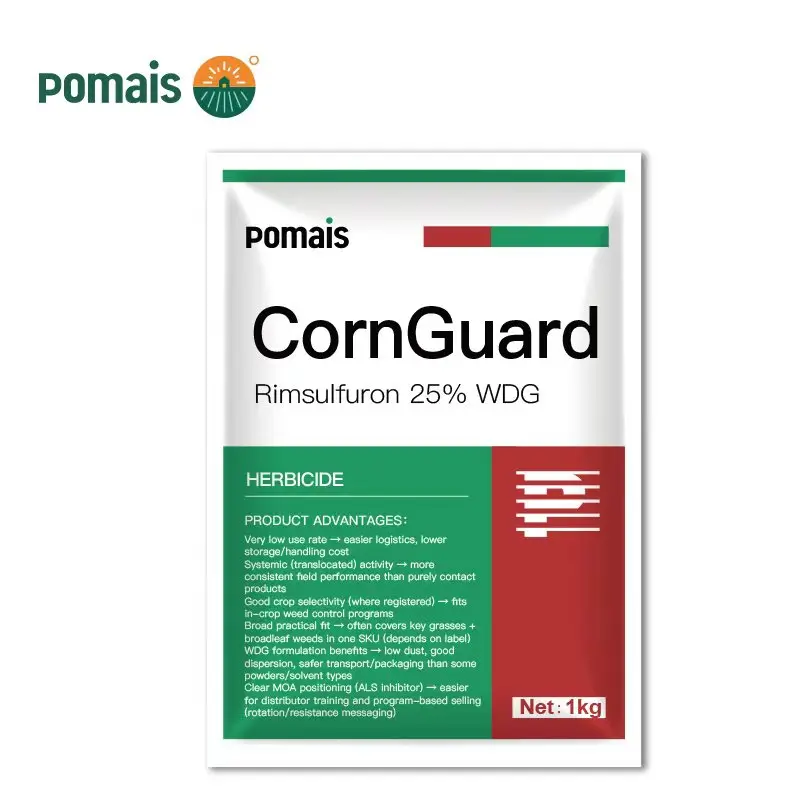
Rimsulfuron 25% WDG Herbicide
If you need a selective sulfonylurea herbicide for field-crop weed management, Rimsulfuron 25% WDG is positioned for programs where you want reliable control of key grass weeds plus selected broadleaf weeds with a clear, rotation-ready mode of action. Rimsulfuron is widely described as an ALS/AHAS inhibitor (Group 2) and is commonly used in field corn (maize), potatoes, and field-grown tomatoes under label-led crop and weed spectrum claims.
- Designed for Professional Buyers & Bulk Orders
- We support custom packaging, labeling, and formulation to meet your market needs.
- Export wholesale inquiries only.
- Please include destination country, business type (importer/distributor/registrant), and expected volume.
- Retail requests will not be processed.

About Rimsulfuron 25% WDG Herbicide
| Product name | Rimsulfuron 25% WDG |
| Active ingredient | Rimsulfuron |
| CAS No. | 122931-48-0 |
| Chemical class | Sulfonylurea herbicide |
| Mode of action | ALS/AHAS inhibitor (Group 2, amino acid synthesis inhibitor) |
| Crop fit (typical labels/markets) | Field corn (maize), potatoes (including seed potatoes), field-grown tomatoes (label-led) |
| Weed spectrum positioning | Annual/perennial grasses + selected broadleaf weeds (label-led) |
| Formulation | Water dispersible granule (WDG/WG) |
| Documents | COA, SDS/MSDS, TDS (available on request) |
Rimsulfuron
Rimsulfuron is a selective sulfonylurea herbicide used to manage weeds in major field-crop programs. In widely referenced label and technical summaries, rimsulfuron is positioned for control of certain grass and broadleaf weeds in potatoes, field corn, and field-grown tomatoes (final claims depend on the destination-country label).
Mode of Action: ALS (AHAS) Inhibition
Rimsulfuron controls susceptible weeds by inhibiting acetolactate synthase (ALS)—also called acetohydroxyacid synthase (AHAS)—an enzyme required for synthesis of branched-chain amino acids. In practical field terms, susceptible weeds stop growing at the meristems, followed by decline over time. This is why rimsulfuron is commonly discussed as a Group 2 / amino acid synthesis inhibitor in professional weed-management communication.
What this means for your program: because Group 2 herbicides are widely used globally, your positioning should always include rotation and resistance-management discipline (see the Resistance Management section below).
Target Weed Spectrum: What You Can Position on a Product Page
For a product detail page, the strongest approach is to describe weed control by weed groups (rather than overpromising a long list). Supplier and label summaries commonly position rimsulfuron for:
- Annual and perennial grasses
- Selected broadleaf weeds
- Use in maize/corn, and often also in potatoes and tomatoes (label-led)
Commercial note: weed spectrum is label-dependent and region-dependent. If you share your destination market and main problem weeds, you can align the claim language to that registration pathway.
Crop Fit: Field-Crop Focus
Rimsulfuron is widely referenced in official and supplier materials as being used in:
Field Corn (Maize)
Positioning typically focuses on protecting early-season yield potential by keeping fields clean during critical competition windows (label-led weed spectrum and timing).
Potatoes (Including Seed Potatoes)
Rimsulfuron is commonly described as used in potatoes for selective weed control; procurement teams often look for clean label language and predictable selectivity in potato systems.
Field-Grown Tomatoes
Many label summaries include field-grown tomatoes as a use site; in export channels, you should treat tomatoes as a market-specific claim and align to local registration wording.
Why 25% WDG Is a Strong Commercial Format
WDG (water dispersible granule) is a procurement-friendly formulation because it supports stable logistics, easy handling for distributors, and consistent dosing accuracy at the point of use (as directed by the label). A 25% WDG format is also widely recognized in supplier catalogs and in market procurement language for rimsulfuron.
Resistance Management: How to Protect Performance Over Seasons
Because rimsulfuron is a Group 2 ALS inhibitor, the key to long-term performance is program design:
- Rotate with herbicides from different modes of action across seasons
- Use integrated weed management practices (crop rotation, sanitation, and field scouting)
- Follow destination-market label directions and local agronomy guidance for resistance prevention
This is a high-trust section for importers and distributors because it signals that you sell the product with long-term stewardship in mind—not just short-term volume.
Quality Control and Documentation You Receive
For importers, distributors, and brand owners, rimsulfuron purchasing decisions are typically driven by spec clarity + documentation readiness. You can request:
- COA (batch confirmation)
- SDS/MSDS
- TDS (technical data sheet)
- Packaging specs and label-ready information support for your destination market
FAQ
What is rimsulfuron herbicide used for?
Rimsulfuron is a selective sulfonylurea herbicide commonly positioned for control of certain grass and broadleaf weeds in field corn, potatoes, and field-grown tomatoes (label-led by country).
What is the mode of action of rimsulfuron?
It is an ALS/AHAS inhibitor (Group 2)—an amino acid synthesis inhibitor.
Is rimsulfuron used outside field crops?
Yes. Market materials include rimsulfuron products positioned for turf programs and certain non-crop areas. For this page, we keep the focus on field crops; turf programs are typically handled as a separate label and positioning strategy.
What does WDG mean?
WDG means water dispersible granule, a solid formulation designed to disperse in water for application as directed by the local label.
Do you provide COA/SDS/TDS for importer onboarding?
Yes—these documents can be provided as part of a quote-ready specification pack.
Request a Label-Ready Specification Pack
To receive a quote-ready response for Rimsulfuron 25% WDG, send:
- Destination country/region (Central Asia priority, or your target market list)
- Target crop(s) and your main weed pressure description
- Packaging preference and label language requirements
- Documentation requirements (COA, SDS/MSDS, TDS)
You’ll receive a market-aligned spec sheet, document checklist, and a supply proposal tailored to your distribution plan.