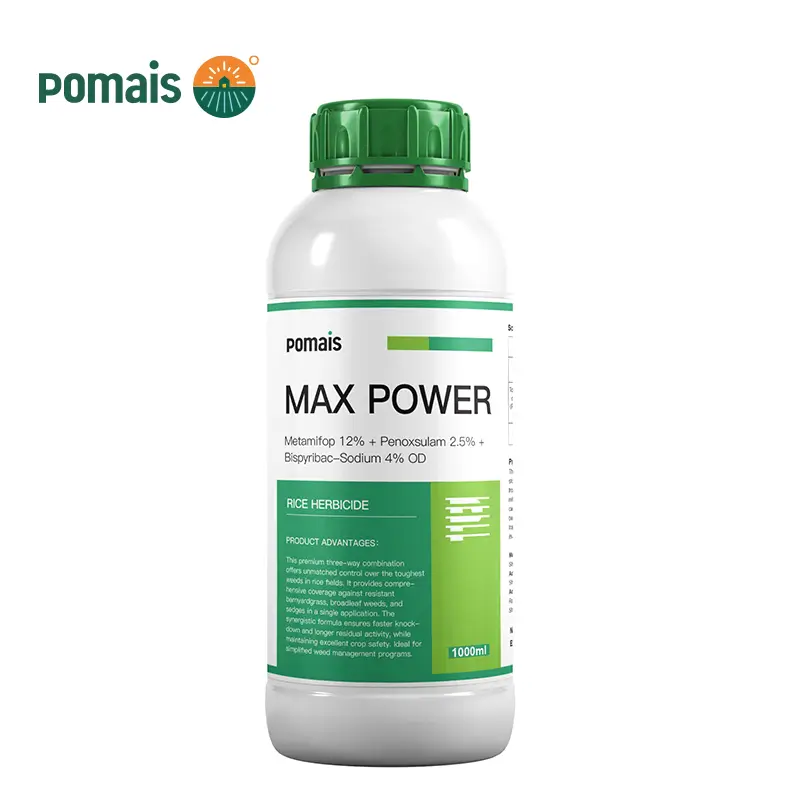
Metamifop 12% + Penoxsulam 2.5% + Bispyribac-Sodium 4% OD
Total A.I. 18.5% | OD Formulation | Rice Weed Control Portfolio Positioning
If you are sourcing a rice herbicide for import and distribution, you need three things immediately: a clear active-content statement, a defensible mode-of-action position, and trade-ready execution (documents, packaging, consistent batches). This triple-active OD (oil dispersion) formulation is built for rice weed-control portfolios, combining one ACCase inhibitor with two ALS inhibitors to support broader program positioning and stewardship language (final claims are label- and country-dependent).
MOQ: Standard orders from 1 MT
Samples: Small samples may be available for qualified projects (case-by-case)
Lead time: Confirmed case-by-case based on production schedule, packaging, and label approval timeline
Documents: COA / MSDS / TDS / label template / export documents available
Packaging: Common export bottles, jerrycans, and drums; custom capacities and private label supported
- Designed for Professional Buyers & Bulk Orders
- We support custom packaging, labeling, and formulation to meet your market needs.
- Export wholesale inquiries only.
- Please include destination country, business type (importer/distributor/registrant), and expected volume.
- Retail requests will not be processed.

About Metamifop 12% + Penoxsulam 2.5% + Bispyribac-Sodium 4% OD
| Product Type | Herbicide (rice weed-control positioning) |
| Formulation | OD (Oil Dispersion) |
| Total Active Ingredients | 18.5% |
| Active Ingredients (%) | Metamifop 12% + Penoxsulam 2.5% + Bispyribac-Sodium 4% |
| Concentration (g/L) | Available upon request (recommended for tenders and registration files) |
| Mode of Action (Concept-Level) | ACCase inhibitor (Metamifop) + ALS inhibitors Group 2 (Penoxsulam, Bispyribac-sodium) |
| Crop Positioning | Rice programs (label-dependent; country registration determines exact claims) |
| Target Spectrum (Category-Level) | Rice weed-control positioning; spectrum statements follow local label |
| MOQ | 1 MT (standard) |
| Samples | Case-by-case for qualified projects |
| Packaging Options | 100 mL / 250 mL / 500 mL / 1 L; 5 L / 10 L / 20 L; 200 L drum; custom capacity available |
| Documentation Pack | COA (per batch), MSDS, TDS, label template, export documents |
| Lead Time | Case-by-case—confirm during quotation after packaging & label approval |
Metamifop 12% + Penoxsulam 2.5% + Bispyribac-Sodium 4% OD
This product is a triple-active OD herbicide positioned for rice weed-control portfolios. You can use it to anchor a channel-ready SKU with clear active disclosure and a simple training narrative for your distributors: ACCase + ALS chemistry coverage (concept-level), with stewardship language built into your rollout.
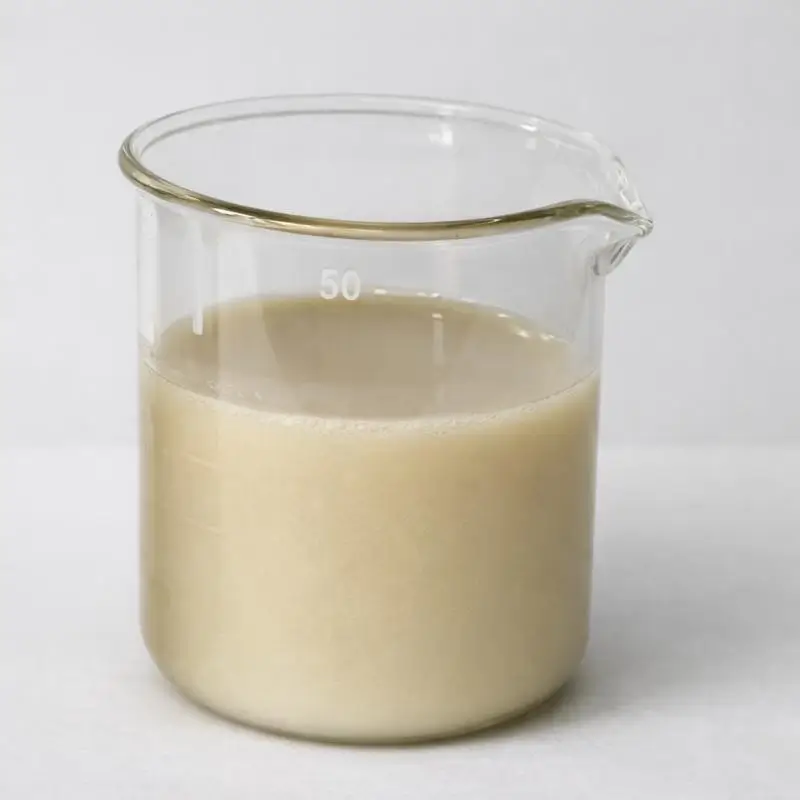
OD definition (why buyers care): FAO/WHO guidance describes an oil dispersion (OD) as a stable suspension of active ingredient(s) in an organic fluid. In practical terms, OD is often chosen for commercial channels because formulation quality and batch consistency matter across long logistics cycles and mixed storage conditions.
Compliance note: This page is for product identification and procurement evaluation. Final approved claims, use directions, and restrictions depend on local registration and must follow the official label.
Active Ingredients and Mode of Action
Metamifop (12%) — ACCase inhibitor positioning
Scientific references describe metamifop as an herbicide that inhibits acetyl-CoA carboxylase (ACCase) in sensitive weeds (concept-level). This chemistry class is widely recognized for grass-weed positioning narratives in crop programs (label-dependent).
Penoxsulam (2.5%) — ALS/AHAS inhibitor (Group 2)
Penoxsulam is commonly categorized as a WSSA Group 2 herbicide, meaning it inhibits acetolactate synthase (ALS) (concept-level).
Bispyribac-sodium (4%) — ALS inhibitor (Group 2)
Bispyribac-sodium is also categorized as a Group 2 ALS inhibitor in regulatory and classification references (concept-level).
What this combination means commercially: you are not buying “three unrelated actives.” You are buying a portfolio structure of one ACCase inhibitor + two ALS inhibitors, which supports program messaging while making it easier to build a stewardship narrative around ALS resistance management (without publishing use instructions online).
Where It Fits in Rice Programs
This formulation is positioned for rice weed management as part of a broader product line. Your exact market claims should be aligned to local label approvals, but from a procurement perspective, the product is designed to serve buyers who need:
- A rice-positioned SKU suitable for distributor rollout
- A clear MoA story (ACCase + ALS) to support channel education
- A stable formulation type (OD) that can perform reliably through export logistics
Global relevance: rice production is heavily concentrated in Asia, and demand for modern weed-management portfolios follows that crop footprint. USDA reporting shows major producing countries include China, Bangladesh, Indonesia, and Vietnam (among others), and FAO-based datasets track rice production globally over time.
Why OD Formulation Matters for Distribution and Private Label
For importers and brand owners, formulation choice affects downstream outcomes: distributor confidence, complaint rates, and consistency across seasons.
OD is frequently selected for commercial channels because it can support:
- Batch-to-batch consistency expectations when the supplier controls milling, suspension stability, and release standards
- Handling consistency across regional distributors and mixed warehousing conditions
- Private-label scalability—a clean specification plus COA-per-batch reduces onboarding friction with larger networks
Packaging and Private Label Options
You can standardize packaging to accelerate rollout or customize capacities to match your market’s price ladder.
Typical export range (recommended):
- Bottles: 100 mL, 250 mL, 500 mL, 1 L
- Jerrycans: 5 L, 10 L, 20 L
- Drums: 200 L
- Custom bottle/jerrycan/drum capacities available upon request
Private label support (commercial scope):
- Multilingual label layout based on your destination market
- Carton marking and batch-code alignment with documentation
- Packaging configuration for distributor handling and pallet efficiency
Documentation Pack and Compliance Support
To reduce import friction and speed up distributor onboarding, you can request a complete technical and trade file:
- COA (per batch)
- MSDS
- TDS
- Label template (for localization and market-specific statements)
- Export documents aligned to shipment requirements
Boundary statement: we support documentation preparation and label localization. Final registration approval depends on local authority review and importer submission requirements.
Quality Assurance and Batch Consistency
Long-term channel success depends on repeatability, not just first shipment performance. A professional supply setup should support:
- COA-per-batch issuance aligned to shipment lots
- Batch traceability across bottle, carton, and documents
- Retained samples for complaint resolution
- Release controls to prevent off-spec exports
If you are building a multi-season rice herbicide line, these controls are often decisive in supplier selection.
Safety, Storage, and Environmental Stewardship (Principle-Level)
Safety classification and detailed instructions are label-specific. For responsible trade and handling:
- Avoid unnecessary skin/eye exposure; use appropriate PPE during handling and transfer
- Prevent contamination of waterways and sensitive areas; follow local restrictions
- Store locked in a cool, dry, ventilated area, away from food, beverages, feed, and seed
- During transport, protect from sun/rain and handle carefully to avoid leakage
If exposure discomfort occurs, stop contact and seek medical advice with the product label.
FAQ
What is the total active content?
Total active ingredients are 18.5%: Metamifop 12% + Penoxsulam 2.5% + Bispyribac-sodium 4%.
What is the mode-of-action structure?
Metamifop is an ACCase inhibitor, while penoxsulam and bispyribac-sodium are ALS inhibitors (Group 2) (concept-level; claims must follow local label).
Why does the OD formulation matter?
FAO/WHO defines OD as a stable suspension of active ingredient(s) in an organic fluid. In commercial distribution, OD is often chosen to support consistent product behavior through export logistics and storage variation.
Can you provide g/L concentration and a tender-ready technical file?
Yes. Share your destination market and documentation format requirements, and we will provide the concentration details and technical file.
What documents can you provide?
COA per batch, MSDS, TDS, label template, and export documents.
What are MOQ and sample terms?
Standard MOQ is 1 MT. Samples may be available for qualified projects (case-by-case).
What packaging formats can you supply?
Standard export bottles, jerrycans, and drums, plus custom capacities for your channel plan.
How is lead time handled?
Lead time is confirmed case-by-case after production scheduling, packaging selection, and label approval requirements are clear.
Get a Procurement-Ready Offer
To receive a quotation and full documentation pack, send:
- Destination market
- Label language(s)
- Target pack sizes
- Estimated annual demand and preferred shipping window