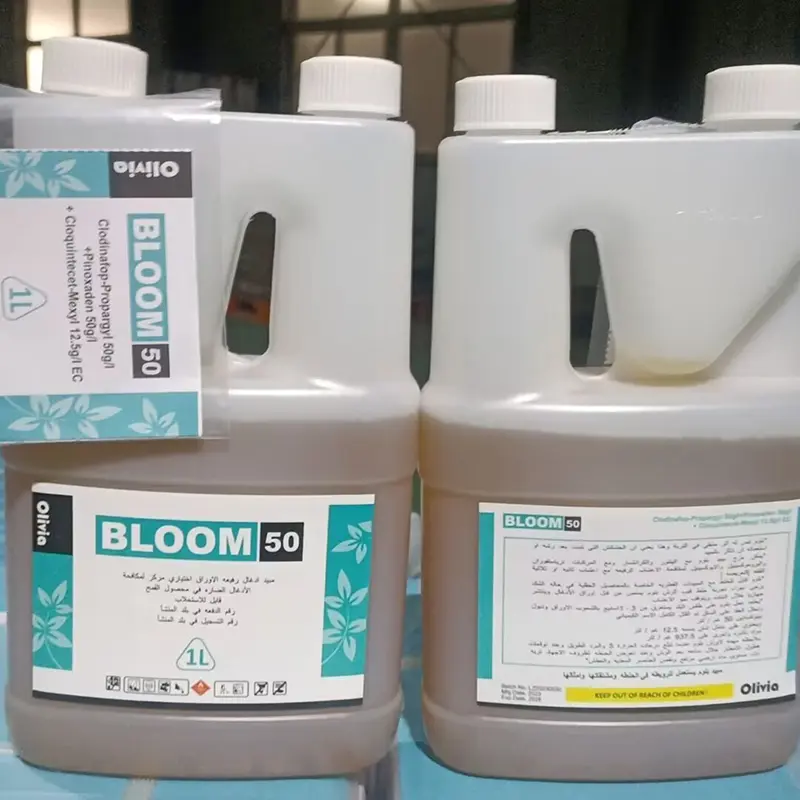
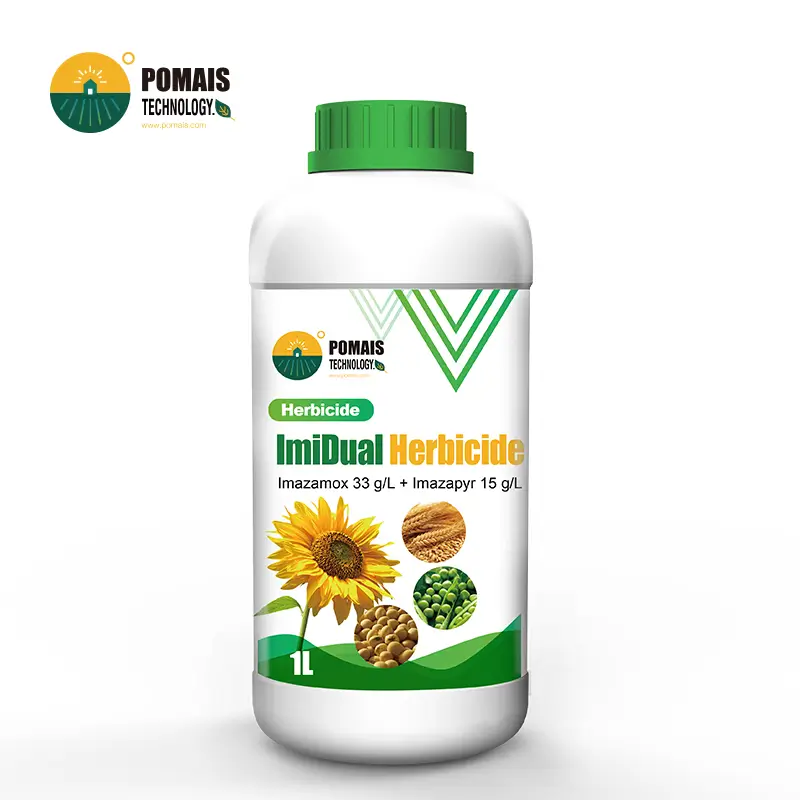
Imazamox 33g/L + Imazapyr 15g/L SL Herbicide
If you are commercializing a selective imidazolinone herbicide for Clearfield crop systems and specified non-crop vegetation management, this Imazamox 33 g/L + Imazapyr 15 g/L SL is built for that job: broad-spectrum control, systemic uptake, and practical residual support—delivered with the documentation and packaging flexibility you need to sell confidently in your market.
Fast procurement checklist (what you can get from POMAIS):
- Batch-level COA with traceability, plus MSDS/TDS on request
- Private label artwork support and multi-language label coordination
- Flexible packs: 1L / 5L / 20L and customized bulk options
- Designed for Professional Buyers & Bulk Orders
- We support custom packaging, labeling, and formulation to meet your market needs.
- Export wholesale inquiries only.
- Please include destination country, business type (importer/distributor/registrant), and expected volume.
- Retail requests will not be processed.

About Imazamox 33g/L + Imazapyr 15g/L SL Herbicide
| Product Name | Imazamox 33g/L + Imazapyr 15g/L SL |
| Active Ingredients | Imazamox 33 g/L + Imazapyr 15 g/L |
| Chemical Family | Imidazolinone Herbicide |
| CAS Numbers | Imazamox: 114311-32-9, Imazapyr: 81334-34-1 |
| Molecular Formulas | Imazamox: C15H19N3O4, Imazapyr: C13H15N3O3 |
| Formulation Type | Soluble Liquid (SL) |
| Mode of Action | ALS (Acetolactate Synthase) Inhibitor; disrupts amino acid synthesis, leading to plant death |
| Target Weeds | Annual & perennial broadleaf weeds and grasses, including barnyardgrass, wild oat, foxtail, bindweed |
| Target Crops | Sunflowers, Soybeans, Peas, Wheat, Barley, Non-Crop Areas |
| Application Timing | Pre-emergence and early post-emergence |
| Recommended Dosage | 0.75-2.5 L/ha depending on crop and weed spectrum |
| Application Method | Foliar spray or soil application |
| Rainfastness | 1-3 hours after application |
| Persistence in Soil | Moderate residual activity, degradation varies based on soil type and moisture |
| Toxicity Classification | WHO Class III (Slightly Hazardous) |
| Environmental Impact | Potentially persistent in soil and water; avoid drift to non-target plants |
| Storage Stability | Stable for 2 years when stored in a cool, dry place |
| Packaging Options | 1L, 5L, 20L HDPE bottles/drums or customized bulk packaging |
| Regulatory Compliance | FAO, WHO, EPA, EU Standards |
Mode of action: why ALS inhibition matters
Both actives inhibit acetohydroxyacid synthase (AHAS), also referred to as ALS, which is essential for synthesizing branched-chain amino acids in plants. Once uptake occurs, susceptible weeds stop growing, gradually lose vigor, and eventually die.
From a commercialization standpoint, ALS inhibition is a familiar and widely recognized mechanism. That means your downstream customers—importers, distributors, and large farms—can quickly understand how this product fits into their weed management portfolio, especially when they are running Clearfield-tolerant crop systems.
Why the Imazamox + Imazapyr combination is commercially useful
You are building a SKU that can address mixed weed populations—broadleaf weeds, grasses, and sedges—while maintaining a practical fit for modern production systems.
Key value drivers your sales team can use (without overpromising):
- Systemic performance: uptake through foliage and/or roots supports consistent movement within susceptible weeds
- Operational flexibility: supports programs where a post-emergence tool with residual contribution helps reduce late-season weed pressure (subject to label and conditions)
- Clearfield positioning: compatible with imidazolinone-tolerant systems where crop safety is determined by the tolerant variety and the approved use pattern
Target weed spectrum and typical use scenarios
This formulation is positioned for control of annual and perennial weeds across broadleaf, grass, and sedge categories. Representative targets commonly associated with this segment include barnyardgrass, foxtail, wild oats, and various Amaranthus and Solanum species—exact performance depends on local species, growth stage, and label directions.
Where buyers typically deploy it (market-facing scenarios):
- Clearfield sunflower/legume/cereal programs facing mixed-spectrum infestations
- Conservation tillage systems where limiting soil disturbance increases reliance on post-emergence tools
- Approved non-crop/industrial vegetation management programs (rights-of-way, facility perimeters), where imazapyr is commonly positioned for broad-spectrum vegetation control
Application principles
To protect your registration position and reduce downstream misuse risk, the correct commercial message is label-first stewardship:
- Apply in alignment with local label and local regulations (crop, timing, buffer zones, and equipment requirements vary by country).
- Prioritize actively growing weeds and good coverage; avoid conditions that elevate drift or runoff risk.
- In Clearfield programs, use only on tolerant varieties and within the approved crop safety window.
Use-window checklist (non-prescriptive):
- Crop system verified as tolerant (where applicable)
- Weed spectrum confirmed (broadleaf + grasses + sedges)
- Weather window supports deposition and uptake
- Sensitive neighboring crops and non-target plants protected through drift management
Tank-mix and compatibility: how to communicate it safely
In many markets, ALS inhibitors are integrated into broader programs. Commercially, you should frame compatibility as program-based rather than listing specific “recipes.”
- Conduct a jar test for physical compatibility when combining products.
- Avoid extreme pH mixes unless the partner product label explicitly supports it.
- Confirm crop safety and resistance strategy at the program level, not only by actives.
If your customer requires market-specific mixing claims, provide them through label drafts, TDS, and local compliance review, not as open-web instructions.
Resistance management (HRAC Group 2): protect your SKU’s long-term value
This product belongs to HRAC Group 2 (ALS inhibitors). As a category, ALS inhibitors are vulnerable to resistance selection pressure when used repeatedly without rotation.
Best-practice stewardship messaging for distributors and large farms:
- Rotate with herbicides from different modes of action when permitted and agronomically appropriate.
- Integrate non-chemical controls where practical (crop rotation, sanitation, competitive crop stands).
- Monitor escapes and investigate suspected resistance early.
This section is not “extra content”—it is a commercial defense layer that helps your buyers justify repeat purchases while protecting brand reputation.
Safety and environmental positioning
Imazamox and imazapyr target a plant enzyme system; however, off-target exposure can still create agronomic and environmental risk.
- Avoid drift to non-target plants and sensitive crops; implement equipment hygiene and buffer practices per label.
- Where soil residual activity is relevant, consider soil and moisture behavior in your label and distributor training.
- Treat risk as Hazard × Exposure—your goal is to control exposure through correct use conditions, labeling, and training.
Packaging, private label, and commercialization support
You are not just buying a formulation; you are building shelf-ready inventory and a sales narrative that your channel partners can execute.
Packaging options (trade-friendly):
- Standard: 1L / 5L / 20L HDPE bottles/drums
- Optional: customized bulk packaging and carton configurations for container efficiency
Private label support:
- Artwork alignment (brand colors, compliance blocks, hazard statements, QR/trace elements)
- Multi-language label coordination to match your destination market
- Documentation bundle for distributor onboarding (COA/MSDS/TDS on request)
Suggested internal link (one only): Anchor text — Services (link to your OEM/label/registration support services page).
Quality control and documentation pack
For professional procurement, product performance is only one part of the decision. The other part is whether you can support their import clearance, tender documentation, and in-market compliance workflow.
What you can request from POMAIS for this SKU:
- COA for batch release and incoming QC alignment
- MSDS for logistics and warehouse compliance
- TDS for distributor training and technical selling
- Packaging and labeling specification support for your market rollout
This is the fastest way to reduce buyer friction and shorten your sales cycle.
Frequently asked questions
Is this product suitable for Clearfield crops?
It is positioned for Clearfield-tolerant systems where the crop variety and label approvals support imidazolinone use. Always verify tolerant varieties and follow local label directions.
What weeds does it target?
It is designed for broad-spectrum control across broadleaf weeds, grasses, and sedges, with performance dependent on local species and use conditions.
How does ALS inhibition work in simple terms?
It blocks a plant enzyme (ALS/AHAS) needed for essential amino acids. Susceptible weeds stop growing and decline over time.
Is it rainfast?
Rainfast guidance is label-dependent because it varies with conditions and local registration language. Share your target country and intended use so we can provide the correct label-based statement.
Can you provide private label and customized packaging?
Yes. POMAIS supports private label, customized packaging formats, and market-facing documentation to support your commercialization plan.
What documents can you provide for compliance and trade?
COA/MSDS/TDS can be provided based on your market needs and order stage, aligned with your import and distributor workflow.
Get a spec pack and commercial quote
If you are building a herbicide portfolio for Clearfield systems or approved non-crop vegetation management, send us:
- Destination country
- Crop system / non-crop use scenario
- Target weed pressure (broad categories are enough)
- Estimated annual volume range
- Preferred pack sizes and label language
You will receive: a technical spec pack (COA/TDS/MSDS as applicable), packaging options, and a quote aligned with your route-to-market.