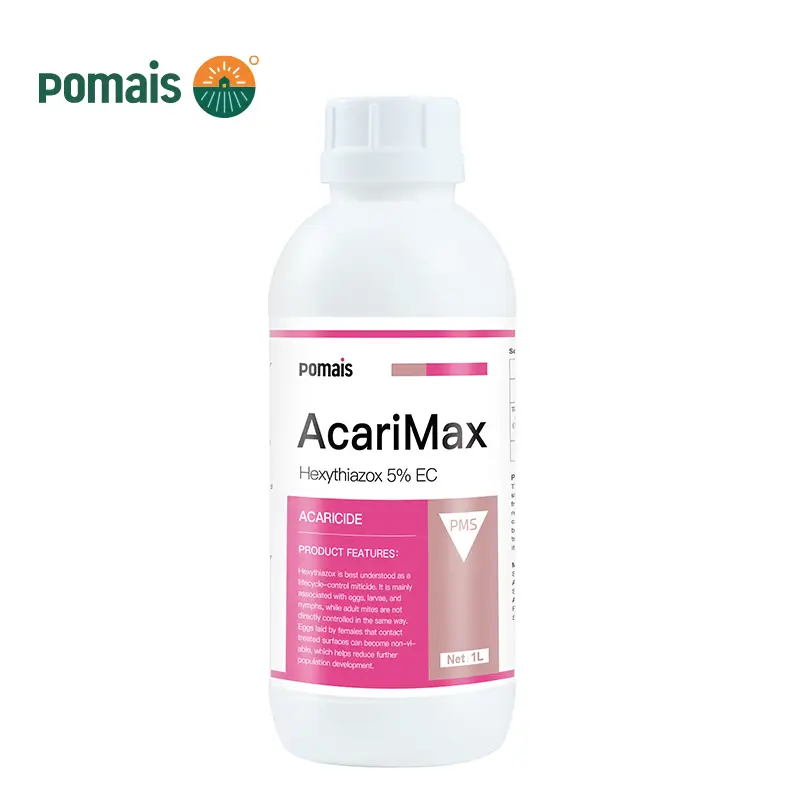
Hexythiazox 5% EC Miticide
POMAIS Hexythiazox 5% EC is a selective mite growth inhibitor developed for the management of mite eggs, larvae and nymphs in approved crop protection programs. Its main role is to interrupt mite population development before heavy adult pressure becomes established.
As an IRAC Group 10A miticide, Hexythiazox affects the normal development of immature mites. It is not positioned as a fast adult knockdown product. The strongest program value comes from early application, lifecycle management and control of the next mite generation.
We supply Hexythiazox 5% EC for agrochemical importers, distributors, registration companies and crop protection brands. Product specifications, packaging, label language and technical documents can be reviewed according to the destination market and commercial project.
- Designed for Professional Buyers & Bulk Orders
- We support custom packaging, labeling, and formulation to meet your market needs.
- Export wholesale inquiries only.
- Please include destination country, business type (importer/distributor/registrant), and expected volume.
- Retail requests will not be processed.

About Hexythiazox 5% EC Miticide
| Product Attribute | Specification |
|---|---|
| Product Name | Hexythiazox 5% EC |
| Active Ingredient | Hexythiazox |
| Content | 5% |
| Formulation | EC — Emulsifiable Concentrate |
| Product Type | Miticide / Acaricide |
| IRAC Group | Group 10A |
| Mode of Action | Mite growth inhibitor affecting CHS1 |
| Primary Target Stages | Eggs, larvae and nymphs |
| Adult Mite Activity | Limited direct adult control |
| Primary Use Timing | Preventive or early mite population development |
| Main Target Direction | Tetranychid spider mites and other labeled mite species |
| Application Method | Foliar spray |
| Typical Crop Direction | Fruit, citrus, grapes, cotton, vegetables, ornamentals and specialty crops where registered |
| Standard MOQ | Normally 1,000 L |
| Available Documents | COA, SDS, TDS, product specification and available registration-supporting information |
| Packaging Support | Bottles, drums, labels, cartons and shipping configurations |
| Supply Type | Bulk B2B supply for import, registration and distribution |
Final crops, target mites, application rates, treatment intervals, pre-harvest intervals and re-entry requirements must follow the approved product label in the destination market.
What Is Hexythiazox?
Hexythiazox is a pesticide active ingredient used primarily as a selective miticide or acaricide.
Its commercial value is not broad insect control. It is mainly used to manage phytophagous mites by targeting their eggs and immature developmental stages.
Unlike adult-active miticides that are selected for rapid reduction of visible motile populations, Hexythiazox is positioned around lifecycle interruption. It helps prevent eggs and immature mites from developing into the next damaging adult generation.
This makes it particularly relevant for:
- Preventive mite-management programs
- Early infestation treatment
- Orchard and specialty-crop programs
- Resistance-management rotations
- Programs where mite eggs are already present
- Situations requiring longer-term population suppression
For importers building a structured mite-control portfolio, Hexythiazox 5% EC can be positioned alongside other miticide and acaricide products with different target stages and modes of action.
Is Hexythiazox an Insecticide or a Miticide?
Hexythiazox may appear under broad pesticide or insecticide classifications in some regulatory and commercial databases.
However, its primary agricultural role is mite control.
The most accurate product descriptions are:
- Miticide
- Acaricide
- Ovicide
- Mite growth inhibitor
- Mite lifecycle-management product
It should not be promoted as a general insecticide for caterpillars, aphids, whiteflies, beetles or other unrelated insect pests unless the exact registered label contains a specific claim.
Hexythiazox Mode of Action
IRAC Group 10A Mite Growth Inhibitor
Hexythiazox belongs to IRAC Group 10A.
Products in this group interfere with the normal growth and development of susceptible mites. Hexythiazox is associated with activity affecting CHS1, which is involved in the formation and development of the mite’s outer structure during immature growth.
This is different from:
- Nerve-acting adulticides
- Mitochondrial respiration inhibitors
- Lipid biosynthesis inhibitors
- Contact products designed for rapid adult mortality
Its main technical identity is developmental disruption rather than immediate nervous-system knockdown.
How Hexythiazox Disrupts Mite Development
The mode of action can be understood in four stages:
Contact with the spray or treated surface → disruption of immature mite development → failure to complete normal growth → reduced next-generation mite pressure
Eggs and immature mites exposed to the treatment may fail to hatch or develop normally, depending on the mite species, life stage, application timing, coverage and approved product claim.
The resulting population decline may therefore develop gradually rather than appearing as immediate adult mortality.
Why Adult Mites May Remain Visible
Adult mites are not directly controlled in the same way as eggs, larvae and nymphs.
After treatment, users may continue to observe adult mites for a period of time. This does not automatically mean the product has failed.
The correct evaluation should consider:
- Whether new eggs remain viable
- Whether larvae are emerging normally
- Whether nymph populations continue developing
- Whether the next adult generation is increasing
- Whether adult mite pressure was already high before treatment
Where medium or high adult populations are already present, a locally registered adult-active miticide may be required as part of the program.
Hexythiazox should not be described as delivering instant adult knockdown.
Which Mite Life Stages Does Hexythiazox Control?
The value of Hexythiazox comes from its selective lifecycle activity.
| Mite Life Stage | Hexythiazox Positioning |
|---|---|
| Eggs | Primary target stage |
| Newly Deposited Eggs | May be controlled where supported by the approved label |
| Larvae | Important immature target stage |
| Nymphs | Development may be disrupted after sufficient exposure |
| Adults | Limited direct control |
| Eggs Laid by Exposed Females | May become nonviable where supported by product data and registration |
Mite Eggs
Mite eggs are one of the most important target stages.
Applications made at the first sign of egg deposition can help prevent a developing infestation from producing a larger motile population.
Coverage remains important because activity depends on direct treatment or contact with treated plant surfaces.
Larvae and Nymphs
Larvae and nymphs are immature motile stages.
Hexythiazox interferes with their normal development, reducing the number that successfully reach adulthood.
This makes the product useful where monitoring shows:
- A high proportion of eggs
- Newly emerging larvae
- Early nymph development
- A population beginning to build
- Low to moderate adult pressure
Adult Mites
Hexythiazox is not selected primarily for direct adult mite control.
Where adult pressure is already severe, delaying treatment until the population consists mainly of adults can reduce the practical value of the product.
The decision should be based on the mite stage structure, not only the total number of mites observed.
What Does Hexythiazox 5% EC Control?
Hexythiazox is used mainly against tetranychid spider mites and other labeled crop mites.
Typical target directions may include:
- Two-spotted spider mite
- European red mite
- Citrus red mite
- Pacific spider mite
- Strawberry spider mite
- McDaniel spider mite
- Banks grass mite
- Willamette mite
- Other labeled phytophagous mites
Exact claims depend on the destination-country registration.
| Target Mite Direction | Typical Crop Damage | Hexythiazox Positioning |
|---|---|---|
| Two-Spotted Spider Mite | Leaf stippling, yellowing, webbing and canopy decline | Egg and immature-stage population management |
| European Red Mite | Leaf bronzing and reduced photosynthetic performance | Early orchard intervention |
| Citrus Red Mite | Leaf discoloration and reduced tree performance | Lifecycle management where registered |
| Pacific Spider Mite | Feeding injury, webbing and leaf deterioration | Early population suppression |
| Banks Grass Mite | Leaf discoloration and crop stress | Field-crop use where approved |
| Other Spider Mites | Progressive feeding injury and reduced crop quality | Crop-specific registration required |
The product should not be promoted as controlling every species of agricultural mite.
Hexythiazox Uses in Agriculture
Hexythiazox products are used in a range of crop sectors, but approved uses vary by market.
The following crop directions describe typical commercial positioning rather than a universal label.
Citrus
Citrus red mites and other spider mites can affect leaf condition, tree vigor and crop performance.
Hexythiazox may be used in approved citrus programs where egg and immature-stage management is required.
Applications should be based on:
- Mite monitoring
- Egg deposition
- Population development
- Canopy coverage
- Local thresholds
- Approved treatment timing
Apples, Pears and Other Pome Fruit
European red mites and spider mites can affect leaf function and orchard productivity.
Hexythiazox may be positioned for early-season or developing mite populations where the approved label supports use.
The product is especially relevant when eggs or immature stages make up a significant part of the population.
Grapes and Vine Crops
Spider mites in vineyards can reduce leaf performance and contribute to premature canopy decline.
Where locally registered, Hexythiazox may support vineyard programs designed to suppress the next mite generation before severe webbing and adult buildup develop.
Stone Fruit and Tree Nuts
Stone fruit and tree nut crops may experience pressure from red mites, spider mites and other crop-specific species.
Product use must consider:
- Crop growth stage
- Mite species
- Egg density
- Adult pressure
- Harvest interval
- Local resistance history
Cotton and Field Crops
Mite pressure can increase rapidly under hot, dry and dusty conditions.
Hexythiazox may be used in approved field-crop programs when monitoring detects eggs and immature stages before adult populations become dominant.
Vegetables and Protected Crops
Potential directions may include registered vegetable, greenhouse and protected-crop programs.
However, greenhouse use cannot be assumed from an outdoor crop label.
Buyers must confirm:
- Whether protected-crop use is registered
- Which vegetable crops are approved
- Which mite species are listed
- The permitted application method
- Crop-safety requirements
- Maximum annual applications
Ornamentals and Nursery Crops
Mites can reduce the visual quality and marketability of ornamentals.
Where registered, Hexythiazox may be used for early lifecycle management in:
- Flowering plants
- Foliage plants
- Nursery crops
- Landscape ornamentals
- Greenhouse ornamentals
Crop tolerance should be checked because ornamental varieties may respond differently to EC formulations and tank mixtures.
When Should Hexythiazox Be Applied?
Application timing is one of the most important factors in Hexythiazox performance.
Apply at Early Egg Deposition
The product is best positioned when monitoring identifies mite eggs before a large adult population has developed.
This helps interrupt the lifecycle before the next generation becomes damaging.
Apply During Early Population Development
Suitable timing may include periods when:
- Eggs are present
- Larvae are beginning to emerge
- Nymph numbers are increasing
- Adult pressure remains low
- Mite hot spots are beginning to develop
- Crop damage is still limited
Do Not Wait for Severe Adult Buildup
Hexythiazox is not an emergency adult knockdown product.
If the crop already has:
- High adult mite density
- Heavy webbing
- Extensive bronzing
- Severe leaf decline
- Rapid active feeding
- Multiple overlapping generations
a different program may be required.
Where locally permitted, an adult-active product from another mode-of-action group may be considered according to the label and resistance strategy.
Use Field Monitoring
Treatment decisions should be based on:
- Egg counts
- Immature mite counts
- Adult mite counts
- Predatory mite activity
- Crop growth stage
- Weather conditions
- Previous treatment history
- Local intervention thresholds
A product selected only by active ingredient name, without considering mite life stages, may not deliver the expected field result.
Application Guidance
The following information describes general professional principles. It does not replace the registered product label.
Inspect the Crop Before Treatment
Examine:
- Upper and lower leaf surfaces
- Young and mature foliage
- Crop edges
- Dry or dusty areas
- Previous infestation hot spots
- Leaves showing stippling or bronzing
- Areas with early webbing
A hand lens may be required to distinguish eggs, larvae, nymphs and adults.
Achieve Thorough Coverage
Hexythiazox acts through direct spray contact and contact with treated surfaces.
Applications should reach:
- Leaf undersides
- Inner canopy foliage
- Egg-deposition sites
- Young shoots
- Infested fruit surfaces where relevant
- Protected areas where immature mites develop
Dense canopies may require greater spray penetration and carefully selected water volumes.
Use Calibrated Equipment
Before application, confirm:
- Nozzle condition
- Spray pressure
- Travel speed
- Flow rate
- Spray pattern
- Tank agitation
- Boom or nozzle position
- Total output per hectare
Poor calibration can leave untreated areas or produce excessive runoff.
Follow the Approved Rate
Do not reduce the rate only to lower application cost.
Sublethal exposure can produce inconsistent control and may increase resistance-selection pressure.
Exact rate, water volume, treatment interval and maximum number of applications must follow the approved local label.
Avoid Unfavorable Conditions
Do not apply when:
- Strong wind may cause drift
- Heavy rain is expected before deposits are established
- Leaves are already saturated
- Runoff into water bodies may occur
- Crops are severely stressed
- Temperature conditions exceed label restrictions
- The intended crop is not listed
Hexythiazox 5% EC Formulation Features
EC means Emulsifiable Concentrate.
In an EC formulation, the active ingredient is incorporated into a liquid system that forms an emulsion when diluted with water.
Practical EC Characteristics
A commercial Hexythiazox 5% EC should be evaluated for:
- Active ingredient content
- Physical appearance
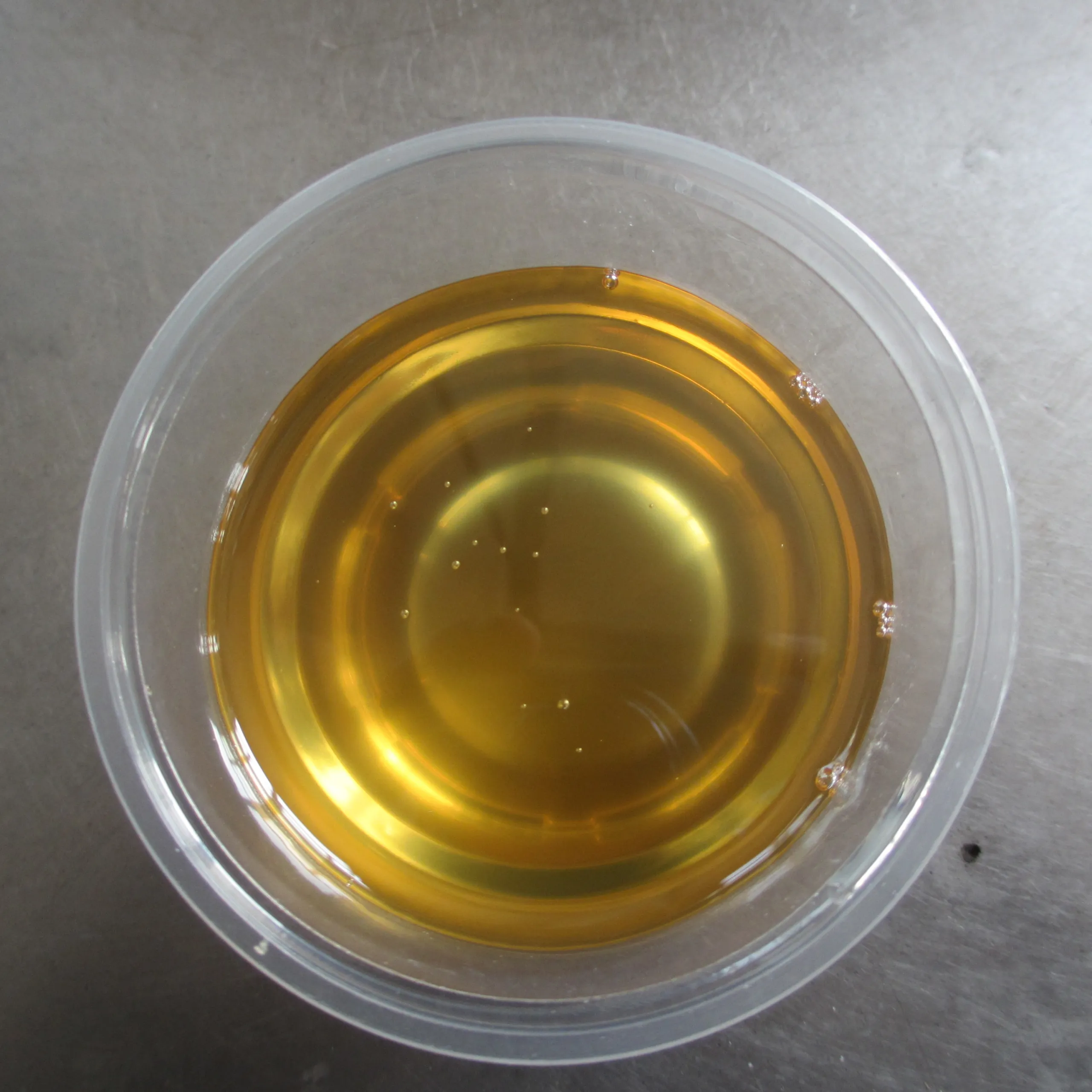
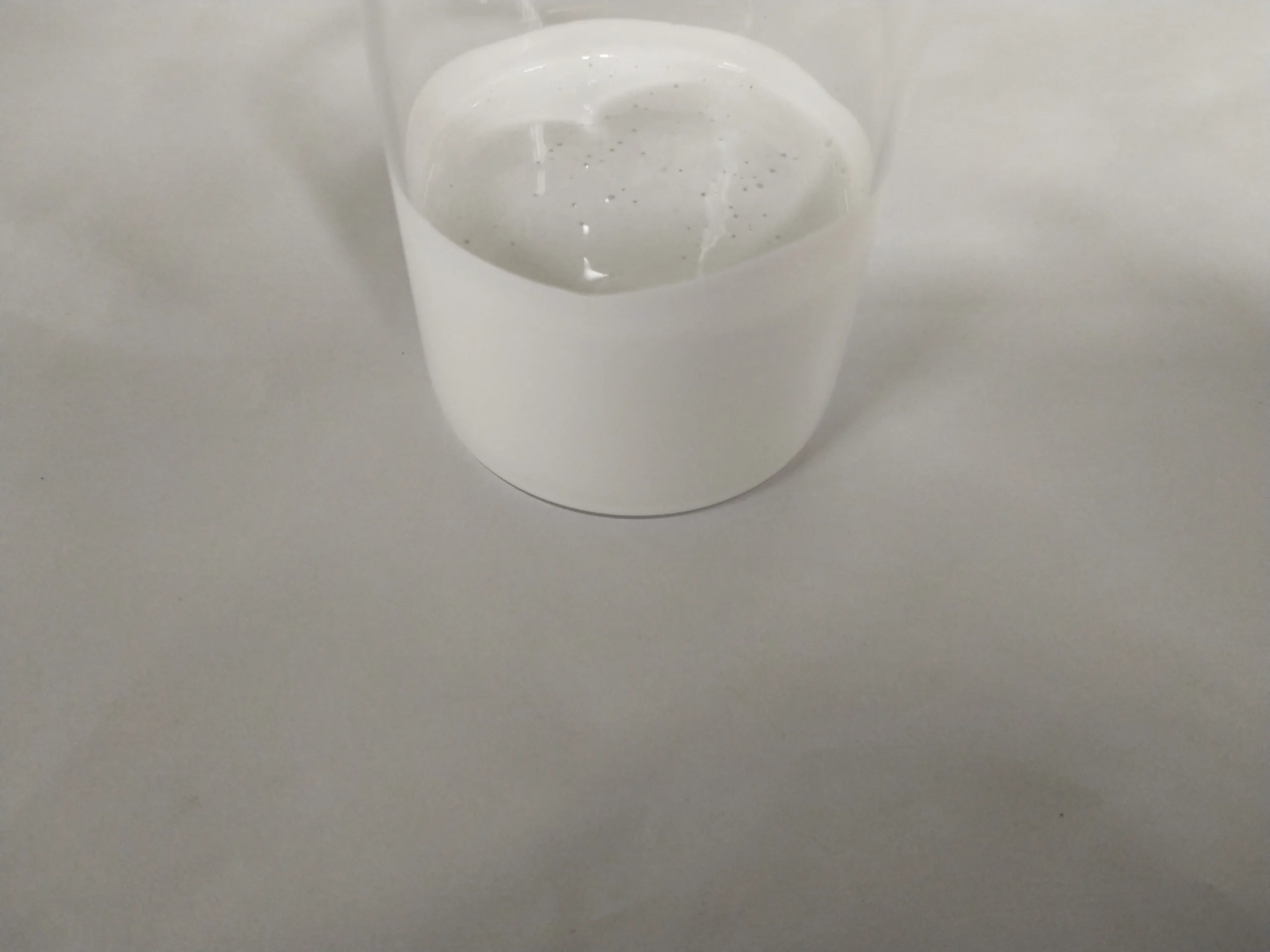
- Emulsion stability
- Persistent foam
- Water content
- Acidity or alkalinity
- Low-temperature stability
- Heat stability
- Pourability
- Dilution behavior
- Packaging compatibility
- Batch consistency
Emulsion Stability
After the product is mixed with water, the spray solution should form a stable emulsion according to the technical specification.
Instability may appear as:
- Rapid separation
- Excessive oiling
- Sediment
- Creaming
- Persistent foam
- Irregular spray behavior
Water quality and mixing order may influence field dilution.
Packaging Compatibility
EC formulations may interact with unsuitable packaging materials.
Bottle, cap, induction seal, gasket, label adhesive and printing system should be reviewed against the final formulation.
Packaging checks should consider:
- Leakage
- Bottle deformation
- Seal swelling
- Cap compatibility
- Label lifting
- Product evaporation
- Long-term storage
- Container-shipping temperatures
Temperature Stability
Cold storage and high-temperature transport can affect formulation performance.
For export markets, buyers should confirm:
- Low-temperature stability
- Heat stability
- Shelf-life specification
- Warehouse requirements
- Container transport conditions
Water Quality and Tank Mixing
Hexythiazox 5% EC should not be presented as universally compatible with all pesticides, fertilizers or adjuvants.
Compatibility may be influenced by:
- Water hardness
- Water pH
- Mixing order
- Partner formulation
- Adjuvant type
- Spray-oil concentration
- Tank temperature
- Crop sensitivity
- Number of products in the mixture
- Time between mixing and application
General Mixing Principles
Where permitted by the label:
- Fill part of the spray tank with clean water.
- Start agitation.
- Measure the required product accurately.
- Add Hexythiazox 5% EC according to the recommended sequence.
- Add compatible partners only where permitted.
- Complete filling with water.
- Maintain agitation during application.
- Use the mixture within the recommended period.
Conduct a Compatibility Test
For an unfamiliar mixture:
- Use the same water source intended for field application.
- Add products in the planned sequence.
- Use proportionally correct quantities.
- Observe for separation, sediment, heat or excessive foam.
- Do not use the mixture if physical instability develops.
Physical compatibility does not automatically confirm crop safety or biological performance.
Hexythiazox vs Adult-Active Miticides
Hexythiazox and adult-active miticides serve different roles.
| Comparison Factor | Hexythiazox 5% EC | Adult-Active Miticide |
|---|---|---|
| Primary Target Stage | Eggs, larvae and nymphs | Mainly motile nymphs and adults |
| Visible Speed | Population reduction develops over time | Adult reduction may become visible sooner |
| Best Timing | Preventive or early population growth | Established motile mite pressure |
| Main Program Role | Lifecycle interruption | Reduction of active feeding populations |
| Adult Knockdown | Limited | Depends on the selected active ingredient |
| Residual Value | Suppression of the next generation | Depends on formulation and active ingredient |
| Selection Logic | Based on mite stage structure | Based on adult and motile-stage pressure |
Where adult mite pressure is already significant, importers may compare Hexythiazox with an adult-active mite control option.
The correct decision is not based on which product appears “stronger.” It is based on:
- Mite species
- Dominant life stage
- Infestation severity
- Crop
- Previous applications
- Resistance history
- Approved local label
Resistance Management
Hexythiazox belongs to IRAC Group 10A.
Repeated exposure to the same mode of action can select resistant mite populations.
Do Not Treat Clofentezine as a Different Rotation Group
Clofentezine and Hexythiazox are both classified in Group 10A.
They should not be treated as unrelated modes of action simply because they have different active ingredient names.
Using Hexythiazox followed by Clofentezine may continue selection pressure on the same resistance group.
Resistance-Management Principles
- Avoid consecutive Group 10A applications.
- Follow the maximum number of treatments on the label.
- Rotate with an effective product from another IRAC group.
- Do not use below-label rates.
- Treat before populations become severe.
- Monitor control after application.
- Investigate unexpected egg hatch or immature survival.
- Record product names and IRAC groups.
- Integrate biological and cultural measures.
- Protect useful predatory mites where the program allows.
- Control weeds and alternative mite hosts where relevant.
An alternative mite lifecycle management mode of action may serve a different technical role where locally registered.
This does not mean products should be mixed or alternated automatically. Crop registration, residue limits, resistance status and beneficial arthropods must be considered.
Hexythiazox Product and Formulation Selection
This page represents Hexythiazox 5% EC.
Buyers searching for broader Hexythiazox products should confirm:
- Required concentration
- Required formulation
- Target market
- Crop registration
- Target mites
- Packaging size
- Available technical documents
- Local commercial demand
Other Hexythiazox concentrations or formulations should not be added to the page unless POMAIS can confirm:
- Stable production
- Complete technical specification
- Formulation identity
- Packaging compatibility
- Storage data
- SDS
- Registration support
- Commercial availability
Different concentrations and formulations require separate specifications and labels.
Hexythiazox Label and Registration Requirements
There is no single global Hexythiazox label.
Every commercial product label must match the exact:
- Active ingredient
- Content
- Formulation
- Registration holder
- Manufacturer
- Destination country
- Approved crops
- Target mites
- Application rates
- Spray intervals
- Pre-harvest intervals
- Re-entry intervals
- Maximum annual applications
- Safety classification
- Packaging size
Information Required for Label Review
Importers and registration partners should provide:
- Destination country
- Target crops
- Target mite species
- Required formulation
- Required concentration
- Preferred package size
- Label language
- Registration status
- Required technical documents
- Expected annual volume
The bottle, carton, COA, SDS, TDS and registration documents must use consistent product information.
POMAIS does not present a generic specification as an approved label for every market.
Safety and Operator Protection
Hexythiazox 5% EC must be handled according to the final SDS and approved product label.
General Safety Principles
- Wear the protective equipment required by the label.
- Avoid skin and eye contact.
- Do not inhale spray mist.
- Do not eat, drink or smoke during handling.
- Wash hands and exposed skin after use.
- Remove contaminated clothing.
- Keep unauthorized personnel away from mixing areas.
- Do not reuse empty pesticide containers.
- Follow local re-entry requirements.
The final hazard classification depends on the complete EC formulation, not only the active ingredient.
Solvents and other formulation components can influence:
- Skin irritation
- Eye irritation
- Flammability
- Inhalation risk
- Transport classification
- PPE requirements
Environmental Precautions
Prevent contamination of non-target environments.
Users should:
- Avoid direct application to water.
- Prevent spray drift into rivers, lakes and drainage systems.
- Follow required aquatic buffer zones.
- Prevent field runoff.
- Avoid cleaning equipment near water.
- Dispose of spray residues responsibly.
- Follow local container-rinsing requirements.
- Protect non-target organisms according to the label.
Do not describe the product as environmentally harmless or universally safe for beneficial mites.
Environmental risk depends on formulation, rate, crop, application method and local conditions.
Storage and Transport
Store Hexythiazox 5% EC:
- In its original sealed container
- In a cool, dry and ventilated warehouse
- Away from direct sunlight
- Away from excessive heat
- Away from freezing conditions where relevant
- Away from food and animal feed
- Away from incompatible chemicals
- In a secure pesticide-storage area
- Under conditions stated in the SDS
Before shipment, inspect:
- Bottle condition
- Cap security
- Induction seal
- Leakage
- Label adhesion
- Batch coding
- Fill volume
- Carton strength
- Shipping marks
- Pallet condition
Transport classification must be confirmed according to the final formulation, container size, SDS, route and destination-country requirements.
Packaging, Quality Control and Documentation Support
POMAIS supplies Hexythiazox 5% EC for bulk import, registration and distribution projects.
Packaging Options
Commercial packaging may include:
- Small agricultural bottles
- Standard retail bottles
- Larger commercial containers
- Drums
- EC-compatible bottle materials
- Induction seals
- Tamper-evident closures
- Multilingual labels
- Retail cartons
- Master cartons
- Batch and expiry coding
- Shipping marks
- Pallet and container planning
Packaging must be reviewed against the final EC formulation.
Quality-Control Focus
Product and packaging checks may include:
- Raw material identity
- Active ingredient content
- Physical appearance
- Emulsion stability
- Water content
- Acidity or alkalinity
- Persistent foam
- Low-temperature stability
- Heat stability
- Packaging compatibility
- Fill-volume control
- Seal integrity
- Label verification
- Batch consistency
Available Documents
Commercial document support may include:
- COA — Certificate of Analysis
- SDS — Safety Data Sheet
- TDS — Technical Data Sheet
- Product Specification
- Packaging Specification
- Available registration-supporting technical information
- Batch-related quality documents
- Commercial and shipping documents
Document availability depends on the destination market, registration pathway, cooperation stage and final commercial specification.
Frequently Asked Questions
Request Hexythiazox 5% EC
To evaluate a Hexythiazox 5% EC purchasing or registration project, please provide:
- Destination country
- Company type
- Required quantity
- Preferred package size
- Target crops
- Target mite species
- Dominant mite life stages
- Current registration status
- Required label language
- Required technical documents
- Expected purchasing schedule
We will review product specifications, packaging compatibility, document availability, production planning and destination-market requirements before confirming the commercial proposal.
Hexythiazox 5% EC is supplied for professional B2B procurement, registration and wholesale distribution.
Contact us!
We will reply to you within 24 hours on business days!