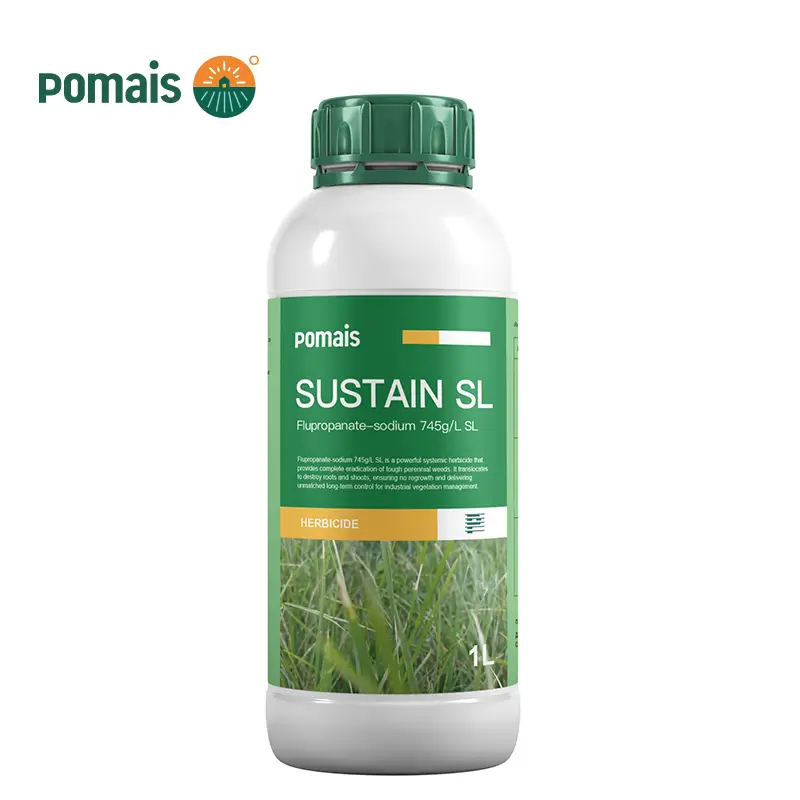
Flupropanate 745 g/L SL Herbicide
A slow-acting, soil-active herbicide for the long-term suppression of hard-to-kill perennial grasses such as serrated tussock, Chilean needle grass, giant Parramatta grass, giant rat’s tail grasses, and African lovegrass—formulated as a water-soluble liquid (SL) with 745 g/L flupropanate (present as the sodium salt). Designed for pasture and non-crop programs as part of an integrated approach, following the locally registered label.
Why this active matters (at a glance)
- Group J (inhibitors of fat/lipid synthesis, non-ACCase): a distinct MoA slot for rotating against perennial grass populations.
- Slow but lasting: visible control develops over months (≈ 3–12 mo); residual performance depends on soil type and rainfall/leaching.
- Root-dominant uptake: primarily absorbed via roots (some foliar uptake); best results come from label-timed applications and season-long follow-up.
- Fit for integrated programs: labels position it as a component of integrated weed management (IWM) in rangeland, pasture and non-crop settings.
- Designed for Professional Buyers & Bulk Orders
- We support custom packaging, labeling, and formulation to meet your market needs.
- Export wholesale inquiries only.
- Please include destination country, business type (importer/distributor/registrant), and expected volume.
- Retail requests will not be processed.

About Flupropanate 745 g/L SL Herbicide
| Active ingredient | Flupropanate (present as the sodium salt) |
| Concentration | 745 g/L |
| Formulation type | Soluble Liquid (SL), water-soluble herbicide |
| Mode of Action (AU label) | Group 0 (resistance warning refers to inhibitors of fat/lipid synthesis) |
| Legacy MoA (agr. references) | Group J — inhibitors of fat (lipid) synthesis (non-ACCase) |
| Uptake & behavior | Root-dominant uptake; soil-active with residual effect |
| Expression of control | Slow: visible effects typically in ~3–12 months |
| Primary sites | Pastures & non-crop/ROW/amenity areas (country-specific) |
| Label-listed targets (AU) | Serrated tussock, Chilean needle grass, African lovegrass, rat’s-tail grasses, giant Parramatta grass (and others per local label) |
| Pack sizes (example) | 1 L / 5 L / 20 L |
Mechanism of action
What it is. Flupropanate-sodium 745 g/L SL is a soil-active, slow-acting herbicide used for long-term suppression of invasive perennial grasses in pasture and non-crop programs. Australian labels and APVMA records describe it as a water-soluble liquid with the active constituent “745 g/L flupropanate (present as sodium salt).”
How it works. In HRAC/AU terms, flupropanate sits in Group J — inhibitors of lipid (fat) synthesis, not ACCase. This mode of action slows growth and ultimately kills established perennial grasses; the product is root-absorbed (some foliar uptake possible), acts very slowly, and shows residual soil activity—control typically develops over months and is influenced by rainfall and soil type.
What that means for programs.
- Unique rotation slot: Group-J chemistry is distinct from ACCase and ALS herbicides, adding diversity to perennial-grass programs.
- Designed for the long game: Labels and government guidance emphasize delayed symptom development and season-long follow-up, aligning it to integrated weed management rather than quick burn-down.
- Pasture & non-crop fit: Widely positioned for pasture, rangeland, rights-of-way and other non-crop areas (country-specific).
Crop/site uses, re-grazing/harvest intervals, environmental buffers, and any local restrictions must follow the registered label in your market.
Target Weeds & Use Scenarios
Core target grasses (label-backed)
Flupropanate-sodium 745 g/L SL is positioned as a component of integrated management for invasive perennial grasses, including: serrated tussock, Chilean needle grass, giant Parramatta grass and other rat’s-tail grasses, and African lovegrass (country-specific registrations apply).
Where it fits best
- Pasture and rangeland programs where slow-acting, soil-active chemistry can suppress entrenched tussock/needle/rat’s-tail populations over a season or more.
- Non-crop/right-of-way & amenity areas such as urban open space, woodlands, roadsides, nature reserves and similar non-arable sites noted on labels.
- Jurisdictional context for rat’s-tail grasses: several species are designated restricted invasive plants (e.g., in Queensland), so programs typically combine compliant chemistry with hygiene and pasture competition measures.
Program considerations you should set with buyers
- Slow but durable: control develops over months; labels and extension materials emphasize that results depend on rainfall/leaching and soil type (dry conditions favor persistence). Plan for monitoring and follow-up.
- Soil/root emphasis: labels note root-dominant uptake (with limited foliar contribution), which underpins the product’s residual fit and the importance of season timing and site stewardship.
- Stewardship boundaries: avoid drift to sensitive plants; protect waterways; observe grazing/harvest intervals and any re-seeding conditions listed on the local registered label.
Allowed target weeds, sites, and any grazing/withholding or re-seeding provisions are label- and country-specific. Always align claims and proposals with the locally registered label.
Application Guidance
Apply only where flupropanate-sodium 745 g/L SL is registered and follow the approved label. The points below align use with best practice—without prescribing country-specific rates.
Timing & program fit
- Position it for season-long suppression of entrenched perennial grasses; expect slow expression of control (months) and plan follow-up within an integrated program (competitive pasture, hygiene, monitoring).
Soil activity & uptake
- The product is soil-active and taken up primarily via roots (some foliar uptake possible). Performance depends on rainfall/leaching and soil type; dry conditions typically extend persistence.
Coverage, drift & sensitive areas
- Avoid spray drift onto desirable vegetation and tree root zones; keep buffers to waterways and sensitive sites as per label. These constraints are explicit on Australian labels for 745 g/L flupropanate (present as sodium salt).
Grazing/withholding & re-seeding
- Observe withholding periods and any slaughter intervals on your national label; some labels also prescribe re-seeding/rehabilitation conditions after adequate rainfall/leaching. Do not generalize numbers across countries—use the locally registered label only.
Non-crop & pasture stewardship
- Match nozzle/droplet to minimize off-target movement; clean down equipment to prevent seed spread (especially with rat’s-tail grasses, which are regulated in parts of Australia). Align chemical control with non-chemical measures required by local authorities.
Crop/site uses, adjuvant rules, buffers, grazing/withholding and re-seeding provisions are label- and country-specific. The locally registered label supersedes any general guidance.
Selectivity & Pasture Considerations
Grass-selective, but manage desirable species carefully. Flupropanate-sodium 745 g/L SL is a grass herbicide suited to invasive perennial grasses in non-crop and pasture settings. Labels note it is very slow-acting and residual, with performance influenced by soil type and rainfall, and they caution about leaching to the root zone of desirable plants (especially near trees) and reduced control in shaded sites.
Legume sensitivity. Multiple labels and technical summaries indicate subterranean clover and other annual legumes may be damaged if exposed to spray or if they emerge before residues dissipate; resowing desirable species is advised only after sufficient leaching rainfall per the local label.
Pasture species & renovation timing. Product literature outlines that desirable pasture grasses (e.g., phalaris, ryegrass, tall fescue, Poa tussock) should not be treated; renovation (e.g., re-sowing clovers/lucerne/cocksfoot) is typically scheduled after adequate leaching as specified on the label.
Stewardship boundaries. Registered labels consistently require spray-drift restraints, buffers to waterways, and avoidance of tree root zones; in some jurisdictions, rat’s-tail grasses are regulated weeds, reinforcing the need to pair chemistry with hygiene and competitive pasture practices.
Impacts on legumes, resowing windows, stock grazing/withholding, and buffers are country- and label-specific. Always follow the locally registered label.
Resistance Management(HRAC-aligned, Group J)
Use as one tool within IWM—rotate sites of action. HRAC guidance stresses planning mixtures/rotations across different sites of action within an integrated weed management (IWM) system to slow resistance evolution. Group-J herbicides inhibit fatty-acid/lipid synthesis (non-ACCase) and should not be the sole reliance across seasons.
Program principles
- Rotate MoA: Alternate Group J with non-J grass herbicide classes appropriate for your site and species; plan windows so successive generations aren’t exposed to the same MoA.
- Pair with non-chemical tactics: Maintain competitive pasture, enforce hygiene (seed spread control), and time management to the weed’s perennial life cycle; several state manuals and labels emphasize these pairings.
- Avoid off-target injury that selects survivors: Follow drift/buffer rules and label stewardship to deliver on-target exposure; shaded or partially covered plants can escape, contributing to selection.
- Document & review: Keep field records; if reduced sensitivity is suspected, diversify tactics and consult local guidance. HRAC frames classification as a planning tool for such decisions.
Allowed mixes/alternatives, application caps, intervals, and any grazing/withholding provisions are defined on your national label and by local regulators; these supersede general guidance.
Packaging & OEM
- Pack formats: 1 L / 5 L / 20 L HDPE with tamper-evident caps; palletized master cartons and UN-style drums available for bulk. (Pack sizes appear on AU labels.)
- Transport note: Several AU labels state “Not a Dangerous Good according to the Australian Dangerous Goods (ADG) Code for road and rail.” Always confirm against your destination country’s transport rules.
- Private label: Multi-language artwork (EN/ES/FR/AR/RU), barcode/QR traceability, localized compliance statements aligning to the registered label in market.
- Document set: COA, MSDS/SDS, TDS, batch HPLC data, and stability screening included in the spec pack; SDS examples list the typical target grasses (serrated tussock, rat’s-tail grasses, Chilean needle grass, African lovegrass, giant Parramatta grass).
Quality & Certificates
- QC baseline: incoming raw-material checks → in-process controls → final HPLC assay, appearance, pH, density → hot/cold stability → 24 h inverted leak test。
- Certificates & files: ISO-based factory QA; COA / MSDS / TDS provided per batch; label set localized to the registered use sites and target grasses in market.
- Traceability: batch ID traceable to raw materials; non-conforming lots never released.
Market Fit by Region
- Australia / New Zealand
Multiple 745 g/L flupropanate (as sodium salt) labels are on record (e.g., Titan, Surefire, GP FluPro), and APVMA Gazettes show recent registrations/variations—indicating an active, current market. Target sites include pastures & non-crop/ROW/amenity areas with slow-acting, residual positioning; labels list serrated tussock, Chilean needle grass, rat’s-tail/Parramatta grasses, African lovegrass among key targets.
In Queensland, giant rat’s-tail grass and related Sporobolus species are restricted invasive plants under the Biosecurity Act, reinforcing the need for integrated programs and hygiene alongside compliant chemistry. - Other regions
Positioning depends on local registrations. Where not yet registered, we support dossier preparation and label localization; claims and use sites will strictly follow the local registered label once approved.
FAQs
Q1. What is the concentration and formulation?
A. 745 g/L flupropanate present as the sodium salt in a water-soluble liquid (SL) formulation; classification appears as Group 0 on AU labels (legacy agronomy texts list Group J – inhibitors of fat/lipid synthesis, non-ACCase).
Q2. Where is it typically used?
A. Labels position it for pastures and non-crop/ROW/amenity areas—as a slow-acting, soil-active tool against invasive perennial grasses within integrated programs.
Q3. How fast are results, and how long does it last?
A. Labels and extension materials emphasize very slow expression (control develops over months) and residual, soil-active behavior influenced by rainfall/leaching and soil type.
Q4. Is it root-absorbed?
A. Yes—performance relies primarily on root uptake (some foliar contribution possible) and is sensitive to site factors such as shade and soil conditions.
Q5. What are key stewardship boundaries?
A. Labels set spray-drift restraints, buffers to waterways/sensitive areas, and caution around tree root zones; follow only the local registered label.
Q6. When can I re-seed desirable pasture species?
A. Several AU labels include re-seeding after adequate leaching rainfall language; consult the local label for the exact requirement in your jurisdiction.
Q7. Is it a Dangerous Good for transport?
A. AU labels specify “Not a Dangerous Good according to the ADG Code for road and rail.” Check your destination country’s transport codes.