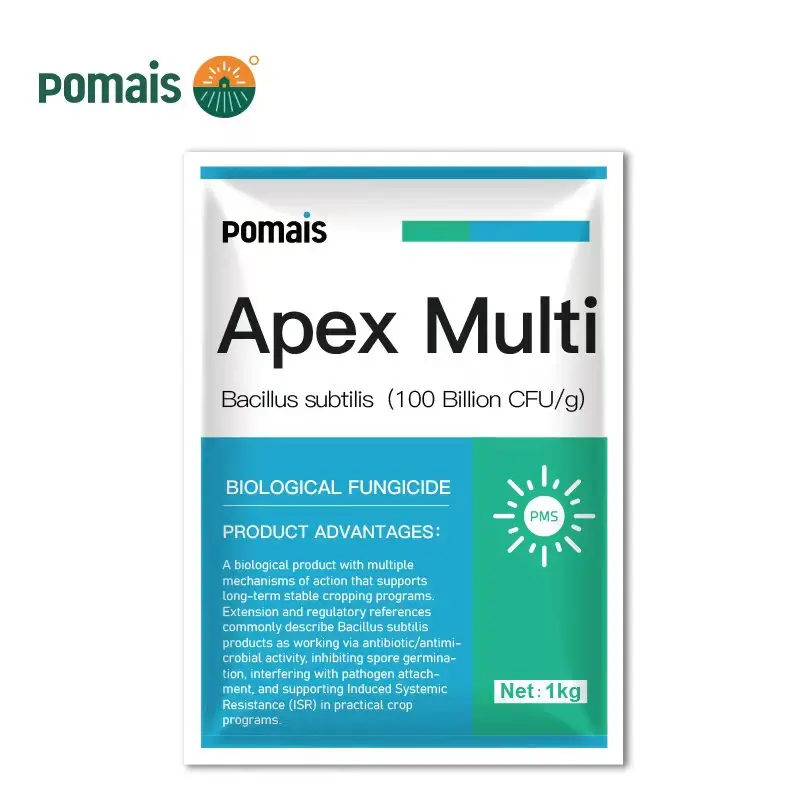
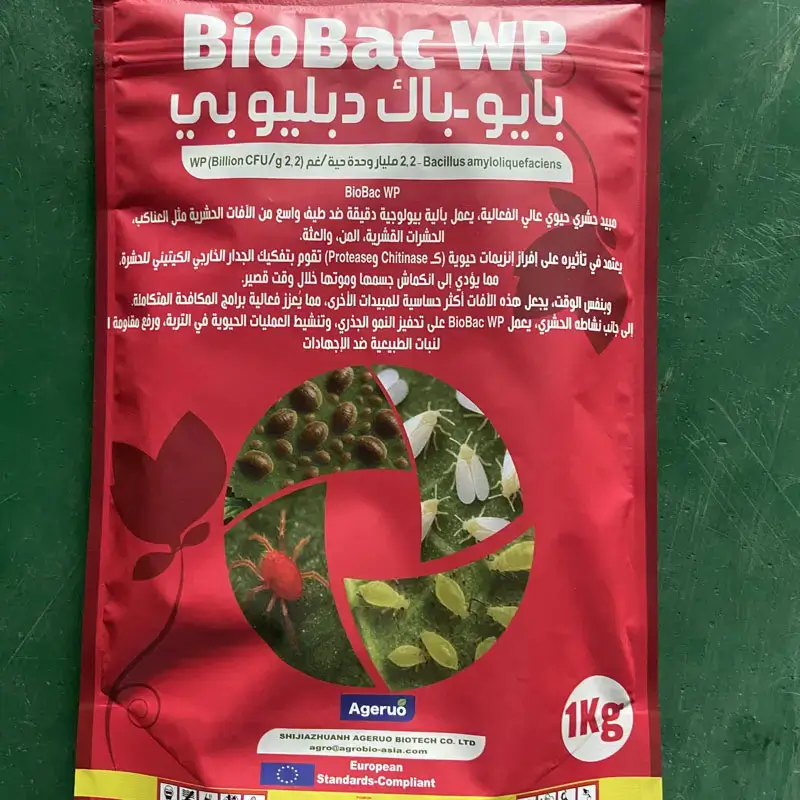
Bacillus subtilis Biofungicide Powder 100 Billion CFU/g
If you’re building a biological disease-control line for vegetables, field crops, or orchards, Bacillus subtilis is one of the most procurement-friendly options: spore-forming, shelf-stable, and designed to colonize plant surfaces and the rhizosphere, where it competes with pathogens and supports plant resilience.
At POMAIS, we supply agriculture-grade Bacillus subtilis powder with high viable count (up to 100 billion CFU/g) and support you with COA/MSDS/TDS, batch consistency, and OEM private label execution.
- Designed for Professional Buyers & Bulk Orders
- We support custom packaging, labeling, and formulation to meet your market needs.
- Export wholesale inquiries only.
- Please include destination country, business type (importer/distributor/registrant), and expected volume.
- Retail requests will not be processed.

About Bacillus subtilis Biofungicide Powder 100 Billion CFU/g
| Product Name | Bacillus subtilis Biofungicide Powder |
| Active Microorganism | Bacillus subtilis (spore-forming beneficial bacterium) |
| Viable Count (Potency) | Premium: 100 Billion CFU/g (target spec, per batch COA) | Standard template: 10 Billion CFU/g (WP) |
| Formulation | WP (Wettable Powder) | Customizable to WG/WDG based on your market needs |
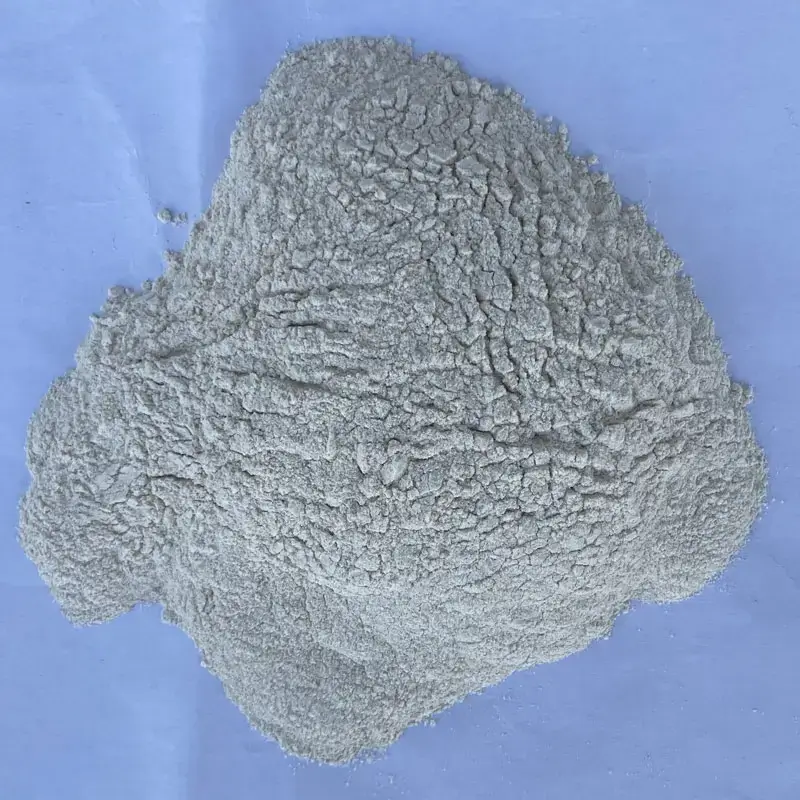
| Appearance | Free-flowing powder; color may vary by carrier (grey to off-white) |
| Mode of Action (Program Logic) | Multi-pathway biocontrol: competition/exclusion + antibiosis + induced resistance |
| Target Crops (Label-ready examples) | Chinese cabbage, ginger, citrus, tobacco, corn, peanut (custom claims by market/registration) |
| Target Diseases (Label-ready examples) | Clubroot, ginger wilt, citrus canker, tobacco anthracnose & wildfire, corn northern leaf blight, peanut southern blight (market-dependent claims) |
| Application Scenarios | Foliar, root-zone (drench/dip), seed treatment as per local label & regulations |
| Compatibility Notes | Avoid mixing with copper-based or antibiotic bactericides (e.g., streptomycin) unless local label allows |
| Shelf Life / Quality Guarantee | 24 months (typical quality guarantee) |
| Storage & Transport | Cool, dry, ventilated; keep sealed; away from heat/fire; keep locked; do not store/ship with food/feed |
| Documents & QA | COA (per batch viable count), MSDS, TDS, traceable batch control; OEM label & packaging support |
Bacillus subtilis (Agricultural Biofungicide)
Bacillus subtilis is a naturally occurring bacterium widely found in soil and the plant environment. In agriculture, selected strains are used as antagonistic microorganisms to help suppress disease pressure on leaves, stems, and root zones, especially when deployed preventively as part of an integrated program.
How It Works
A well-selected Bacillus subtilis strain typically supports crop health through a stacked mode-of-action model:
- Nutrient and space competition: establishes a protective microbial presence where pathogens would otherwise germinate or colonize.
- Colonization & attachment: adheres to plant surfaces and can interact directly with fungal/bacterial threats, reducing successful infection events.
- Antagonistic effects: many Bacillus-based biofungicides are described as producing antimicrobial metabolites and forming protective layers under high local density (strain-dependent).
Primary Crops & Diseases to Position for Bacillus subtilis (Agricultural Biofungicide)
Bacillus subtilis products are mainly positioned for preventive protection and early-stage suppression across foliar diseases (leaf/fruit infections) and soilborne/root-zone diseases (damping-off, root rots), especially under humid, high-pressure conditions.
Where it performs best (buyer-friendly mapping)
| Crop segment (what buyers grow) | High-intent diseases to highlight (what buyers search for) | Typical positioning |
|---|---|---|
| Fruiting vegetables (tomato, pepper, eggplant) | Bacterial spot / speck / canker, anthracnose, early blight, late blight, gray mold (Botrytis), powdery mildew, target spot | Foliar protection + early suppression; also supports root-zone health against common soil pathogens |
| Leafy vegetables & Brassica crops (cabbage, Chinese cabbage, leafy greens) | Bacterial blight/leaf spot, downy mildew, powdery mildew, white mold (Sclerotinia), anthracnose, white rust | Strong fit for routine preventive programs in leafy/brassica production |
| Cucurbits (cucumber, melon, squash) | Angular leaf spot, downy mildew, powdery mildew (and other common leaf diseases depending on local label) | Preventive foliar coverage; rotation-friendly in IPM |
| Grapes & berries | Downy mildew, powdery mildew, gray mold, black rot (crop-specific) | Seasonal preventive protection for high-value fruit crops |
| Potato & other field/row crops (where registered) | Scab, blight-type diseases, leaf spots (crop-specific) | Program partner for resistance management and residue-sensitive channels |
| Seedling/root-zone use cases (nursery, transplant, early growth) | Pythium, Rhizoctonia, Fusarium, Phytophthora, Verticillium (soilborne complex) | “Root-zone shield” positioning—supports establishment, reduces early losses |
Key Advantages of Bacillus subtilis Biofungicide (100 Billion CFU/g Powder)
This is a program-driven biofungicide, built to protect yield quality across repeated disease cycles—not a “one-spray rescue.” Bacillus subtilis is widely described as suppressing pathogens by competing for nutrients and growth sites, colonizing/attaching to plant surfaces, and interfering with pathogen establishment.
Multi-pathway performance that fits IPM and rotation strategies
You can position this product as a multi-mechanism biological that supports long-term program stability. Extension and regulatory references commonly describe Bacillus subtilis products as working via antibiotic/antimicrobial activity, inhibiting spore germination, interfering with pathogen attachment, and supporting induced systemic resistance (ISR) in practical crop programs.
Supply-chain friendly: spore-forming = more stable distribution
Bacillus subtilis forms a protective endospore, which is a major commercial advantage for export and multi-layer distribution (warehouse handling, temperature variation, longer shelf time). This is why Bacillus-based products are often considered easier to scale than many non-spore microbes.
High CFU positioning: stronger “value per kg” and spec-driven procurement
A 100B CFU/g spec supports premium positioning for professional channels, tenders, and distributor portfolios—especially when paired with batch COA and consistent viability. It also gives you more flexibility to match different market specs under one product line strategy.
Resistance-management language your buyers recognize
Many Bacillus-based biofungicides are positioned in resistance-management references under FRAC Group BM02, which helps buyers fit it into rotation planning with clear program logic.
Formulation Options You Can Commercialize
We can supply Bacillus subtilis as a high-count powder and support downstream formulation strategy depending on your channel:
- WP / WDG / WG: distributor-friendly, cost-efficient, and easy to scale
- Customized viable count: align CFU target with your registration, pricing, and positioning
- Private label packs: retail-ready or professional packs with multi-language labels
If you already have a target market (e.g., Middle East, Africa, Central Asia, South America), we can align packaging size, label layout, and documentation format to that market’s procurement workflow.
Program Positioning and Compatibility Notes
To protect viability and performance consistency, Bacillus-based products are typically positioned with basic compatibility rules:
- Avoid highly reactive or strongly antimicrobial tank-mix partners unless the local label explicitly allows it.
- In many labels, copper-containing products or antibiotic bactericides are listed as restricted or cautionary mix partners—this is a common procurement question, so it’s worth addressing clearly with “follow label guidance.”
This is a biological tool that performs best when applied proactively and rotated intelligently inside an IPM plan.
Quality Control and Documentation
For importers, distributors, and government tenders, the decision is often made on batch reliability + paperwork completeness:
- COA per batch: viable count, basic physical parameters, batch traceability
- MSDS / TDS: aligned to shipping and customs workflows
- Stability & storage guidance: practical handling notes for distributors
- OEM support: label design, regulatory file formatting, and packaging execution
POMAIS operates with batch-control logic: you get consistent supply, clear paperwork, and predictable lead times.
FAQs
Is Bacillus subtilis a fungicide or a fertilizer?
In agriculture, it is most commonly positioned as a microbial biofungicide / biocontrol agent. Some programs also market it as a plant-beneficial microbe depending on local regulatory category and claim scope.
What diseases does it target?
That depends on strain, formulation, and local registration. Regulatory dossiers for certain Bacillus subtilis strains describe activity against harmful fungi and some bacteria, mainly through competition, colonization, and direct interaction.
Will it replace chemical fungicides?
Most buyers use it to strengthen the program, not replace everything. The practical value is reducing disease momentum and improving rotation options in resistance-management strategies.
What makes “100 billion CFU/g” commercially useful?
Higher CFU supports flexible formulation and stronger positioning, especially when you need performance consistency across distribution layers and variable field conditions.
How should it be stored and shipped?
As a live microbial product, it should be stored in a way that protects viability. Your final storage statement should follow your real stability data and the market’s distribution reality.
Commercial Next Step
If you’re building a Bacillus subtilis line, send your target market and positioning requirements. We’ll reply with a quote-ready spec pack:
- CFU target and formulation direction (WP/WG/WDG)
- COA/MSDS/TDS templates
- OEM label + packaging options
- MOQ and lead time proposal