
Barnyardgrass Control in Rice: How to Choose Herbicides
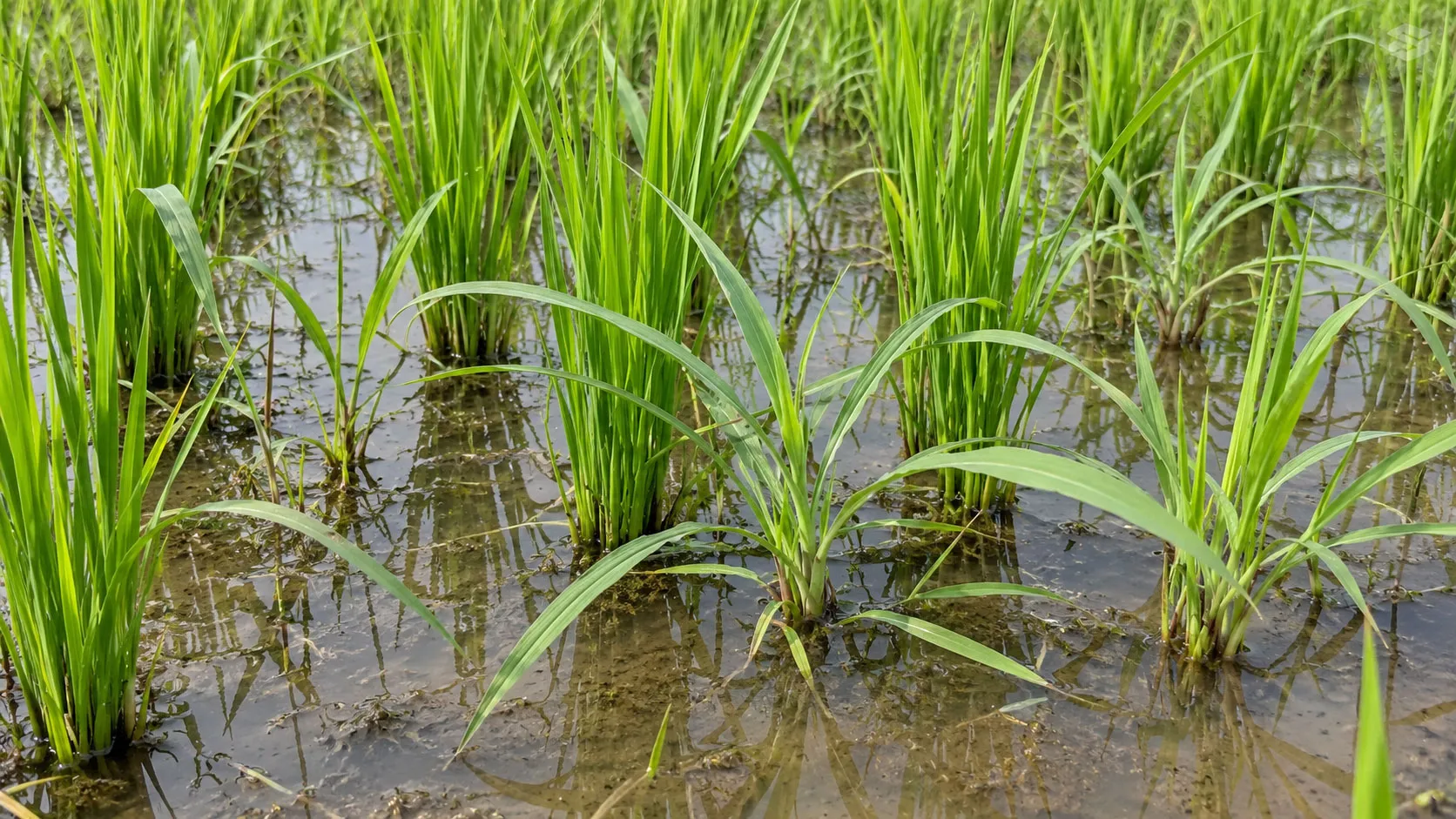
Barnyard grass is one of the grass weeds requiring priority management in rice production. During the early stages of rice growth, barnyard grass may emerge simultaneously with the rice plants, competing for light, nutrients and growing space. If barnyard grass density in the field is high and is not controlled in a timely manner, it may impair the normal growth of rice and increase the cost of subsequent weed management. Uncontrolled barnyard grass may also continue to set seed, increasing weed pressure in the field for the following season.
When selecting a herbicide for barnyard grass, one must not simply consider whether a particular active ingredient is effective against grass weeds. Factors that truly influence control efficacy include the species of barnyard grass, its growth stage, rice cultivation practices, field moisture conditions, crop safety, and local herbicide resistance patterns.
For example, the fact that a herbicide effectively controls barnyard grass in one region does not mean it will achieve the same results in all rice-growing areas. Differences in barnyard grass species, biotypes and local population resistance may all alter the actual control outcomes.
For pesticide importers, distributors and registration companies, understanding these factors also helps in determining the product positioning, target markets and conditions of use for different rice herbicides. POMAIS’s Рішення для захисту рисових культур page covers a broader range of rice crop protection topics, whilst this article focuses specifically on selecting herbicides for controlling barnyard grass.
What is barnyard grass? Why is it difficult to control in rice fields?
The term ‘barnyard grass’ usually refers to Ехінохлоа хруст-галлі, but other weeds of the Ехінохлоя genus may also be present in rice fields. These weeds may appear similar during the seedling stage, but different species or biotypes do not necessarily exhibit the same sensitivity to herbicides.
Therefore, control efforts should begin with accurate weed identification, rather than selecting a herbicide directly without first confirming the target weed.
How to identify barnyard grass in rice fields?
Barnyard grass belongs to the Poaceae family and can easily be confused with rice during the seedling stage. When identifying it in the field, one can observe leaf morphology, leaf sheath characteristics, plant growth habits and subsequent growth changes.
Barnyard grass typically lacks the ligule and auricles found on rice leaves; however, definitive identification should still be based on reliable botanical identification references, particularly when multiple Poaceae weeds are present in the field simultaneously.
It should be noted that multiple species of Ехінохлоя weeds may coexist in rice fields. If only the general term ‘barnyard grass’ is used without further identification of the specific species or biotype, the suitability of a particular herbicide may be overestimated.
For large-scale farming enterprises and agricultural technicians, accurately identifying the main weed species helps to reduce errors in herbicide selection and improves the targeted nature of subsequent control strategies.
Why do barnyard grass weeds affect rice yields?
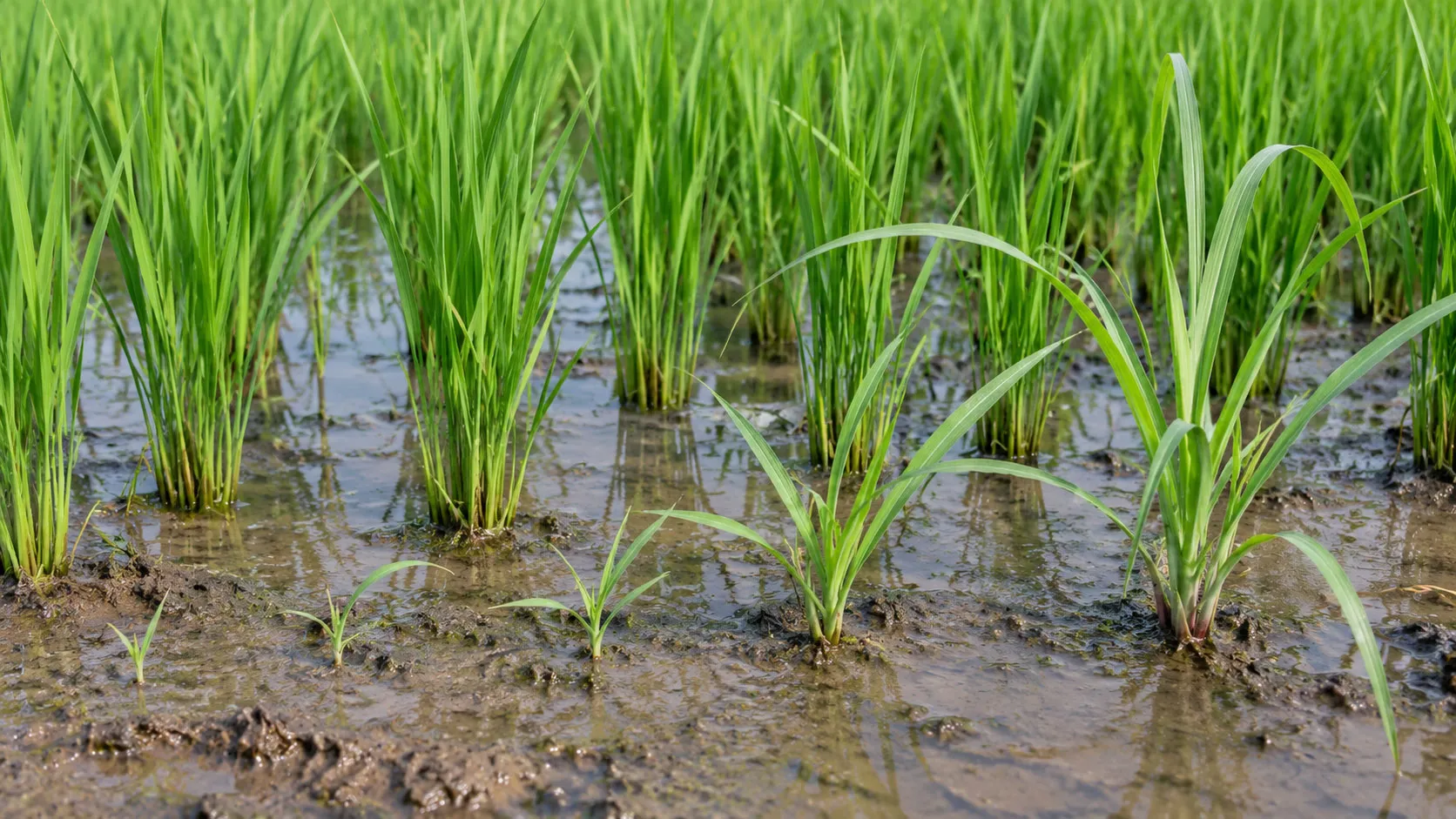
When barnyard grass grows alongside rice, it competes for light, water, nutrients and growing space. The density of the weeds, their emergence time and the duration of competition with the rice all influence the final crop loss.
If barnyard grass occurs in large numbers during the early establishment stage of the rice crop, the rice may face intense competition during critical growth stages.
Even if barnyard grass is controlled at a later stage, it may not be possible to fully compensate for the growth losses already incurred.
Furthermore, barnyard grass that has not been effectively controlled may produce seeds later in the season, which will enter the soil seed bank and increase weed pressure in the following season.
Therefore, barnyard grass control should not focus solely on short-term effects following herbicide application; it should also take into account early competition, residual weeds in the field and the risk of subsequent seed dispersal.
How do rice cultivation methods influence herbicide selection?
Weed occurrence patterns, crop growth stages and water management requirements vary across different rice cultivation methods. Consequently, herbicide programmes designed for one cultivation system cannot be directly applied to all rice fields.
Differences in herbicide selection between transplanted and direct-seeded rice
Transplanted rice may have a certain growth advantage after planting, but the specific timing of weed control still depends on the recovery of the rice, the growth stage of barnyard grass and the crop safety requirements of the product.
In direct-seeded rice, however, rice and barnyard grass may emerge simultaneously. As the early growth stages of both are similar, herbicides must not only be effective against the target weeds but also take into account their selectivity towards rice.
| Cultivation methods | Key factors to consider when selecting pesticides | Основні ризики |
|---|---|---|
| Пересаджений рис | Post-transplant recovery, timing of barnyard grass emergence and crop safety window | Applying the herbicide too early may affect the normal recovery of the rice |
| Dry-sown direct-drilled rice | Soil moisture, barnyard grass emergence and early-stage herbicide resistance in rice | Rice and barnyard grass emerge simultaneously, making herbicide selection more difficult |
| Water-sown direct-drilled rice | Sowing method, water level management, weed emergence patterns and product suitability | If moisture conditions do not meet requirements, control efficacy may be compromised |
| Intermittently irrigated rice | Soil moisture, irrigation schedules, weed emergence and application timing | Changes in field conditions may affect herbicide performance |
The above constitutes general guidance for herbicide selection and does not constitute standardised application procedures. Whether a specific product is suitable for a particular rice cultivation method should be determined by the product label approved in the target country.
Field Moisture Management and Crop Safety
Moisture conditions can affect the mode of action, field distribution and actual control performance of certain herbicides.
Some products act primarily through the soil and require appropriate soil moisture or irrigation conditions; others act primarily through weed foliage and may require application under specific water level conditions to ensure adequate weed exposure.
Before selecting a product, the following points should be confirmed:
- Whether the product is intended for soil treatment, foliar application, or has other specific application methods.
- Whether drainage is required prior to application and whether irrigation should be resumed after application.
- Whether the product imposes any restrictions on the growth stage of rice or root system development.
- Whether rainfall, irrigation or waterlogging in the field is likely to affect the performance of the herbicide.
- Whether the current growth stage of barnyard grass falls within the application window specified on the product label.
It is important to emphasise that moisture management requirements may vary significantly between different products. One should not assume that two herbicides have the same application conditions simply because they are both used in rice fields.
How should pre-emergence and post-emergence herbicides be selected?
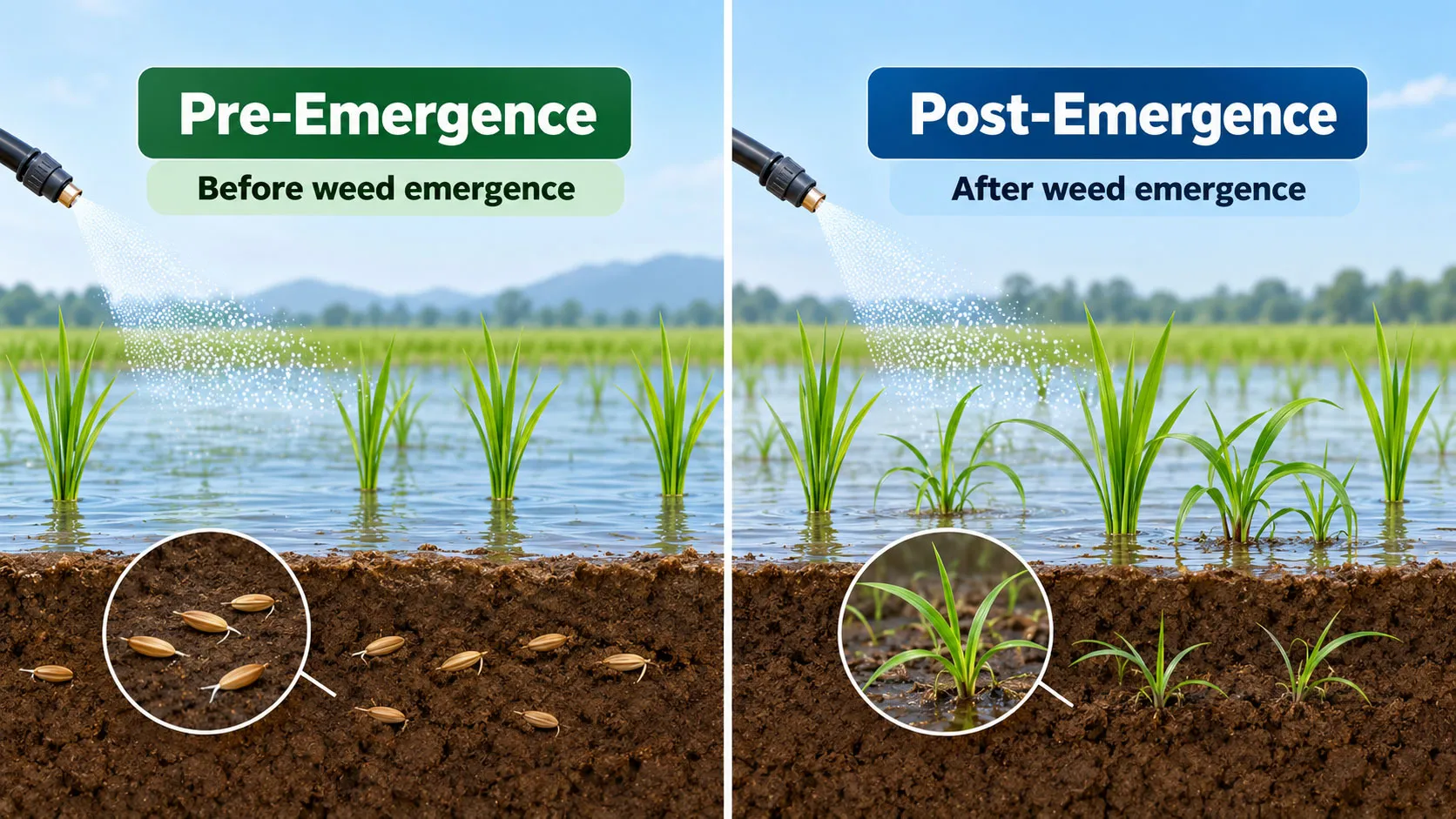
For barnyard grass, depending on product characteristics and field conditions, one may consider pre-emergence treatment, post-emergence treatment, or incorporate measures at different stages into a continuous weed management programme.
The choice of approach should depend on the timing of barnyard grass emergence, its current growth stage, the rice cultivation system, and the application methods permitted under local registration.
When should pre-emergence weed control be considered?
Pre-emergence treatment is typically applied before the target weeds emerge; the specific timing should be in accordance with the product label. Some pre-emergence herbicides act primarily through the soil, inhibiting weed germination or early seedling growth.
The main benefit of this approach is to minimise the opportunity for weeds to establish a population at the earliest possible stage, thereby reducing competition during the early growth of the rice crop.
However, the effectiveness of pre-emergence treatments is influenced by factors such as soil properties, soil moisture, field levelling, irrigation conditions and the emergence patterns of barnyard grass.
If new barnyard grass seedlings emerge after application, the original treatment may not fully control subsequent weeds. Therefore, pre-emergence treatment should not be interpreted as a single application that guarantees the complete absence of barnyard grass throughout the entire growing season.
When should post-emergence weed control be considered?
Post-emergence treatment targets weeds that have already emerged. Its effectiveness depends on the mode of action of the active ingredient, the growth stage of the barnyard grass, plant size, coverage of the application and environmental conditions.
For many post-emergence grass herbicides, weeds that are at a suitable growth stage and have not yet begun to tiller significantly are generally more easily controlled. However, the specific optimal application window should be determined in accordance with the product label and local technical guidance.
Prior to application, it is essential to confirm whether the barnyard grass has exceeded the growth stage recommended by the product and whether the rice crop is currently at a stage where application is permitted.
| Критерії порівняння | Досходова обробка | Post-emergence treatment |
|---|---|---|
| Основні цілі | To suppress the emergence or early establishment of target weeds, depending on product characteristics | To control target weeds that have already emerged |
| Main application timing | Apply before target weeds emerge or within the corresponding early window, as specified by the product | Apply at suitable weed and crop growth stages, as specified by the product |
| Key field conditions | Soil moisture, water management, uniformity of application | Weed size, leaf exposure, spray coverage and growth stage |
| Ключові обмеження | Weeds emerging later may evade the initial treatment | Control efficacy may be reduced if barnyard grass is too large or has developed resistance |
| Key considerations for product selection | Soil application conditions, residual efficacy requirements and safety for rice | Sensitivity of target weeds, leaf stage and suitable application window |
Some products may possess both soil and foliar activity; however, one should not infer from the terms ‘pre-emergence’ or ‘post-emergence’ that all products have the same mode of action.
Which active ingredients in herbicides warrant priority assessment?
When selecting herbicides for barnyard grass, no single active ingredient can guarantee optimal results across all countries, all barnyard grass populations and all rice cultivation systems.
A more sensible approach is to compare active ingredients, HRAC groups, application windows, crop safety and local registration scope, and then make a judgement based on field conditions.
Comparison of Common Active Ingredients in Rice Herbicides
| Активний інгредієнт | Група HRAC | Ключові критерії оцінки | Points to Verify When Selecting a Herbicide |
|---|---|---|---|
| Претилахлор | Група 15 | Early weed management in rice fields | Cultivation methods, moisture conditions, crop safety and local registration |
| Бутахлор | Група 15 | Early weed management in rice fields | Application timing, target weed spectrum and product label |
| Цигалофоп-бутил | Група 1 | Post-emergence control of grass weeds | Growth stages of barnyard grass, local susceptibility and history of resistance |
| Fenoxaprop-ethyl | Група 1 | Post-emergence control of grass weeds in selected rice systems | Rice selectivity, formulation and scope of registration |
| Пеноксулам | Група 2 | Weed control strategies for selected rice fields | Local weed sensitivity and Group 2 resistance |
| Квінклорак | Група 4 | Control strategies for specific susceptible weeds | Specific species, local registrations and resistance status |
| Пропаніл | Група 5 | Post-emergence contact herbicide application | Weed size, leaf cover, application conditions and resistance risk |
The HRAC groupings in the table are used to illustrate the classification of active ingredients by mode of action and do not represent a ranking of control efficacy. When formally developing a management plan, the latest HRAC classification data and product labels in the target country should be verified.
Different active ingredients within the same mode of action group should not automatically be regarded as an effective resistance rotation strategy; nor is it necessarily the case that there is no cross-resistance between different mode of action groups.
Why is it essential to verify product registration and crop safety?
The fact that an active ingredient possesses a certain herbicidal activity does not mean that all formulations containing that ingredient can be used in rice fields.
Different products may have varying active ingredient concentrations, formulation types, label requirements and registered uses. Even where the active ingredient is the same, it cannot be assumed without evidence that their application windows and crop safety profiles are identical.
When evaluating products, buyers should focus on verifying the following:
- The name and concentration of the active ingredient.
- The formulation type and relevant product specifications.
- Whether the target country has approved the product for use on rice and the relevant weeds.
- Permitted application periods, number of applications and application methods.
- Restrictions regarding rice growth stages and water management.
- Whether there are any issues with herbicide resistance in the local area.
For example, POMAIS provides Propanil 360 g/L and 480 g/L EC Herbicide product information. Propanil belongs to HRAC Group 5 and is a contact post-emergence herbicide. Whether a specific formulation can be used for barnyard grass control in the target market still needs to be assessed in light of local registration status, weed sensitivity and actual application conditions.
For importers and registration companies, what is truly valuable is not merely confirming the existence of a product, but verifying whether the product specifications, technical documentation and registration requirements are compatible with the target market.
Why does herbicide resistance affect the efficacy of barnyard grass control?
Herbicide resistance is a significant risk in the management of barnyard grass in rice fields. The long-term, repeated use of herbicides with the same mode of action may exert sustained selective pressure on weed populations, leading to a gradual increase in plants with resistance traits and resulting in a decline in the efficacy of previously effective control strategies.
In some rice-growing regions, barnyard grass and related Ехінохлоя weed populations have already developed resistance to multiple herbicide modes of action. However, resistance exhibits regional variations, population-specific differences and temporal changes; therefore, resistance records from one region cannot be directly applied to all markets.
What are the risks of continuous use of the same HRAC group?
If herbicides from the same mode-of-action group are used continuously, this may lead to the ongoing selection of weed individuals that are insensitive to that mode of action.
A change in trade name does not imply a change in the mode of action.
For example, cyhalofop-butyl and fenoxaprop-ethyl both belong to HRAC Group 1. Simply alternating between the two cannot automatically be regarded as an effective rotation across action mechanisms.
Therefore, managers should record the active ingredient and HRAC group for each application and make decisions on future choices based on local resistance information.
Does poor weed control by a herbicide necessarily mean that resistance has developed?
Не обов'язково.
Failure to effectively control barnyard grass may be related to the following factors:
- Incorrect identification of the weed species.
- The barnyard grass had already passed the optimal growth stage at the time of application.
- Field moisture conditions did not meet the product’s requirements.
- Uneven spray coverage.
- Weather conditions affected the performance of the herbicide.
- Issues during product storage, preparation or application.
- The weed population’s sensitivity to the relevant active ingredients has decreased.
If barnyard grass persists despite correct product use, one should examine its distribution in the field, application records, the growth stage of the weeds and local resistance information before determining whether further resistance investigations are required.
In the absence of clear evidence, not all cases of treatment failure should be directly attributed to resistance, nor should the problem be addressed simply by increasing the frequency of applications.
How can the risk of resistance be reduced through rotation of modes of action?
The core of resistance management is not the mechanical replacement of products, but the rational planning of control measures that remain effective and comply with local registration requirements.
When formulating a plan, the following should be considered:
- Which active ingredients and HRAC groups were used in the previous treatment phase.
- Whether the current barnyard grass population remains susceptible to the alternative herbicides.
- Whether the alternative products are registered for use in the relevant rice cultivation systems and against the target weeds.
- Whether subsequent treatments are compatible with the rice growth stage and water management requirements.
- Whether weed survival and seed production can be reduced through field management.
Even if two herbicides belong to different HRAC groups, it cannot automatically be assumed that there is no cross-resistance between them. For mixed-formulation products, the actual contribution of each active ingredient to the control of target weeds must also be assessed.
Apart from herbicides, what other measures can improve barnyard grass management?
Barnyard grass management should not rely solely on chemical control. Combining herbicide application with field management helps to reduce weed survival, minimise the risk of seed dispersal, and enhance the sustainability of subsequent control efforts.
Timely treatment of surviving barnyard grass to reduce seed dispersal
Following application, the field should be inspected for any uncontrolled barnyard grass.
If surviving plants continue to grow and produce seeds, this may increase the number of weed seeds in the soil, making control more difficult in the following season.
Therefore, where conditions permit and in accordance with local agricultural management requirements, escape weeds should be identified and treated promptly to prevent them from continuing to set seed.
When moving agricultural machinery between different fields, attention should also be paid to the risk of weed seed dispersal. Cleaning equipment, using clean seed, and managing weeds along field margins and near irrigation channels can all form part of an integrated weed management programme.
Combined with land preparation, irrigation and crop rotation management
The quality of land preparation, field levelling, water management, crop rotation and early weed monitoring can all influence the occurrence of barnyard grass and the effectiveness of control measures.
However, the applicability of these measures depends on the specific rice production system. For example, waterlogging may suppress certain weeds but may not effectively control all species of barnyard grass.
Under suitable production conditions, crop rotation can alter the environment in which weeds thrive and help reduce long-term reliance on a single herbicide mode of action.
These measures should be combined with a sound herbicide programme and should not be regarded as a universal method capable of completely replacing chemical control.
For a broader understanding of the principles governing the management of grass weeds, sedges and resistant weeds, please refer to the POMAIS Рішення для боротьби з бур'янами на сільськогосподарських культурах стр.
What are the most common mistakes when selecting herbicides for barnyard grass in rice?
| загальні помилки | Потенційні проблеми | More sensible approaches |
|---|---|---|
| Selecting a herbicide without first identifying the weed species | Different species or biotypes may have varying levels of susceptibility | Identify the main weeds first, then assess the suitability of the herbicide |
| Занадто пізнє застосування гербіциду | The barnyard grass has already passed the product’s recommended control stage | Determine the application window based on weed leaf stage and product label |
| Replacing only the brand name without verifying the HRAC group | May continue to exert the same resistance selection pressure | Record pesticide use by active ingredient and mode of action |
| Assuming that mixed-formulation products will inevitably solve the resistance problem | One of the ingredients may already have lost its efficacy | Assess the actual control efficacy of each active ingredient separately |
| Neglecting water management | May affect product performance or crop safety | Follow product-specific water management requirements |
| Attributing all control failures to resistance | May overlook application conditions or weed identification issues | Systematically investigate the causes of failure |
| Failure to treat surviving barnyard grass after application | Weeds may continue to set seed and increase the seed bank | Monitor and manage surviving plants promptly |
For pesticide importers and distributors, product evaluation should not be limited to comparing active ingredient concentrations and purchase prices; it should also take into account practical applicability, local registration requirements and long-term weed management needs.
Frequently asked questions regarding barnyard grass control in rice
Which herbicide should be chosen for barnyard grass in rice fields?
No single herbicide is suitable for all rice fields.
When making a selection, factors such as the species of barnyard grass, its growth stage, rice cultivation practices, local resistance profiles, crop safety and the scope of product registration should be taken into account.
Should barnyard grass be controlled pre-emergence or post-emergence?
Both approaches may form part of a rice weed management programme. Pre-emergence treatment is primarily used to reduce early weed establishment, whilst post-emergence treatment targets weeds that have already emerged.
The specific choice depends on field conditions, product characteristics and local label requirements.
Why do barnyard grasses still survive after application?
Possible causes include resistance, incorrect weed identification, late application, unsuitable moisture conditions or inadequate spray coverage. These factors should be checked first before deciding whether to adjust the active ingredient or conduct a resistance survey.
Can different herbicides be mixed together?
Whether mixing is possible requires verification of product labels, mixing compatibility, crop safety and the actual control targets. Even if different active ingredients can be mixed, it cannot automatically be assumed that they will resolve resistance issues.
How can the risk of barnyard grass developing resistance to herbicides be reduced?
Active ingredients and HRAC groups should be selected judiciously based on local resistance data, avoiding unnecessary repetition of the same mode of action. This should be combined with field monitoring, crop rotation and the management of residual weeds to minimise the opportunity for resistant populations to continue to increase.
Establishing a more reliable rice barnyard grass control programme
Effective barnyard grass management begins with accurate identification of the weed and an understanding of the relationship between barnyard grass and the rice cultivation system.
Before selecting a herbicide, the species and growth stage of barnyard grass should be assessed, and the rice cultivation practices, water management requirements, crop safety window and local resistance situation should be confirmed. Following application, field efficacy should be checked and surviving weeds investigated, rather than repeating the use of the same product without identifying the cause.
Pesticide importers, distributors and registration companies should also take into account the active ingredient, concentration, formulation, registered uses, technical documentation and target market demand when evaluating rice herbicides.
If you are evaluating barnyard grass herbicides for a specific rice market, it is advisable to first identify the target weeds, cultivation systems and registration requirements of the target country, before further verifying product specifications and supply conditions. This approach is more conducive to developing a product selection plan that meets actual needs than simply adopting a generic list of recommended active ingredients.
Гарячі продукти
Гарячі новини
Рекомендовані новини