---
description: Yes. Spinosad can kill susceptible thrips when it is used in a registered agricultural insecticide formulation.
It belongs to the spinosyn insecticide class and is classified as IRAC Group 5. Spinosad disrupts insect nerve signaling by allosterically modulating nicotinic acetylcholine receptors. This causes nervous-system hyperexcitation, loss of normal movement, paralysis, and death.
Feeding
title: Does Spinosad Kill Thrips? - POMAIS Agriculture
image: https://www.pomais.com/wp-content/uploads/2024/08/spinosad8.jpg
---


[Skip to content](#content) 

16+ years professional one-stop agricultural plant protection solution provider

[](https://www.pomais.com/)

[Inquiry](#awb-oc%5F%5F10593)

Does Spinosad Kill Thrips?

Last Updated: July 21st, 20262620 words13.1 min read

# Does Spinosad Kill Thrips?

[Table Of Contents](#c18fabf1a969fc936)

* [Quick Answer: Can Spinosad Kill Thrips?](#toc%5FQuick%5FAnswer%5FCan%5FSpinosad%5FKill%5FThrips)
* [What Is Spinosad?](#toc%5FWhat%5FIs%5FSpinosad)
* [How Does Spinosad Kill Thrips?](#toc%5FHow%5FDoes%5FSpinosad%5FKill%5FThrips)
* [Which Thrips Life Stages Does Spinosad Affect?](#toc%5FWhich%5FThrips%5FLife%5FStages%5FDoes%5FSpinosad%5FAffect)
* [Why Spray Coverage Matters](#toc%5FWhy%5FSpray%5FCoverage%5FMatters)
* [Why Application Timing Matters](#toc%5FWhy%5FApplication%5FTiming%5FMatters)
* [Why Spinosad May Not Control Thrips](#toc%5FWhy%5FSpinosad%5FMay%5FNot%5FControl%5FThrips)
* [Spinosad Resistance in Thrips](#toc%5FSpinosad%5FResistance%5Fin%5FThrips)
* [Is Spinosad Effective Against Every Thrips Species?](#toc%5FIs%5FSpinosad%5FEffective%5FAgainst%5FEvery%5FThrips%5FSpecies)
* [Is Spinosad Systemic?](#toc%5FIs%5FSpinosad%5FSystemic)
* [Is Spinosad Enough for Complete Thrips Control?](#toc%5FIs%5FSpinosad%5FEnough%5Ffor%5FComplete%5FThrips%5FControl)
* [What Buyers Should Check in a Spinosad Product for Thrips](#toc%5FWhat%5FBuyers%5FShould%5FCheck%5Fin%5Fa%5FSpinosad%5FProduct)
* [Common Misunderstandings](#toc%5FCommon%5FMisunderstandings)
* [FAQ](#toc%5FFAQ)
* [Practical Summary](#toc%5FPractical%5FSummary)

Yes. [Spinosad](https://www.pomais.com/product/spinosad/) can kill susceptible thrips when it is used in a registered agricultural insecticide formulation.

It belongs to the spinosyn insecticide class and is classified as **IRAC Group 5**. Spinosad disrupts insect nerve signaling by allosterically modulating nicotinic acetylcholine receptors. This causes nervous-system hyperexcitation, loss of normal movement, paralysis, and death.

Feeding larvae and exposed adults are the most relevant direct targets. However, thrips are difficult to manage because they often hide inside flowers, buds, growing points, folded leaves, and other protected plant tissues.

Their eggs may be inserted into plant tissue, while prepupae and pupae may remain in soil, growing media, leaf litter, or plant crevices.

The practical answer is:

**Spinosad can control susceptible thrips, but field performance depends on life-stage exposure, spray coverage, application timing, species susceptibility, resistance status, and the use of a properly registered product.**

## Quick Answer: Can Spinosad Kill Thrips?

Registered spinosad insecticides can control or suppress susceptible thrips on approved crops.

Spinosad acts through contact and ingestion. Thrips become exposed when they contact treated surfaces or feed on treated plant tissue. The active ingredient then affects their nervous system.

Young feeding larvae are important treatment targets because they are actively feeding and may be more exposed than eggs or protected pupal stages. Exposed adults can also be affected, although adult movement and reinfestation may complicate field assessment.

| Question                      | Practical Answer                                              |
| ----------------------------- | ------------------------------------------------------------- |
| Does spinosad kill thrips?    | Yes, susceptible thrips can be controlled                     |
| Product category              | Agricultural foliar insecticide                               |
| Chemical class                | Spinosyn                                                      |
| IRAC group                    | Group 5                                                       |
| Mode of action                | nAChR allosteric modulation                                   |
| Main exposed stages           | Feeding larvae and exposed adults                             |
| Less directly exposed stages  | Eggs and protected prepupae or pupae                          |
| Main activity route           | Contact and ingestion                                         |
| Conventional systemic product | No                                                            |
| Main field limitations        | Hidden feeding sites, coverage, reinfestation, and resistance |

Spinosad is a legitimate thrips-control active ingredient, but it should not be presented as a product that automatically kills every thrips stage under every field condition.

## What Is Spinosad?

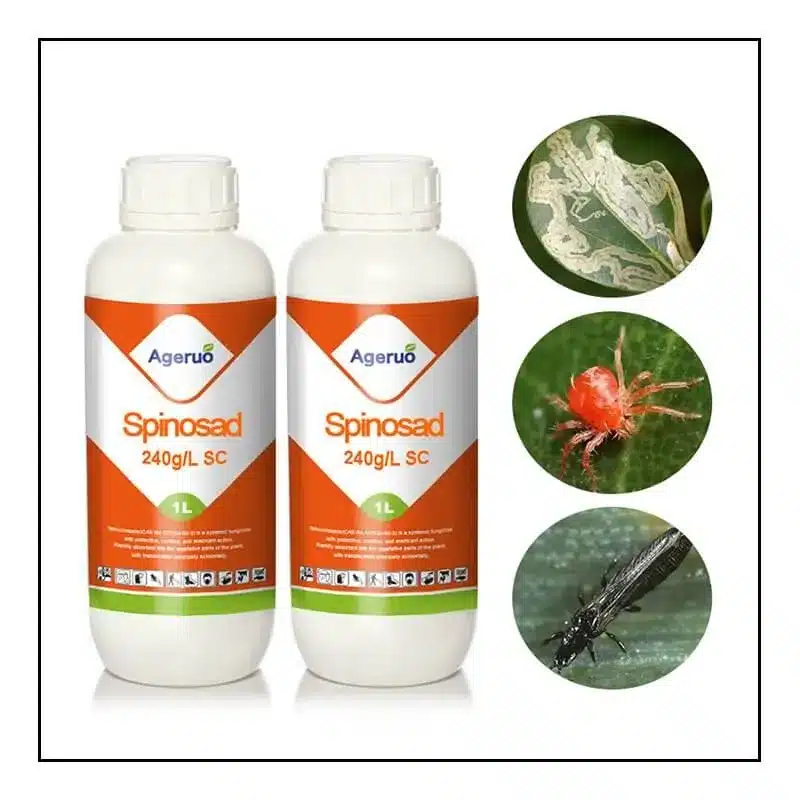
[Spinosad](https://www.pomais.com/product/spinosad/) is a biologically derived insecticidal active ingredient.

It consists mainly of two related compounds:

* Spinosyn A
* Spinosyn D

These compounds originate from fermentation associated with the soil microorganism _Saccharopolyspora spinosa_.

Spinosad is used against a range of agricultural and public-health pests. Thrips are among the pests listed for registered spinosad products, although the exact crop, species, claim, rate, and application method depend on the individual product label.

Its natural origin does not mean it can be used without restrictions. Spinosad remains a regulated insecticide, and its performance and safety depend on the formulation, approved use, application quality, and resistance-management program.

[](https://www.pomais.com/product/spinosad/)

## How Does Spinosad Kill Thrips?

Spinosad kills susceptible thrips by disrupting their nervous system.

IRAC classifies spinosad as:

**Group 5 — Nicotinic acetylcholine receptor allosteric modulators, Site 1**

This mode of action is different from pyrethroids, organophosphates, carbamates, neonicotinoids, avermectins, and insect growth regulators.

### Nicotinic Acetylcholine Receptor Modulation

Nicotinic acetylcholine receptors help transmit signals through the insect nervous system.

Spinosad interacts with an allosteric site associated with these receptors. This changes normal receptor activity and overstimulates nerve signaling.

The mechanism can be summarized as:

**Spinosad exposure → Group 5 receptor modulation → nervous-system hyperexcitation → paralysis → thrips death**

### Contact and Ingestion Activity

Thrips may become exposed by contacting treated plant surfaces or ingesting residues while feeding.

This means spinosad does not need to act only through direct spray impact. However, the target insect must still encounter biologically active residues.

Spray placement remains important because many thrips feed in protected plant structures.

### Feeding Disruption

After exposure, normal movement and feeding are disrupted.

A thrips population may not disappear immediately from visual inspection, but affected insects may stop feeding before mortality is complete.

Field evaluation should therefore consider both live insect counts and the development of new crop damage.

## Which Thrips Life Stages Does Spinosad Affect?

Thrips develop through several distinct stages:

1. Egg
2. First-instar larva
3. Second-instar larva
4. Prepupa
5. Pupa
6. Adult

The first two larval stages and adults feed. Prepupae and pupae do not feed. Many pest thrips place their eggs inside plant tissue, while pupation may occur in soil, growing media, leaf litter, or protected plant structures.

### Feeding Larvae

Feeding larvae are important direct targets of foliar spinosad treatments.

They actively consume plant tissue and are likely to ingest residues when coverage reaches their feeding areas.

Early larval stages may also be easier to manage before the population becomes concentrated in flowers, buds, fruit structures, or a dense crop canopy.

The correct positioning is:

**Spinosad can be highly relevant against feeding thrips larvae, but the result still depends on exposure and susceptibility.**

### Adult Thrips

Exposed adult thrips can also be controlled.

However, adults are mobile and may move between plants or enter the crop from surrounding vegetation. They often hide inside flowers, growing points, or plant crevices.

This creates two practical difficulties:

* Some adults may avoid direct exposure.
* New adults may migrate into the crop after treatment.

Finding adults after application does not automatically prove that the exposed population survived.

### Thrips Eggs

Direct control of all thrips eggs should not be assumed.

Many economically important thrips insert eggs into leaves, flowers, buds, or other plant tissue. The plant tissue can limit direct contact between the egg and a foliar spray.

Eggs already present at application may continue to hatch.

This is one reason new larvae may appear after treatment.

### Prepupae and Pupae

Prepupae and pupae are non-feeding stages.

Depending on the species, they may remain in soil, growing media, leaf litter, plant crevices, or other protected locations. A standard foliar treatment may provide limited direct exposure to these stages.

They may later develop into adults and make the population appear to return.

## Why Spray Coverage Matters

Thrips are difficult to control because they rarely remain on open, easy-to-reach leaf surfaces.

They commonly feed or shelter in:

* Flowers
* Flower buds
* Growing points
* Leaf folds
* Leaf undersides
* Plant crevices
* Developing fruit
* Dense inner canopies

Many pest thrips feed while hidden in buds, shoot tips, flowers, or beneath plant structures. In some cases, crop damage becomes visible before the insects themselves are found.

### Hidden Feeding Sites

A spray that covers only the outer canopy may miss thrips inside flowers, buds, or folded tissue.

The application must place residues where feeding larvae and adults are active.

### Crop Canopy Density

Dense vegetation can prevent spray droplets from reaching inner leaves, flowers, and growing points.

Application equipment, water volume, travel speed, nozzle selection, and canopy penetration should match the crop and product label.

### Droplet Placement

More spray is not automatically better.

The objective is suitable coverage of the target plant structures without exceeding the registered rate or creating unnecessary runoff.

### Adjuvant Decisions

Some product labels may permit or recommend a suitable adjuvant to improve spreading or coverage.

This should not be generalized to every spinosad product or crop. Adjuvant selection must follow the specific label and crop-safety requirements.

## Why Application Timing Matters

Spinosad usually performs best when treatment decisions are based on monitoring rather than waiting for severe visible damage.

### Treat Before Populations Build Up

Thrips can reproduce quickly under favorable conditions.

Once large populations become established inside flowers, buds, or a dense canopy, uniform exposure becomes more difficult.

Early intervention may improve the opportunity to reach feeding larvae before extensive crop damage occurs.

### Target Active Feeding Stages

Eggs hidden inside plant tissue and non-feeding pupal stages are harder to reach with a foliar treatment.

Applications directed at exposed feeding stages have a stronger biological basis.

### Monitor New Migration

Adult thrips can move into a treated crop from weeds, neighboring fields, discarded crop material, or surrounding vegetation.

Post-treatment scouting should distinguish between surviving insects and new immigration.

## Why Spinosad May Not Control Thrips

Several factors can reduce field performance.

### The Thrips Were Not Identified Correctly

Different thrips species and populations may have different susceptibility, behavior, feeding locations, and resistance histories.

Correct identification matters before product selection.

### Spray Coverage Was Incomplete

Thrips hidden in flowers, buds, growing points, or the inner canopy may receive insufficient exposure.

### Eggs Continued to Hatch

Eggs protected inside plant tissue may produce new larvae after the original application.

### Pupae Continued to Produce Adults

Protected prepupae and pupae may complete development after foliar treatment.

### Adults Reinfested the Crop

New adults may move into the crop from surrounding host plants.

### The Product Did Not Match the Label

A spinosad product registered for one crop or pest cannot automatically be used for another.

The label must cover the crop, target pest, application method, interval, and local use conditions.

### Resistance Reduced Susceptibility

Resistance is one of the most important explanations for declining spinosad performance against thrips.

## Spinosad Resistance in Thrips

Spinosad has been used extensively against western flower thrips, _Frankliniella occidentalis_.

Field and laboratory research has documented populations with reduced susceptibility or high resistance to spinosad. In one field-population study, resistance ratios varied substantially, with some populations showing moderate or high resistance.

Resistance does not mean spinosad has no value. It means the active ingredient must be used as part of a disciplined resistance-management program.

### Do Not Use Group 5 Continuously

Repeated exposure to the same mode of action increases selection pressure.

Successive pest generations should not be treated continuously with the same IRAC group.

### Spinosad and Spinetoram Share Group 5

Spinosad and spinetoram are both Group 5 spinosyn insecticides.

Changing from spinosad to spinetoram is therefore not a true mode-of-action rotation.

The product name changes, but the IRAC group remains the same.

### Rotate by Mode of Action

A resistance program should use locally registered alternatives from genuinely different IRAC groups.

The rotation should be based on pest generation, crop stage, local registration, and resistance history—not only on changing brands.

### Investigate Unexpected Failure

Poor results do not automatically prove resistance.

Before reaching that conclusion, check:

* Thrips identification
* Application timing
* Spray coverage
* Water quality
* Product storage
* Mixing accuracy
* Reinfestation
* Weather after application
* Label compliance
* Local resistance data

## Is Spinosad Effective Against Every Thrips Species?

Spinosad can be effective against several economically important thrips, but no single result should be applied to every species and population.

Relevant pest species may include:

* Western flower thrips
* Onion thrips
* Tobacco thrips
* Chilli thrips
* Other flower- or crop-feeding thrips

Susceptibility can vary by:

* Species
* Production region
* Crop
* Previous insecticide exposure
* Resistance status
* Greenhouse or open-field environment

The commercial product claim must remain consistent with the approved label.

A distributor should not expand a general “thrips” claim to every species, crop, or country without registration support.

## Is Spinosad Systemic?

Spinosad should not be positioned as a conventional systemic insecticide.

Its thrips-control value mainly depends on foliar contact, ingestion, and suitable residue placement. It should not be described as moving extensively through the plant vascular system and reaching every hidden insect automatically.

The practical implication is:

**Spray coverage remains important.**

This distinction prevents buyers and users from expecting the product to control every thrips hidden inside flowers, buds, or untreated plant tissue.

## Is Spinosad Enough for Complete Thrips Control?

Spinosad can be an effective part of a thrips-management program, but it should not be presented as a complete stand-alone solution.

A stronger program combines:

* Correct thrips identification
* Regular crop scouting
* Flower, bud, or leaf inspection
* Sticky-card monitoring where appropriate
* Early population detection
* Weed and alternate-host management
* Removal of heavily infested plant material where practical
* Suitable biological-control measures
* Accurate spray coverage
* Rotation among different IRAC groups
* Post-treatment evaluation

The objective is not to apply more insecticide. It is to target the correct pest stage with the correct tool while reducing resistance pressure.

## What Buyers Should Check in a Spinosad Product for Thrips

For importers, distributors, registration companies, and agricultural retailers, the active ingredient name is only the starting point.

### Active Ingredient Identity

Confirm that the product contains spinosad rather than spinetoram or another insecticide.

Spinosad and spinetoram are related, but they are separate active ingredients and require correct documentation.

### Formulation Type

The formulation must fit the target market, crop system, registration, spray equipment, and storage conditions.

Potential agricultural formulations should only be discussed when supported by the actual product portfolio and registration pathway.

### Thrips and Crop Claims

The label should clearly support thrips control or suppression on the intended crop.

A thrips claim on one crop cannot automatically be transferred to vegetables, fruit, flowers, ornamentals, or greenhouse crops generally.

### IRAC Group Identification

Technical literature and labels should clearly identify spinosad as Group 5.

This supports resistance-management communication and avoids false rotation claims.

### Coverage Requirements

The product information should explain that hidden feeding sites can limit exposure.

Distributors need realistic performance guidance rather than a universal kill claim.

### Resistance Positioning

A professional market plan should explain:

* Group 5 rotation limits
* The shared group of spinosad and spinetoram
* The need for locally registered alternatives
* The value of post-treatment monitoring

### Pollinator and Environmental Precautions

Registered spinosad labels may include restrictions or warnings related to bees and aquatic invertebrates.

Applications during bloom, pollinator exposure, water contamination, drift, and product disposal must follow the local label.

Biological origin does not remove these environmental responsibilities.

### Technical Documentation

Professional buyers should verify:

* Registration certificate
* Approved label
* COA
* MSDS
* TDS
* Active ingredient specification
* Formulation specification
* Stability data
* Efficacy data
* Packaging specification
* Storage conditions

## Common Misunderstandings

### Spinosad Kills Every Thrips Stage Equally

No.

Feeding larvae and exposed adults are more likely to encounter a foliar treatment than eggs embedded in tissue or protected pupal stages.

### One Application Removes the Entire Population

Not necessarily.

Egg hatch, pupal emergence, and adult migration can cause thrips to reappear.

### Spinosad Is Fully Systemic

This is not an appropriate general claim.

Coverage and residue placement remain important.

### Spinosad and Spinetoram Are Different Rotation Groups

No.

Both belong to IRAC Group 5.

### Natural Origin Prevents Resistance

No.

Spinosad resistance in western flower thrips has been documented.

### Every Spinosad Product Can Be Used on Every Crop

No.

The crop, thrips claim, application method, rate, interval, and restrictions must appear on the local product label.

## FAQ

### Does spinosad kill thrips?

Yes. Registered agricultural spinosad products can control or suppress susceptible thrips on approved crops.

### How does spinosad kill thrips?

Spinosad allosterically modulates insect nicotinic acetylcholine receptors. This causes nervous-system hyperexcitation, paralysis, and death.

### What IRAC group is spinosad?

Spinosad belongs to IRAC Group 5.

### Does spinosad kill adult thrips?

Exposed adult thrips may be controlled, but performance depends on coverage, species susceptibility, resistance, and reinfestation.

### Does spinosad kill thrips larvae?

Yes. Feeding larvae are important direct targets because they can contact or ingest residues on treated plant tissue.

### Does spinosad kill thrips eggs?

Direct control of all eggs should not be assumed. Many thrips insert eggs into plant tissue, which limits direct foliar exposure.

### Does spinosad kill thrips pupae?

Protected, non-feeding prepupae and pupae may receive limited exposure from a standard foliar application.

### Why are thrips still present after spraying spinosad?

Possible causes include hidden eggs, protected pupae, incomplete coverage, adult migration, incorrect identification, or resistance.

### Is spinosad systemic?

It should not be positioned as a conventional systemic insecticide. Foliar contact, ingestion, and effective coverage remain important.

### Can spinosad and spinetoram be rotated?

They should not be treated as different mode-of-action rotations because both belong to IRAC Group 5.

## Practical Summary

Spinosad can kill susceptible thrips when used through a registered agricultural insecticide formulation.

It belongs to **IRAC Group 5** and disrupts insect nerve signaling through nicotinic acetylcholine receptor allosteric modulation. Feeding larvae and exposed adults are the most relevant direct targets.

However, successful thrips control depends on more than active ingredient selection.

Eggs may remain protected inside plant tissue. Prepupae and pupae may occur in soil or hidden locations. Adults may shelter inside flowers and growing points or reinfest the crop from surrounding vegetation.

The final decision should consider:

* Thrips species
* Life stage
* Spray coverage
* Application timing
* Crop canopy
* Resistance status
* Local registration
* Formulation quality
* IRAC rotation
* Post-treatment monitoring

The core conclusion is:

**Spinosad can control susceptible thrips, but reliable field performance requires early targeting of exposed feeding stages, thorough coverage, correct registration, and disciplined resistance management.**

Share to:

Hot Products

* [Fluroxypyr Herbicide](https://www.pomais.com/product/fluroxypyr-herbicide/)
* [Isoxadifen-ethyl 200 g/L + Tembotrione 400 g/L SC](https://www.pomais.com/product/isoxadifen-ethyl-200-g-l-tembotrione-400-g-l-sc/)
* [Oxaziclomefone 30% SC](https://www.pomais.com/product/oxaziclomefone-30-sc/)
* [Difenoconazole 25 g/L + Thiamethoxam 262.5 g/L + Fludioxonil 25 g/L FS Seed Treatment](https://www.pomais.com/product/difenoconazole-25-g-l-thiamethoxam-262-5-g-l-fludioxonil-25-g-l-fs/)
* [Prohexadione-Calcium Plant Growth Regulator](https://www.pomais.com/product/prohexadione-calcium-plant-growth-regulator/)
* [Mesosulfuron-Methyl 10 g/L + Iodosulfuron-Methyl Sodium 2 g/L + Mefenpyr-Diethyl 30 g/L OD](https://www.pomais.com/product/mesosulfuron-methyl-10-g-l-iodosulfuron-methyl-sodium-2-g-l-mefenpyr-diethyl-30-g-l-od/)
* [Azadirachtin Insecticide 0.3% EC, 1% ME Featured](https://www.pomais.com/product/azadirachtin-insecticide-0-3-ec-1-me-featured/)
* [Metamifop 12% + Penoxsulam 2.5% + Bispyribac-Sodium 4% OD](https://www.pomais.com/product/metamifop-12-penoxsulam-2-5-bispyribac-sodium-4-od/)
* [Maleic Hydrazide 80% WDG](https://www.pomais.com/product/maleic-hydrazide-80-wdg/)
* [Fludioxonil 11 g/L + Metalaxyl-M 17 g/L + Thiamethoxam 222 g/L FS](https://www.pomais.com/product/fludioxonil-11-g-l-metalaxyl-m-17-g-l-thiamethoxam-222-g-l-fs/)

Hot news

* [Meet SunAgro at Expo Agrofuturo 2026 in Bogotá](https://www.pomais.com/meet-sunagro-at-expo-agrofuturo-2026-in-bogota/)
* [Glyphosate: Mixing Ratios and Application Guidelines](https://www.pomais.com/glyphosate-mixing-ratios-and-application-guidelines/)
* [Common Purslane (Portulaca oleracea) Control Strategies](https://www.pomais.com/common-purslane-portulaca-oleracea-control-strategies/)
* [Triclopyr vs. Glyphosate for Poison Ivy: Which Herbicide Works Best?](https://www.pomais.com/triclopyr-vs-glyphosate-for-poison-ivy/)
* [How Long Does Glyphosate Need to Be on Before Rain?](https://www.pomais.com/how-long-does-glyphosate-need-to-be-on-before-rain/)
* [Bifenthrin vs Permethrin](https://www.pomais.com/bifenthrin-vs-permethrin/)
* [Bifenthrin vs Fipronil](https://www.pomais.com/bifenthrin-vs-fipronil/)
* [How Soon Can You Plant After Using Glyphosate?](https://www.pomais.com/how-soon-can-you-plant-after-using-glyphosate/)
* [Cypermethrin vs Permethrin](https://www.pomais.com/cypermethrin-vs-permethrin/)
* [Comprehensive Guide on Quinclorac Herbicide](https://www.pomais.com/comprehensive-guide-on-quinclorac-herbicide/)
* [Deltamethrin, Bifenthrin, and Cyfluthrin: What’s the difference?](https://www.pomais.com/deltamethrin-bifenthrin-and-cyfluthrin-whats-the-difference/)

Recommended news

* [Meet SunAgro at Expo Agrofuturo 2026 in Bogotá](https://www.pomais.com/meet-sunagro-at-expo-agrofuturo-2026-in-bogota/)
* [Beta-Cypermethrin vs Cypermethrin: Key Differences](https://www.pomais.com/beta-cypermethrin-vs-cypermethrin-key-differences/)
* [Prochloraz Mode of Action](https://www.pomais.com/prochloraz-mode-of-action/)
* [What Is Trichlorfon?](https://www.pomais.com/what-is-trichlorfon/)
* [What is Deltamethrin?](https://www.pomais.com/what-is-deltamethrin/)
* [Explore POMAIS Agriculture: A Key Agrochemical Player in China](https://www.pomais.com/explore-pomais-agriculture-a-key-agrochemical-player-in-china/)
* [Abscisic Acid Function in Plants: What Does ABA Do?](https://www.pomais.com/abscisic-acid-function-in-plants-what-does-aba-do/)
* [Is Captan Fungicide Systemic or Contact?](https://www.pomais.com/is-captan-fungicide-systemic-or-contact/)
* [Chlorothalonil for Fungal Leaf Spot Control](https://www.pomais.com/chlorothalonil-for-fungal-leaf-spot-control/)
* [Does Mesotrione Kill Crabgrass?](https://www.pomais.com/does-mesotrione-kill-crabgrass/)

FAQ

* [Does Spinosad Kill Thrips?](https://www.pomais.com/faq-items/does-spinosad-kill-thrips/)
* [Does Spinosad Kill Mosquitoes?](https://www.pomais.com/faq-items/does-spinosad-kill-mosquitoes/)
* [Does Spinosad Kill Fleas?](https://www.pomais.com/faq-items/does-spinosad-kill-fleas/)
* [Does Spinosad Kill Ants?](https://www.pomais.com/faq-items/does-spinosad-kill-ants/)
* [Does Spinosad Kill Fungus Gnats?](https://www.pomais.com/faq-items/does-spinosad-kill-fungus-gnats/)
* [Does Spinosad Kill Spider Mites?](https://www.pomais.com/faq-items/does-spinosad-kill-spider-mites/)
* [Will 2,4-D Kill Broom Sage?](https://www.pomais.com/faq-items/will-24-d-kill-broom-sage/)
* [Will 2,4-D Kill Cattails?](https://www.pomais.com/faq-items/will-24-d-kill-cattails/)
* [Will 2,4-D Kill Centipede Grass?](https://www.pomais.com/faq-items/will-24-d-kill-centipede-grass/)
* [Will 2,4-D Kill Johnsongrass?](https://www.pomais.com/faq-items/will-24-d-kill-johnsongrass/)

## Tell Us About Your Business Needs

We look forward to working with global partners in agrochemical distribution and private labeling.

Please include your company name, business type, and estimated volume so we can provide tailored support for your project.

[Pomais product list.pdf](https://www.pomais.com/wp-content/uploads/2026/03/Pomais-product-list.pdf)

[ICAMA LIST.pdf](https://www.pomais.com/wp-content/uploads/2026/03/ICAMA-LIST.pdf)

Business TypeAgrochemical Brand OwnersImporters & Master DistributorsRegional WholesalersAgro-dealers & Retail ChainsCommercial Farms & AgribusinessGovernment & TendersTrading Companies

Please note that our products are not sold to individual users!

You will receive a response from our market experts within 24 hours (workdays: Monday to Friday); please keep an eye on your email or WhatsApp!

×

Message failed! Contact me via WhatsApp or email!

×

Send Message

[](https://www.pomais.com/)

16+ years professional one-stop agricultural plant protection solution provider

[](https://www.facebook.com/Pesticide2/ "Facebook")[](https://x.com/Karen13468809 "X")[](https://www.instagram.com/pomais%5Fagrochemicals/ "Instagram")[](https://www.linkedin.com/company/pomais-agrochemicals/?viewAsMember=true "LinkedIn")[](https://www.youtube.com/@Pomais-Agrochemicals "YouTube")

Product

Services

Contact Us

[info@sunagros.com](mailto:info@sunagros.com)

[WhatsApp](https://wa.me/8619930546995)

**ADDRESS**  
Room 1907, Baichuan Building-West, Chang’an District, Shijiazhuang City, Hebei Province, China

CopyRight © 2024 – 2026 Shijiazhuang Pomais Technology Co.,Ltd. All Rights Reserved.

[Toggle Sliding Bar Area](#) 

[Page load link](#) 

[](https://www.pomais.com/meet-sunagro-at-expo-agrofuturo-2026-in-bogota/)

[](#awb-oc%5F%5F10593)[](mailto:info@sunagros.com)

Chat with market experts!

Business TypeAgrochemical Brand OwnersImporters & Master DistributorsRegional WholesalersAgro-dealers & Retail ChainsCommercial Farms & AgribusinessGovernment & TendersTrading Companies

Please note that our products are not sold to individual users!

You will receive a response from our market experts within 24 hours (workdays: Monday to Friday); please keep an eye on your email or WhatsApp!

×

Message failed! Contact me via WhatsApp or email!

×

Send Message

[ Go to Top ](#)

```json
{"@context":"https://schema.org","@graph":[{"@type":"Place","@id":"https://www.pomais.com/#place","address":{"@type":"PostalAddress","streetAddress":"Room 1907, Baichuan Building-West, Chang\u2019an District","addressRegion":"Hebei Province","postalCode":"0311 050011","addressCountry":"\u4e2d\u56fd","addressLocality":"Shijiazhuang City, Hebei Province, China"}},{"@type":"Organization","@id":"https://www.pomais.com/#organization","name":"Shijiazhuang Pomais Technology Co.,Ltd.","url":"https://www.pomais.com","sameAs":["https://www.facebook.com/Pesticide2/","https://twitter.com/Karen13468809","https://www.instagram.com/pomais_agrochemicals/","https://www.youtube.com/@Pomais-Agrochemicals","https://www.linkedin.com/company/pomais-agrochemicals/?viewAsMember=true","https://vk.com/feed?payload=%7b%22user%22%3a%7b%22first_name%22%3a%22%22%2c%22last_name%22%3a%22%22%7d%7d"],"email":"info@pomais.com","address":{"@type":"PostalAddress","streetAddress":"Room 1907, Baichuan Building-West, Chang\u2019an District","addressRegion":"Hebei Province","postalCode":"0311 050011","addressCountry":"\u4e2d\u56fd","addressLocality":"Shijiazhuang City, Hebei Province, China"},"contactPoint":[{"@type":"ContactPoint","telephone":"+8619930546995","contactType":"customer support"}],"description":"15+ years professional one-stop agricultural plant protection solution provider","legalName":"Shijiazhuang Pomais Technology Co.,Ltd.","location":{"@id":"https://www.pomais.com/#place"}},{"@type":"WebSite","@id":"https://www.pomais.com/#website","url":"https://www.pomais.com","name":"POMAIS Agriculture","alternateName":"POMAIS","publisher":{"@id":"https://www.pomais.com/#organization"},"inLanguage":"en-US"},{"@type":"ImageObject","@id":"https://www.pomais.com/wp-content/uploads/2024/08/spinosad8.jpg","url":"https://www.pomais.com/wp-content/uploads/2024/08/spinosad8.jpg","width":"800","height":"800","caption":"spinosad","inLanguage":"en-US"},{"@type":"BreadcrumbList","@id":"https://www.pomais.com/faq-items/does-spinosad-kill-thrips/#breadcrumb","itemListElement":[{"@type":"ListItem","position":"1","item":{"@id":"https://www.pomais.com","name":"POMAIS"}},{"@type":"ListItem","position":"2","item":{"@id":"https://www.pomais.com/faq-items/","name":"FAQs"}},{"@type":"ListItem","position":"3","item":{"@id":"https://www.pomais.com/faq-items/does-spinosad-kill-thrips/","name":"Does Spinosad Kill Thrips?"}}]},{"@type":"WebPage","@id":"https://www.pomais.com/faq-items/does-spinosad-kill-thrips/#webpage","url":"https://www.pomais.com/faq-items/does-spinosad-kill-thrips/","name":"Does Spinosad Kill Thrips? - POMAIS Agriculture","datePublished":"2026-07-25T07:04:10+00:00","dateModified":"2026-07-25T07:04:10+00:00","isPartOf":{"@id":"https://www.pomais.com/#website"},"primaryImageOfPage":{"@id":"https://www.pomais.com/wp-content/uploads/2024/08/spinosad8.jpg"},"inLanguage":"en-US","breadcrumb":{"@id":"https://www.pomais.com/faq-items/does-spinosad-kill-thrips/#breadcrumb"}},{"@type":"Person","@id":"https://www.pomais.com/faq-items/does-spinosad-kill-thrips/#author","name":"info@sunagros.com","image":{"@type":"ImageObject","@id":"https://secure.gravatar.com/avatar/def1d2ce0dc1ad4913908cb6f0dd55e7b32269b421f09c83a6484b971e72abf2?s=96&amp;d=mm&amp;r=g","url":"https://secure.gravatar.com/avatar/def1d2ce0dc1ad4913908cb6f0dd55e7b32269b421f09c83a6484b971e72abf2?s=96&amp;d=mm&amp;r=g","caption":"info@sunagros.com","inLanguage":"en-US"},"sameAs":["https://www.pomais.com/"],"worksFor":{"@id":"https://www.pomais.com/#organization"}},{"@type":"Article","headline":"Does Spinosad Kill Thrips? - POMAIS Agriculture","datePublished":"2026-07-25T07:04:10+00:00","dateModified":"2026-07-25T07:04:10+00:00","author":{"@id":"https://www.pomais.com/faq-items/does-spinosad-kill-thrips/#author","name":"info@sunagros.com"},"publisher":{"@id":"https://www.pomais.com/#organization"},"description":"Learn how spinosad kills thrips, which life stages it affects, why spray coverage matters, and how resistance can reduce field performance.","name":"Does Spinosad Kill Thrips? - POMAIS Agriculture","@id":"https://www.pomais.com/faq-items/does-spinosad-kill-thrips/#richSnippet","isPartOf":{"@id":"https://www.pomais.com/faq-items/does-spinosad-kill-thrips/#webpage"},"image":{"@id":"https://www.pomais.com/wp-content/uploads/2024/08/spinosad8.jpg"},"inLanguage":"en-US","mainEntityOfPage":{"@id":"https://www.pomais.com/faq-items/does-spinosad-kill-thrips/#webpage"}}]}
{"@context":"https:\/\/schema.org","@type":["FAQPage"],"mainEntity":[{"@type":"Question","name":"Does Spinosad Kill Thrips?","acceptedAnswer":{"@type":"Answer","text":"[fusion_builder_container type=\"flex\" hundred_percent=\"yes\" equal_height_columns=\"no\" hide_on_mobile=\"small-visibility,medium-visibility,large-visibility\" background_position=\"center center\" background_repeat=\"no-repeat\" fade=\"no\" background_parallax=\"none\" parallax_speed=\"0.3\" video_aspect_ratio=\"16:9\" video_loop=\"yes\" video_mute=\"yes\" border_style=\"solid\"][fusion_builder_row][fusion_builder_column type=\"1_1\" type=\"1_1\" layout=\"1_1\" background_position=\"left top\" border_style=\"solid\" border_position=\"all\" spacing=\"yes\" background_repeat=\"no-repeat\" margin_top=\"0px\" margin_bottom=\"0px\" animation_speed=\"0.3\" animation_direction=\"left\" hide_on_mobile=\"small-visibility,medium-visibility,large-visibility\" center_content=\"no\" last=\"true\" hover_type=\"none\" first=\"true\" min_height=\"\" link=\"\"][fusion_text columns=\"\" rule_size=\"\" margin_medium=\"\" margin_small=\"\" render_logics=\"\" logics=\"\" animation_direction=\"left\" animation_color=\"\" animation_speed=\"0.3\" animation_delay=\"0\" disable_idd=\"no\" hide_on_mobile=\"small-visibility,medium-visibility,large-visibility\" sticky_display=\"normal,sticky\" html_attributes=\"\"]<p>Yes. <a href=\"https:\/\/www.pomais.com\/product\/spinosad\/\" target=\"_blank\" rel=\"noopener noreferrer\">Spinosad<\/a> can kill susceptible thrips when it is used in a registered agricultural insecticide formulation.<\/p>\n<p>It belongs to the spinosyn insecticide class and is classified as <strong>IRAC Group 5<\/strong>. Spinosad disrupts insect nerve signaling by allosterically modulating nicotinic acetylcholine receptors. This causes nervous-system hyperexcitation, loss of normal movement, paralysis, and death.<\/p>\n<p>Feeding larvae and exposed adults are the most relevant direct targets. However, thrips are difficult to manage because they often hide inside flowers, buds, growing points, folded leaves, and other protected plant tissues.<\/p>\n<p>Their eggs may be inserted into plant tissue, while prepupae and pupae may remain in soil, growing media, leaf litter, or plant crevices.<\/p>\n<p>The practical answer is:<\/p>\n<p><strong>Spinosad can control susceptible thrips, but field performance depends on life-stage exposure, spray coverage, application timing, species susceptibility, resistance status, and the use of a properly registered product.<\/strong><\/p>\n<h2>Quick Answer: Can Spinosad Kill Thrips?<\/h2>\n<p>Registered spinosad insecticides can control or suppress susceptible thrips on approved crops.<\/p>\n<p>Spinosad acts through contact and ingestion. Thrips become exposed when they contact treated surfaces or feed on treated plant tissue. The active ingredient then affects their nervous system.<\/p>\n<p>Young feeding larvae are important treatment targets because they are actively feeding and may be more exposed than eggs or protected pupal stages. Exposed adults can also be affected, although adult movement and reinfestation may complicate field assessment.<\/p>\n<table>\n<thead>\n<tr>\n<th>Question<\/th>\n<th>Practical Answer<\/th>\n<\/tr>\n<\/thead>\n<tbody>\n<tr>\n<td>Does spinosad kill thrips?<\/td>\n<td>Yes, susceptible thrips can be controlled<\/td>\n<\/tr>\n<tr>\n<td>Product category<\/td>\n<td>Agricultural foliar insecticide<\/td>\n<\/tr>\n<tr>\n<td>Chemical class<\/td>\n<td>Spinosyn<\/td>\n<\/tr>\n<tr>\n<td>IRAC group<\/td>\n<td>Group 5<\/td>\n<\/tr>\n<tr>\n<td>Mode of action<\/td>\n<td>nAChR allosteric modulation<\/td>\n<\/tr>\n<tr>\n<td>Main exposed stages<\/td>\n<td>Feeding larvae and exposed adults<\/td>\n<\/tr>\n<tr>\n<td>Less directly exposed stages<\/td>\n<td>Eggs and protected prepupae or pupae<\/td>\n<\/tr>\n<tr>\n<td>Main activity route<\/td>\n<td>Contact and ingestion<\/td>\n<\/tr>\n<tr>\n<td>Conventional systemic product<\/td>\n<td>No<\/td>\n<\/tr>\n<tr>\n<td>Main field limitations<\/td>\n<td>Hidden feeding sites, coverage, reinfestation, and resistance<\/td>\n<\/tr>\n<\/tbody>\n<\/table>\n<p>Spinosad is a legitimate thrips-control active ingredient, but it should not be presented as a product that automatically kills every thrips stage under every field condition.<\/p>[\/fusion_text][fusion_builder_row_inner hide_on_mobile=\"small-visibility,medium-visibility,large-visibility\"][fusion_builder_column_inner type=\"2_3\" align_self=\"auto\" content_layout=\"column\" align_content=\"flex-start\" valign_content=\"flex-start\" content_wrap=\"wrap\" center_content=\"no\" column_tag=\"div\" target=\"_self\" hide_on_mobile=\"small-visibility,medium-visibility,large-visibility\" sticky_display=\"normal,sticky\" type=\"2_3\" order_medium=\"0\" order_small=\"0\" hover_type=\"none\" border_style=\"solid\" box_shadow=\"no\" box_shadow_blur=\"0\" box_shadow_spread=\"0\" background_type=\"single\" gradient_start_position=\"0\" gradient_end_position=\"100\" gradient_type=\"linear\" radial_direction=\"center center\" linear_angle=\"180\" lazy_load=\"none\" background_position=\"left top\" background_repeat=\"no-repeat\" background_blend_mode=\"none\" background_slider_skip_lazy_loading=\"no\" background_slider_random_order=\"no\" background_slider_loop=\"yes\" background_slider_pause_on_hover=\"no\" background_slider_slideshow_speed=\"5000\" background_slider_animation=\"fade\" background_slider_direction=\"up\" background_slider_animation_speed=\"800\" sticky=\"off\" sticky_devices=\"small-visibility,medium-visibility,large-visibility\" absolute=\"off\" collapse_fade=\"none\" collapse_fade_color=\"#ffffff\" collapse_trigger=\"button\" collapse_more_text=\"Read More\" collapse_less_button=\"yes\" collapse_less_text=\"Read Less\" collapse_button_position=\"below\" collapse_button_align=\"center\" collapse_speed=\"400\" filter_type=\"regular\" filter_hover_element=\"self\" filter_hue=\"0\" filter_saturation=\"100\" filter_brightness=\"100\" filter_contrast=\"100\" filter_invert=\"0\" filter_sepia=\"0\" filter_opacity=\"100\" filter_blur=\"0\" filter_hue_hover=\"0\" filter_saturation_hover=\"100\" filter_brightness_hover=\"100\" filter_contrast_hover=\"100\" filter_invert_hover=\"0\" filter_sepia_hover=\"0\" filter_opacity_hover=\"100\" filter_blur_hover=\"0\" filter_backdrop_type=\"regular\" filter_backdrop_hover_element=\"self\" filter_backdrop_hue=\"0\" filter_backdrop_saturation=\"100\" filter_backdrop_brightness=\"100\" filter_backdrop_contrast=\"100\" filter_backdrop_invert=\"0\" filter_backdrop_sepia=\"0\" filter_backdrop_opacity=\"100\" filter_backdrop_blur=\"0\" filter_backdrop_hue_hover=\"0\" filter_backdrop_saturation_hover=\"100\" filter_backdrop_brightness_hover=\"100\" filter_backdrop_contrast_hover=\"100\" filter_backdrop_invert_hover=\"0\" filter_backdrop_sepia_hover=\"0\" filter_backdrop_opacity_hover=\"100\" filter_backdrop_blur_hover=\"0\" transform_type=\"regular\" transform_hover_element=\"self\" transform_scale_x=\"1\" transform_scale_y=\"1\" transform_translate_x=\"0\" transform_translate_y=\"0\" transform_rotate=\"0\" transform_skew_x=\"0\" transform_skew_y=\"0\" transform_scale_x_hover=\"1\" transform_scale_y_hover=\"1\" transform_translate_x_hover=\"0\" transform_translate_y_hover=\"0\" transform_rotate_hover=\"0\" transform_skew_x_hover=\"0\" transform_skew_y_hover=\"0\" transition_duration=\"300\" transition_easing=\"ease\" scroll_motion_devices=\"small-visibility,medium-visibility,large-visibility\" animation_direction=\"left\" animation_speed=\"0.3\" animation_delay=\"0\" min_height=\"\" last=\"no\" link=\"\" border_position=\"all\"][fusion_text animation_direction=\"left\" animation_speed=\"0.3\" animation_delay=\"0\" disable_idd=\"no\" hide_on_mobile=\"small-visibility,medium-visibility,large-visibility\" sticky_display=\"normal,sticky\"]<h2>What Is Spinosad?<\/h2>\n<p><a href=\"https:\/\/www.pomais.com\/product\/spinosad\/\">Spinosad<\/a> is a biologically derived insecticidal active ingredient.<\/p>\n<p>It consists mainly of two related compounds:<\/p>\n<ul>\n<li>Spinosyn A<\/li>\n<li>Spinosyn D<\/li>\n<\/ul>\n<p>These compounds originate from fermentation associated with the soil microorganism <em>Saccharopolyspora spinosa<\/em>.<\/p>\n<p>Spinosad is used against a range of agricultural and public-health pests. Thrips are among the pests listed for registered spinosad products, although the exact crop, species, claim, rate, and application method depend on the individual product label.<\/p>\n<p>Its natural origin does not mean it can be used without restrictions. Spinosad remains a regulated insecticide, and its performance and safety depend on the formulation, approved use, application quality, and resistance-management program.<\/p>[\/fusion_text][\/fusion_builder_column_inner][fusion_builder_column_inner type=\"1_3\" align_self=\"auto\" content_layout=\"column\" align_content=\"flex-start\" valign_content=\"flex-start\" content_wrap=\"wrap\" center_content=\"no\" column_tag=\"div\" target=\"_self\" hide_on_mobile=\"small-visibility,medium-visibility,large-visibility\" sticky_display=\"normal,sticky\" type=\"1_3\" order_medium=\"0\" order_small=\"0\" hover_type=\"none\" border_style=\"solid\" box_shadow=\"no\" box_shadow_blur=\"0\" box_shadow_spread=\"0\" background_type=\"single\" gradient_start_position=\"0\" gradient_end_position=\"100\" gradient_type=\"linear\" radial_direction=\"center center\" linear_angle=\"180\" lazy_load=\"none\" background_position=\"left top\" background_repeat=\"no-repeat\" background_blend_mode=\"none\" background_slider_skip_lazy_loading=\"no\" background_slider_random_order=\"no\" background_slider_loop=\"yes\" background_slider_pause_on_hover=\"no\" background_slider_slideshow_speed=\"5000\" background_slider_animation=\"fade\" background_slider_direction=\"up\" background_slider_animation_speed=\"800\" sticky=\"off\" sticky_devices=\"small-visibility,medium-visibility,large-visibility\" absolute=\"off\" collapse_fade=\"none\" collapse_fade_color=\"#ffffff\" collapse_trigger=\"button\" collapse_more_text=\"Read More\" collapse_less_button=\"yes\" collapse_less_text=\"Read Less\" collapse_button_position=\"below\" collapse_button_align=\"center\" collapse_speed=\"400\" filter_type=\"regular\" filter_hover_element=\"self\" filter_hue=\"0\" filter_saturation=\"100\" filter_brightness=\"100\" filter_contrast=\"100\" filter_invert=\"0\" filter_sepia=\"0\" filter_opacity=\"100\" filter_blur=\"0\" filter_hue_hover=\"0\" filter_saturation_hover=\"100\" filter_brightness_hover=\"100\" filter_contrast_hover=\"100\" filter_invert_hover=\"0\" filter_sepia_hover=\"0\" filter_opacity_hover=\"100\" filter_blur_hover=\"0\" filter_backdrop_type=\"regular\" filter_backdrop_hover_element=\"self\" filter_backdrop_hue=\"0\" filter_backdrop_saturation=\"100\" filter_backdrop_brightness=\"100\" filter_backdrop_contrast=\"100\" filter_backdrop_invert=\"0\" filter_backdrop_sepia=\"0\" filter_backdrop_opacity=\"100\" filter_backdrop_blur=\"0\" filter_backdrop_hue_hover=\"0\" filter_backdrop_saturation_hover=\"100\" filter_backdrop_brightness_hover=\"100\" filter_backdrop_contrast_hover=\"100\" filter_backdrop_invert_hover=\"0\" filter_backdrop_sepia_hover=\"0\" filter_backdrop_opacity_hover=\"100\" filter_backdrop_blur_hover=\"0\" transform_type=\"regular\" transform_hover_element=\"self\" transform_scale_x=\"1\" transform_scale_y=\"1\" transform_translate_x=\"0\" transform_translate_y=\"0\" transform_rotate=\"0\" transform_skew_x=\"0\" transform_skew_y=\"0\" transform_scale_x_hover=\"1\" transform_scale_y_hover=\"1\" transform_translate_x_hover=\"0\" transform_translate_y_hover=\"0\" transform_rotate_hover=\"0\" transform_skew_x_hover=\"0\" transform_skew_y_hover=\"0\" transition_duration=\"300\" transition_easing=\"ease\" scroll_motion_devices=\"small-visibility,medium-visibility,large-visibility\" animation_direction=\"left\" animation_speed=\"0.3\" animation_delay=\"0\" min_height=\"\" last=\"no\" link=\"\" border_position=\"all\"][fusion_imageframe aspect_ratio=\"\" custom_aspect_ratio=\"100\" aspect_ratio_position=\"\" lightbox=\"no\" linktarget=\"_blank\" align_medium=\"none\" align_small=\"none\" align=\"none\" mask=\"\" custom_mask=\"\" mask_size=\"\" mask_custom_size=\"\" mask_position=\"\" mask_custom_position=\"\" mask_repeat=\"\" style_type=\"\" hover_type=\"none\" magnify_duration=\"120\" scroll_height=\"100\" scroll_speed=\"1\" margin_medium=\"\" margin_small=\"\" caption_style=\"off\" caption_align_medium=\"none\" caption_align_small=\"none\" caption_align=\"none\" caption_title_tag=\"2\" render_logics=\"\" animation_direction=\"left\" animation_color=\"\" animation_speed=\"0.3\" animation_delay=\"0\" hide_on_mobile=\"small-visibility,medium-visibility,large-visibility\" sticky_display=\"normal,sticky\" html_attributes=\"\" filter_hue=\"0\" filter_saturation=\"100\" filter_brightness=\"100\" filter_contrast=\"100\" filter_invert=\"0\" filter_sepia=\"0\" filter_opacity=\"100\" filter_blur=\"0\" filter_hue_hover=\"0\" filter_saturation_hover=\"100\" filter_brightness_hover=\"100\" filter_contrast_hover=\"100\" filter_invert_hover=\"0\" filter_sepia_hover=\"0\" filter_opacity_hover=\"100\" filter_blur_hover=\"0\" dynamic_params=\"eyJlbGVtZW50X2NvbnRlbnQiOnsiZGF0YSI6InBvc3RfZmVhdHVyZWRfaW1hZ2UiLCJ0eXBlIjoibWFpbiJ9fQ==\" link=\"https:\/\/www.pomais.com\/product\/spinosad\/\" \/][\/fusion_builder_column_inner][\/fusion_builder_row_inner][fusion_text]<h2>How Does Spinosad Kill Thrips?<\/h2>\nSpinosad kills susceptible thrips by disrupting their nervous system.\n\nIRAC classifies spinosad as:\n\n<strong>Group 5 \u2014 Nicotinic acetylcholine receptor allosteric modulators, Site 1<\/strong>\n\nThis mode of action is different from pyrethroids, organophosphates, carbamates, neonicotinoids, avermectins, and insect growth regulators.\n<h3>Nicotinic Acetylcholine Receptor Modulation<\/h3>\nNicotinic acetylcholine receptors help transmit signals through the insect nervous system.\n\nSpinosad interacts with an allosteric site associated with these receptors. This changes normal receptor activity and overstimulates nerve signaling.\n\nThe mechanism can be summarized as:\n\n<strong>Spinosad exposure \u2192 Group 5 receptor modulation \u2192 nervous-system hyperexcitation \u2192 paralysis \u2192 thrips death<\/strong>\n<h3>Contact and Ingestion Activity<\/h3>\nThrips may become exposed by contacting treated plant surfaces or ingesting residues while feeding.\n\nThis means spinosad does not need to act only through direct spray impact. However, the target insect must still encounter biologically active residues.\n\nSpray placement remains important because many thrips feed in protected plant structures.\n<h3>Feeding Disruption<\/h3>\nAfter exposure, normal movement and feeding are disrupted.\n\nA thrips population may not disappear immediately from visual inspection, but affected insects may stop feeding before mortality is complete.\n\nField evaluation should therefore consider both live insect counts and the development of new crop damage.\n<h2>Which Thrips Life Stages Does Spinosad Affect?<\/h2>\nThrips develop through several distinct stages:\n<ol>\n \t<li>Egg<\/li>\n \t<li>First-instar larva<\/li>\n \t<li>Second-instar larva<\/li>\n \t<li>Prepupa<\/li>\n \t<li>Pupa<\/li>\n \t<li>Adult<\/li>\n<\/ol>\nThe first two larval stages and adults feed. Prepupae and pupae do not feed. Many pest thrips place their eggs inside plant tissue, while pupation may occur in soil, growing media, leaf litter, or protected plant structures.\n<h3>Feeding Larvae<\/h3>\nFeeding larvae are important direct targets of foliar spinosad treatments.\n\nThey actively consume plant tissue and are likely to ingest residues when coverage reaches their feeding areas.\n\nEarly larval stages may also be easier to manage before the population becomes concentrated in flowers, buds, fruit structures, or a dense crop canopy.\n\nThe correct positioning is:\n\n<strong>Spinosad can be highly relevant against feeding thrips larvae, but the result still depends on exposure and susceptibility.<\/strong>\n<h3>Adult Thrips<\/h3>\nExposed adult thrips can also be controlled.\n\nHowever, adults are mobile and may move between plants or enter the crop from surrounding vegetation. They often hide inside flowers, growing points, or plant crevices.\n\nThis creates two practical difficulties:\n<ul>\n \t<li>Some adults may avoid direct exposure.<\/li>\n \t<li>New adults may migrate into the crop after treatment.<\/li>\n<\/ul>\nFinding adults after application does not automatically prove that the exposed population survived.\n<h3>Thrips Eggs<\/h3>\nDirect control of all thrips eggs should not be assumed.\n\nMany economically important thrips insert eggs into leaves, flowers, buds, or other plant tissue. The plant tissue can limit direct contact between the egg and a foliar spray.\n\nEggs already present at application may continue to hatch.\n\nThis is one reason new larvae may appear after treatment.\n<h3>Prepupae and Pupae<\/h3>\nPrepupae and pupae are non-feeding stages.\n\nDepending on the species, they may remain in soil, growing media, leaf litter, plant crevices, or other protected locations. A standard foliar treatment may provide limited direct exposure to these stages.\n\nThey may later develop into adults and make the population appear to return.\n<h2>Why Spray Coverage Matters<\/h2>\nThrips are difficult to control because they rarely remain on open, easy-to-reach leaf surfaces.\n\nThey commonly feed or shelter in:\n<ul>\n \t<li>Flowers<\/li>\n \t<li>Flower buds<\/li>\n \t<li>Growing points<\/li>\n \t<li>Leaf folds<\/li>\n \t<li>Leaf undersides<\/li>\n \t<li>Plant crevices<\/li>\n \t<li>Developing fruit<\/li>\n \t<li>Dense inner canopies<\/li>\n<\/ul>\nMany pest thrips feed while hidden in buds, shoot tips, flowers, or beneath plant structures. In some cases, crop damage becomes visible before the insects themselves are found.\n<h3>Hidden Feeding Sites<\/h3>\nA spray that covers only the outer canopy may miss thrips inside flowers, buds, or folded tissue.\n\nThe application must place residues where feeding larvae and adults are active.\n<h3>Crop Canopy Density<\/h3>\nDense vegetation can prevent spray droplets from reaching inner leaves, flowers, and growing points.\n\nApplication equipment, water volume, travel speed, nozzle selection, and canopy penetration should match the crop and product label.\n<h3>Droplet Placement<\/h3>\nMore spray is not automatically better.\n\nThe objective is suitable coverage of the target plant structures without exceeding the registered rate or creating unnecessary runoff.\n<h3>Adjuvant Decisions<\/h3>\nSome product labels may permit or recommend a suitable adjuvant to improve spreading or coverage.\n\nThis should not be generalized to every spinosad product or crop. Adjuvant selection must follow the specific label and crop-safety requirements.\n<h2>Why Application Timing Matters<\/h2>\nSpinosad usually performs best when treatment decisions are based on monitoring rather than waiting for severe visible damage.\n<h3>Treat Before Populations Build Up<\/h3>\nThrips can reproduce quickly under favorable conditions.\n\nOnce large populations become established inside flowers, buds, or a dense canopy, uniform exposure becomes more difficult.\n\nEarly intervention may improve the opportunity to reach feeding larvae before extensive crop damage occurs.\n<h3>Target Active Feeding Stages<\/h3>\nEggs hidden inside plant tissue and non-feeding pupal stages are harder to reach with a foliar treatment.\n\nApplications directed at exposed feeding stages have a stronger biological basis.\n<h3>Monitor New Migration<\/h3>\nAdult thrips can move into a treated crop from weeds, neighboring fields, discarded crop material, or surrounding vegetation.\n\nPost-treatment scouting should distinguish between surviving insects and new immigration.\n<h2>Why Spinosad May Not Control Thrips<\/h2>\nSeveral factors can reduce field performance.\n<h3>The Thrips Were Not Identified Correctly<\/h3>\nDifferent thrips species and populations may have different susceptibility, behavior, feeding locations, and resistance histories.\n\nCorrect identification matters before product selection.\n<h3>Spray Coverage Was Incomplete<\/h3>\nThrips hidden in flowers, buds, growing points, or the inner canopy may receive insufficient exposure.\n<h3>Eggs Continued to Hatch<\/h3>\nEggs protected inside plant tissue may produce new larvae after the original application.\n<h3>Pupae Continued to Produce Adults<\/h3>\nProtected prepupae and pupae may complete development after foliar treatment.\n<h3>Adults Reinfested the Crop<\/h3>\nNew adults may move into the crop from surrounding host plants.\n<h3>The Product Did Not Match the Label<\/h3>\nA spinosad product registered for one crop or pest cannot automatically be used for another.\n\nThe label must cover the crop, target pest, application method, interval, and local use conditions.\n<h3>Resistance Reduced Susceptibility<\/h3>\nResistance is one of the most important explanations for declining spinosad performance against thrips.\n<h2>Spinosad Resistance in Thrips<\/h2>\nSpinosad has been used extensively against western flower thrips, <em>Frankliniella occidentalis<\/em>.\n\nField and laboratory research has documented populations with reduced susceptibility or high resistance to spinosad. In one field-population study, resistance ratios varied substantially, with some populations showing moderate or high resistance.\n\nResistance does not mean spinosad has no value. It means the active ingredient must be used as part of a disciplined resistance-management program.\n<h3>Do Not Use Group 5 Continuously<\/h3>\nRepeated exposure to the same mode of action increases selection pressure.\n\nSuccessive pest generations should not be treated continuously with the same IRAC group.\n<h3>Spinosad and Spinetoram Share Group 5<\/h3>\nSpinosad and spinetoram are both Group 5 spinosyn insecticides.\n\nChanging from spinosad to spinetoram is therefore not a true mode-of-action rotation.\n\nThe product name changes, but the IRAC group remains the same.\n<h3>Rotate by Mode of Action<\/h3>\nA resistance program should use locally registered alternatives from genuinely different IRAC groups.\n\nThe rotation should be based on pest generation, crop stage, local registration, and resistance history\u2014not only on changing brands.\n<h3>Investigate Unexpected Failure<\/h3>\nPoor results do not automatically prove resistance.\n\nBefore reaching that conclusion, check:\n<ul>\n \t<li>Thrips identification<\/li>\n \t<li>Application timing<\/li>\n \t<li>Spray coverage<\/li>\n \t<li>Water quality<\/li>\n \t<li>Product storage<\/li>\n \t<li>Mixing accuracy<\/li>\n \t<li>Reinfestation<\/li>\n \t<li>Weather after application<\/li>\n \t<li>Label compliance<\/li>\n \t<li>Local resistance data<\/li>\n<\/ul>\n<h2>Is Spinosad Effective Against Every Thrips Species?<\/h2>\nSpinosad can be effective against several economically important thrips, but no single result should be applied to every species and population.\n\nRelevant pest species may include:\n<ul>\n \t<li>Western flower thrips<\/li>\n \t<li>Onion thrips<\/li>\n \t<li>Tobacco thrips<\/li>\n \t<li>Chilli thrips<\/li>\n \t<li>Other flower- or crop-feeding thrips<\/li>\n<\/ul>\nSusceptibility can vary by:\n<ul>\n \t<li>Species<\/li>\n \t<li>Production region<\/li>\n \t<li>Crop<\/li>\n \t<li>Previous insecticide exposure<\/li>\n \t<li>Resistance status<\/li>\n \t<li>Greenhouse or open-field environment<\/li>\n<\/ul>\nThe commercial product claim must remain consistent with the approved label.\n\nA distributor should not expand a general \u201cthrips\u201d claim to every species, crop, or country without registration support.\n<h2>Is Spinosad Systemic?<\/h2>\nSpinosad should not be positioned as a conventional systemic insecticide.\n\nIts thrips-control value mainly depends on foliar contact, ingestion, and suitable residue placement. It should not be described as moving extensively through the plant vascular system and reaching every hidden insect automatically.\n\nThe practical implication is:\n\n<strong>Spray coverage remains important.<\/strong>\n\nThis distinction prevents buyers and users from expecting the product to control every thrips hidden inside flowers, buds, or untreated plant tissue.\n<h2>Is Spinosad Enough for Complete Thrips Control?<\/h2>\nSpinosad can be an effective part of a thrips-management program, but it should not be presented as a complete stand-alone solution.\n\nA stronger program combines:\n<ul>\n \t<li>Correct thrips identification<\/li>\n \t<li>Regular crop scouting<\/li>\n \t<li>Flower, bud, or leaf inspection<\/li>\n \t<li>Sticky-card monitoring where appropriate<\/li>\n \t<li>Early population detection<\/li>\n \t<li>Weed and alternate-host management<\/li>\n \t<li>Removal of heavily infested plant material where practical<\/li>\n \t<li>Suitable biological-control measures<\/li>\n \t<li>Accurate spray coverage<\/li>\n \t<li>Rotation among different IRAC groups<\/li>\n \t<li>Post-treatment evaluation<\/li>\n<\/ul>\nThe objective is not to apply more insecticide. It is to target the correct pest stage with the correct tool while reducing resistance pressure.\n<h2>What Buyers Should Check in a Spinosad Product for Thrips<\/h2>\nFor importers, distributors, registration companies, and agricultural retailers, the active ingredient name is only the starting point.\n<h3>Active Ingredient Identity<\/h3>\nConfirm that the product contains spinosad rather than spinetoram or another insecticide.\n\nSpinosad and spinetoram are related, but they are separate active ingredients and require correct documentation.\n<h3>Formulation Type<\/h3>\nThe formulation must fit the target market, crop system, registration, spray equipment, and storage conditions.\n\nPotential agricultural formulations should only be discussed when supported by the actual product portfolio and registration pathway.\n<h3>Thrips and Crop Claims<\/h3>\nThe label should clearly support thrips control or suppression on the intended crop.\n\nA thrips claim on one crop cannot automatically be transferred to vegetables, fruit, flowers, ornamentals, or greenhouse crops generally.\n<h3>IRAC Group Identification<\/h3>\nTechnical literature and labels should clearly identify spinosad as Group 5.\n\nThis supports resistance-management communication and avoids false rotation claims.\n<h3>Coverage Requirements<\/h3>\nThe product information should explain that hidden feeding sites can limit exposure.\n\nDistributors need realistic performance guidance rather than a universal kill claim.\n<h3>Resistance Positioning<\/h3>\nA professional market plan should explain:\n<ul>\n \t<li>Group 5 rotation limits<\/li>\n \t<li>The shared group of spinosad and spinetoram<\/li>\n \t<li>The need for locally registered alternatives<\/li>\n \t<li>The value of post-treatment monitoring<\/li>\n<\/ul>\n<h3>Pollinator and Environmental Precautions<\/h3>\nRegistered spinosad labels may include restrictions or warnings related to bees and aquatic invertebrates.\n\nApplications during bloom, pollinator exposure, water contamination, drift, and product disposal must follow the local label.\n\nBiological origin does not remove these environmental responsibilities.\n<h3>Technical Documentation<\/h3>\nProfessional buyers should verify:\n<ul>\n \t<li>Registration certificate<\/li>\n \t<li>Approved label<\/li>\n \t<li>COA<\/li>\n \t<li>MSDS<\/li>\n \t<li>TDS<\/li>\n \t<li>Active ingredient specification<\/li>\n \t<li>Formulation specification<\/li>\n \t<li>Stability data<\/li>\n \t<li>Efficacy data<\/li>\n \t<li>Packaging specification<\/li>\n \t<li>Storage conditions<\/li>\n<\/ul>\n<h2>Common Misunderstandings<\/h2>\n<h3>Spinosad Kills Every Thrips Stage Equally<\/h3>\nNo.\n\nFeeding larvae and exposed adults are more likely to encounter a foliar treatment than eggs embedded in tissue or protected pupal stages.\n<h3>One Application Removes the Entire Population<\/h3>\nNot necessarily.\n\nEgg hatch, pupal emergence, and adult migration can cause thrips to reappear.\n<h3>Spinosad Is Fully Systemic<\/h3>\nThis is not an appropriate general claim.\n\nCoverage and residue placement remain important.\n<h3>Spinosad and Spinetoram Are Different Rotation Groups<\/h3>\nNo.\n\nBoth belong to IRAC Group 5.\n<h3>Natural Origin Prevents Resistance<\/h3>\nNo.\n\nSpinosad resistance in western flower thrips has been documented.\n<h3>Every Spinosad Product Can Be Used on Every Crop<\/h3>\nNo.\n\nThe crop, thrips claim, application method, rate, interval, and restrictions must appear on the local product label.\n<h2>FAQ<\/h2>\n<h3>Does spinosad kill thrips?<\/h3>\nYes. Registered agricultural spinosad products can control or suppress susceptible thrips on approved crops.\n<h3>How does spinosad kill thrips?<\/h3>\nSpinosad allosterically modulates insect nicotinic acetylcholine receptors. This causes nervous-system hyperexcitation, paralysis, and death.\n<h3>What IRAC group is spinosad?<\/h3>\nSpinosad belongs to IRAC Group 5.\n<h3>Does spinosad kill adult thrips?<\/h3>\nExposed adult thrips may be controlled, but performance depends on coverage, species susceptibility, resistance, and reinfestation.\n<h3>Does spinosad kill thrips larvae?<\/h3>\nYes. Feeding larvae are important direct targets because they can contact or ingest residues on treated plant tissue.\n<h3>Does spinosad kill thrips eggs?<\/h3>\nDirect control of all eggs should not be assumed. Many thrips insert eggs into plant tissue, which limits direct foliar exposure.\n<h3>Does spinosad kill thrips pupae?<\/h3>\nProtected, non-feeding prepupae and pupae may receive limited exposure from a standard foliar application.\n<h3>Why are thrips still present after spraying spinosad?<\/h3>\nPossible causes include hidden eggs, protected pupae, incomplete coverage, adult migration, incorrect identification, or resistance.\n<h3>Is spinosad systemic?<\/h3>\nIt should not be positioned as a conventional systemic insecticide. Foliar contact, ingestion, and effective coverage remain important.\n<h3>Can spinosad and spinetoram be rotated?<\/h3>\nThey should not be treated as different mode-of-action rotations because both belong to IRAC Group 5.\n<h2>Practical Summary<\/h2>\nSpinosad can kill susceptible thrips when used through a registered agricultural insecticide formulation.\n\nIt belongs to <strong>IRAC Group 5<\/strong> and disrupts insect nerve signaling through nicotinic acetylcholine receptor allosteric modulation. Feeding larvae and exposed adults are the most relevant direct targets.\n\nHowever, successful thrips control depends on more than active ingredient selection.\n\nEggs may remain protected inside plant tissue. Prepupae and pupae may occur in soil or hidden locations. Adults may shelter inside flowers and growing points or reinfest the crop from surrounding vegetation.\n\nThe final decision should consider:\n<ul>\n \t<li>Thrips species<\/li>\n \t<li>Life stage<\/li>\n \t<li>Spray coverage<\/li>\n \t<li>Application timing<\/li>\n \t<li>Crop canopy<\/li>\n \t<li>Resistance status<\/li>\n \t<li>Local registration<\/li>\n \t<li>Formulation quality<\/li>\n \t<li>IRAC rotation<\/li>\n \t<li>Post-treatment monitoring<\/li>\n<\/ul>\nThe core conclusion is:\n\n<strong>Spinosad can control susceptible thrips, but reliable field performance requires early targeting of exposed feeding stages, thorough coverage, correct registration, and disciplined resistance management.<\/strong>[\/fusion_text][\/fusion_builder_column][\/fusion_builder_row][\/fusion_builder_container]"}}]}
```