
Cotton Whitefly Control: How to Select Insecticides Based on Different Life Stages
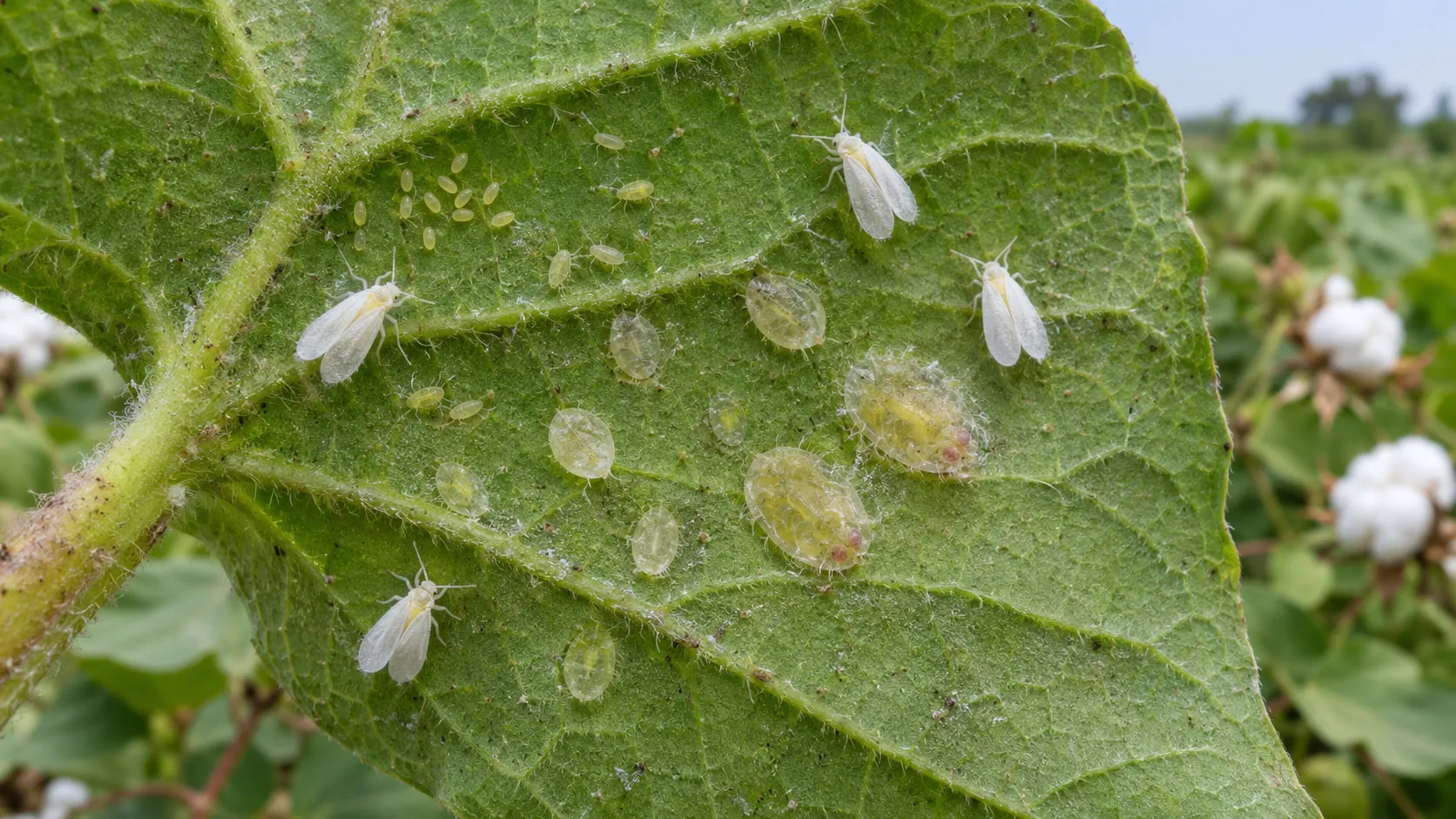
The cotton whitefly (Cotton Whitefly) is one of the sucking pests that requires priority management in cotton production. Under warm climatic conditions, whiteflies can reproduce rapidly and form continuously growing populations on the undersides of leaves.
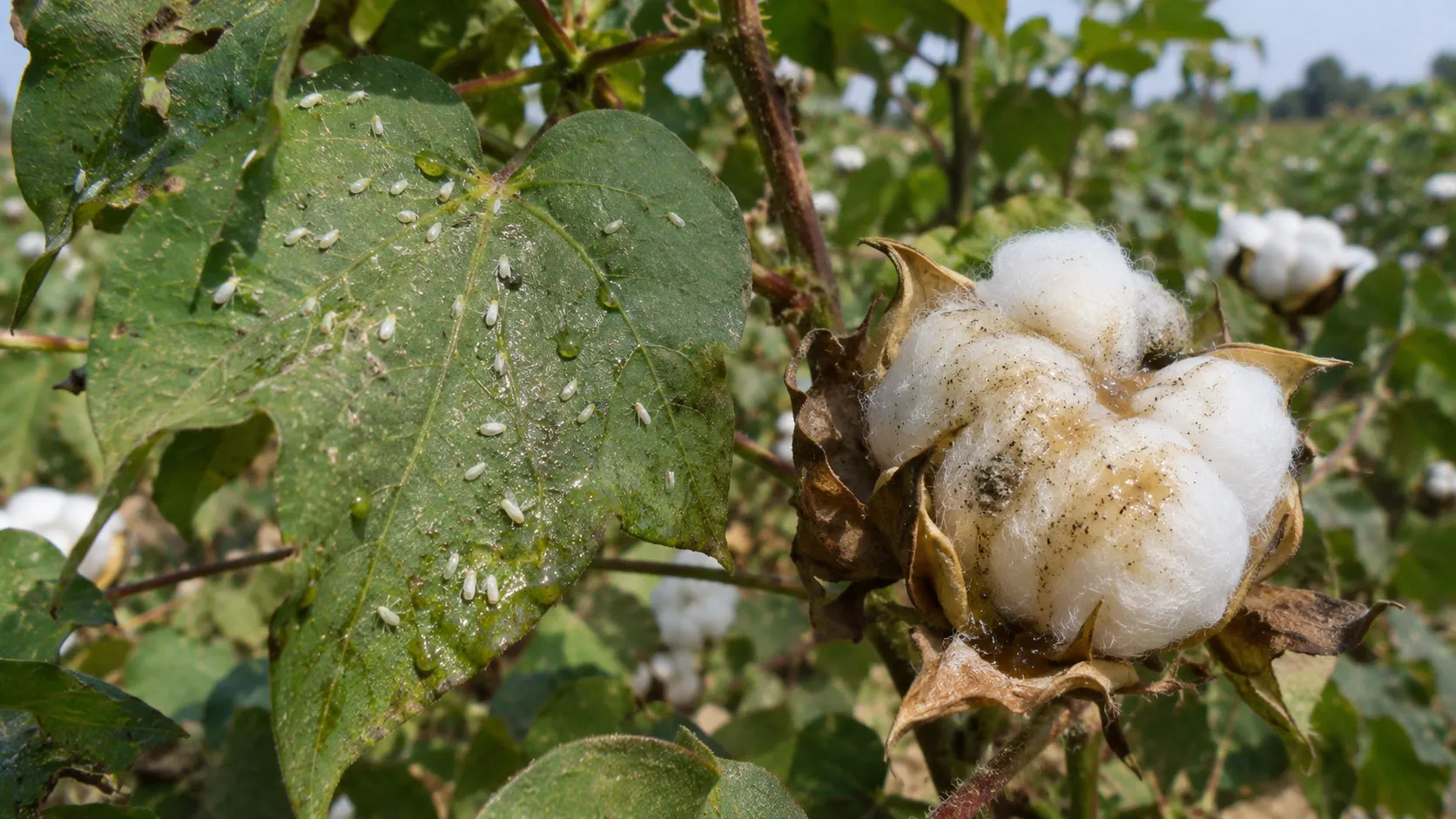
Not only do they affect cotton plant growth by sucking plant sap, but they also secrete large amounts of honeydew. When honeydew adheres to open cotton bolls and cotton fibers, it can cause “sticky cotton,” which affects harvesting, ginning, and subsequent spinning processes.
One often-overlooked issue in cotton whitefly control is that eggs, nymphs, and adults have different biological characteristics, and not all insecticides can control these life stages in the same way.
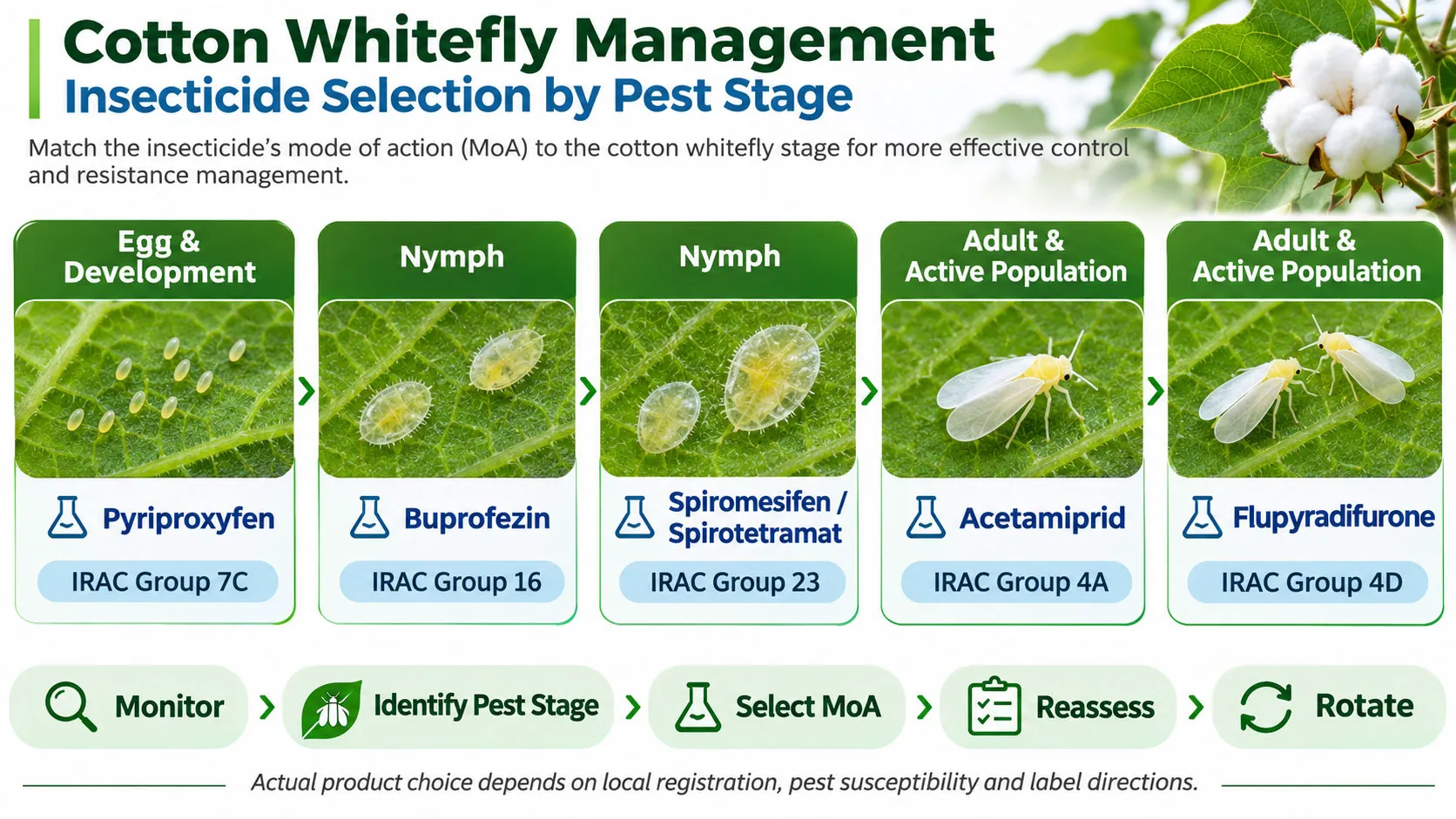
For example, buprofezin primarily targets the molting process of nymphs, while pyriproxyfen mainly disrupts normal insect development and the formation of adults. Acetamiprid, on the other hand, is an insecticide with a nervous system mode of action and can be used to manage active populations covered by the label.
If product selection is based solely on the insecticide name or market price without considering the pest life stage, adult populations may temporarily decline, but nymphs on the undersides of leaves will continue to develop.
Therefore, effective cotton whitefly management requires integrating the pest life cycle, cotton growth stages, field monitoring, and the IRAC mechanism of action.
For pesticide importers, distributors, and registration companies, understanding the technical positioning of different active ingredients also helps in establishing a more rational portfolio of cotton insecticide products. For comprehensive cotton pest, disease, and weed management, please refer to POMAIS’s Cotton Crop Protection Solutions.
What is the cotton whitefly? Why does it require focused management?
목화에 경제적으로 중요한 주요 흰파리 중 하나는 담배흰파리( Bemisia tabaci )입니다. 이 곤충은 노린재목(Hemiptera)의 알레이로디대과(Aleyrodidae)에 속하며, 열대, 아열대 및 일부 온대 농경 지역에 분포하는 여러 은밀종으로 구성된 복잡한 개체군을 형성합니다.
목화밭에서 보이는 작고 하얀 날아다니는 곤충들이 모두 같은 종류의 흰파리는 아니라는 점에 유의해야 합니다. 흰파리 종에 따라 외형, 숙주 범위, 경제적 영향이 다를 수 있으므로 방제 전략을 세우기 전에 대상 해충을 정확히 식별해야 합니다.
What are the major populations of Bemisia tabaci?
From an agricultural control perspective, MEAM1 and MED are the two lineages of the tobacco whitefly complex that receive the most attention.
| 분류 | 영어 이름 | 역사적으로 사용된 이름 | 관리 고려 사항 |
|---|---|---|---|
| MEAM1 | 중동-소아시아 1 | Biotype B | Widespread distribution with strong host adaptability |
| MED | 지중해 | 생물형 Q | Some populations pose a high risk of insecticide resistance |
In the past, agricultural literature often used “Biotype B” and “Biotype Q” to describe these two population types. It is now recommended to use taxonomic names such as MEAM1 and MED.
Population composition and resistance patterns vary by region. Particularly in cotton-producing areas where insecticides have been used for a long time, one cannot determine a pest’s sensitivity to a specific active ingredient based solely on its appearance.
What damage do whiteflies cause to cotton?
Both adult and nymph whiteflies obtain nutrients by piercing and sucking sap from the phloem of plants. When population densities are high, sustained feeding can impair the normal growth of cotton plants.
주요 손해 내역은 다음과 같습니다.
| 손상 유형 | 특정 증상 | 면화 생산에 미치는 영향 |
|---|---|---|
| 직접 먹이기 | 잎의 엽록소 감소, 황변 및 말림 현상 | 정상적인 광합성을 저해합니다 |
| Stunted plant growth | 활력 저하; 심한 경우 잎 떨어짐 | May affect boll formation and yield |
| Honeydew secretion | Sticky substance appears on the surface of leaves and cotton bolls | 면섬유 오염 위험을 증가시킵니다. |
| 그을음곰팡이 | 감로 표면에는 검은 그을음 곰팡이가 자랍니다. | Reduces the visual quality of leaves and fibers |
| 바이러스 전파 | Some whitefly populations transmit the Cotton leaf curl virus | 바이러스가 존재하는 지역에서 추가적인 손실을 초래할 수 있습니다. |
| Post-Harvest Processing Issues | 감로(꿀물)는 벌어진 목화 꼬투리와 섬유에 달라붙습니다. | 수확, 면화 가공 및 방적 공정에 영향을 미칩니다. |
Among these, “Sticky Cotton” is a particular concern in commercial cotton production.
Once the cotton bolls open, the honeydew comes into direct contact with the cotton fibers, which can make the fibers sticky, increase the difficulty of cleaning ginning equipment, and affect the quality of yarn processing.
Therefore, thrips management affects not only field yield but also the commercial value of the final cotton product.
How Does the Life Cycle of the Cotton Whitefly Affect Pesticide Selection?
살충제를 선택하기 전에 흰파리의 생활주기를 이해하는 것이 필수적입니다.
The cotton whitefly is an insect with incomplete metamorphosis, primarily undergoing egg, nymph, and adult stages. Nymphs have multiple instars; the first-instar nymphs possess limited mobility, while subsequent instars gradually become sessile, feeding on the surface of leaves.
계란 단계
Whiteflies typically lay their eggs on the underside of leaves. The eggs are oval or slightly elongated, and in some species, they have short stalks.
Whiteflies do not feed directly on plants during this stage, but once the eggs hatch, they form a new population of nymphs.
When selecting a pesticide, consider the following:
- Whether adults are still laying eggs.
- 밭에 신선한 달걀이 많이 있는지 여부.
- Whether the candidate active ingredient affects egg development or subsequent hatching.
- 해당 제품에 적절한 라벨이 부착되어 있는지 여부.
For example, pyriproxyfen can affect whitefly populations by disrupting insect development and reproductive processes, but it should not be simply viewed as a contact insecticide capable of rapidly killing all eggs.
Crawler Stage—First-instar Nymphs
After whitefly eggs hatch, first-instar nymphs, also known as crawlers, emerge.
This is the mobile stage within the immature life cycle. The nymphs briefly search for a suitable feeding site before settling on the underside of a leaf.
이 단계는 새로운 세대의 흰파리가 형성되는 시기이므로 면밀한 관찰이 필요합니다.
주요 관찰 내용은 다음과 같습니다.
- The number of newly hatched nymphs.
- The distribution of nymphs on the underside of leaves.
- Whether large numbers of adults are continuously migrating in and laying eggs.
- The activity of natural enemies and parasitic wasps.
Once first-instar nymphs have established a population, they will subsequently enter the stationary feeding stage; therefore, timely detection of new populations helps determine future control windows.
약충 단계—중기~후기 약충 단계
흰파리 유충은 여러 발달 단계를 거칩니다. 1령 유충 이후, 유충은 점차 움직이는 능력을 잃고 잎 뒷면에 정착하여 계속해서 먹이를 섭취합니다.
Second- through fourth-instar nymphs are key targets for field surveys.
Among these, fourth-instar nymphs typically exhibit distinct red eye spots and are often referred to as the “Red-Eye Stage” or “Puparium.”
It is important to note that whiteflies are insects with incomplete metamorphosis; this stage does not constitute a true pupal stage as defined for insects with complete metamorphosis.
Key management considerations for this stage include:
- The number of nymphs on the underside of leaves.
- 나이가 든 약충의 비율.
- 약충들이 아직 살아 있는지 여부.
- Natural mortality due to parasitism and predation.
- Whether it is necessary to use active ingredients effective against immature life stages.
부프로페진, 피리프록시펜, 스피로메시펜과 같은 활성 성분은 다양한 약충 관리 전략에서 선택 사항으로 고려될 수 있지만, 작용 방식은 서로 다릅니다.
성인 단계
Adults have two pairs of wings covered with a white powdery substance and are primarily active on the undersides of leaves and near the plant canopy.
When plants are disturbed, adults may quickly fly away from the leaves.
성체 단계는 개체군의 번식과 확산에 매우 중요합니다. 성체는 계속해서 알을 낳고 새로운 개체군을 형성하기 때문입니다.
Therefore, adult management should focus on the following considerations:
- Whether the number of adults in the field is continuing to increase.
- Whether whiteflies have migrated from nearby host crops.
- Whether adults have already begun laying eggs in large numbers.
- 현재 해충 상황에 적합한 성충 방제 조치를 시행해야 하는지 여부.
아세타미프리드와 같이 흰파리에 효과적인 살충제는 성충 및 활동적인 개체군 관리에 고려될 수 있습니다. 구체적인 사용은 현지 등록 및 제품 라벨을 기준으로 해야 합니다.
주의할 점은 성충 개체 수 감소가 약충 개체 수의 소멸을 의미하는 것은 아니라는 것입니다. 잎 뒷면의 유충 단계를 확인하지 않고 성충 개체 수만 관찰하면 향후 개체 수 증가 위험을 과소평가할 수 있습니다.
Which insecticides are suitable for different life stages of whiteflies?
활성 성분마다 작용 방식이 다르기 때문에, 살충제 선택 시에는 먼저 현장에서 주로 발생하는 해충의 생활 단계를 파악한 후, 살충제의 실제 방제 효과를 고려해야 합니다.
The following active ingredients warrant priority evaluation in cotton whitefly management.
살충제의 생활 주기 및 활성 성분 비교
| Major Life Stages of Whiteflies | Candidate Active Ingredients | IRAC 그룹 | Key Mode of Action |
|---|---|---|---|
| 알과 유충 단계 | 파이리 프록시 펜 | 7C | Interferes with insect development and reproductive processes, affecting adult formation |
| 님프 | 부프로페진 | 16 | Interferes with chitin biosynthesis and normal molting |
| 님프 | 스피로메시펜 | 23 | 지질 생합성을 억제하며, 주로 미성숙 생애 단계를 표적으로 합니다. |
| Immature life stages | 스피로테트라맷 | 23 | Inhibits lipid biosynthesis; exhibits systemic activity |
| Adults and active populations | 아세 타미 프리드 | 4A | 곤충의 니코틴성 아세틸콜린 수용체에 작용합니다. |
| Adults and active populations | 플루피라디푸론 | 4D | 부테놀라이드 계열; 니코틴성 아세틸콜린 수용체에 작용 |
| Rapid control of adults | 비 펜트 린 | 3A | Pyrethroid class, with a neurotoxic mode of action |
This table is intended to explain the technical classification of candidate active ingredients; it does not imply that all products have the same control efficacy, nor does it imply that these ingredients are registered for use against cotton whiteflies in all countries.
Pyriproxyfen—primarily targets immature developmental stages
Pyriproxyfen belongs to IRAC Group 7C and is classified as a juvenile hormone analog.
It interferes with the insect’s normal growth, development, and reproductive processes, thereby disrupting the normal transition of whiteflies from immature stages to adulthood.
In whitefly management, its technical applications primarily include:
- Inhibiting normal egg development and hatching.
- Interfering with the development of mature nymphs into adults.
- 성체의 생식 능력에 영향을 미칩니다.
- Reducing the ability to establish subsequent populations.
The mode of action of pyriproxyfen means it is not suitable for use as a product designed to rapidly knock down adults.
살포 후 성충 개체 수가 즉시 감소하지 않더라도 단기적인 관찰 결과만으로 제품의 효과를 판단해서는 안 됩니다. 새로 부화한 약충, 성숙한 약충, 그리고 성충의 출현을 지속적으로 모니터링해야 합니다.
Additionally, resistance of the cotton whitefly to pyriproxyfen has been detected in some regions; therefore, local resistance data must be consulted to determine whether its use is still appropriate.
Buprofezin—Focus on the Nymphal Molting Process
Buprofezin belongs to IRAC Group 16 and primarily acts by interfering with the biosynthesis of insect chitin and the normal molting process.
이는 목화가루이 유충 방제에 있어 특별히 주목할 만한 활성 성분입니다.
주요 특징은 다음과 같습니다.
- Primarily targets the nymphal developmental stage.
- It disrupts normal molting and subsequent development.
- It is not an insecticide that provides rapid knockdown of adults.
- It is best evaluated in conjunction with nymph surveys and population trends.
부프로페진을 사용할 때는 약충의 나이와 생존 상태에 주의를 기울여야 하며, 성충이 즉시 죽는지 여부만으로 효과를 판단해서는 안 됩니다.
If the primary field issue is a continuous influx of large numbers of adults, and no significant nymph population has yet formed on the undersides of leaves, then using a product that targets nymphs alone may not fully resolve the current problem.
Spiromesifen—Lipid Biosynthesis Inhibitor
Spiromesifen belongs to IRAC Group 23 and affects normal development by inhibiting processes related to insect lipid biosynthesis.
In whitefly management, it is primarily used to control immature life stages.
Factors to consider when selecting a product:
- Whether a significant number of nymphs are present in the field.
- 약충이 방제에 적합한 발달 단계에 있는지 여부.
- Whether the undersides of leaves can be adequately covered.
- Whether Group 23 resistance exists in the local population.
스피로메시펜과 부프로페진은 작용 기전이 다르므로, 기술적 포지셔닝이 동일하지 않습니다.
However, one should not overlook their respective registration scopes and actual control efficacy simply because they belong to different IRAC groups.
Spirotetramat—A Group 23 Product with Systemic Translocation Properties
Spirotetramat also belongs to IRAC Group 23.
이는 지질 생합성을 억제함으로써 흰파리와 같은 흡즙성 해충의 발달과 번식에 영향을 미칩니다.
One of its key technical characteristics is its ability to translocate bidirectionally within the plant, which helps distribute the active ingredient to different parts of the plant.
However, although Spirotetramat and Spiromesifen are different active ingredients, they belong to the same IRAC group.
따라서:
- The two should not be considered rotation products with different modes of action.
- Attention should be paid to local resistance situations within Group 23.
- The scope of application must be determined based on the specific product’s application method and label.
- 전신 이동 능력이 잎 뒷면에 서식하는 모든 흰파리를 무조건적으로 방제할 수 있다는 것을 의미하는 것으로 해석되어서는 안 됩니다.
아세타미프리드—성체 및 활동성 개체군 관리
Acetamiprid belongs to IRAC Group 4A and is a neonicotinoid insecticide.
이는 곤충의 니코틴성 아세틸콜린 수용체(nAChR)에 작용하여 정상적인 신경 전달을 방해하고 감수성이 있는 해충에게 신경 기능 장애를 일으킵니다.
In the management of cotton whiteflies, acetamiprid can serve as a candidate active ingredient for managing adults and active populations.
Key considerations when selecting this product include:
- Whether the current adult population is increasing.
- Whether the target population remains susceptible to Group 4A.
- Whether the product has the appropriate registration for cotton and whiteflies.
- Whether other Group 4A products have already been used.
- Whether there is currently a risk of exposure to bees and other non-target organisms.
POMAIS는 20% SP, 15% SP, 20% WP, 25% WP 및 기타 프로젝트별 맞춤형 제형을 포함하여 다양한 아세타미프리드 제품 제형을 제공합니다.
당신이 볼 수 있습니다 Acetamiprid insecticide product specifications for details on the active ingredient, CAS number, IRAC group, formulation, and technical documentation.
Please note that product specifications and proposed uses do not imply that the product has already obtained the corresponding registration in the target country. Specific scope of use must be determined by the locally approved label.
Flupyradifurone—Another Mode-of-Action Option
Flupyradifurone belongs to IRAC Group 4D and is classified as a butenolide.
It also acts on the nicotinic acetylcholine receptors of insects but belongs to a different subgroup than the neonicotinoids in Group 4A.
In some whitefly management systems, it can serve as a candidate for controlling active populations.
그러나 4A군과 4D군이 서로 다른 하위군에 속한다고 해서 모든 지역에서 교차 내성이 존재하지 않는다는 의미는 아닙니다. 제품을 교체할 때는 여전히 지역별 내성 기전과 IRAC 권고 사항을 고려하여 결정을 내려야 합니다.
Bifenthrin—A Broad-Spectrum Insecticide Requiring Careful Evaluation
비펜트린은 IRAC 그룹 3A에 속하며 피레트로이드계 살충제로 분류됩니다.
In some cotton production systems, it can be used to control adult whiteflies at specific life stages.
However, it is not recommended as the routine first-line treatment for all cotton growth stages.
주요 이유는 다음과 같습니다.
- Whitefly populations in some regions have already developed resistance to pyrethroids.
- Broad-spectrum insecticides may affect parasitic wasps and predatory natural enemies.
- 부적절한 조기 사용은 잎응애나 진딧물과 같은 2차 해충 발생 위험을 증가시킬 수 있습니다.
- 약충 방제를 성충의 신속한 방제와 동일시할 수는 없습니다.
따라서 비펜트린 사용 여부를 결정할 때는 해충의 생활 단계, 지역 저항성, 목화의 생육 단계, 그리고 비표적 생물에 대한 위험성을 신중하게 고려해야 합니다.
How should whitefly management be planned for different cotton growth stages?
In addition to the whitefly’s own life cycle, the cotton growth stage also influences control strategies.
The same whitefly population may pose different economic risks during the vegetative growth stage compared to the boll-opening stage.
묘목 단계 및 초기 영양 생장 단계
During the cotton seedling stage, special attention should be paid to whitefly migration from surrounding host crops.
Nearby cucurbits, vegetables, weeds, and other host plants may provide a breeding and survival environment for whiteflies.
When these crops are harvested, or the plants die back, adult whiteflies may migrate into nearby cotton fields.
경영 초점:
- Check the edges of cotton fields for adult whiteflies.
- Inspect the undersides of leaves for eggs and early-instar nymphs.
- 인근 기주 작물의 수확 및 제거 과정을 감시하십시오.
- Avoid preventive, broad-spectrum applications without evidence of an infestation.
- Protect parasitic wasps and predatory natural enemies.
If only a small number of migrating adults are found, but a stable nymph population has not yet formed, first determine whether intervention is necessary based on local monitoring standards.
Vegetative Growth and Budding Stages
목화 식물의 잎 수가 증가함에 따라 흰파리는 더 많은 잎의 뒷면에 개체군을 형성할 수 있습니다.
이 단계에서는 약충의 개체 수와 발달 상태에 특별히 주의를 기울여야 합니다.
Management Priorities:
- 중간 잎과 위쪽 잎의 아랫면을 살펴보세요.
- Record the numbers of eggs, first-instar nymphs, and mid-to-late-instar nymphs.
- 성충 약충의 수가 지속적으로 증가하는지 여부를 판단하십시오.
- Decide whether to use an IGR based on local control thresholds.
- Prioritize evaluating selective pesticides that are relatively friendly to natural enemies.
If a nymph population is establishing, active ingredients such as buprofezin, pyriproxyfen, or spiromesifen can be considered as treatment options, but selection should be based on the target life stage and local product registrations.
개화 및 열매 형성 단계
As the crop enters the flowering and boll formation stages, the cotton canopy gradually expands, and whitefly populations may continue to grow.
이 시기에는 특히 주변 작물의 대규모 수확이 진행 중이고 기후 조건이 흰파리의 번식에 유리할 때 현장 조사를 강화해야 합니다.
Key points to monitor:
- Whether adult populations are continuing to increase.
- 중후기 단계에 약충 개체군이 대규모로 정착했는지 여부.
- Whether significant honeydew is present in the field.
- Whether natural enemies have been affected by earlier pesticide applications.
- 목화 열매 형성이 정상적으로 진행되고 있는지 여부.
성충과 약충이 모두 존재하는 경우, 먼저 주요 문제가 성충의 지속적인 유입 때문인지 아니면 이미 현장에 안정적으로 자리 잡은 번식 개체군 때문인지 판단해야 합니다.
단 하나의 살충제로 모든 생물의 생애 단계를 방제할 수 있다고 섣불리 판단하지 마십시오.
목화 열매 맺음부터 수확까지
이는 목화진딧물 방제에 있어 매우 중요한 품질 관리 단계입니다.
목화 열매가 벌어지면서 목화 섬유가 점차 외부 환경에 노출됩니다. 진딧물 개체 수가 많으면 진딧물이 분비하는 감로가 목화 섬유에 직접 달라붙을 수 있습니다.
This situation can lead to “Sticky Cotton,” which further affects ginning, spinning, and ultimate fiber quality.
At this stage, inspections should focus on:
- Nymphs on the undersides of lower and middle leaves.
- The presence of honeydew around open cotton bolls.
- 이동하는 성체들이 목화밭 가장자리에 많이 나타나는지 여부.
- 기생당한 약충이 있는지, 아니면 잡아먹힌 약충이 있는지 여부.
- Whether current control measures can economically reduce the risk of fiber contamination.
At the same time, it is necessary to strictly verify the PHI (pre-harvest interval), the maximum number of applications, and the harvest schedule.
If harvest is approaching, one should not only consider the speed of insect control but also evaluate actual economic benefits, residue risks, and product label restrictions.
Post-harvest and Field Cleanup
The end of harvest does not mean that whitefly management is completely over.
If there are large amounts of crop residues, regrowth, and other host plants in the field, they may still provide conditions for whiteflies to continue reproducing.
In accordance with local agricultural management requirements:
- Promptly dispose of cotton crop residues.
- Control volunteer cotton and regrowth.
- 계속해서 식물의 숙주 역할을 하는 잡초를 제거하십시오.
- Monitor whitefly populations on surrounding host crops.
- Prevent whiteflies from continuously migrating between different crops.
이러한 조치는 다음 목화 재배 시즌에 발생할 수 있는 초기 해충 피해를 줄이는 데 도움이 됩니다.
| Cotton Growth Stages | Major Whitefly Risks | 경영 우선순위 | 후보 살충제 |
|---|---|---|---|
| Emergence and Seedling Stage | Adult Migration | 주변 해충 발생 감시 | Evaluate products effective against adult whiteflies based on local conditions |
| 식물 성장 단계 | Eggs and early-instar nymphs establish populations | Inspect the undersides of leaves promptly | Select products based on pest population assessment |
| 싹트는 단계 | 약충 개체 수 증가 | Focus on surveying nymph proportion | Buprofezin, Pyriproxyfen, etc. |
| 개화기 | Simultaneous occurrence of adults and nymphs | Assess population development and natural enemies | Select active ingredients based on the predominant life stage |
| Cotton boll formation stage | Increased risk of honeydew and sooty mold | Intensify monitoring of pest populations and honeydew | Evaluate appropriate control strategies for nymphs and adults |
| Cotton boll opening stage | Sticky Cotton Risk | Monitor fiber contamination and harvest scheduling | Make decisions based on local registrations and PHI |
| 수확 후 | 남아있는 식물과 기타 숙주 식물들은 계속해서 곤충의 공급원 역할을 합니다. | Remove residual hosts from the field | Focus on agricultural management |
목화가루이를 어떻게 모니터링하고 최적의 살포 시기를 결정할까요?
흰파리 방제에서 가장 중요한 작업 중 하나는 잎 뒷면을 정기적으로 조사하여 알, 약충, 성충을 찾는 것입니다.
식물 위를 날아다니는 하얀 성충만 관찰하면 이미 형성된 약충 개체군을 쉽게 간과할 수 있습니다.
How to Conduct a Cotton Aphid Survey in Cotton Fields?
It is recommended to use a fixed survey route and a standardized leaf inspection method to ensure comparability across different survey dates.
The following procedure can be followed:
- 목화밭을 여러 개의 대표적인 구역으로 나누세요.
- Inspect both the interior and edge areas of the field.
- Select representative cotton plants.
- Inspect the undersides of leaves at different positions on the main stem.
- 돋보기를 사용하여 알, 초기 유충, 중기 및 후기 유충을 관찰하십시오.
- Record the number of adults and the proportion of late-instar nymphs.
- Also observe parasitic wasps, predatory insects, and dead nymphs.
- 주기적으로 조사 결과를 비교하여 흰파리 개체 수의 추세를 파악하십시오.
Throughout the cotton growing season, maintain relatively consistent leaf positions and sampling methods; otherwise, data from different dates may lack comparability.
흰파리에 대한 경제적 조치 기준치는 어떻게 해석해야 할까요?
The economic action threshold is used to determine whether control measures are necessary.
하지만 전 세계적으로 통용되는 단일한 흰파리 방제 기준치는 없습니다.
Cotton varieties, climate, production costs, survey methods, and harvesting practices may vary across different countries and regions.
예를 들어, 캘리포니아 UC IPM의 면화 조사 지침에서는 다음과 같은 지역 평가 방법을 사용합니다.
| 조사 기준 | Reference Standards in the California Protocol |
|---|---|
| 성인 | 성충이 3마리 이상 발견된 잎은 손상된 잎으로 간주됩니다. |
| Late-instar nymphs | Check the undersides of leaves for third- to fourth-instar nymphs |
| Adult Reference Threshold | 조사 대상 잎의 40%가 성충 피해 기준을 충족합니다. |
| 약충 기준 임계값 | 40% of surveyed leaves show late-instar nymphs |
| IGR 신청 기준 | The presence of nymphs in the field must also be confirmed |
이 데이터는 특정 지역의 조사 및 평가 방법을 설명하기 위한 목적으로만 제공되며, 아프리카, 중동, 중앙아시아 또는 남미의 면화 재배지에 대한 통일된 적용 기준으로 직접 사용해서는 안 됩니다.
In actual production, survey methods and thresholds published by the agricultural extension agencies or local cotton management systems of the target country should be adopted.
왜 경작지 경계선에도 별도의 측량이 필요한가요?
Whiteflies are capable of long-distance flight, and adult aggregations may appear earlier at field edges.
If nearby cucurbits, vegetables, or other host crops are being harvested, adults may migrate to cotton fields.
그러므로 현장 조사는 경작지 내부에만 국한되어서는 안 됩니다.
When pest densities at the field edges are significantly higher than in the interior, the feasibility of localized treatment can be assessed in conjunction with locally registered pesticides and control recommendations.
This approach helps reduce the cost of unnecessary whole-field applications and minimizes the impact on natural enemies in the field.
How can IRAC-based rotation reduce whitefly resistance?
담배가루이는 살충제에 대한 저항성을 발달시키는 능력이 뛰어납니다. IRAC 데이터에 따르면 담배가루이는 네오니코티노이드, 피레트로이드 및 특정 곤충 성장 조절제를 포함한 다양한 살충제 활성 성분에 저항성을 보이는 사례가 있습니다.
Therefore, long-term reliance on a single mode of action is not a reliable management strategy.
Why does changing a brand name not equate to changing the mode of action?
Different brand names may use the same active ingredient, or they may use different active ingredients that belong to the same IRAC group.For example:
| 활성 성분 | IRAC 그룹 | 이들은 서로 다른 작용 방식에 속합니까? |
|---|---|---|
| 아세 타미 프리드 | 4A | - |
| 이미다클로 프리드 | 4A | 아니 |
| 티아 메 톡삼 | 4A | 아니 |
| 디노 테 푸란 | 4A | 아니 |
| 플루피라디푸론 | 4D | 서로 다른 하위 그룹이지만, 교차 내성에 대한 평가는 여전히 필요합니다. |
| 파이리 프록시 펜 | 7C | 4조와는 다릅니다 |
| 부프로페진 | 16 | 4족 및 7C족과 다릅니다. |
| 스피로메시펜 | 23 | 16조와는 다릅니다 |
| 스피로테트라맷 | 23 | Same group as Spiromesifen |
| 비 펜트 린 | 3A | Different from other groups |
There are two particularly noteworthy details here:
첫째, 아세타미프리드, 이미다클로프리드, 티아메톡삼, 디노테푸란은 모두 4A군에 속합니다. 이들 제품 중 하나를 교체한다고 해서 작용 기전이 완전히 바뀌는 것은 아닙니다.
Second, although Spiromesifen and Spirotetramat are different active ingredients, they both belong to Group 23 and cannot be rotated as two distinct modes of action.
합리적인 살충제 순환 계획을 세우는 방법은 무엇일까요?
합리적인 윤작 계획은 단순히 매번 다른 살충제를 사용하는 것이 아니라, 흰파리의 세대와 목화의 생육 단계를 기반으로 해야 합니다. 다음 원칙을 따르는 것이 좋습니다.
- Record the active ingredient and IRAC Group for each application.
- Avoid exposing consecutive whitefly generations to the same mode of action repeatedly.
- 지역 저항성 모니터링 결과를 바탕으로 효과적이면서도 서로 다른 작용 방식을 선택하십시오.
- Consider insecticides used against other pests during the current growing season, as these applications may also exert selective pressure on whiteflies.
- Do not mistake combination products containing active ingredients from the same group for combinations of different modes of action.
- Adhere to the maximum number of applications and application intervals specified on the product label.
예를 들어, 16군, 7C군, 23군, 4A군은 서로 다른 작용 방식을 나타내며, 후보자 순환 시스템을 구축할 때 기술적 참고 자료로 활용될 수 있습니다.
However, this does not mean that all products must be used in a fixed sequence of Group 16 → 7C → 23 → 4A.
Specific rotation strategies should be determined based on the sensitivity of local whitefly populations, product registration scope, and IRAC’s resistance management recommendations.
Do combination insecticides always help with resistance management?
꼭 그런 것은 아닙니다.
복합 제품은 각 활성 성분이 대상 해충에 대해 실질적인 방제 효과를 제공하고 작용 방식의 조합이 적절할 경우에만 저항성 관리에 도움이 될 수 있습니다.
다음 사항들은 특별 확인이 필요합니다.
- Whether each active ingredient is effective against the target whitefly population.
- Whether the two ingredients have different modes of action.
- Whether cross-resistance exists.
- Whether the periods of action for the two ingredients align.
- Whether the product is suitable for cotton and the target whitefly species.
- 해당 지역의 최대 적용 빈도 및 사용 요건을 준수하는지 여부.
활성 성분 중 하나가 효능을 잃은 경우, 복합 제제라고 해서 내성 발생 위험이 반드시 줄어드는 것은 아닙니다.
How can biological control and agronomic practices be combined to manage cotton whiteflies?
Whitefly management should not rely solely on chemical insecticides.
If broad-spectrum insecticides are used in the field over the long term, the population of natural enemies may decline, making it easier for whiteflies to re-establish their populations.
Therefore, sound IPM (Integrated Pest Management) should combine biological control, agronomic practices, and necessary chemical control.
Protecting Natural Enemies of Cotton Whiteflies
There are various natural enemies in cotton fields that can help control cotton whitefly populations.
| 자연의 적 | 영어 이름 | 주요 역할 |
|---|---|---|
| 기생 말벌 | 엔카르시아 속 | 흰파리 유충에 기생합니다. |
| 기생 말벌 | Eretmocerus spp. | Parasitize immature whiteflies |
| Lacewing larvae | 풀잠자리 유충 | 흰파리와 기타 작은 해충을 잡아먹는다. |
| Minute Pirate Bugs | Minute Pirate Bugs | Prey on some whitefly nymphs and other small pests |
| 딱정벌레 레이디 | 딱정벌레 레이디 | Prey on whiteflies and other sucking pests |
When developing an insecticide strategy, the impact of the chemicals on these non-target organisms must be considered.
Especially when whitefly populations have not yet reached local control thresholds, unnecessary broad-spectrum applications may disrupt natural control mechanisms.
농업적 조치를 통해 흰파리 발생 압력을 줄이는 방법
Since whiteflies are polyphagous, other crops and weeds surrounding cotton fields must also be managed.
다음 사항을 고려하십시오 :
- Promptly remove crop residues from harvested host plants.
- Control weeds that can serve as a continuous source of hosts for whiteflies.
- Monitor whitefly populations in nearby vegetable, melon, and other cash crops.
- Schedule planting and harvest times appropriately based on local production conditions.
- Avoid excessive cotton growth and excessive nitrogen fertilizer application.
- Promptly dispose of cotton stubble after harvest to reduce the pest source provided by regrowth.
However, before removing weeds, check for the presence of parasitic wasps and predatory natural enemies to avoid destroying the habitats of beneficial organisms while clearing host plants.
Why Should We Not Rely on Broad-Spectrum Insecticides Too Early?
While some broad-spectrum insecticides can reduce pest populations in the short term, they may also have a significant impact on whitefly natural enemies.
For example, premature or inappropriate use of pyrethroids may destroy natural enemies and increase the risk of outbreaks of secondary pests such as leaf mites and aphids.
Therefore, early management of cotton whiteflies should prioritize monitoring, selective products, and the protection of natural enemies.
해충 개체수가 지역 방제 기준치에 도달했을 때에만 화학적 방제의 필요성을 추가적으로 평가해야 합니다.
목화가루이 방제에서 가장 흔히 저지르는 실수는 무엇인가요?
| 흔한 실수 | 잠재적 문제 | 보다 적절한 관리 방식 |
|---|---|---|
| 약충은 확인하지 않고 성충만 관찰합니다. | 기존 번식 개체군을 무시함 | Regularly inspecting the undersides of leaves |
| Assuming all insecticides are effective against all life stages | 성충과 약충을 동시에 방제할 수는 없습니다. | 주된 생애 단계에 따라 제품을 선택합니다. |
| IGR을 신속한 억제제로 사용 | Concluding too early that a product has failed | 발달 과정 및 그에 따른 인구 변화를 기준으로 평가합니다. |
| 동일한 IRAC 그룹의 지속적인 사용 | Increases selective pressure for resistance | 현지 내성 현황에 따라 제품을 적절히 교체하십시오. |
| Switching brands but not active ingredients | The actual mode of action remains unchanged | Verify the active ingredient and IRAC group |
| 천적을 무시하는 것 | May lead to a resurgence of whiteflies and other pests | 제품 선택성 및 비표적 효과를 평가합니다. |
| Ignoring the risk of honeydew during the boll-opening stage | May cause “Sticky Cotton” | Strengthen monitoring during the open boll stage |
| Failure to consider the Pre-Harvest Interval (PHI) | Increases risks related to harvest timing and residue compliance | Verify product labels in conjunction with harvest timing |
Frequently Asked Questions on Cotton Whitefly Control
목화가루이 방제에 가장 효과적인 살충제는 무엇입니까?
No single insecticide maintains the same level of control across all regions, all cotton growth stages, and all life stages of whiteflies.
Active ingredients such as pyriproxyfen, buprofezin, and spiromesifen are primarily used to manage immature life stages; products such as acetamiprid can be used to manage active populations within the scope of the label.
When selecting a product, consider local whitefly populations, the proportion of life stages, IRAC groups, and product registrations.
부프로페진으로 성체 흰파리를 죽일 수 있나요?
Buprofezin belongs to Group 16 and primarily controls nymphs by interfering with chitin biosynthesis and the normal molting process.
It is not an insecticide characterized by rapid knockdown of adults.If the primary field issue is a massive influx of adults while nymph populations are low, it is necessary to reassess whether the product is suitable for the current pest situation.
What is the difference between pyriproxyfen and buprofezin?
Both can be used to manage immature whiteflies, but they have different modes of action.
Pyriproxyfen belongs to Group 7C and affects adult development by interfering with insect development and reproductive processes; buprofezin belongs to Group 16 and primarily affects the normal molting of nymphs.
Therefore, the two are not direct substitutes for one another.
Can Spiromesifen and Spirotetramat be rotated?
It is not recommended to rotate these two as they share the same IRAC mechanism of action.
Although they are different active ingredients, they both belong to Group 23, and their mechanisms of action involve the inhibition of lipid biosynthesis.
Consecutive use of these two products may still maintain selection pressure for resistance based on the same mechanism of action.
Why do cotton whiteflies reappear after treatment?
몇 가지 이유가있을 수 있습니다.
- 성충 흰파리는 인근의 다른 기주 식물에서 계속해서 이동해 오고 있습니다.
- Nymphs on the undersides of leaves were not adequately controlled.
- Insufficient coverage during field spraying.
- Previous use of broad-spectrum insecticides has destroyed natural enemies.
- The whitefly population has already developed resistance.
- A large number of eggs and newly hatched nymphs remain after application.
따라서 단순히 살포 횟수를 늘리는 것보다는 살포 후 해충 상황을 재평가하는 것이 필요합니다.
What is “Sticky Cotton”? Why do whiteflies cause this problem?
“Sticky Cotton” refers to the phenomenon where cotton fibers become sticky after being contaminated by honeydew.
Whiteflies secrete honeydew while feeding on the sap of cotton plants. When honeydew adheres to open cotton bolls and cotton fibers, it can interfere with harvesting, ginning, and spinning processes.
Therefore, during the cotton boll opening stage, special attention must be paid to whitefly populations and honeydew contamination.
보다 효과적인 목화가루이 방제 프로그램을 개발하려면 어떻게 해야 할까요?
The key to managing cotton mealybugs is not to find a single insecticide that controls all life stages, but to develop a reasonable control strategy based on the mealybug life cycle, cotton growth stages, and local resistance patterns.
First, regularly survey the undersides of leaves for eggs, nymphs, and adults to understand the field population structure.
둘째, 주요 생활 단계에 따라 적절한 활성 성분을 선택해야 합니다. 부프로페진, 피리프록시펜, 스피로메시펜은 미성숙 생활 단계 관리에 고려될 수 있으며, 아세타미프리드와 같은 제품은 해당 국가의 허가 및 목표 생활 단계를 고려하여 평가해야 합니다.
At the same time, rotation should be planned based on IRAC mode of action to avoid the misconception that products with different trade names but belonging to the same group have different modes of action.
Once the cotton boll opening stage begins, honeydew contamination, “Sticky Cotton,” and the pre-harvest interval (PHI) should also be incorporated into management decisions.
For pesticide importers, distributors, and registration companies, when selecting cotton whitefly control products, they should simultaneously evaluate the active ingredients, concentrations, formulations, technical documentation, and target market demand.
목화가루이 방제 제품 포트폴리오를 개발하는 경우, 단순히 제품 수를 늘리는 것보다는 대상 국가, 가루이 개체군, 주요 생활 단계, 필요한 IRAC 작용 방식 등을 고려하여 적합한 제품을 선정하는 것이 좋습니다. POMAIS는 살충제 수입업체, 유통업체, 등록업체 및 브랜드 고객에게 다양한 목화 살충제 제품 사양 및 관련 수출 서류를 제공합니다.
목표 시장에 적합한 흰파리 방제 제품을 평가하려면 당사 팀에 문의하여 유효 성분, 제형 유형, 제품 사양 및 공급 조건을 자세히 확인하십시오.
핫 제품
최신 뉴스
추천 뉴스